
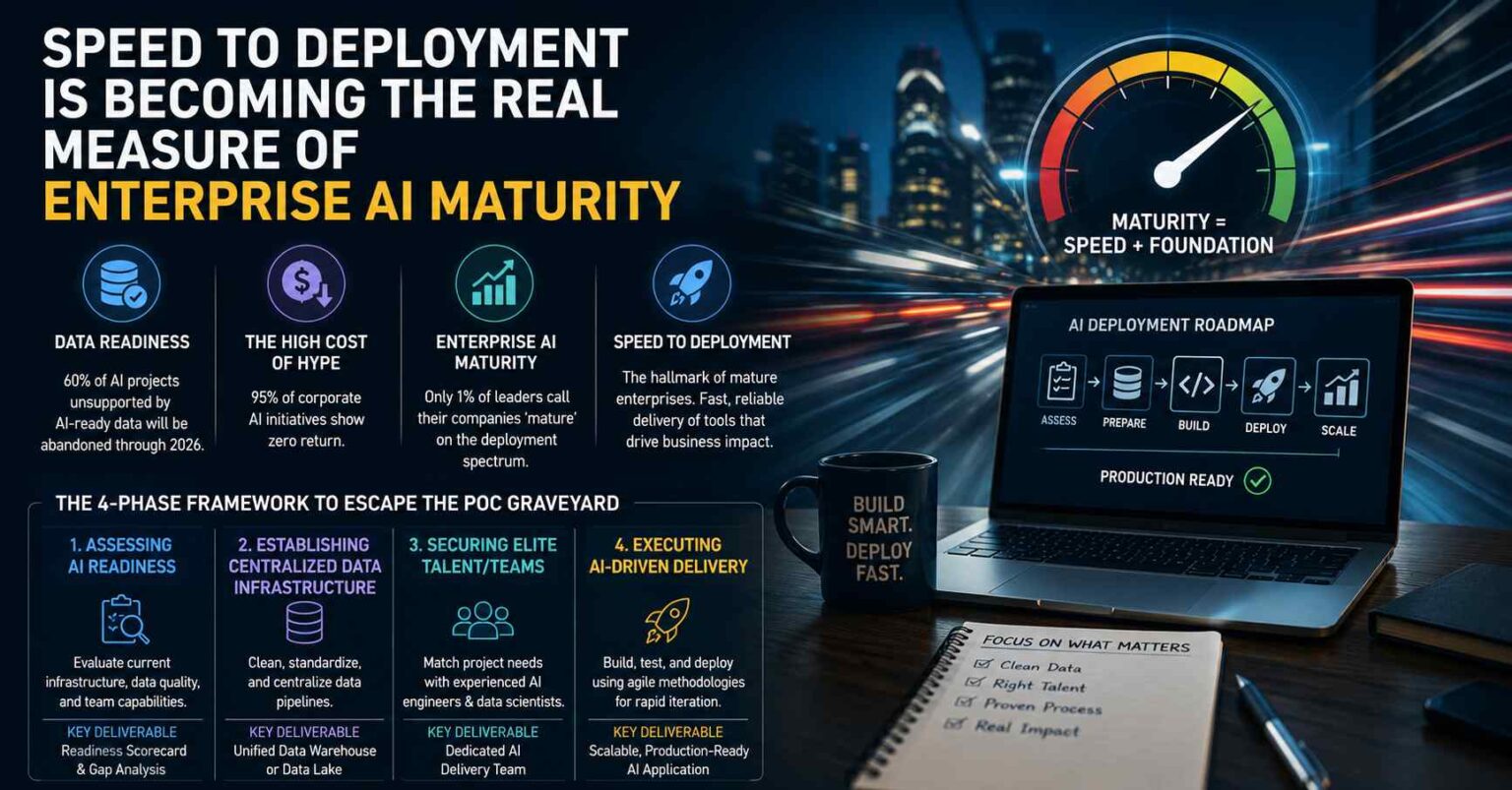
Speed to Deployment Is Becoming the Real Measure of Enterprise AI Maturity
You face immense pressure to deliver artificial intelligence solutions. The board expects immediate results, and your budget is approved. Yet, like many enterprise IT leaders, you are likely watching your initiatives hit a massive bottleneck. Projects get stuck in the experimental Proof of Concept (POC) phase and never make it to production.
This bottleneck is a symptom of a larger problem. Companies are trying to run before they can walk. They rush to deploy complex language models and predictive tools without building a solid foundational infrastructure first.
Why Enterprise Projects Stall
There is a severe disconnect between the high urgency for AI and the poor execution of these projects. Executive teams often demand immediate innovation. In response, IT teams scramble to build a quick pilot to prove the technology works.
The pilot often succeeds in a vacuum. However, the moment you try to scale that exact same model across the entire enterprise, the application breaks. The system cannot handle the complexities of real-world, daily operations.
This creates the AI POC graveyard. Budgets drain, timelines extend indefinitely, and stakeholders lose faith in the technology. The root cause is almost always a lack of preparation.
Before chasing the latest AI trends or rushing into development, organizations must evaluate their data infrastructure and team capabilities with a comprehensive AI Readiness Assessment. Taking a structured approach to assess your foundation is the only way to ensure your projects don’t become another stalled statistic.
The High Cost of “Shiny Object Syndrome”
“Shiny object syndrome” happens when executives demand the newest AI tool they read about in a headline. They push for adoption regardless of how the technology actually fits your specific business model. This reactionary approach leads to poorly planned initiatives.
When you build isolated applications to solve non-existent problems, you waste valuable engineering hours. Enterprise leaders must prioritize AI opportunities based on actual stakeholder buy-in and clear return on investment. If a tool does not solve a specific, measurable business problem, it belongs in a lab, not in production.
The financial risk of this syndrome is steep. As recent data shows, “95% of corporate AI initiatives show zero return.” Chasing hype simply burns through your IT budget and damages the credibility of your department.
The Data Readiness Bottleneck
An AI model is only as good as the foundational data infrastructure supporting it. You cannot train an effective algorithm on siloed, messy, or inaccessible datasets. If your company data is scattered across legacy systems, your AI initiatives will inevitably stall.
Data readiness is the bridge between a neat pilot program and a robust production environment. If you rush deployment without cleaning and centralizing your data, the applications will break under the weight of real-world use.
The urgency to fix this foundational issue is clear. Industry analysts note that “60% of AI projects unsupported by AI-ready data will be abandoned through 2026.” Building a reliable, clean data pipeline is a strict prerequisite for any successful rollout.
Defining True Enterprise AI Maturity
Enterprise AI Maturity is the state where your data infrastructure, strategic alignment, and talent are fully prepared to support scalable operations. It means your company has moved past the trial-and-error phase. You no longer build one-off tools; you build systems that integrate naturally into daily workflows.
Achieving this state requires an AI Maturity Model. This is a critical framework that helps you rate your current operational capabilities and safely progress toward your specific goals. It acts as a mirror, showing you exactly where your data architecture or talent pool falls short.
Hitting this level of maturity takes discipline, and it remains uncommon. In fact, “Only 1 percent of leaders call their companies ‘mature’ on the deployment spectrum, meaning that AI is fully integrated into workflows and drives substantial business outcomes.” Reaching that top tier requires solving underlying operational issues before writing a single line of code.
The organizations that get there share a few things in common: clean data infrastructure, the right engineering talent, and a delivery model that can move an initiative from architecture through production without losing momentum. That is precisely what enterprise AI implementation looks like in practice, with dedicated engineers handling system integration, scalable deployment, and the ongoing technical work that keeps the application performing once it is live.
Speed to Deployment Is Becoming the Real Measure of Enterprise AI Maturity
Many IT leaders assume that moving fast means sacrificing stability. But when your foundational architecture is fully prepared, Speed to Deployment Is Becoming the Real Measure of Enterprise AI Maturity.
For immature companies, speed is the enemy. Rushing causes systems to break, data to leak, and projects to fail. However, for organizations with a solid data foundation, rapid deployment is the ultimate indicator of success.
Once maturity is achieved, you stop wasting months on basic setup and configuration. Enterprises can leverage optimized talent-matching and AI-driven delivery frameworks to rapidly build scalable apps. Your engineering teams can focus entirely on solving business problems rather than wrestling with messy infrastructure.
The true hallmark of a well-planned enterprise is the fast, reliable delivery of tools that impact 5% to 10% of the business at a time. This iterative, rapid delivery proves that your foundational work is paying off.
A Structured Framework
Moving from experimental AI to fully operational tools requires a step-by-step methodology. You cannot guess your way to scale. Following a proven roadmap helps you stabilize your current applications and creates a predictable path for future rollouts.
The journey out of the POC graveyard requires specific, measurable actions. Below is the framework to successfully transition your initiatives from the pilot phase into secure production environments.
| Phase | Objective | Key Deliverable |
|---|---|---|
| 1. Assessing AI Readiness | Evaluate current infrastructure, data quality, and internal team capabilities to identify gaps. | Readiness Scorecard & Gap Analysis |
| 2. Establishing Centralized Data Infrastructure | Clean, standardize, and centralize data pipelines to ensure secure and accurate model training. | Unified Data Warehouse or Data Lake |
| 3. Securing Elite Talent/Teams | Match your specific project needs with experienced, specialized AI engineers and data scientists. | Dedicated AI Delivery Team |
| 4. Executing AI-Driven Delivery | Build, test, and deploy the AI application using agile methodologies for rapid iteration. | Scalable, Production-Ready AI Application |
Predictable pricing and clearly defined outcomes are only possible when you follow this structured methodology. It removes the guesswork from enterprise deployment and ensures your team stays aligned with business goals.
Conclusion
Avoiding the POC graveyard requires taking a step back. You must build a mature data and infrastructure foundation before you try to scale your initiatives. Trying to bypass this foundational work guarantees failure and wasted resources.
Prioritizing AI readiness and proper governance empowers IT leaders to move past “shiny object syndrome.” It ensures you only invest in secure, scalable tools that drive real return on investment.
Speed to deployment isn’t about rushing. It is the natural, powerful result of doing the foundational work right the first time. When your data is ready and your team is aligned, rapid innovation becomes the standard rather than the exception.
