
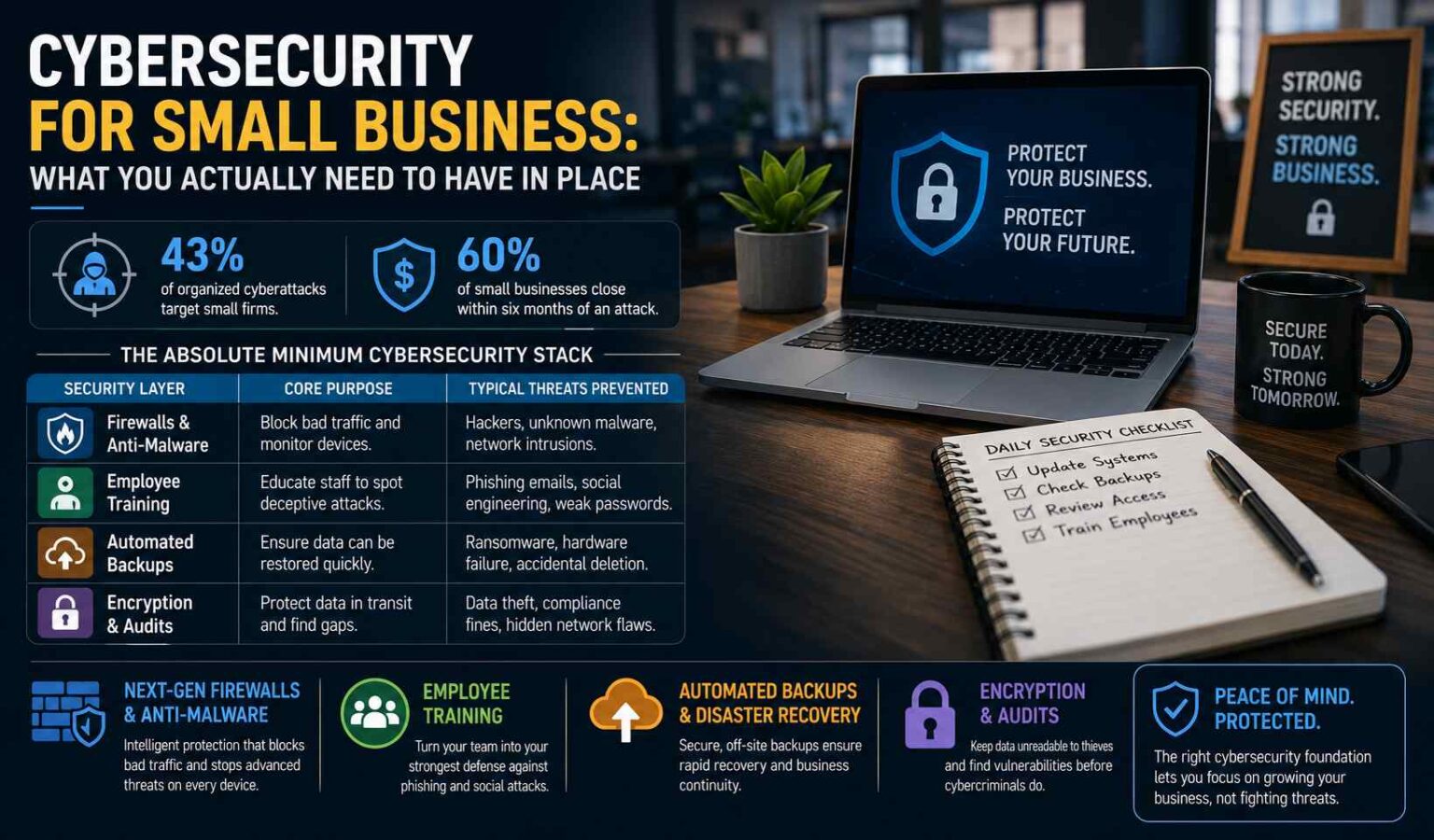
Cybersecurity for Small Business: What You Actually Need to Have in Place.
As a business owner, you have a lot on your plate. You want to focus on growth, managing your team, and serving your clients. You do not want to spend your days untangling confusing IT jargon or worrying about ransomware.
You also probably have a budget to stick to. When IT vendors try to scare you into buying massive, expensive software packages, it is easy to feel overwhelmed. You might even wonder if your current setup is good enough.
Unfortunately, ignoring the threat is not an option. Hackers do not just go after giant corporations. Research shows that 43% of organized cyberattacks target small firms. The fallout from these events is often fatal. That same report notes that 60% of small businesses close within six months of experiencing an attack.
Why Cybercriminals Target Small Businesses
You might assume hackers would rather target massive corporations with millions of dollars in the bank. In reality, cybercriminals look for the path of least resistance. They target small businesses specifically because smaller firms often lack the dedicated IT security infrastructure of larger enterprises.
Hackers use automated software to scan thousands of networks at once. They look for unlocked digital doors. If your business relies on basic, out-of-the-box antivirus software, your doors are likely wide open.
Basic antivirus only catches known, legacy viruses. It compares files on your computer to a list of known threats. If a hacker writes a brand-new piece of malware, a basic antivirus program will simply let it through.
Modern businesses require actual endpoint protection. This advanced software actively monitors your network for suspicious behavior. If a normal program suddenly tries to delete all your files, endpoint protection will recognize the strange behavior and stop the attack in its tracks.
You just need a partner who speaks plain English and provides flexible solutions tailored to your actual risks. PCM is one example of a managed services provider that takes this approach, offering businesses the kind of comprehensive IT coverage that keeps operations stable, data protected, and technology aligned with where the business is actually headed.
The Absolute Minimum Cybersecurity Stack
Effective cybersecurity relies on a layered approach. No single piece of software is a silver bullet that stops every attack. If a hacker gets past your first defense, you want another defense waiting for them right behind it.
The concept of “Exactly What You Need” applies here. You can achieve excellent protection without the enterprise bloat. This stack contains the absolute non-negotiables for compliance, client trust, and your own peace of mind.
| Security Layer | Core Purpose | Typical Threats Prevented |
|---|---|---|
| Firewalls & Anti-Malware | Block bad traffic and monitor devices. | Hackers, unknown malware, network intrusions. |
| Employee Training | Educate staff to spot deceptive attacks. | Phishing emails, social engineering, weak passwords. |
| Automated Backups | Ensure data can be restored quickly. | Ransomware, hardware failure, accidental deletion. |
| Encryption & Audits | Protect data in transit and find gaps. | Data theft, compliance fines, hidden network flaws. |
Next-Generation Firewalls and Advanced Anti-Malware
Your first layer of defense sits at the edge of your network. Next-generation firewalls act as an intelligent barrier between your company data and the wild internet. They monitor incoming and outgoing web traffic, automatically blocking unauthorized access attempts.
Unlike older firewalls that just checked where traffic came from, next-generation models inspect the actual contents of the data packets. If a hacker tries to sneak a malicious command through a normal-looking web connection, the firewall catches it.
Advanced anti-malware works in the background on your specific devices. If an employee takes a laptop to a coffee shop and connects to public Wi-Fi, the firewall in your office cannot protect them. Advanced anti-malware steps in to proactively catch threats that slip past traditional defenses, regardless of where the device is located.
Employee Security Training
Your technology can be flawless, but human error will always be a vulnerability. Cybercriminals know this. They often bypass firewalls entirely by tricking an employee into handing over their login credentials.
A typical attack involves sending a deceptive phishing email that looks exactly like a message from Microsoft, Google, or even your own CEO. The email asks the employee to click a link and log in to fix an issue. Once they do, the hacker has the keys to your network.
Ongoing security training is the only way to protect your business from these mistakes. Regular training teaches your team how to spot fake URLs, suspicious attachments, and urgent requests for wire transfers. An educated workforce turns your biggest vulnerability into a strong line of defense.
Automated Backups and Disaster Recovery
Sometimes, despite your best efforts, an attack succeeds. This is why having a robust recovery plan is just as critical as having a strong perimeter defense. You need to know what happens the day after a hacker locks your files.
This is where automated backups and disaster recovery fit into a modern cybersecurity strategy. A true backup is not just a hard drive plugged into your server. If ransomware hits your server, it will lock the attached backup drive, too.
You need a secure backup strategy. If an attack does occur, having these isolated copies of your data ensures rapid business continuity. You can simply wipe the infected machines and restore your network from yesterday’s backup, completely preventing a data hostage situation.
End-to-End Encryption and Regular Compliance Audits
The final layers of your security stack focus on making your data useless to thieves and proactively finding hidden weak spots.
End-to-end encryption is a simple concept. It scrambles your data into unreadable code while it travels across the internet and while it sits on your hard drives. If a hacker manages to steal a folder full of client financial records, they will only see a mess of random characters. Without the encryption key, the stolen data is entirely useless to them.
Finally, you need regular compliance audits. Technology changes rapidly, and new software updates can accidentally open security holes. Regular audits assess your network to identify hidden vulnerabilities before cybercriminals do. These audits also ensure you are meeting the specific privacy laws required by your industry, protecting you from massive regulatory fines.
Conclusion
Effective small business cybersecurity requires a targeted, multi-layered approach. It does not require a bottomless IT budget. By focusing on the tools that actually stop modern threats, you can build a formidable defense without wasting money.
Moving away from basic antivirus to a professional stack is a non-negotiable step for growing companies. You must implement next-generation firewalls, ongoing employee training, and automated off-site backups. These are the core elements that keep your doors open and your client data safe when an attack inevitably happens.
True peace of mind comes from knowing your business is secure. You get there by partnering with experts who remove the jargon, understand the financial challenges of growth, and manage your security proactively in the background. With the right foundation in place, you can finally stop worrying about IT threats and get back to running your business.
