
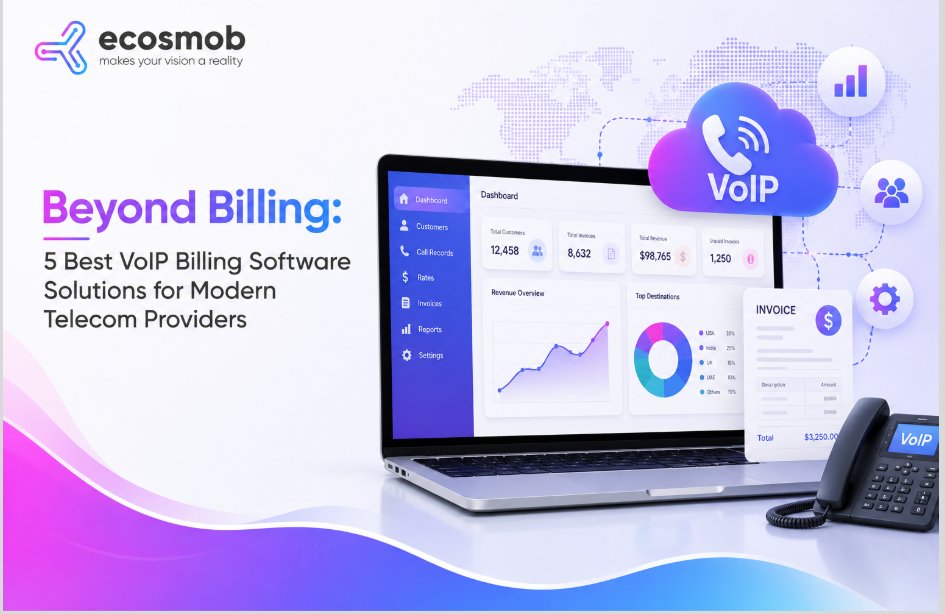
Beyond Billing: 5 Best VoIP Billing Software Solutions for Modern Telecom Providers
Managing a VoIP business isn’t just about delivering clear calls or maintaining network uptime. It is also about making sure every call, message, subscription, and service is billed accurately.
That sounds simple until your business starts supporting multiple customers, pricing plans, currencies, resellers, and thousands of call records every hour.
At that point, billing becomes more than an accounting task. It becomes a critical part of customer experience, revenue protection, and business growth.
The right VoIP billing software solution helps automate complex billing processes, eliminate manual errors, and provide complete visibility into your telecom operations. More importantly, it gives service providers the flexibility to launch new pricing models and scale without rebuilding their billing infrastructure.
This guide reviews the best VoIP billing software solutions, explains how they were evaluated, and highlights the strengths that make each platform suitable for different business requirements.
How We Evaluated These VoIP Billing Software Solutions
Choosing billing software is a long-term decision. A platform that works well today should also support new customers, pricing models, and business expansion tomorrow.
Rather than comparing marketing claims, we evaluated each solution based on the capabilities that directly influence billing accuracy, operational efficiency, and scalability.
1. Billing Automation
Manual billing quickly becomes difficult as customer volumes grow. We looked for platforms that automate rating, invoicing, recurring billing, taxation, and payment processing to reduce administrative effort.
2. Rating and Charging
Modern telecom businesses rarely rely on a single pricing model. We evaluated each solution based on its ability to support prepaid and postpaid billing, usage-based charging, subscriptions, and custom rate plans.
3. Scalability
Billing systems should grow alongside the business. Solutions that support high call volumes, multiple customers, and multi-tenant environments received stronger consideration.
4. Integration Capabilities
Billing platforms should connect seamlessly with the rest of the telecom ecosystem. We assessed each solution based on its compatibility with VoIP platforms, payment gateways, CRM systems, ERP software, and third-party applications.
5. and Analytics
Billing data should provide more than invoices. We considered the availability of dashboards, financial reports, usage analytics, and operational insights that help businesses make informed decisions.
6. Telecom Industry Experience
Telecom billing comes with unique challenges. We prioritized solutions designed specifically for VoIP providers, telecom operators, ISPs, and communication service providers rather than generic billing platforms.
Using these criteria, we identified five billing solutions that consistently deliver the functionality, flexibility, and reliability modern telecom businesses require.
The evaluation is complete. Now let’s look at the platforms that earned a place on this list.
Best VoIP Billing Software Solutions for Telecom Providers
Choosing the right billing platform depends on far more than invoice generation. The best solutions simplify complex charging models, automate repetitive tasks, and adapt as your business grows.
The following platforms stand out for their telecom-focused capabilities, automation features, and ability to support modern VoIP businesses.
1. Ecosmob
Ecosmob offers a comprehensive VoIP billing software solutions designed for telecom operators, VoIP providers, and communication service businesses. The platform combines billing automation with customer management, service provisioning, and reporting to simplify day-to-day operations.
Its flexible architecture supports businesses with evolving pricing models while integrating smoothly with broader VoIP ecosystems.
Core Features
- Automated billing and invoicing
- Prepaid and postpaid billing
- Customer and reseller management
- Flexible pricing plans
- Payment gateway integration
- Reporting and analytics
Best for: Telecom operators, VoIP service providers, UCaaS businesses, and enterprises looking for a customizable telecom billing platform.
Key Strengths
- Built specifically for telecom businesses
- Flexible billing workflows
- Strong integration capabilities
- Scalable architecture
2. PortaBilling
PortaBilling is a telecom billing and customer management platform widely used by VoIP providers and communication service businesses. It supports carrier-grade billing while simplifying service management across multiple customers and business models.
The platform is known for handling complex telecom billing environments with strong automation capabilities.
Core Features:
- Real-time billing
- Customer self-service portal
- Multi-currency support
- Subscription management
- Fraud detection
- Revenue reporting
Best for: Wholesale VoIP providers, carriers, and businesses managing large telecom infrastructures.
Key Strengths:
- Carrier-grade performance
- Flexible charging models
- Multi-tenant capabilities
- Global deployment experience
3. TimelyBill
TimelyBill provides billing and subscriber management software for communication service providers. Its platform focuses on automating billing operations while improving customer management and financial visibility.
The solution supports businesses operating across voice, messaging, broadband, and cloud communication services.
Core Features:
- Automated invoicing
- Subscriber management
- Usage-based billing
- Revenue reporting
- CRM integration
- Tax management
Best for: Communication service providers, ISPs, and businesses offering subscription-based telecom services.
Key Strengths:
- Strong reporting capabilities
- Flexible billing models
- Subscriber lifecycle management
- User-friendly interface
4. ASTPP
ASTPP is an open-source telecom billing platform designed for VoIP providers seeking flexibility and cost-effective deployment. It combines billing, routing, customer management, and service provisioning within a single platform.
Its open-source model makes it attractive for businesses that require extensive customization.
Core Features:
- Open-source billing platform
- Call routing
- Customer management
- Reseller support
- Payment integration
- Real-time monitoring
Best for: Growing VoIP providers, startups, and businesses seeking customizable billing solutions.
Key Strengths:
- Open-source flexibility
- Strong community support
- Telecom-focused functionality
- Cost-effective deployment
5. Togai
Togai is a usage-based billing platform designed for businesses with complex pricing structures. While not exclusively built for telecom providers, its flexible metering and billing capabilities make it suitable for SaaS businesses and communication platforms adopting usage-based pricing.
The platform emphasizes automation, pricing experimentation, and developer-friendly integrations.
Core Features:
- Usage-based billing
- Metering engine
- Subscription management
- Revenue analytics
- API-first architecture
- Automated invoicing
Best for: SaaS companies, communication platforms, and businesses using consumption-based pricing models.
Key Strengths:
- Flexible pricing engine
- API-driven integrations
- Modern billing workflows
- Strong automation capabilities
The software options are on the table. The next step is understanding the billing challenges they are designed to solve.
Common VoIP Billing Challenges Businesses Face
As a VoIP tools business grows, billing often becomes one of the first operational bottlenecks. New customers, changing rate plans, and increasing call volumes add complexity that manual processes struggle to handle.
Recognizing these challenges early can help businesses choose billing software that supports long-term growth instead of creating future limitations.
1. Complex Pricing Models
VoIP providers rarely offer a single pricing plan.
Many support prepaid and postpaid billing, subscription plans, pay-as-you-go pricing, wholesale rates, and reseller discounts at the same time. Managing these models manually increases the risk of billing inconsistencies.
2. Revenue Leakage
Small billing errors can quickly become significant revenue losses.
Missing call records, incorrect rate calculations, or delayed invoicing can reduce profitability without being immediately noticeable. A reliable billing platform helps identify and prevent these issues before they affect the business.
3. High Call Record Volumes
Every call generates a Call Detail Record (CDR). As customer numbers increase, businesses may need to process thousands or even millions of records each day.
Without an efficient billing system, processing these records accurately becomes both time-consuming and resource-intensive.
4. Billing Accuracy
Customers expect invoices to be accurate every time.
Even minor discrepancies can lead to disputes, delayed payments, and reduced trust. Automated billing minimizes manual intervention and helps ensure consistent, error-free invoicing.
5. Payment Collection
Generating invoices is only one part of the billing process.
Businesses also need to manage payment reminders, recurring billing, multiple payment methods, taxes, and financial reporting. Handling these activities from separate systems often creates unnecessary operational overhead.
The challenges may differ from one provider to another, but the evaluation process remains largely the same. Choosing the right platform starts with knowing what questions to ask.
How to Choose the Right VoIP Billing Software
Every billing platform offers a different combination of features, pricing models, and deployment options. The best choice depends on how well those capabilities align with your business requirements.
Before making a decision, consider the following factors.
1. Understand Your Billing Model
Start by identifying how your services are billed today and how they may evolve in the future.
Whether you support subscriptions, prepaid services, postpaid plans, wholesale billing, or usage-based charging, the platform should accommodate your pricing strategy without requiring extensive customization.
2. Prioritize Automation
Manual billing processes become increasingly difficult as the business grows.
Look for software that automates rating, invoicing, payment reminders, taxation, and recurring billing. Automation not only saves time but also reduces the likelihood of costly billing errors.
3. Evaluate Integration Options
Billing software should fit naturally into your existing technology stack.
Choose a solution that integrates with your VoIP platform, CRM, payment gateways, accounting software, and other business applications to create a connected workflow.
4. Check Scalability
Your billing requirements will change as your customer base expands.
A scalable platform should support increasing call volumes, additional users, new pricing plans, and multiple business entities without affecting performance.
5. Review Reporting Features
Billing data can provide valuable business insights beyond revenue tracking.
Comprehensive reports and analytics help businesses monitor customer usage, identify revenue trends, forecast growth, and make informed operational decisions.
Knowing how to evaluate billing software makes the selection process easier. The next step is understanding which capabilities deserve the highest priority.
What are the Key Features to Look for in VoIP Billing Software
Not every feature carries the same weight. The most valuable billing platforms simplify operations while giving businesses the flexibility to grow without replacing their existing systems.
1. Real-Time Billing
Real-time billing allows businesses to monitor service usage and charges as they occur. This improves billing accuracy, provides better visibility into customer activity, and helps reduce revenue leakage.
2. Flexible Pricing Models
Customer requirements often change over time. A capable billing platform should support multiple pricing structures, including subscriptions, usage-based billing, tiered plans, prepaid services, and postpaid billing.
3. Automated Invoicing
Generating invoices manually consumes valuable time and increases the chance of human error. Automated invoicing ensures bills are generated accurately and delivered on schedule, improving operational efficiency and customer satisfaction.
4. Multi-Tenant Support
Many telecom businesses serve multiple customers, resellers, or business units from a single platform. Multi-tenant capabilities simplify management while allowing each customer to operate independently within the same billing environment.
5. Reporting and Analytics
Billing platforms generate valuable operational and financial data. Advanced reporting helps businesses monitor revenue, customer activity, payment status, and service usage from a single dashboard.
6. API and Platform Integrations
Billing software should work alongside the systems your business already depends on. API support makes it easier to connect billing platforms with VoIP infrastructure, CRM systems, payment gateways, ERP software, and other business applications.
Features provide the foundation. Choosing the right platform depends on how those capabilities align with your business model.
Which VoIP Billing Software Fits Your Business?
Every telecom business operates differently. The right billing solution depends on the services you offer, your customer base, and how your business plans to grow.
1. Telecom Service Providers
Providers managing carrier services, SIP trunking, or UCaaS platforms often require advanced billing automation and flexible pricing models.
Ecosmob, PortaBilling, and ASTPP are well-suited for businesses operating in large-scale telecom environments.
2. Wholesale VoIP Providers
Wholesale providers typically manage complex routing, multiple rate plans, and reseller relationships.
PortaBilling and Ecosmob offer capabilities that support high-volume wholesale billing and customer management.
3. Contact Centers
Contact centers benefit from billing platforms that integrate with communication systems while simplifying customer management and reporting.
TimelyBill and Ecosmob provide features that support operational visibility and billing automation.
4. SaaS and Communication Platforms
Businesses embedding communication features into their applications often require flexible, usage-based pricing.
Togai and TimelyBill are strong options for organizations adopting subscription or consumption-based business models.
5. Growing Telecom Businesses
Growing providers need software that can scale without requiring frequent platform changes.
Ecosmob and ASTPP offer the flexibility to support expanding customer bases, evolving pricing strategies, and long-term business growth.
Choosing the right platform starts with understanding your business needs. The final decision comes down to selecting software that can support those needs as your business grows.
The Bottom Line?
The best VoIP billing software does more than generate invoices. It helps telecom businesses automate operations, improve billing accuracy, and adapt to changing customer demands without adding unnecessary complexity.
If you came straight to the conclusion, you missed the evaluation criteria, software comparisons, and use-case recommendations that can make choosing the right platform much easier.
Whether you’re launching a new VoIP service or upgrading an existing billing system, the right solution should fit your business today while supporting where it goes next. For organizations looking for a flexible, telecom-focused billing platform, Ecosmob is a strong option to consider alongside the other solutions discussed in this guide.
