
Have you noticed how the most significant changes at work rarely come with an announcement?
One Monday morning, a colleague wraps up in two hours what used to take a full day. A team that was always behind is suddenly the first one done. Nothing looks different from the outside. Same faces, same desks, same coffee machine. But the rhythm of the place has changed in ways nobody quite signed up for.
Generative AI did not hold a press conference. It came in through the side entrance, tucked inside software people were already comfortable with, showing up in chat platforms that quietly added a new button one afternoon.
Now, the early questions feel almost quaint. The ones worth asking are harder. Is the experience of work getting better for ordinary people? Are jobs becoming a steadier or shakier ground? And when this technology creates value, where does that value go?
Real Productivity Gains, Unevenly Distributed
Nobody with honest eyes is arguing that the gains are not there. They are visible and measurable across industries.
The marketing manager buried in brief writing is out of that meeting by mid-morning. The developer chasing syntax errors is catching them in seconds. The support team that used to drown in ticket volume is keeping its head above water without anyone working weekends.
According to Federal Reserve research, workers using generative AI reported saving an average of 5.4% of their work hours each week, roughly 2.2 hours in a standard forty-hour week. That may sound modest on paper. Spread across an entire organization, it adds up fast.
Where the distinction is most evident:
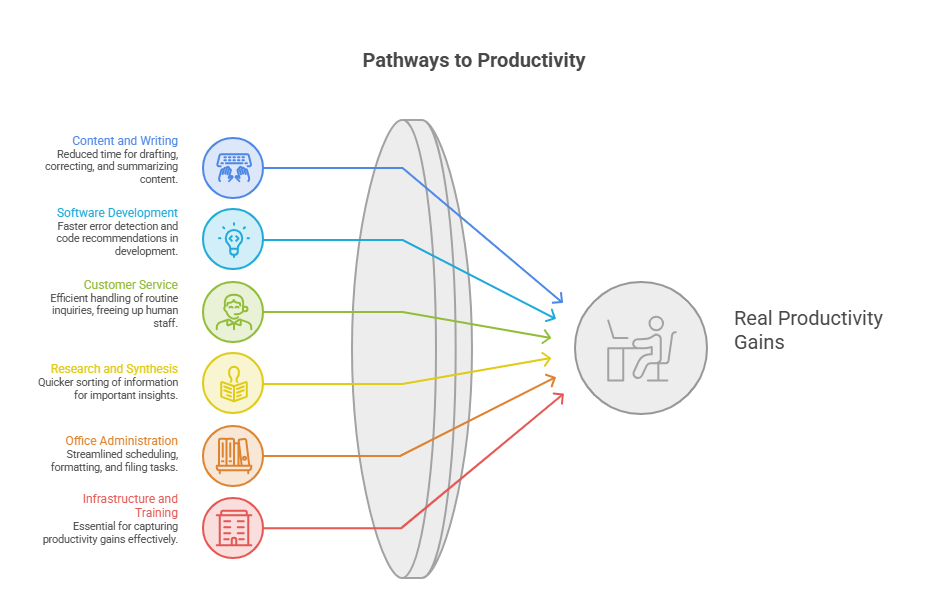
- Content and writing: Previously consuming half a workday with drafts, corrections, and summaries now only require a small portion of that time.
- Software development: Project timelines have been greatly shortened by error detection and code recommendations.
- Customer service: Human agents can manage more sophisticated conversations by directing routine questions to another location.
- Research and synthesis: Sorting through enormous volumes of information to identify what is significant is speedier and less labor-intensive.
- Office administration: Tasks that used to silently occupy calendars, such as scheduling, formatting, and filing, have significantly decreased.
Here is the part that gets left out of most excitement around these numbers. A company with solid infrastructure and a workforce that received training captures these gains meaningfully. A smaller operation with no IT support and nothing budgeted for training captures almost none of it. The headline averages look strong. The reality behind them is considerably patchier.
The Truth About AI and Jobs
This conversation is not new. It has just changed clothes.
Factory automation arrived, and people feared the end of work as they knew it. Spreadsheets made bookkeepers’ arithmetic skills worth less overnight. The internet restructured entire industries. Each time, more work eventually appeared than vanished. That record deserves to be taken seriously.
But generative AI has a quality that makes leaning on that history feel slightly too easy.
Earlier automation went after physical, repetitive tasks. Narrow and slow to spread. Generative AI is going after cognitive work, the writing, reviewing, summarizing, and advising that most white-collar jobs are built around.
The pressure to measure has quietly intensified. As AI takes on more cognitive tasks, organizations need to know precisely what their workforce is doing and whether output reflects real work or the appearance of it. That is why investment in employee productivity tracking has accelerated alongside AI adoption.
Today’s workforce analytics tools go well beyond login times:
- Active vs. idle time: tracks the gap between hours logged and hours actually worked
- Application and website usage: reveals whether employees are spending time in work-related applications or on non-work websites
- Location-based dashboards: compare output across remote, hybrid, and in-office teams
- Utilization rate analysis: flags overloaded teams before burnout sets in and surfaces underutilized capacity before it becomes a headcount conversation
- Automated productivity scoring: turns raw activity data into actionable insights without manual auditing
The harder question is what organizations do with that visibility. Used well, it surfaces problems early and helps redistribute workloads fairly. Used poorly, it feeds a surveillance culture that makes workers feel monitored rather than supported. Technology does not decide which outcome happens. Management does.
Meanwhile, customer-facing roles are changing shape faster than most anticipated. The shift is no longer theoretical. Platforms like Murf’s AI voice agent now handle inbound support calls, qualify leads, book appointments, and update CRM records mid-conversation, covering the full workload that once required a support team.
The conversations sound natural, respond in under 800 milliseconds, and run across 35-plus languages. That kind of capability deployed at scale raises a question that organizations cannot defer much longer: where do the people handling these calls go next?
Two honest positions exist:
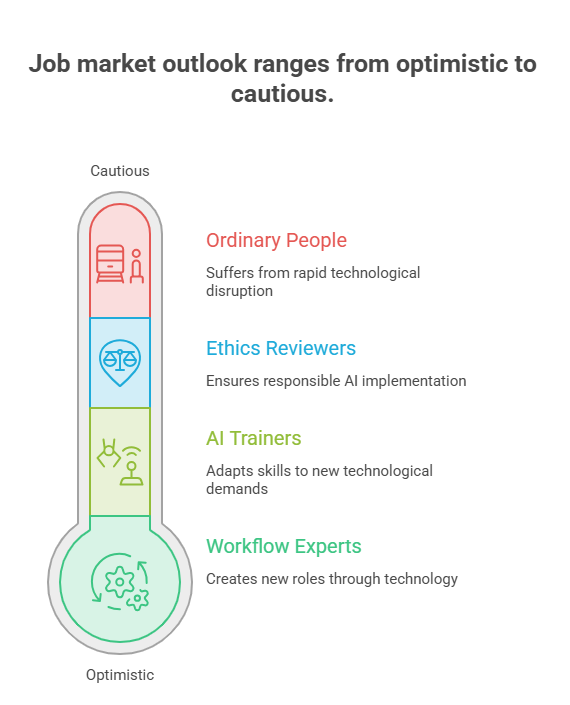
- The optimistic scenario: New technology invariably creates new job categories. Workflow experts, ethics reviewers, and AI trainers are currently hiring. This pattern is supported by history.
- The cautious case: Policy structures, retraining initiatives, and educational systems were never designed to handle this rapid change. Ordinary people suffer when disruption spreads more quickly than support systems.
Both positions are grounded. Grabbing one and dismissing the other is not clarity. It is convenient.
Disrupted Is Not the Same as Eliminated
Public conversation tends to blur this distinction, and that blurring causes problems in both directions.
Roles facing the highest pressure
| Role | What Makes It Vulnerable |
| Data entry clerks | Structured repetitive tasks are now handled automatically |
| Entry-level copywriters | Basic drafting is absorbed by AI faster and more cheaply |
| Tier-one support agents | Routine queries managed reliably by chatbots |
| Junior paralegals | Document review is now largely AI-assisted |
| Standard reporting analysts | Template reports generated without manual input |
Roles holding firm or growing
| Role | Why Demand Is Holding |
| Skilled tradespeople | Hands-on physical work sits outside what AI reaches |
| Care and mental health professionals | Human presence and connection cannot be replicated |
| Senior strategists | Judgments built over the years cannot be templated |
| AI oversight specialists | Someone accountable must own what machines produce |
| Relationship-driven sales | Major decisions still travel on trust between real people |
Predictable and repetitive work faces pressure. Work requiring physical presence, emotional depth, and accumulated judgment does not. That thread ran through every previous wave of automation. This one is broader but not categorically different.
The Problem Inside the Productivity Numbers
When a team of eight starts producing what twelve people used to manage, leadership faces a real choice. Reinvest that freed capacity into growth and quality. Or trim the roster and call it operational efficiency.
A significant number of organizations are taking the second road.
Workers are living the awkward end of this. They adopt AI tools, get faster, absorb more volume, and watch the financial return on all that extra output travel upward through the organization. What they are left holding is a heavier load, a tighter clock, and a growing feeling that this technology was built for the balance sheet rather than for them.
Speed brings its own hidden cost, and it is one that rarely gets discussed alongside the efficiency wins. Although generative AI is fundamentally altering the production of digital material, the human cost of keeping up with that pace is another topic entirely:
- The human function changes from producing work to auditing it when AI generates material on a large scale.
- It is more difficult to review faults in 100 AI-generated documents than in 20 human-written ones.
- The pace increases. The accountability stays with the person, not the tool.
None of that appears in a productivity dashboard. But it shows up in exhaustion, disengagement, and people walking out the door.
What Sensible Adoption Looks Like
Businesses that successfully threaded this needle disclose more about how they treated their users than about the technologies they chose. It’s only half the story to comprehend the AI developments that every company has to be aware of. What distinguishes companies that benefit from this change from those that merely survive it often comes down to how thoughtfully they approach AI transformation at the organizational level, not just the tools they select.
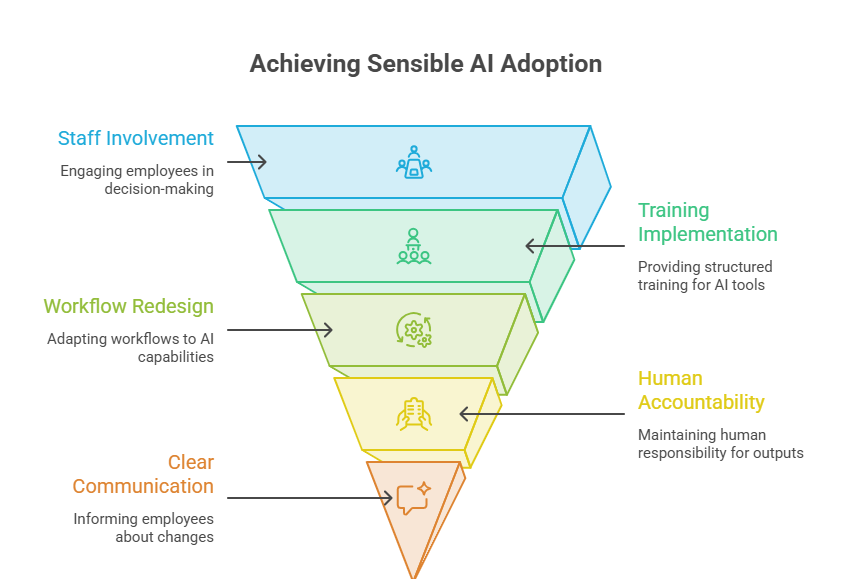
- Before decisions were made, they included staff members in the discussion.
- They built training into the rollout rather than assuming people would figure it out.
- They redesigned workflows around what AI genuinely handles well.
- They kept humans accountable for outputs rather than passing responsibility to the machine.
- They spoke plainly to their workforce about what was changing and what was not.
Organizations struggling moved fast, skipped the groundwork, and left their teams anxious with no real answers. Anxious workers do not embrace new tools openly. They use them defensively and resentfully. That is not adoption. It is the performance of adoption, and the results eventually show the difference.
Self-Generated
Make Generative AI Work for You
The capability of generative AI services keeps growing, and what feels significant today will look like the opening chapter a decade from now.
The workers who land steadily on the other side will not be those who resisted AI hardest or handed everything to it without thinking. They will be the ones who understood clearly what it cannot do and built their value around that.
Every generation has made that adjustment as tools changed around them. This one is making it faster, under more pressure, with considerably less runway.
Technology does not change that task. It just removes the option of doing it slowly.
Ready to make smarter decisions in a fast-moving world? Visit Droven.io for sharper insights on AI, work, and business strategies.
