
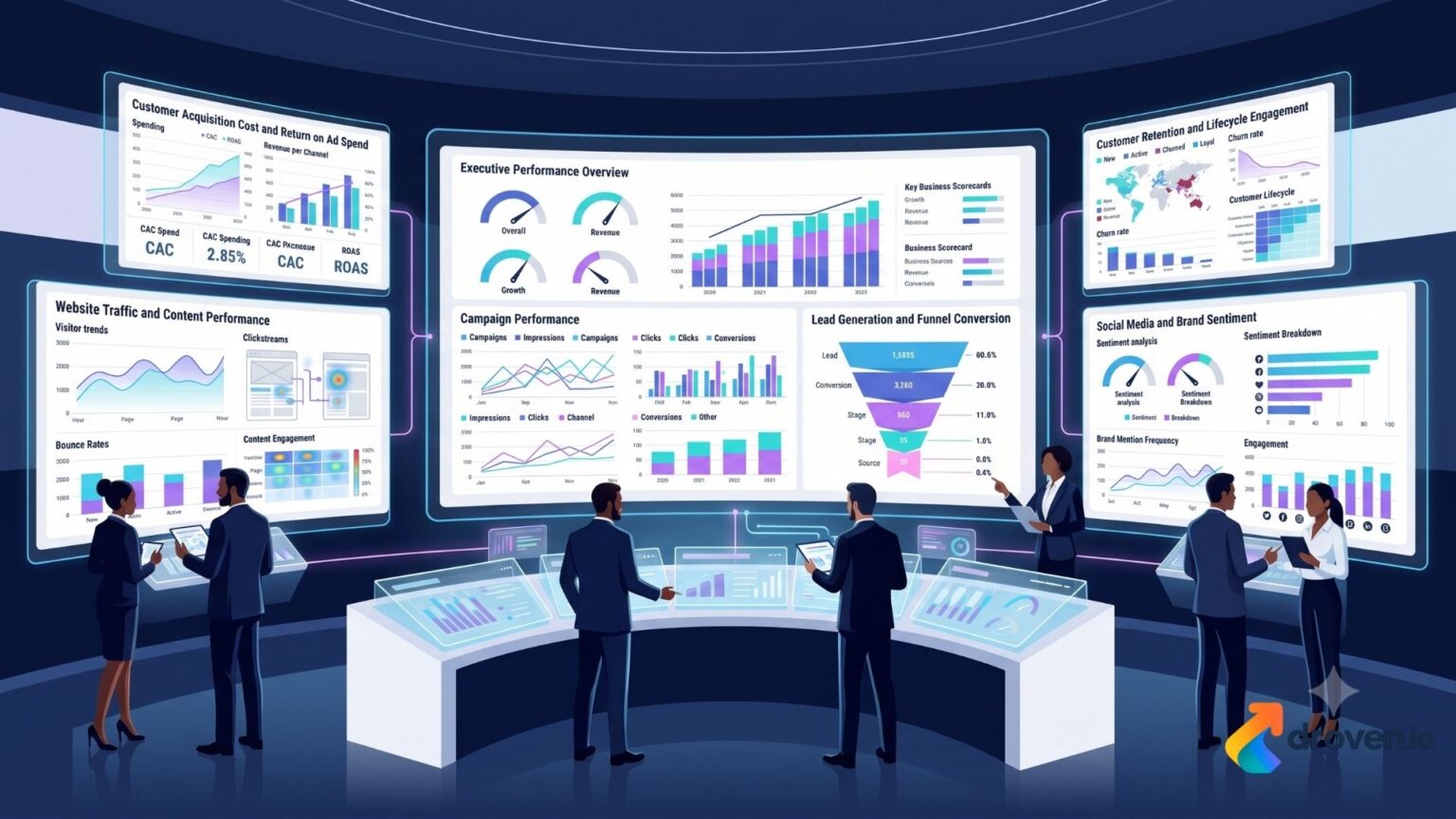
Marketing has become increasingly data-driven, with businesses relying on insights from websites, social media, paid advertising, email campaigns, CRM systems, and eCommerce platforms to guide decision-making. While the volume of available data continues to grow, the real challenge lies in turning that information into actionable insights. Reviewing dozens of spreadsheets or switching between multiple analytics platforms wastes valuable time and often leads to missed opportunities.
This is where marketing dashboards have become indispensable. A well-designed dashboard brings together key performance metrics from multiple channels into one centralized view, allowing teams to monitor progress, identify trends, and make informed decisions quickly. As artificial intelligence, automation, and privacy-focused analytics reshape digital marketing in 2026, businesses need dashboards that go beyond simple reporting. They need tools that provide strategic visibility, improve collaboration, and support continuous optimization.
The following seven dashboards represent the most valuable reporting systems every modern marketing team should implement to improve efficiency, increase accountability, and drive measurable business growth.
1. Campaign Performance Dashboard
Every marketing department runs multiple campaigns simultaneously across search engines, social media platforms, email marketing software, influencer partnerships, and display advertising networks. Without a centralized reporting system, understanding overall campaign effectiveness becomes difficult.
A campaign performance dashboard combines essential metrics such as impressions, clicks, click-through rate (CTR), conversions, conversion rate, cost per click (CPC), cost per acquisition (CPA), return on ad spend (ROAS), and overall revenue generated. Instead of reviewing each advertising platform individually, marketers gain a complete overview from one interface.
Real-time reporting is especially valuable because it allows teams to identify problems before significant budget is wasted. If an advertising campaign suddenly experiences declining conversions or rising acquisition costs, marketers can investigate immediately and adjust targeting, creative assets, or bidding strategies.
Modern dashboards increasingly include AI-powered alerts that automatically detect unusual performance patterns, helping teams respond faster than traditional manual reporting methods.
2. Customer Journey Dashboard
Today’s customers rarely purchase after a single interaction. They may first discover a brand through search engines, engage with social media content, subscribe to an email newsletter, read product reviews, and finally complete a purchase weeks later.
A customer journey dashboard maps these interactions across every stage of the buying process. Rather than focusing on isolated metrics, it helps marketers understand how different touchpoints influence customer decisions.
Advanced marketing dashboards integrate website analytics, CRM data, email engagement, customer support interactions, and first-party customer information into a unified journey. This holistic perspective enables marketers to identify where customers drop off, which channels generate the highest-quality leads, and which experiences contribute most to conversions.
These insights support better personalization strategies while helping businesses improve customer experiences throughout the entire sales funnel.
3. Content Marketing Dashboard
Content remains one of the strongest long-term drivers of organic traffic, customer education, and brand authority. However, measuring content success requires much more than tracking page views.
A content marketing dashboard evaluates blog articles, videos, podcasts, whitepapers, webinars, newsletters, and downloadable resources using meaningful performance indicators. Typical metrics include organic traffic, average engagement time, bounce rate, returning visitors, social shares, backlinks, keyword rankings, lead generation, and assisted conversions.
Rather than guessing which topics resonate with audiences, content teams can use data to identify high-performing subjects and formats.
Well-structured marketing dashboards also reveal content gaps, allowing editorial teams to build comprehensive topic clusters that strengthen search visibility and improve user engagement over time. This data-driven approach ensures content investments align with business objectives instead of relying on assumptions.
4. Marketing Funnel Dashboard
Generating website traffic alone does not guarantee business growth. Companies also need visibility into how prospects move through the marketing and sales funnel.
A funnel dashboard tracks every stage of the customer acquisition process—from website visitors and lead generation to marketing-qualified leads (MQLs), sales-qualified leads (SQLs), opportunities, and completed sales.
By measuring conversion rates between each stage, marketing and sales teams can quickly identify bottlenecks. For example, strong lead generation paired with poor qualification rates may indicate targeting issues, while a high number of qualified leads but low sales conversions could reveal challenges within the sales process.
These insights encourage better collaboration between marketing and sales departments while supporting ongoing optimization efforts that increase overall conversion efficiency.
5. SEO and Organic Growth Dashboard
Organic search remains one of the most cost-effective acquisition channels for many businesses. Maintaining strong visibility requires continuous monitoring of technical performance, content quality, and search rankings.
An SEO dashboard typically includes keyword rankings, organic traffic, click-through rate, indexed pages, Core Web Vitals, backlinks, referring domains, crawl errors, and top-performing landing pages. Combining these metrics creates a comprehensive view of search performance.
Professional marketing dashboards enable SEO specialists to quickly identify declining rankings, technical issues, and new keyword opportunities before competitors capitalize on them. Since Google’s ranking systems increasingly reward helpful, authoritative content and excellent user experience, continuous SEO monitoring has become more valuable than periodic reporting.
Organizations can also compare content performance across different topics, helping prioritize future content investments based on measurable search demand and user engagement.
6. Revenue Attribution Dashboard
Marketing leaders are increasingly expected to demonstrate how their activities contribute directly to business growth. Vanity metrics such as impressions and likes are no longer sufficient for executive reporting.
A revenue attribution dashboard connects marketing campaigns to pipeline development and revenue generation. By integrating CRM platforms, marketing automation software, advertising platforms, and sales data, businesses gain a clearer understanding of which channels produce measurable financial results.
Rather than relying solely on last-click attribution, many organizations now adopt multi-touch attribution models that recognize the influence of multiple customer interactions throughout longer buying journeys.
These insights help marketing teams allocate budgets more effectively while providing leadership with reliable evidence of marketing’s contribution to organizational success.
7. Executive Marketing Dashboard
Senior executives require a strategic overview rather than operational detail. An executive marketing dashboard summarizes the most important business metrics in a format that supports informed leadership decisions.
Typical key performance indicators include marketing-generated revenue, customer acquisition cost (CAC), customer lifetime value (CLV), marketing return on investment (ROI), lead quality, pipeline contribution, brand awareness trends, and year-over-year growth.
Unlike operational reports, executive dashboards emphasize business outcomes instead of channel-specific metrics. Interactive visualizations, automated reporting, and trend comparisons allow leadership teams to evaluate overall marketing performance quickly.
When built effectively, these dashboards improve transparency, encourage cross-functional alignment, and support long-term strategic planning.
Building Dashboards That Deliver Actionable Insights
The most effective dashboards focus on decision-making rather than simply displaying large amounts of information. Every metric should support a clear business objective and encourage meaningful action.
Organizations should begin by defining their key performance indicators before selecting visualization tools. Integrating reliable data sources, maintaining consistent reporting standards, and automating updates help ensure dashboard accuracy.
Regular review meetings also play an important role. Weekly operational discussions, monthly performance reviews, and quarterly strategic evaluations transform dashboard insights into measurable business improvements.
Artificial intelligence further enhances modern dashboards by identifying anomalies, forecasting future trends, recommending optimization opportunities, and reducing manual reporting tasks. These capabilities enable marketers to spend more time improving campaigns instead of compiling reports.
Conclusion
As marketing grows more complex, centralized reporting has become essential for maintaining visibility across multiple channels and customer touchpoints. Well-designed marketing dashboards help organizations move beyond isolated metrics by providing a unified view of campaign performance, customer behavior, content effectiveness, search visibility, revenue contribution, and executive-level business outcomes.
Implementing these seven dashboards enables marketing teams to make faster, smarter decisions based on accurate, real-time information. More importantly, they foster collaboration between departments, improve accountability, and ensure marketing strategies remain aligned with broader business objectives. In 2026 and beyond, organizations that invest in meaningful dashboard reporting will be better equipped to adapt to changing market conditions and achieve sustainable, data-driven growth.
