
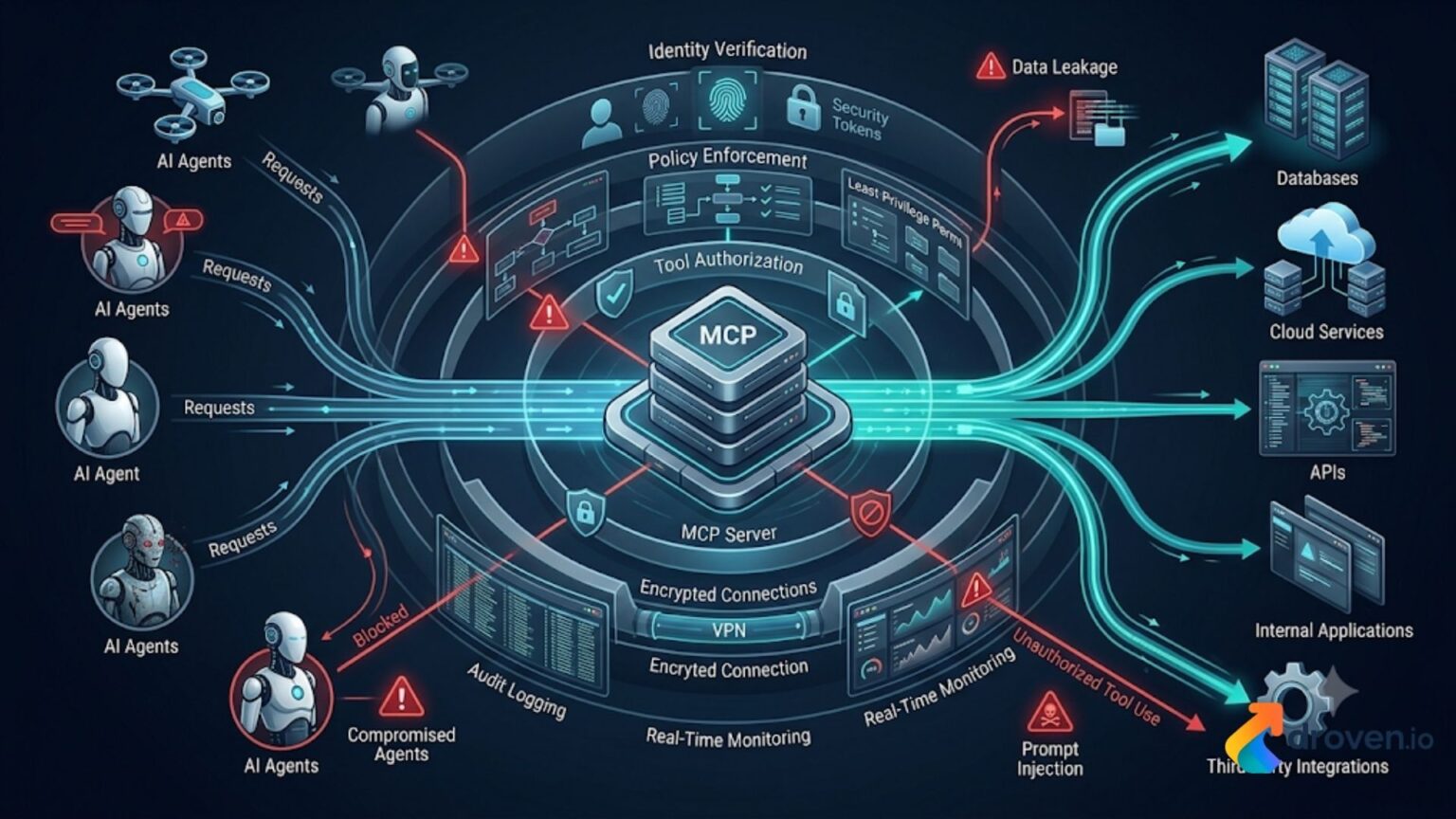
Artificial intelligence is rapidly changing how organizations interact with applications, data, and digital services. Rather than relying solely on traditional software interfaces, many businesses are beginning to deploy AI agents capable of reasoning, planning, and completing complex tasks across multiple systems. As this transformation accelerates, Model Context Protocol (MCP) servers are emerging as a foundational component that enables AI agents to securely communicate with enterprise tools and resources.
However, increased capability also brings increased responsibility. MCP servers often sit between powerful AI models and sensitive business systems, making them an attractive target for attackers. Traditional security strategies that focus primarily on authenticating users are no longer sufficient when autonomous agents can make decisions, invoke tools, and access data with minimal human intervention.
Organizations must therefore rethink how access is granted, monitored, and controlled. Agentic access control introduces a more adaptive security model designed specifically for AI-driven environments, ensuring that intelligent agents receive only the permissions they genuinely need while preventing unintended or malicious actions.
What Makes MCP Servers Different from Traditional APIs
Unlike conventional APIs that primarily respond to direct user requests, MCP servers facilitate structured communication between AI models and external tools. They allow agents to retrieve information, execute actions, and maintain contextual awareness while performing multi-step workflows.
This capability dramatically expands what AI systems can accomplish. An AI assistant might retrieve customer records, generate reports, update databases, schedule meetings, or trigger automated workflows without constant user supervision.
While this flexibility improves productivity, it also increases the attack surface. Every connected service, permission, and tool becomes another potential entry point if access policies are too broad or improperly enforced.
Traditional API security generally assumes that authenticated users intentionally perform each request. MCP environments, by contrast, must account for autonomous decision-making, continuous context changes, and interactions spanning multiple enterprise systems.
Why Identity Alone Is No Longer Enough
Authentication remains an essential layer of security, but verifying identity alone cannot adequately protect modern AI infrastructures.
An authenticated AI agent may still receive malicious instructions through prompt injection, access information beyond its intended scope, or misuse legitimate permissions in unexpected ways. The challenge is no longer simply determining who is making the request but also evaluating what the agent intends to do, why it needs access, and whether the requested action aligns with organizational policies.
This shift has led many security professionals to explore more dynamic authorization models. Noma Security addresses these challenges through policy-based approvals, runtime enforcement, and continuous monitoring across AI agents, MCP servers, and enterprise tools, rather than relying solely on static permissions or one-time authentication decisions.
Organizations increasingly recognize that every AI action should be evaluated based on context instead of assuming all authenticated requests are inherently trustworthy.
Key Security Risks Facing MCP Servers
As AI ecosystems mature, several security challenges have become increasingly important for organizations deploying MCP servers.
One major concern is prompt injection. Attackers may manipulate prompts so that an AI agent ignores previous instructions or executes unintended operations. Without adequate safeguards, seemingly harmless conversations can result in unauthorized actions.
Tool misuse represents another growing risk. AI agents often have access to multiple enterprise applications. Excessive permissions may allow an agent to interact with tools or datasets unrelated to its intended responsibilities.
Unauthorized data exposure is equally concerning. MCP servers frequently connect to internal documentation, customer databases, cloud storage, and proprietary knowledge bases. Weak authorization controls increase the likelihood of sensitive information being retrieved inappropriately.
Credential abuse also remains a serious issue. Long-lived credentials, shared API keys, or poorly managed authentication tokens can provide attackers with persistent access if compromised.
Modern security frameworks, including approaches supported by Noma Security, emphasize minimizing these risks through continuous evaluation of agent behavior instead of relying on one-time authentication decisions.
Additional risks include:
- Prompt injection attacks
- Excessive tool permissions
- Unauthorized data retrieval
- Credential theft or token misuse
- Lateral movement across connected systems
- Poor visibility into agent activities
- Inadequate policy enforcement
Understanding these threats is the first step toward designing effective defensive strategies.
Building Effective Agentic Access Control
Agentic access control extends beyond conventional role-based permissions by evaluating multiple contextual factors before allowing an AI agent to perform sensitive operations.
Fine-grained authorization enables organizations to define precisely which resources an agent may access, under what circumstances, and for what specific tasks. Instead of granting broad administrative privileges, permissions can be limited according to business requirements.
Context-aware policies further strengthen security. Decisions may consider factors such as requested tool, data sensitivity, user approval status, geographic location, workload type, or recent behavioral patterns.
Runtime enforcement is equally important. Rather than validating permissions only at login, organizations should continuously verify that every action remains compliant with established policies.
Platforms focused on AI security, including Noma Security, demonstrate the growing industry emphasis on monitoring AI interactions throughout their execution lifecycle rather than treating authorization as a single event.
Effective agentic access control commonly includes:
- Least privilege access
- Just-in-time authorization
- Context-aware policy evaluation
- Continuous runtime monitoring
- Human approval for high-risk actions
- Automatic session expiration
- Detailed audit logging
Together, these practices significantly reduce the likelihood of unauthorized or unintended AI behavior.
The Importance of Continuous Visibility and Governance
Security teams cannot protect what they cannot observe. Comprehensive visibility into AI agent activities is becoming a critical requirement for organizations adopting MCP architectures.
Every interaction should be logged, including prompts, accessed resources, invoked tools, policy decisions, and execution outcomes. These records support forensic investigations, compliance reporting, and operational improvements.
Behavioral analytics further enhance detection capabilities by identifying unusual patterns that may indicate compromised agents or malicious activity. Unexpected increases in tool usage, abnormal data access requests, or repeated authorization failures often warrant investigation.
Governance also requires regular policy reviews. As AI capabilities evolve, permissions that were once appropriate may become unnecessarily broad. Periodic audits help ensure access controls continue reflecting current operational needs.
Organizations implementing solutions inspired by Noma Security often prioritize centralized policy management alongside continuous monitoring, enabling security teams to maintain stronger oversight across increasingly complex AI environments.
Preparing for the Future of AI Infrastructure
The adoption of AI agents is expected to accelerate across nearly every industry, making secure MCP implementations increasingly important for long-term resilience.
Rather than treating security as an afterthought, organizations should integrate protective measures throughout the AI development lifecycle. Developers, security teams, infrastructure engineers, and compliance specialists all play important roles in designing trustworthy AI systems.
Future-ready organizations will likely invest in automated policy validation, adaptive authorization models, threat detection powered by behavioral analysis, and continuous governance processes that evolve alongside AI capabilities.
Building secure AI infrastructure is not simply about preventing attacks. It also supports regulatory compliance, strengthens customer trust, protects intellectual property, and enables organizations to confidently expand their AI initiatives without introducing unnecessary risk.
Conclusion
MCP servers are rapidly becoming a foundational layer for enterprise AI, enabling intelligent agents to interact with business applications, data repositories, and digital workflows. Their growing importance also makes them a critical security priority.
Traditional authentication and static access controls were designed for human users, not autonomous systems capable of making independent decisions. Agentic access control addresses this gap by combining fine-grained authorization, contextual decision-making, continuous monitoring, and comprehensive governance.
Organizations that embrace these principles can better protect sensitive resources while allowing AI agents to operate efficiently and responsibly. As enterprise AI continues to mature, securing MCP servers will become an essential component of modern cybersecurity strategies, helping businesses balance innovation with strong, trustworthy security practices.
