
If you’re confused about whether you need generative AI, agentic AI, or both, you’re not alone. Most articles explain what these systems are, but not what they’re actually for in a real business.
You want to know what they do, how they’re different, and what happens if you choose the wrong one. You want to avoid wasting time, money, and effort on tools that don’t solve your problem. This article is written for that exact reason.
We break down agentic AI vs generative AI in simple language, with real examples and engineering insight. We’ll show you where each one fits, where each one falls short, and how teams make this decision in practice.
Despite growth in interest, a large enterprise survey found that as of early 2026, only about 8.6% of companies have AI agents deployed in production, with many still in pilot stages, underscoring that agentic maturity is still emerging.
Agentic AI vs Generative AI: What’s the Difference in Practice?
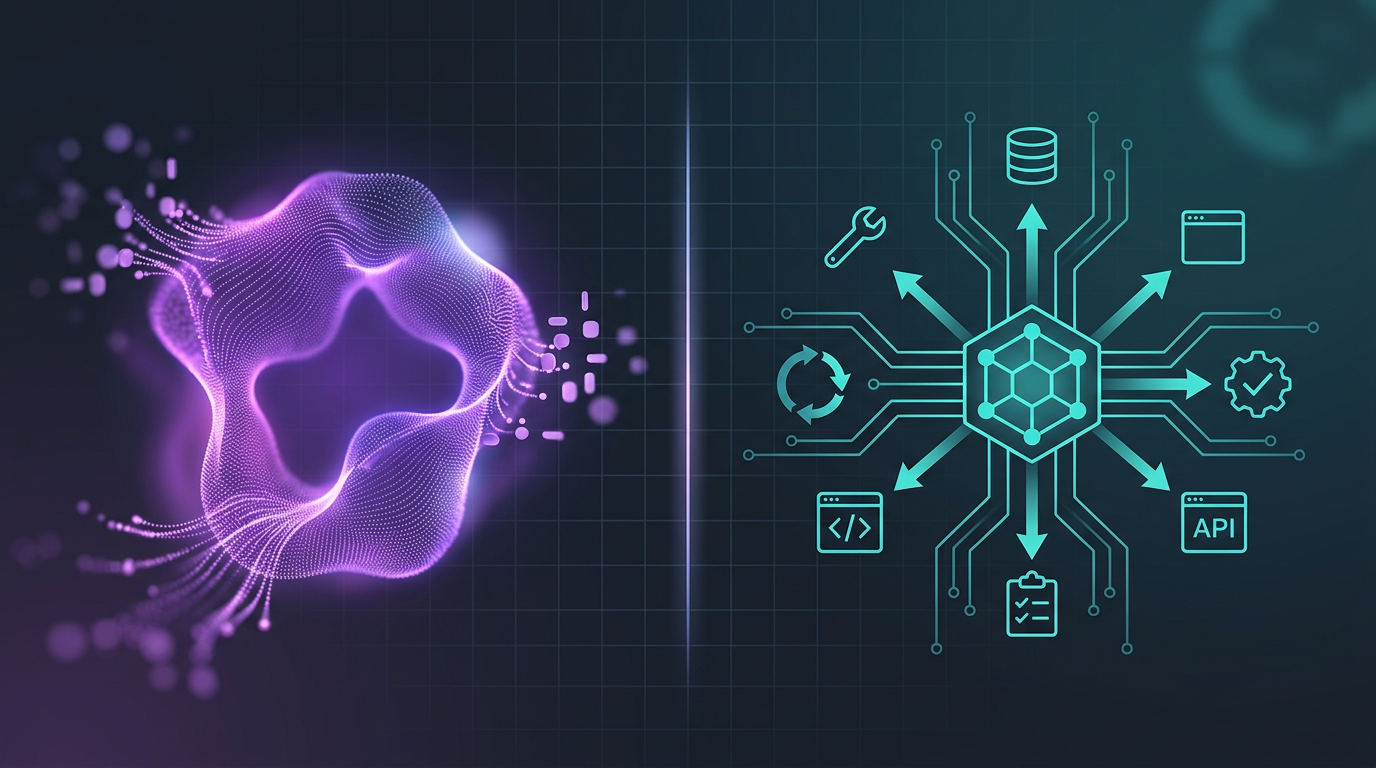
Before comparing tools, vendors, or technical setups, it’s important to understand what these two terms actually mean. They are often used interchangeably, but they describe two distinct types of systems with different purposes.
Getting this distinction right early helps avoid confusion, unrealistic expectations, and expensive missteps later.
What Is Generative AI and What Does It Do?
Generative AI is a type of artificial intelligence that creates new content based on patterns it has learned from large datasets.
It does not make decisions or take actions on its own. It responds to input and generates an output, such as text, images, code, or summaries, based on that input. In short, generative AI is built to produce information, not to run processes.
What Generative AI Is Best Used For
Generative AI is designed to support humans by creating and transforming information.
It is typically used to:
- Generate text, images, code, or audio
- Summarize and explain information
- Answer questions
- Assist with writing, research, and analysis
- Support creative and cognitive tasks
It’s very effective at helping people work faster and think more clearly, but it does not operate systems, manage workflows, or make decisions on its own.
What Is Agentic AI and How Does It Work?
Agentic AI is a type of artificial intelligence that can operate toward goals by taking actions within systems.
Instead of only responding to prompts, agentic AI can observe data, decide what needs to happen next, use tools or APIs to act, and adjust its behavior based on outcomes. In short, agentic AI is built to do things, not just describe or generate them.
What Agentic AI Is Best Used For
Agentic AI is designed to support systems by managing actions and workflows.
It is typically used to:
- Monitor data and system states continuously
- Decide when action is required
- Execute tasks across tools and platforms
- Coordinate multi-step workflows
- Track results and adjust behavior
Agentic systems don’t just respond — they operate.
Pro Tips from AI Engineering Teams
Once teams move past the definitions and start building real systems, the difference between generative and agentic AI becomes very clear.
Here are the key lessons engineering teams consistently surface when working with both.
Pro Tip 1: Think in Terms of Responsibility, Not Intelligence
A common early mistake is to think the difference is about how “smart” the AI is. It isn’t.
The real difference is what the system is responsible for.
- Generative AI is responsible for producing an answer.
- Agentic AI is responsible for producing an outcome.
One helps people think. The other helps systems run. This shift in responsibility changes everything about how the system must be designed, tested, and governed.
Pro Tip 2: If It’s Multi-Step, It’s Probably Agentic
If your use case involves more than one step, more than one system, or more than one decision, you’re likely moving into agentic territory. Engineering teams usually see this when workflows include:
- Sequences of actions
- Dependencies between tasks
- Long-running processes
- State that must be tracked over time
Generative systems handle one interaction at a time. Agentic systems are built to manage processes, not just prompts.
Pro Tip 3: Reactive vs Proactive Changes the Risk Profile
Generative AI reacts when prompted. Agentic AI watches systems continuously and acts when conditions change. That makes agentic systems more powerful and also more sensitive. Once a system is proactive, it can:
- Trigger actions automatically
- Change data or system state
- Affect customers, money, or operations
This is why agentic systems require stricter safety, monitoring, and oversight.
Pro Tip 4: Use Generative AI for Knowledge Work
Generative AI works best when the goal is to help humans think, write, or understand. Common uses include:
- Customer support chat interfaces
- Marketing and product content generation
- Code suggestions and documentation
- Internal knowledge assistants
- Report and meeting summarization
These systems improve speed and access to information, but humans remain responsible for decisions and actions.
Pro Tip 5: Use Agentic AI Where Coordination Is the Bottleneck
Agentic AI becomes valuable when work is slowed down by manual coordination rather than a lack of information. Common examples:
- Automated IT incident response
- Inventory and order orchestration
- Fraud detection and automated blocking
- Workflow automation across tools
- Monitoring and escalation systems
These systems reduce human coordination costs and handle repetitive operational decisions at scale.
Pro Tip 6: Agentic AI Is a System, Not a Model
Generative AI is typically:
- Model-centric
- Prompt-driven
- Stateless
Agentic AI is:
- System-centric
- Tool-integrated
- Stateful and persistent
This means agentic systems require orchestration layers, monitoring, logging, retry mechanisms, and control flows, not just a model.
Pro Tip 7: Reliability Is More Important Than Intelligence
Agentic systems interact with real systems, so engineering teams focus heavily on:
- Observability
- Auditability
- Safe interruption and override
- Graceful failure and recovery
In practice, success depends more on engineering discipline than on model sophistication.
Pro Tip 8: Governance Is Not Optional
Once AI touches data, money, infrastructure, or customers, governance becomes a core requirement. Responsible agentic systems require:
- Access controls
- Guardrails and constraints
- Human oversight
- Clear accountability
Without these, automation becomes a liability instead of an advantage.
How Engineering Teams Choose Between Agentic and Generative AI
For most engineering teams, the decision between generative and agentic AI isn’t really a technical one. It’s a maturity decision.
It comes down to how stable an organization’s processes are, how much operational risk it’s willing to accept, and how much trust it’s ready to place in automation.
Teams early in their AI journey often start with generative tools because the value is immediate and visible. You can see content being created, answers being generated, and productivity improving almost right away. That makes generative AI feel accessible and safe.
When Engineering Teams Recommend Agentic AI
Once teams move beyond experiments and start looking for real operational impact, the criteria for choosing agentic AI become much clearer.
The decision is less about how advanced the model is and more about what kind of work needs to happen without constant human coordination.
Agentic AI usually makes sense when:
- Processes are repetitive and rule-based
- Speed and consistency matter
- Manual coordination is expensive or error-prone
- Systems exist, but don’t talk to each other
A practical example of agentic AI in action is an AI-powered talent management system we built to automate hiring workflows for HR teams.
The platform enables HR teams to draft job descriptions, automatically screen and score candidates, match applicants to interviewers, and generate structured interview guides — all within a single system.
Previously, hiring teams spent hours manually writing job descriptions, reviewing resumes, coordinating interviewers, and preparing interview questions.
Now the flow has changed — from job creation to candidate screening to interview preparation — is completed in minutes, with consistent, structured, and auditable outputs.
Key Capabilities
- AI-generated job descriptions tailored to role and seniority
- Resume parsing and AI-based candidate scoring
- Automated interviewer matching based on availability and expertise
- Auto-generated, role-specific interview guides
- HR-friendly interface designed for non-technical users
In such cases, the goal is to support people, not replace coordination, and generative systems are a better, safer fit.
Expert Insight: Hammad Maqbool on Building Real AI Systems
To add a real-world engineering perspective to this discussion, we’re including insights from Hammad Maqbool, who leads AI engineering initiatives at Phaedra Solutions and works directly with teams implementing both generative and agentic systems.
Phaedra Solutions works with both startups and large enterprises globally to design and implement production-ready AI systems — from early generative pilots to full agentic platforms operating inside mission-critical workflows.
The team has been recognized with the ASOCIO AI Award, TechBehemoths Award, and Corporate Vision Technology Innovator Award, and is consistently rated highly on platforms like Clutch for AI development and consulting delivery.
Hammad’s experience covers hundreds of real deployments, giving him a clear view into what works, what fails, and where teams often struggle.
Some of Hammad’s key performance highlights include:
- 700+ digital products delivered with AI components integrated into core workflows
- 30–50% reduction in manual operations achieved through agentic automation design
- Up to 60% improvement in process accuracy in systems where agentic AI replaces repetitive tasks
Hammad explains the distinction in practical terms:
“Generative AI gives people ideas and responses. Agentic AI gives systems the responsibility to act. The choice isn’t about which one is better, it’s about what your business actually needs to get done.”
His perspective reflects a common pattern: teams start with generative tools to understand AI’s potential, then move toward agentic systems when reliability, consistency, and operational impact become priorities.
Common Mistakes Teams Make with Agentic and Generative AI
Across organizations, the same mistakes appear repeatedly:
- Expecting generative AI to run operations: it creates content, it doesn’t manage workflows.
- Underestimating governance and monitoring needs: without oversight, systems become risky and hard to trust.
- Automating unstable processes too early: automation magnifies weak or unclear workflows.
- Ignoring human override and accountability: teams need the ability to intervene and correct outcomes.
- Choosing vendors based only on model performance: reliability and integration matter more than demos.
Even with widespread adoption, over 40% of agentic AI projects are expected to be canceled due to unclear business value or inadequate risk controls, showing that technology alone isn’t enough without the right strategy and infrastructure.
How Engineering Teams Evaluate AI Partners
Instead of focusing only on tools or models, experienced teams ask:
- How do you handle failure and recovery?
- How do you monitor and audit decisions?
- How do you manage permissions and access?
- How do you measure real business impact?
- How do you support long-term evolution?
Many organizations start with expert generative AI developers, then expand into agentic systems as their maturity grows.
Final Verdict
Agentic AI and generative AI are not competing technologies — they serve different layers of how work gets done.
Generative AI changes how people work by making thinking, writing, and analysis faster and more accessible. Agentic AI changes how work itself happens by taking responsibility for coordination, execution, and follow-through inside systems.
The mistake many organizations make is trying to skip straight to autonomy without first understanding their processes, risks, and readiness.
The teams that succeed treat AI as something that grows with their maturity: they start with generative systems to support humans, then move toward agentic systems when reliability, scale, and operational efficiency become the real bottlenecks.
From an engineering perspective, the goal isn’t to build the most autonomous system possible. It’s to build the right system for the job, one that balances intelligence with control, speed with safety, and automation with accountability.
Understanding the difference between generative and agentic AI isn’t just helpful. It’s the foundation for building AI systems that actually work in the real world.
FAQs
- Is agentic AI better than generative AI?
No. Agentic AI and generative AI solve different problems. Generative AI is better for creating content, assisting humans, and working with information. Agentic AI is better for automating workflows, coordinating systems, and taking action inside operations. Most modern AI systems use both together.
- Is agentic AI riskier than generative AI?
Yes, because agentic AI can act inside real systems, it introduces more operational, financial, and security risks. That’s why governance, monitoring, access controls, and human oversight are essential when deploying agentic systems.
- Do small teams or startups need agentic AI?
Usually not at first. Most small teams benefit more from generative AI tools that improve productivity and decision-making. Agentic AI becomes useful later, when processes are stable, scale increases, and manual coordination becomes a real cost.
- Can generative AI turn into agentic AI?
Yes. When generative models are combined with tools, memory, orchestration, and control layers, they can become part of an agentic system. In practice, agentic AI often uses generative AI as its “thinking” or reasoning component.
- What is the long-term trend in enterprise AI?
The long-term trend is toward hybrid systems, where generative AI provides reasoning and understanding, and agentic AI handles execution and coordination. These systems work together to support humans while also running parts of the business autonomously.
