
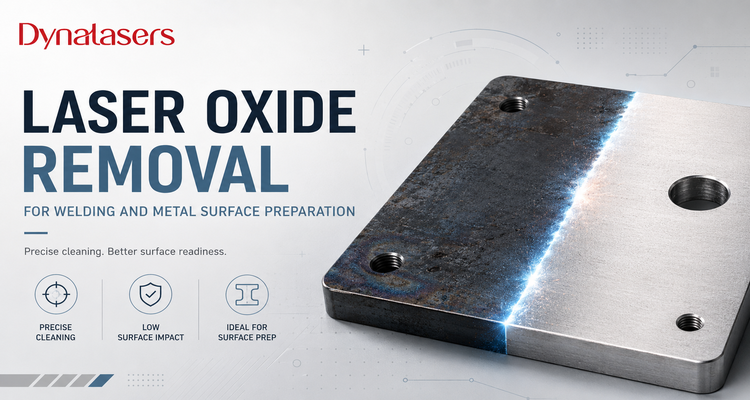
Laser Oxide Removal for Welding and Metal Surface Preparation
Laser oxide removal gives metal shops a dry, non-contact way to clean oxidation before welding, coating, repair, or assembly. Unlike grinding or blasting, a laser can treat a narrow weld edge or selected surface without mechanically working the whole part.
Dynalasers offers two approaches for this work: the P300 pulsed cleaner for controlled surface treatment and the higher-power M75 CW cleaner for larger, heavier jobs. Choosing between them depends less on the word “oxide” and more on the metal, layer thickness, cleaning area, and finish required.
Why Remove Oxide Before Welding or Coating?
Oxide is not always just a cosmetic problem.
On aluminum, the oxide layer behaves differently from the base metal during welding. On stainless steel, heat tint and surface oxide may need removal after fabrication. Carbon steel can carry rust and heavier oxide scale, while laser-cut edges may have an oxide layer that interferes with later welding or finishing.
Before welding, oxide removal helps create a cleaner and more repeatable joint. Before painting, powder coating, or bonding, it removes a weak surface layer that could reduce adhesion.
This is where laser cleaning becomes useful in a Dynalasers workflow. A fabrication team can clean only the weld path or coating area rather than grinding an entire component. For repair jobs, that also means less unnecessary surface damage around the section being treated.
How Laser Oxide Removal Works
A laser directs concentrated energy onto the oxide layer. When the settings are right, the oxide absorbs enough energy to break away or ablate while the underlying metal remains within an acceptable temperature range.
The main advantage is control.
A technician can clean around a weld, flange, bolt hole, edge, or repair patch without making physical contact with the workpiece. There is no abrasive media left behind, and no chemical bath needs to be rinsed from the part.
But an oxide removal machine still needs the right parameters. Too little energy leaves residue. Too much can discolor the metal, alter roughness, or put unnecessary heat into a thin part.
Dynalasers addresses these two ends of the workload with different laser types. P300 uses pulsed energy for more controlled cleaning, while M75 uses continuous-wave output when coverage and removal speed become more important.
Laser Cleaning vs Grinding and Sandblasting
| Method | Surface Control | Contact | Secondary Waste | Best Use |
| Laser oxide removal | High | Non-contact | Fume and particles require extraction | Weld prep, localized oxide, repair, precision parts |
| Grinding | Moderate | Direct contact | Dust and abrasive wear | Accessible general fabrication |
| Sandblasting | Lower | Abrasive impact | Spent media and dust | Large rough surfaces |
| Chemical cleaning | High | Chemical process | Chemical waste and rinse handling | Batch and complex components |
Grinding is still cheap and practical on simple steel parts. Blasting remains efficient when a large surface needs a defined profile.
Laser becomes more attractive when the part itself has value. A finished stainless panel, machined mold, thin aluminum section, installed machine, or repair zone may not be something a shop wants to attack with an abrasive wheel.
For those jobs, a Dynalasers laser cleaner lets the operator work only where cleaning is needed.
How to Get Oxidation Off Metal Without Damaging the Surface
When deciding how to get oxidation off metal, start with the material underneath.
Heavy rust on carbon steel can tolerate much more aggressive cleaning than a thin aluminum sheet. A polished stainless component needs different treatment again.
Four things matter most:
- Type and thickness of oxide
- Base metal and part thickness
- Area that needs cleaning
- Required finish after cleaning
This is why laser power alone is a poor buying guide.
A 300W pulsed cleaner is not simply a “weaker” version of a high-power CW machine. Its short pulses allow finer control of how energy reaches the surface. A CW machine delivers energy continuously and normally makes more sense when oxide, rust, or coating is heavier and spread across a larger area.
For a shop handling several kinds of work, Dynalasers laser cleaners P300 and M75 cover these two different needs rather than competing for the same application.
Aluminum Oxide Removal Needs More Control
Aluminum deserves particular care.
The oxide layer on aluminum has very different thermal behavior from the metal underneath. If the process is too aggressive, the base material can begin to discolor or change before the operator realizes the surface has been overtreated.
For thin aluminum, weld preparation, machined parts, or finished components, Dynalasers P300 is usually the more logical starting point. Its pulsed output gives more control over local heat input than a high-power CW cleaner.
That makes it useful for laser metal cleaning before aluminum welding, particularly when the goal is to prepare a narrow joint area rather than strip a large surface.
The actual part should still be tested first. Alloy, thickness, oxide condition, scan width, and speed all change the usable settings.
Stainless Steel Oxide and Weld Cleaning
Stainless fabrication often leaves heat tint or oxide around the weld.
For cabinets, food-service equipment, machinery covers, enclosures, tanks, and decorative assemblies, cleaning this area can improve appearance and prepare the surface for the next finishing step.
Dynalasers P300 fits localized post-weld cleaning where surface control matters. The operator can work along the weld rather than mechanically polishing a much larger area.
For heavier fabricated stainless parts with broad oxidation or mixed contamination, M75 offers more cleaning speed.
One point still matters: removing visible discoloration is not automatically the same as qualifying a corrosion-critical surface. Food, chemical, marine, or other demanding applications may still require specified post-weld treatment or passivation procedures.
Dynalasers P300 for Controlled Oxide Removal
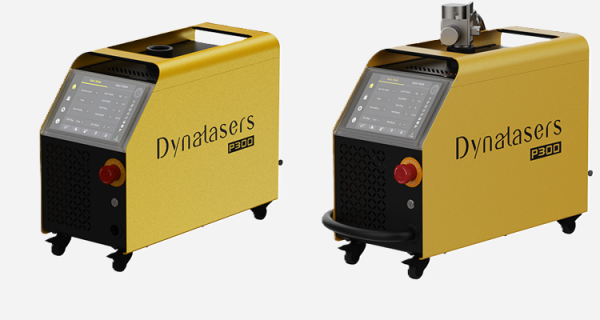
The Dynalasers P300 is built for jobs where the base surface needs more protection than raw cleaning speed.
It is a 300W-class pulsed cleaner using a 1064 nm fiber laser and air cooling. The system weighs under approximately 25 kg and uses dual-wobble scanning with multiple cleaning patterns.
Different pulse-energy configurations, including approximately 2 mJ, 5 mJ, and 15 mJ options, allow the machine to be matched to different surface conditions.
Typical applications include:
- Pre-weld oxide removal
- Stainless weld discoloration
- Light rust
- Mold cleaning
- Machined components
- Thin metal
- Localized coatings
- Aluminum and copper parts
- Precision maintenance
The biggest advantage of the P300 is control. It is the better Dynalasers choice when the instruction is:
“Remove this layer, but keep the surface underneath as unchanged as possible.”
It is also portable enough for maintenance teams moving between machines or work areas rather than operating at one fixed cleaning station.
Dynalasers M75 for Heavy Oxide and Larger Areas
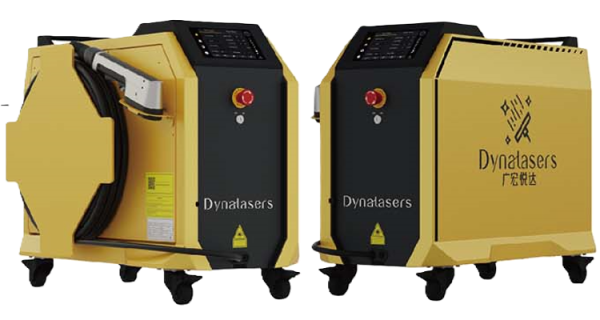
The Dynalasers M75 serves the opposite type of job.
With CW output up to about 1800W, it is designed for larger metal surfaces, heavier rust, oxide, old coatings, machinery frames, fabricated structures, tanks, and general industrial maintenance.
Continuous energy allows the operator to cover a much larger area faster than a precision pulsed cleaner.
That makes M75 useful when oxide removal is part of a bigger restoration job. A steel frame may have oxide, rust, oil residue, and old paint in the same area. The priority there is often productivity rather than preserving a polished finish.
For example:
Choose P300 when:
surface quality, thin material, molds, precision parts, aluminum, or localized cleaning are the priority.
Choose M75 when:
large area, thick oxide, heavy rust, structural steel, machinery, or faster removal is more important.
This is a more useful distinction than comparing 300W and 1800W as if they were meant to do the same work.
Can Laser Cleaning Remove Copper Oxide?
Yes, but copper should be treated carefully.
Copper reflects near-infrared laser energy strongly and conducts heat quickly. Parameters developed for rusty steel should therefore not be copied directly to copper.
For localized copper oxide removal, P300 is the more appropriate Dynalasers option because its pulsed output gives the operator more control over the surface.
This matters on electrical components, machined copper parts, or other areas where roughening or overheating the metal would defeat the purpose of cleaning it.
If electrical performance matters, inspect more than appearance after cleaning. Surface condition and conductivity may both need verification.
Laser Oxide Removal in a Fabrication Workflow
The real value of laser cleaning often appears when it is treated as part of production rather than a separate cleaning service.
A typical workflow may look like:
cut → clean oxide → weld → clean weld → coat or assemble
Dynalasers equipment is particularly relevant to workshops working this way because the company supplies both handheld welding and laser cleaning systems. P300 can handle controlled preparation and finishing, while M75 covers heavier maintenance and large-area cleaning.
That makes laser cleaning useful not only for restoration, but also for reducing manual surface preparation before the next manufacturing step.
Safety and Fume Control Still Matter
Laser cleaning is dry and does not require blasting media or chemical stripping, but the removed material does not disappear.
Oxide, rust, paint, oil, plating, and other residues can become fine particles, smoke, or fumes. Extraction should therefore match what is being removed.
Industrial laser cleaners also require wavelength-appropriate eye protection, controlled access, beam management, fire precautions, and trained operators.
Before cleaning unknown coatings, identify the material first. The correct laser settings are only part of a safe process.
FAQs
Can a laser remove aluminum oxide?
Yes. Pulsed laser cleaning can remove aluminum oxide, but thin and finished parts should be tested carefully to avoid unnecessary surface change.
Is laser oxide removal better than grinding?
For localized or sensitive surfaces, often yes. Grinding may still be cheaper and faster on simple rough parts.
Which Dynalasers machine is better for oxide removal?
P300 is better for controlled and precision cleaning. M75 is better for large surfaces, heavier oxide, and faster industrial cleaning.
Does laser cleaning damage metal?
It can if parameters are too aggressive. Correct power, scan speed, overlap, and laser type are needed to remove the oxide without excessive substrate change.
Conclusion
Laser oxide removal gives workshops a cleaner and more controlled alternative to grinding, blasting, and chemical treatment, especially when only part of the surface needs attention.
Dynalasers covers both precision and heavy industrial cleaning. P300 is built for controlled pulsed cleaning on oxide, thin metal, molds, and sensitive parts, while M75 delivers higher-speed CW cleaning for larger steel structures, heavy oxidation, rust, and maintenance work.
For shops considering either system, the best next step is not choosing by wattage. Test the real material, check the cleaned surface, and select the machine around the job that actually needs to be done.
