
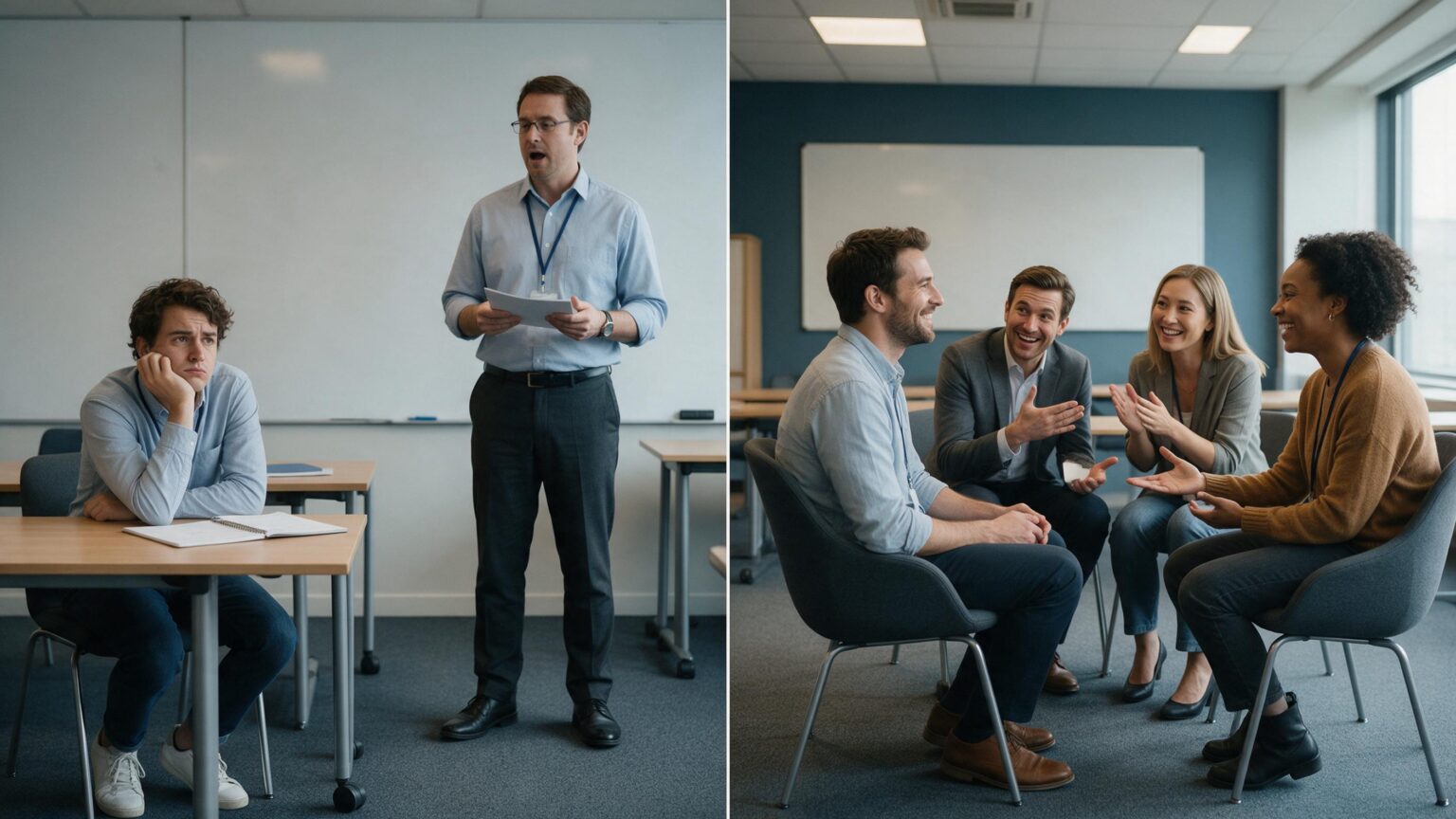
Across industries in the United States, businesses invest significant time and budget into customer service training programs each year. Yet the gap between what employees learn in a training room and how they actually behave with customers remains stubbornly wide. Complaints persist. Staff turnover stays high. Managers find themselves correcting the same behavioral patterns they thought training had already addressed.
The problem is rarely the intent behind the training. Most organizations genuinely want their teams to represent them well. The problem is structural. The way in-person customer service training is designed, delivered, and followed up on is often misaligned with how service behavior actually develops in real operational environments. Understanding where that misalignment occurs is the starting point for building something that works.
The Core Problem With How In-Person Training Is Currently Structured
When organizations invest in face to face customer service training, they often treat it as a single event rather than a sustained process. A trainer comes in, employees attend a session, and the expectation is that behavior will shift on its own once staff return to their roles. This approach fundamentally misunderstands how professional behavior is formed and maintained.
Structured face to face customer service programs that are designed with continuity in mind consistently produce more durable results than those built around isolated workshops. The distinction matters because customer interactions are dynamic. Employees encounter difficult situations, ambiguous requests, and emotionally complex exchanges every day. A single training event cannot prepare staff for the full range of what they will experience, nor can it embed the kind of automatic, composed response that customers actually notice.
Why One-Off Sessions Fail to Transfer to Real Behavior
The reason isolated training events rarely produce lasting change comes down to how professional habits are formed. A person who attends a customer service workshop and then returns to a busy, high-pressure work environment will default to existing habits within days. The new frameworks they were introduced to simply do not have enough reinforcement to compete with the established patterns their job demands.
This is not a reflection of employee motivation or intelligence. It is a predictable outcome of how behavioral conditioning works in professional settings. Without repeated exposure, guided practice, and managerial follow-through, the training content fades quickly. The investment is made, but the operational return is minimal.
The Role of the Work Environment in Sustaining or Undermining Training
Training does not exist in isolation from the day-to-day work environment. If staff are trained to handle customer complaints with patience and structured de-escalation, but their managers react to complaints by blaming employees or rushing resolutions, the training loses its grounding almost immediately. The work environment signals to employees what behavior is actually expected, and those signals are far louder than anything communicated during a training session.
Organizations that ignore the connection between training content and management behavior find that their investment produces temporary results at best. The culture of a team, the modeling behavior of supervisors, and the systems in place to recognize or correct service behavior all shape outcomes more consistently than the training content itself.
What Most Programs Get Wrong About Skill Development
There is a widespread assumption in many US organizations that customer service is a soft skill that most employees either have or do not have by nature. Training, under this assumption, is positioned as a refresher or a correction tool rather than a developmental process. This assumption leads to training programs that are shallow, generic, and disconnected from the specific contexts in which employees actually work.
Generic Content Does Not Prepare Staff for Specific Situations
A training module that covers general principles of politeness and active listening does not prepare a healthcare receptionist to manage a distressed patient, nor does it prepare a bank teller to handle an aggressive customer in a quiet, public-facing environment. The principles may overlap, but the application is entirely different. When training is built around generic content rather than context-specific scenarios, employees receive a framework they cannot reliably translate into their actual work.
Effective programs are built around realistic simulations of the situations employees face most frequently. Role-play, structured feedback, and observed practice in conditions that reflect real work pressures allow employees to rehearse their responses rather than simply hear about them. This distinction between passive instruction and active practice is one of the most consistent predictors of whether training produces behavioral change.
Feedback Loops Are Often Missing or Poorly Designed
Most training programs deliver content but do not build in structured mechanisms for employees to receive feedback on how they are applying that content. Without feedback, employees cannot calibrate their behavior accurately. They may believe they are meeting expectations while consistently falling short in ways that are invisible to them.
Feedback loops in service training are not simply about managers observing staff and making corrections. They involve creating systems where employees can reflect on their own interactions, identify what went well or did not, and receive structured guidance that helps them adjust. This kind of reflective practice is what separates training that changes behavior from training that changes attitudes temporarily.
The Measurement Gap: Why Organizations Do Not Know If Training Is Working
A significant portion of US companies that invest in customer service training have no reliable way to measure whether the training has produced any real change in behavior or customer outcomes. They may track satisfaction scores or complaint volumes, but rarely do they connect those metrics directly to the training programs their staff have completed. As a result, decisions about training continue to be made based on assumption rather than evidence.
Satisfaction Scores Are Not a Reliable Proxy for Service Quality
Customer satisfaction scores are influenced by a wide range of factors that have nothing to do with how staff are trained. Product quality, pricing, wait times, and physical environment all affect how customers rate their experience. Using satisfaction scores as the primary indicator of training effectiveness produces misleading conclusions and makes it difficult to identify where behavioral improvement is actually needed.
More useful indicators include specific behavioral outcomes that can be observed and documented, such as how consistently staff follow escalation procedures, how they handle common objections, and how they adapt their communication style to different customer states. These are measurable, and they connect directly to training content in ways that aggregate satisfaction scores do not.
Organizations Rarely Follow Up After Training Ends
Perhaps the most consistent failure in corporate customer service training in the United States is the absence of structured follow-up. Once a program ends, most organizations move on. Managers return to their primary responsibilities, and employees return to their routines. The assumption is that the training has been delivered and the job is done.
In practice, the period immediately following training is when reinforcement matters most. This is when new habits are most fragile and when employees are most likely to revert to previous patterns. Organizations that build formal check-in processes, observed practice sessions, and brief refresher conversations into the weeks following a training program see significantly more durable behavioral change than those that do not.
What Effective In-Person Service Training Actually Looks Like
The organizations that get the most from their customer service training are not necessarily spending more. They are structuring their programs differently. They treat training as an ongoing operational function rather than a periodic event, and they align training content with the specific demands of their service environment.
According to research published by the Society for Human Resource Management, organizations that integrate on-the-job reinforcement with formal training programs achieve measurably stronger behavioral outcomes than those relying on classroom instruction alone. This finding holds across industries and organization sizes.
The key elements that distinguish effective programs include:
• Training content built around real scenarios drawn from the organization’s own service environment, not generic templates
• Active practice components where employees rehearse specific responses and receive structured, immediate feedback
• Management preparation so that supervisors understand the training content and can model and reinforce expected behaviors on the job
• Scheduled follow-up touchpoints in the weeks after training to observe behavioral application and correct drift
• Clear behavioral indicators that allow the organization to track whether training is producing observable change
• Regular review cycles that update training content as the service environment changes
None of these elements require large budgets or specialized technology. They require organizational discipline and a willingness to treat customer service as a professional skill that develops over time rather than a disposition that employees either have or lack.
Conclusion: Rethinking the Investment
The companies that continue to run single-day workshops, collect end-of-session feedback forms, and consider the job done are not failing because they lack resources or good intentions. They are failing because the model they are using was never built to produce lasting behavioral change. It was built to check a box.
Real improvement in how staff engage with customers in person comes from treating face to face customer service as a discipline, not a topic. It requires training that is grounded in specific operational contexts, supported by management reinforcement, measured against observable behavioral outcomes, and revisited over time as teams evolve.
For US organizations that are serious about improving the quality of in-person service delivery, the starting point is not a better training video or a more engaging workshop format. It is an honest assessment of whether the current approach is designed to produce the results the organization actually needs, and the willingness to rebuild it if the answer is no.
