
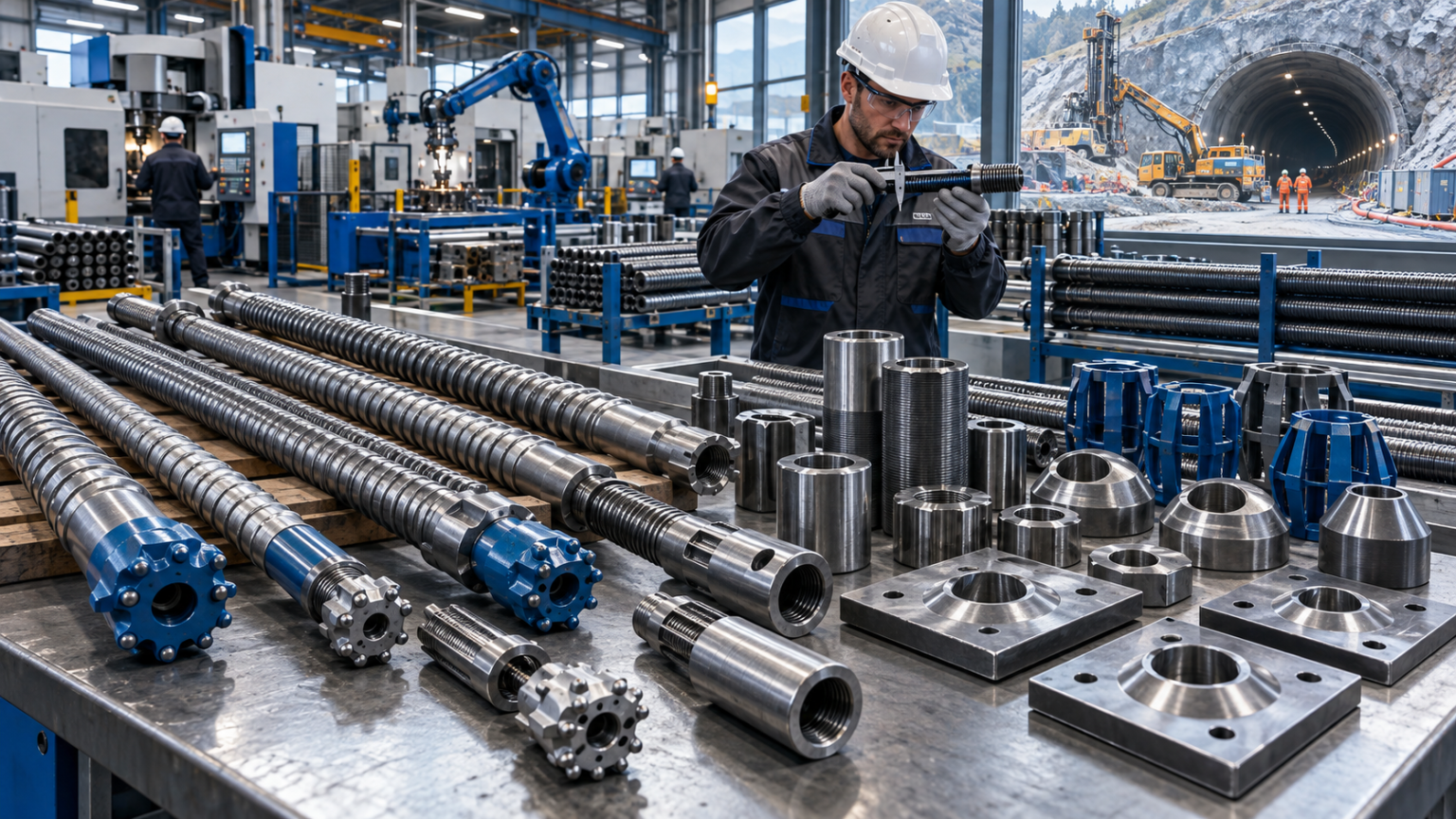
Modern infrastructure depends on much more than visible concrete, steel structures, and architectural design. Beneath roads, bridges, railway tunnels, retaining walls, and commercial developments, specialised anchoring systems help reinforce soil and rock, stabilise excavations, and support demanding engineering projects. Working with reliable Anchor Manufacturers is therefore an important consideration for construction companies, geotechnical engineers, mining contractors, and infrastructure developers seeking dependable ground support solutions.
Ground anchoring systems operate in challenging environments where geological conditions, groundwater, structural loading, and construction methods can significantly influence performance. A product suitable for stable rock may not perform the same way in loose soil or fractured formations.
Selecting the correct anchoring technology requires an understanding of the project rather than simply choosing the strongest-looking steel component.
Self-drilling hollow anchor bars, conventional rock bolts, soil nails, and prestressed ground anchors serve different engineering purposes. Their design, testing, installation, and long-term performance must be evaluated accordingly.
This guide explains the main anchoring technologies, how manufacturers contribute to product quality, and seven essential factors for choosing suitable anchoring systems for modern construction.
What Are Anchor Manufacturers in the Construction Industry?
Anchor Manufacturers are businesses that design, manufacture, assemble, or supply anchoring products used to secure structural elements or reinforce soil and rock.
The term covers several product categories, from mechanical fasteners used in concrete to specialised geotechnical systems installed deep into the ground.
However, these categories should not be treated as interchangeable.
An anchor used to attach machinery to a concrete floor has different design requirements from a hollow steel anchor bar used to stabilise a tunnel excavation.
Understanding Geotechnical Anchoring Systems
Geotechnical anchoring systems are engineered to transfer forces between a reinforced ground mass and supporting elements.
They may be used to strengthen slopes, support excavations, stabilise rock formations, or resist specified movements.
Depending on their design, these systems can include steel bars, hollow threaded rods, couplers, drill bits, bearing plates, nuts, grouting materials, and protective components.
The engineering purpose determines the appropriate configuration.
Self-Drilling Hollow Anchor Systems
Self-drilling anchors are particularly relevant to difficult ground conditions.
These systems typically use a hollow threaded steel bar that also functions as a drill string during installation.
Grout can be pumped through the hollow centre and discharged near the drill bit, allowing drilling and grouting to occur as part of a coordinated operation.
The technique may be useful where conventional boreholes are difficult to maintain because of loose, fractured, or unstable ground.
The suitability of any self-drilling system depends on ground investigation, engineering calculations, equipment compatibility, and installation quality.
The Difference Between Anchors, Rock Bolts, and Soil Nails
These terms are sometimes used broadly in commercial product descriptions, but they can represent different engineering mechanisms.
Rock bolts reinforce rock masses and may contribute to stability through mechanical or grouted interaction with the surrounding rock.
Soil nails are commonly passive reinforcement elements installed to improve the stability of soil excavations and slopes.
Prestressed ground anchors are designed to apply a specified tensile force to support an engineering structure.
Self-drilling hollow bars can be configured for different applications, but a particular system must be assessed for the intended use.
A knowledgeable manufacturer should understand these distinctions and provide appropriate technical information.
1. Choose Anchor Manufacturers With Relevant Engineering Expertise
The first factor is the supplier’s understanding of the specific anchoring application.
Producing steel components is only one part of delivering a suitable geotechnical solution.
Manufacturers supplying ground support systems should understand how their products interact with different soils, rock formations, installation equipment, and loading conditions.
Experience With Ground Stabilisation Projects
Infrastructure projects often involve ground that behaves differently from the conditions assumed during early planning.
A slope stabilisation project may encounter alternating layers of weathered rock and loose soil.
A tunnel excavation may pass through fractured formations with changing groundwater conditions.
These situations influence the type of anchoring system required.
Suppliers with relevant product experience should be able to explain how their equipment is intended to perform under specified conditions.
However, manufacturers should not replace the project’s qualified geotechnical designer.
Final engineering decisions must be made by competent professionals responsible for the design.
Understanding Project Requirements
A manufacturer should request enough information to recommend a technically suitable product.
Important details may include ground conditions, required reinforcement length, design forces, installation method, corrosion exposure, and expected service life.
Without this information, selecting equipment primarily by diameter or price can result in an unsuitable specification.
Technical Drawings and Product Documentation
Professional Anchor Manufacturers should provide appropriate product documentation.
Depending on the system, this may include:
- Material specifications and mechanical properties
- Hollow bar dimensions and thread details
- Nominal steel cross-sectional areas
- Yield and ultimate strength information
- Coupler and accessory specifications
- Drill bit compatibility
- Installation guidance
- Corrosion protection information
- Quality control and testing records
Clear technical documentation helps engineers and contractors evaluate products consistently.
Engineering Support During Procurement
Large infrastructure projects may require clarification about product compatibility or manufacturing tolerances.
A manufacturer that can answer technical questions promptly may help prevent delays during purchasing and installation.
However, technical assistance should be supported by reliable specifications rather than unsupported performance claims.
2. Evaluate the Quality of Self-Drilling Anchor Bolts and Hollow Bars
Self-drilling anchor systems depend heavily on the quality of their steel components.
The hollow bar must perform several functions during installation and service.
It may transmit drilling forces, provide a pathway for grout, and serve as the permanent or temporary reinforcement element.
This combination makes manufacturing accuracy particularly important.
Steel Material Properties
Different anchor bar systems use different steel grades and manufacturing methods.
The required mechanical properties depend on the intended application and design specification.
Important characteristics can include yield strength, tensile strength, ductility, and dimensional consistency.
A higher reported tensile strength does not automatically make a product more suitable.
Ductility, corrosion performance, connection efficiency, and compatibility with the design are equally relevant.
Hollow Bar Geometry
Self-drilling anchor bars normally have a central passage that allows grout to move through the steel member.
The external thread allows components to be connected and may contribute to the interaction between the bar and surrounding grout.
Manufacturing tolerances must be controlled so that couplers, nuts, and other accessories fit as intended.
Excessive dimensional variation may create assembly difficulties or affect performance.
Thread Design and Compatibility
Hollow anchor systems are often available in different nominal series, including R-thread and T-thread configurations.
These product families have different geometry and performance characteristics.
For example, R25, R32, and R38 are common nominal size designations found in the self-drilling anchor market, but available models and capacities differ by supplier.
The nominal size is not sufficient to determine structural resistance.
Engineers must use the documented characteristics of the exact product.
Components from different manufacturers should not be combined unless compatibility has been verified.
Coupler Strength
Couplers connect individual hollow bar sections to create the required reinforcement length.
Because the connection is part of the load path, its performance is important.
A suitable coupler must be compatible with the anchor bar and satisfy the requirements of the intended system.
The manufacturer should provide appropriate connection information rather than relying on appearance or thread similarity.
Consistent Manufacturing Quality
Quality control should address raw materials, forming processes, dimensions, threads, and finished components.
Depending on the product and purchase specification, testing may include tensile tests, dimensional inspection, and verification of relevant mechanical properties.
Batch traceability can help link supplied material to its manufacturing and test records.
For large projects, this information supports better quality assurance throughout construction.
3. Compare Different Anchor Systems and Their Applications
Not every ground support project requires the same anchoring technology.
Reliable Anchor Manufacturers should help buyers understand the available product categories and their intended functions.
Self-Drilling Anchor Bolts
Self-drilling anchors are commonly considered for ground conditions where stable conventional boreholes are difficult to achieve.
They combine drilling and grout delivery through a hollow bar system.
Potential applications include soil nailing, slope reinforcement, tunnel support, and certain micropile arrangements.
However, the exact application must be supported by the manufacturer’s technical data and project engineering.
Conventional Rock Bolts
Rock bolts are used in various rock engineering applications.
They can contribute to the reinforcement of fractured or jointed rock masses.
Some systems use mechanical anchorage, while others use cementitious or resin-based bonding.
Rock bolt design depends on the geological structure, installation method, and required support mechanism.
Prestressed Ground Anchors
Prestressed ground anchors are designed to apply force to a structure or ground support element.
They are commonly associated with retaining systems and particular deep excavation projects.
They require a design approach that accounts for stressing, testing, lock-off loads, and long-term performance.
It is important to distinguish these systems from passive soil nails.
The British and European standard BS EN 1537:2013 addresses the execution of qualifying stressed and tested ground anchors.
Soil Nail Systems
Soil nailing involves installing reinforcing elements into the ground to improve the stability of a slope or excavation.
The technique may be used in temporary or permanent works, subject to the project design.
The Federal Highway Administration identifies soil nailing as an established method for reinforcing excavation faces and retaining structures.
The design must account for stability, reinforcement resistance, pullout behaviour, drainage, and facing performance.
Micropile Reinforcement
Micropiles are small-diameter foundation elements that can transfer loads to deeper soil or rock.
Certain hollow bar systems can be used in micropile construction when specifically designed and qualified for that purpose.
Micropile systems should not be selected solely because a manufacturer describes the bar as strong.
Ground conditions, load transfer, grout properties, structural resistance, and testing requirements must be evaluated.
Selecting the Appropriate System
The best system depends on how forces are transferred and what performance the project requires.
A geotechnical designer should compare available methods before a product is specified.
Different technologies may be technically suitable, but their installation requirements and costs can vary substantially.
4. Prioritise Anchor Manufacturers That Follow Relevant Standards
Ground support systems perform safety-critical functions.
Their design, manufacture, installation, and testing must be consistent with applicable project requirements.
However, there is no single international standard that automatically covers every type of anchor.
Different standards address different systems and engineering activities.
Soil Nailing Standards
BS EN 14490:2010 addresses the execution of special geotechnical works involving soil nailing.
It provides general principles relating to installation, testing, supervision, and monitoring.
The standard is relevant to the execution of soil nail works but does not replace complete geotechnical design requirements.
Ground Anchor Standards
BS EN 1537:2013 applies to particular grouted ground anchors that are stressed and tested.
The standard addresses important considerations associated with executing ground anchor works.
It should not automatically be applied to passive soil nails or every product marketed as an anchor bolt.
American Engineering Guidance
The Federal Highway Administration’s Soil Nail Walls Reference Manual provides guidance on the analysis, design, construction, inspection, and maintenance considerations associated with soil nail walls.
The manual also discusses hollow bar soil nails.
It is a useful engineering reference, especially for projects involving reinforced slopes and excavation support.
Concrete Fastening Standards
Some anchor manufacturers also produce mechanical or adhesive fasteners for concrete.
These products may fall under different technical frameworks.
For example, ACI CODE-355.2-24 covers qualification requirements for specified post-installed mechanical anchors in concrete.
This standard should not be presented as a general qualification for self-drilling hollow bar soil nails.
Manufacturers must identify the standards relevant to the exact product and intended application.
Understanding Quality Management Certification
ISO 9001 certification concerns an organisation’s quality management system.
It does not independently establish the load capacity, corrosion resistance, or suitability of every manufactured anchor.
Buyers should request product-specific test documentation where required.
Why Documentation Matters
Appropriate documentation helps project teams verify that supplied products match the approved technical specification.
It also supports inspection, quality assurance, and future engineering review.
A manufacturer should be willing to identify the exact standards, test methods, and declared characteristics relevant to each product.
General claims of international quality should not replace this evidence.
5. Examine Corrosion Resistance and Long-Term Durability
Ground anchoring systems may remain in service for many years.
During that time, steel components can be exposed to moisture, groundwater chemistry, and other environmental conditions.
Corrosion protection is therefore an important engineering consideration.
Understanding Soil and Groundwater Exposure
Corrosion risk depends on several factors.
These include moisture availability, oxygen exposure, soil chemistry, groundwater composition, electrical conditions, and the protective materials surrounding the anchor.
The ground environment must be assessed as part of the design.
An anchor installed in a dry temporary excavation may face different durability requirements from one supporting permanent infrastructure in aggressive groundwater.
The Role of Cementitious Grout
Cementitious grout can serve structural and protective functions in appropriate anchoring systems.
It transfers forces between the steel reinforcement and surrounding ground.
A correctly specified grout system may also contribute to corrosion protection.
However, grout does not automatically eliminate corrosion risk.
Grout coverage, cracking, permeability, environmental exposure, and installation quality can influence performance.
Protective Coatings
Certain projects may require coated or otherwise protected steel elements.
The correct protection strategy depends on the anchor type, installation procedure, and required service life.
A coating suitable for one product may be damaged by the installation method used for another.
Self-drilling systems deserve particular attention because the reinforcement participates directly in the drilling process.
Temporary Versus Permanent Applications
Temporary and permanent anchoring systems may have different durability requirements.
The planned service life must be clearly established.
A product intended for short-term excavation support should not automatically be selected for permanent ground reinforcement.
Manufacturer Documentation
Manufacturers should explain available corrosion protection options and any applicable limitations.
For permanent works, engineers may also require independent assessment, testing, or specific project approval.
The long-term performance of an anchor depends on the entire system and surrounding environment rather than steel quality alone.
6. Evaluate Manufacturing Capacity and Customisation Capabilities
Large infrastructure projects may require significant quantities of anchoring products.
Demand can include multiple bar sizes, lengths, accessories, and installation configurations.
A manufacturer’s ability to deliver the required specification consistently can affect construction planning.
Standard and Custom Bar Lengths
Different projects require different reinforcement lengths.
Manufacturers may supply standard lengths or offer custom cutting arrangements.
Where long reinforcement is needed, compatible couplers may allow individual sections to be connected.
Customisation should be documented so that supplied components remain consistent with the approved design.
Drill Bit Selection
Self-drilling anchor systems use drill bits designed for particular ground conditions.
Different bit geometries and materials may be appropriate for soil, weathered rock, or harder formations.
The bit must be compatible with the bar and intended drilling method.
Improper selection may reduce drilling performance or create operational difficulties.
Bearing Plates and Nuts
Bearing plates distribute forces at the connection between the anchor and supported surface.
Nuts secure the relevant assembly.
The required dimensions and mechanical properties depend on the design.
A manufacturer should confirm whether the supplied plates and nuts are compatible with the specified anchor system.
Centralisers and Grouting Accessories
Centralisers can help maintain an appropriate position for the anchor bar within the borehole.
Other accessories may support grout delivery or assembly.
The exact requirements depend on the installation method and approved system.
OEM and Project-Specific Production
Some manufacturers offer project-specific dimensions, packaging arrangements, or branded supply.
However, customisation must not compromise documented mechanical characteristics.
Changes to steel grade, threads, couplers, or other structural details may require additional engineering evaluation.
Production and Delivery Planning
Construction schedules depend on predictable material supply.
Before placing a large order, buyers should confirm production lead times, available inventory, shipping arrangements, and documentation requirements.
International projects may also involve customs procedures and destination-specific approvals.
A reliable supply agreement should explain how the manufacturer will handle product variations or unexpected delays.
7. Compare Total Project Value Rather Than Purchase Price Alone
Anchor procurement is often highly price-sensitive.
However, the lowest unit price may not produce the lowest overall construction cost.
Installation efficiency, product compatibility, quality assurance, and delivery reliability can influence total expenditure.
Material Costs
The initial cost depends on steel specifications, bar dimensions, manufacturing processes, accessory requirements, and order quantity.
Buyers should compare products with equivalent documented performance rather than similar names alone.
Installation Efficiency
Self-drilling systems may reduce separate drilling and installation steps in suitable ground.
The Federal Highway Administration has identified potential construction advantages for hollow bar soil nails in conditions where conventional drilling would otherwise require casing.
However, project-specific savings should be assessed rather than assumed.
Ground conditions, drilling equipment, grout consumption, crew experience, and site restrictions can affect productivity.
Reduced Rework
Incorrect dimensions, incompatible components, or inadequate documentation may lead to delays.
Reordering materials can be particularly costly on remote construction sites.
Clear specifications and quality checks help reduce avoidable problems.
Testing and Inspection Costs
Ground anchoring systems often require testing or inspection according to the design and contract.
These costs should be included in the project budget.
A low-priced product that lacks adequate documentation may create additional verification requirements.
Freight and Logistics
Hollow bars and related steel products may be shipped in substantial quantities.
Freight costs depend on shipment size, weight, packaging, route, and delivery terms.
Long or specialised components may require particular handling arrangements.
Long-Term Performance
For permanent installations, maintenance and durability considerations can outweigh small differences in initial purchase price.
A product’s value should be judged according to its suitability for the complete project life cycle.
How Self-Drilling Anchor Systems Work
Self-drilling hollow anchor technology is particularly important in modern geotechnical construction.
It provides a method of installing reinforcement in certain difficult ground conditions without relying on a conventional predrilled hole that must remain open before the bar is inserted.
Step 1: Ground Investigation and Engineering Design
Before installation, engineers evaluate the geological and geotechnical conditions.
They establish the required anchor arrangement, length, loading characteristics, and installation objectives.
Step 2: Equipment and Component Preparation
The construction team prepares the hollow anchor bars, drilling equipment, drill bits, couplers, and grouting system.
The components must be compatible and match the approved design.
Step 3: Drilling and Grout Injection
During self-drilling installation, the hollow bar can act as the drill string.
Grout is pumped through its central passage and exits through the drill bit.
The exact injection sequence, material properties, and operating parameters depend on the system and construction method.
Step 4: Reaching the Required Depth
Additional bar sections may be connected using approved couplers where necessary.
Drilling continues until the specified reinforcement length or termination criteria are achieved.
Actual ground conditions may require review by the responsible engineer.
Step 5: Completing the Anchorage
Once the installation is complete, the grout must achieve the required properties.
Head components, bearing plates, nuts, and associated elements are installed as specified.
The arrangement differs depending on whether the system functions as a soil nail, rock reinforcement, micropile, or another engineered element.
Step 6: Testing and Verification
Testing requirements depend on the system and project specification.
These may involve installation records, material checks, grout testing, pullout testing, or other appropriate acceptance procedures.
A completed installation should not be assumed satisfactory solely because the bar reached the specified depth.
Major Applications of Anchoring Systems in Modern Infrastructure
Anchor Manufacturers serve a broad range of engineering applications.
Understanding these applications helps buyers identify which product characteristics are most important.
Slope Stabilisation
Natural and constructed slopes may experience instability due to ground conditions, water, excavation, or other factors.
Soil nails and other reinforcement systems can form part of engineered stabilisation measures.
Their effectiveness depends on slope geometry, ground strength, drainage, and reinforcement design.
Tunnelling Projects
Tunnel construction may require ground reinforcement to control local instability and support excavation.
Rock bolts and self-drilling anchoring systems can be included in particular support arrangements.
The chosen support system must reflect geological conditions and the tunnel’s engineering design.
Retaining Wall Construction
Retaining structures resist lateral ground pressures.
Certain anchoring systems help support retaining walls or reinforced excavation faces.
However, passive soil nail walls and prestressed anchored retaining walls operate differently.
The required method should be established through geotechnical analysis.
Mining and Underground Excavation
Mining environments may require reinforcement of underground rock masses.
Rock bolts and related systems are used in many ground support applications.
Product selection must account for rock behaviour, environmental conditions, and mine-specific safety requirements.
Foundation Support
Certain ground reinforcement and micropile systems may help transfer structural loads or improve foundation performance.
Such applications require detailed assessment by qualified foundation engineers.
Road and Railway Construction
Transport infrastructure often involves cut slopes, embankments, tunnels, and retaining structures.
Anchoring systems can form part of the measures used to maintain ground stability.
The applicable design and acceptance requirements depend on the project authority and engineering specification.
How to Choose the Right Anchor Manufacturers for a Large Project
Procurement decisions should follow a structured process.
The aim is to identify suppliers that can meet the project’s technical requirements while providing reliable production and delivery.
Review Relevant Product Experience
Ask whether the manufacturer has supplied systems for similar ground conditions and engineering applications.
Experience with self-drilling hollow bars is more relevant to certain geotechnical projects than experience supplying ordinary building fasteners.
Request Material Test Reports
Product documentation should identify the material and declared mechanical properties.
Where required, request batch-specific test information and traceability records.
Confirm Complete System Compatibility
A hollow anchor system may include bars, couplers, bits, nuts, plates, and centralisers.
These components should be selected as a compatible system.
A collection of individually strong parts does not necessarily create a properly engineered assembly.
Assess Technical Support
A supplier should be able to explain dimensions, product options, accessory compatibility, and manufacturing limitations.
Project-specific design responsibility should remain clearly defined.
Evaluate Supply Capability
Check production capacity, packaging requirements, estimated lead times, and export arrangements.
For major projects, determine how the supplier handles urgent replacement orders or additional quantities.
Verify Quality Claims
Review available certification and product-specific evidence.
A supplier’s ISO 9001 certification, if valid, is relevant to quality management but does not substitute for engineering qualification.
Compare Written Quotations
An appropriate quotation should identify the exact product, quantity, accessories, material specification, delivery terms, and documentation included.
This reduces the risk of comparing products that do not meet the same requirements.
ONTON and the Self-Drilling Anchor Industry
Companies specialising in hollow anchor technology illustrate the level of product knowledge required for modern ground engineering.
Third-party supplier information associates ONTON with self-drilling hollow anchor bars, threaded anchor rods, and related geotechnical anchoring products.
These product categories are relevant to engineers and contractors involved in slope reinforcement, tunnelling, and other ground support activities.
However, buyers should verify current product specifications, certifications, manufacturing capabilities, and available services directly with the supplier before making procurement decisions.
Why Self-Drilling Systems Deserve Attention
Self-drilling hollow bars can combine several installation activities into a coordinated process.
This can be particularly useful where conventional borehole stability is difficult to maintain.
Their suitability still depends on appropriate engineering design and site-specific evaluation.
Comparing Technical Specifications
When evaluating ONTON or other specialist suppliers, buyers should request information about available bar series, thread geometry, steel characteristics, couplers, drill bits, and corrosion protection options.
They should also ask which technical documents support the proposed installation.
Prioritising Engineering Compatibility
The most important purchasing question is not simply whether an anchor is available.
It is whether the complete anchoring system meets the specified engineering requirements.
Reliable Anchor Manufacturers should support this evaluation through transparent information and appropriate product documentation.
Common Mistakes to Avoid When Purchasing Anchor Bolts
Several purchasing and specification mistakes can create unnecessary construction risks.
One is assuming that all anchors perform the same function.
Concrete wedge anchors, hollow bar soil nails, and prestressed ground anchors are engineered for different applications.
Another is choosing steel solely by nominal diameter.
Different products with similar outside dimensions may have different steel cross-sectional areas and mechanical properties.
Poor coupler selection can also cause compatibility problems.
Buyers should avoid mixing components from unrelated systems without adequate verification.
Ignoring corrosion requirements is another concern, particularly for permanent reinforcement.
Incomplete technical documentation may create problems during project approval or quality inspections.
Finally, contractors should not assume that an efficient installation method eliminates the need for engineering checks.
Ground reinforcement performance depends on the interaction between the installed system and actual ground conditions.
The Future of Anchor Manufacturing and Geotechnical Technology
Manufacturing technology continues to develop alongside the growing complexity of infrastructure projects.
Improved Production Consistency
Modern production equipment can help manufacturers control dimensions and maintain repeatable manufacturing processes.
However, accuracy must still be verified through suitable quality control.
Better Product Traceability
Digital production and inspection records may make it easier to link delivered materials with their test documentation.
This can support construction quality assurance.
Advanced Corrosion Protection
Manufacturers and engineers continue to examine ways of improving durability in challenging environments.
The suitability of any protection method requires project-specific evaluation.
More Efficient Installation Systems
Self-drilling equipment and compatible accessories may help streamline certain ground reinforcement operations.
The benefits depend on geological conditions, engineering requirements, and contractor capability.
Greater Attention to Environmental Impact
Material use, production energy, transport requirements, and service life are becoming important considerations in construction procurement.
Environmental declarations and life-cycle assessments can support comparisons when they cover equivalent systems and are prepared using appropriate methods.
Integrated Engineering Support
Digital drawings, technical documentation, and coordinated supply processes can improve communication between manufacturers, designers, and contractors.
However, technological improvements do not replace professional engineering responsibility.
Frequently Asked Questions
1. What do Anchor Manufacturers produce?
Anchor Manufacturers supply products such as self-drilling hollow anchor bars, rock bolts, ground anchoring components, and other fastening or reinforcement systems, depending on their specialisation.
2. What are self-drilling anchor bolts used for?
Self-drilling anchor bolts are used in selected geotechnical applications, including slope stabilisation, tunnelling, soil reinforcement, and certain foundation support systems.
3. What is the difference between a hollow anchor bar and a conventional anchor bolt?
A hollow anchor bar contains a central passage that can facilitate grout injection during installation. Conventional anchor bolts use other fastening or load transfer mechanisms depending on their design.
4. How do I choose reliable Anchor Manufacturers?
Evaluate product experience, mechanical specifications, testing documentation, system compatibility, manufacturing consistency, corrosion protection options, and delivery support.
5. Which standards apply to geotechnical anchoring systems?
Relevant standards depend on the application. Examples include EN 14490 for soil nailing and EN 1537 for qualifying stressed ground anchors, alongside applicable local engineering requirements.
6. Can self-drilling anchor systems be used in unstable ground?
They may be suitable for certain loose, fractured, or unstable ground conditions, but their use must be supported by site investigation, engineering design, and appropriate construction procedures.
Conclusion
Choosing reliable Anchor Manufacturers is essential for construction projects that depend on safe and effective ground reinforcement. High-quality anchor systems should combine suitable steel properties, compatible components, appropriate testing, and dependable technical documentation. Self-drilling hollow anchor technology can provide practical advantages in challenging geological conditions when properly designed and installed. By prioritising engineering suitability, manufacturing quality, durability, and total project value, contractors and developers can make more informed procurement decisions.
