
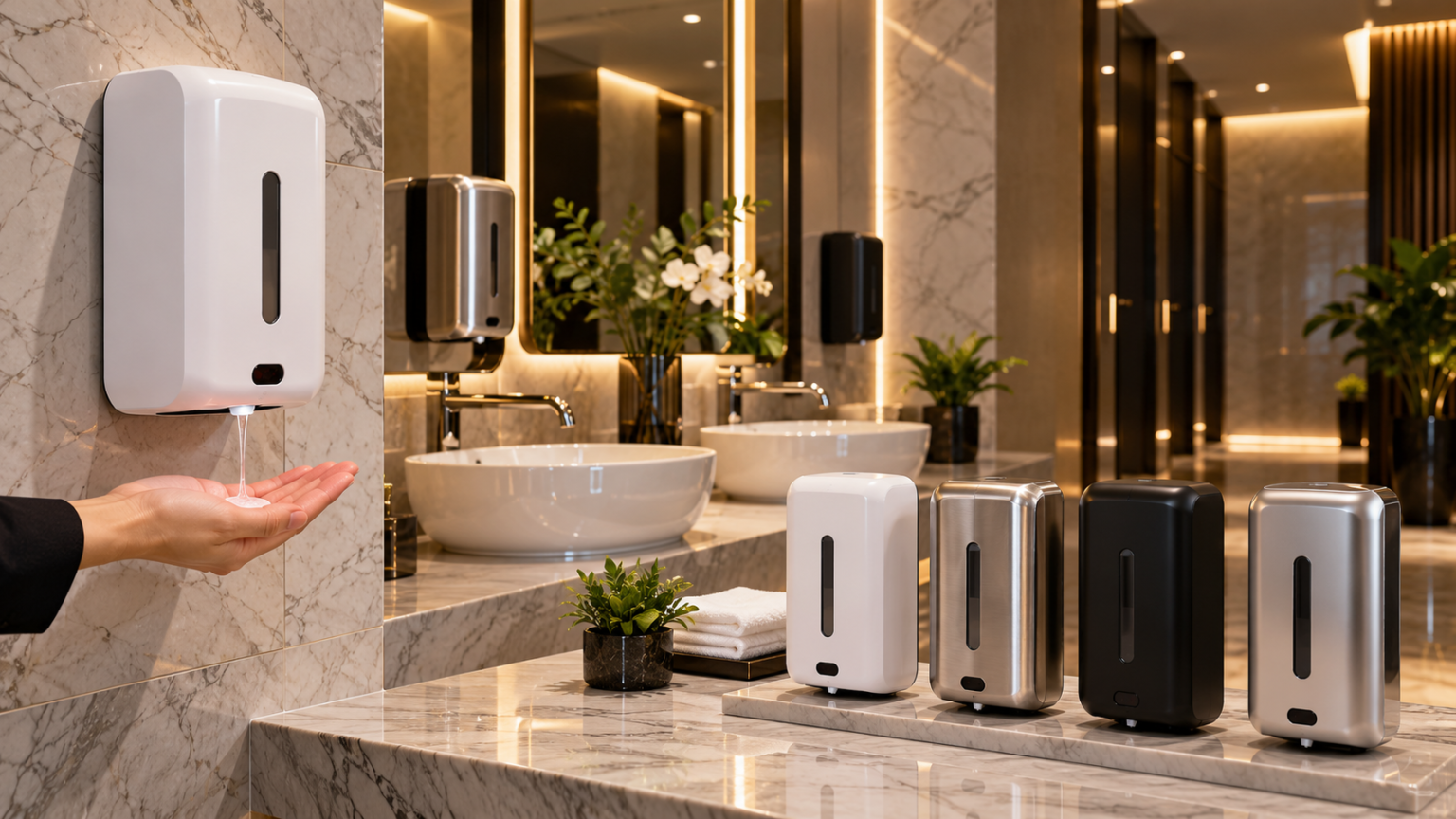
Clean, accessible, and properly maintained washrooms are essential in modern commercial environments. Whether managing a hotel, hospital, shopping mall, restaurant, office building, or educational institution, providing reliable handwashing facilities is an important responsibility. One increasingly popular solution is the touchless soap dispenser, which allows people to access soap without pressing a traditional pump or button. Working with a dependable Automatic Soap Dispenser Manufacturer can help businesses select suitable hygiene equipment, improve washroom convenience, and maintain consistent supplies across multiple facilities.
Commercial washrooms experience different levels of daily traffic. A small office may serve a limited number of employees, while an airport terminal or shopping centre may accommodate thousands of visitors.
These differences influence the type of soap dispenser required, including its capacity, construction material, sensing technology, installation method, and maintenance requirements.
A good automatic dispenser should operate consistently, provide an appropriate amount of soap, and remain convenient for cleaning and refilling.
However, not every model offers the same performance. Understanding the technical and practical differences helps commercial buyers avoid unnecessary expenses and select products that support long-term facility management.
What Is an Automatic Soap Dispenser Manufacturer?
An automatic soap dispenser manufacturer is a company that designs, produces, assembles, or supplies dispensing equipment capable of delivering soap without requiring the user to operate a manual pump.
Many automatic models use infrared sensing technology to detect a hand positioned beneath the outlet.
When the sensor detects the intended movement or presence, the dispenser activates an internal pump and releases a measured quantity of soap.
The dispensing mechanism, sensor, control circuit, reservoir, and power supply must work together to deliver consistent operation.
Some manufacturers develop their own products and components, while others combine in-house production with specialist manufacturing partners.
An established supplier may also provide product development, private-label branding, packaging design, and bulk production services.
How Automatic Soap Dispensers Work
A typical touchless soap dispenser contains a sensor, electronic controller, motor or pumping mechanism, liquid reservoir, and dispensing nozzle.
The sensor detects an object within its operating range.
The controller interprets the signal and activates the pump for a specified duration.
Soap is then dispensed into the user’s hand.
Once the dispensing cycle finishes, the equipment returns to its standby condition.
Some designs include adjustable dispensing settings, indicator lights, or automatic power-saving features.
The exact operation depends on the model.
Automatic Versus Manual Soap Dispensers
Manual dispensers require users to press a lever, push a button, or operate another mechanical control.
Automatic models can dispense soap without direct hand contact with the activation mechanism.
This reduces the need to touch a shared dispenser surface.
However, touchless dispensing alone does not guarantee fewer infections or replace effective handwashing.
The availability of soap, water, appropriate drying facilities, and regular cleaning remains essential.
Why Manufacturer Selection Matters
Commercial buyers often purchase large quantities of restroom equipment.
A small design weakness can become a widespread maintenance problem when the same model is installed across many locations.
Choosing a manufacturer therefore involves assessing more than appearance and initial price.
Technical performance, product consistency, replacement parts, warranty terms, and delivery reliability are equally important.
1. Choose an Automatic Soap Dispenser Manufacturer With Reliable Sensor Technology
Sensor performance is one of the most important features of a touchless soap dispenser.
If the sensor fails to recognise a hand, users may repeatedly move their hands beneath the device, creating inconvenience and confusion.
A sensor that activates too easily can also cause unnecessary soap dispensing.
Both problems affect the washroom experience and maintenance requirements.
Understanding Infrared Sensor Technology
Many automatic soap dispensers use infrared detection.
An infrared emitter and receiving mechanism help identify when a hand enters the sensing area.
The electronics then activate the dispensing mechanism.
Actual sensor performance depends on the design, surrounding lighting, positioning, materials, and operating conditions.
The objective is reliable activation when intended, without excessive false triggers.
Sensor Response and Dispensing Speed
Users generally expect a touchless dispenser to respond without noticeable difficulty.
A delayed response may encourage repeated attempts, while uncontrolled multiple activations can waste soap.
Manufacturers should provide information about sensor range, response behaviour, and available adjustment settings.
Testing samples in a realistic washroom environment can reveal issues that may not be apparent from product photographs.
Adjustable Dispensing Volume
Some automatic dispensers allow the amount of soap released per activation to be adjusted.
This can help facilities choose a suitable quantity for the soap formulation and intended application.
Too little soap may lead users to activate the device repeatedly.
Excessive dispensing can increase consumption and leave unnecessary residue around the sink.
The appropriate dose should follow the soap manufacturer’s instructions and the dispenser’s supported settings.
Preventing Accidental Activation
Sensor placement is important.
A poorly positioned dispenser may activate when people walk past it or place objects near the sink.
The manufacturer should explain recommended mounting distances and environmental limitations.
Reliable activation is particularly important in high-traffic washrooms where cleaning staff cannot constantly monitor every unit.
2. Evaluate Soap Compatibility and Dispensing Options
Different hygiene products require different pumping arrangements.
A dispenser intended for foam soap may not operate correctly with thick liquid soap.
Likewise, equipment designed for ordinary handwashing soap should not automatically be assumed suitable for alcohol-based sanitiser or disinfectants.
Compatibility should be confirmed before purchase.
Liquid Soap Dispensers
Liquid soap dispensers are commonly found in offices, hotels, restaurants, and public washrooms.
They deliver a measured quantity of liquid handwashing product.
The pump and nozzle should be designed for the viscosity of the specified soap.
Using a formulation outside the supported range may cause inconsistent dispensing or blockage.
Foam Soap Dispensers
Foam dispensers use an appropriate formulation and dispensing mechanism to produce foam.
They are widely used in commercial settings because the foam spreads easily across the hands.
However, the amount of active cleaning product delivered depends on the formulation and dose.
A foaming mechanism should not automatically be considered more hygienic or economical than liquid soap.
The actual performance must be evaluated.
Spray Dispensing Systems
Certain automatic dispensing devices deliver compatible liquids as a spray.
These systems may be designed for particular hygiene or sanitising applications.
However, soap, hand sanitiser, and surface disinfectant are different product categories.
A spray dispenser intended for one substance should not be used with another without specific manufacturer approval.
Understanding Chemical Compatibility
Reservoirs, seals, tubes, pumps, and nozzles may be affected by the liquids used inside them.
Chemical compatibility is especially important when buyers want to use different soap brands or formulations.
Request a list of approved liquids or relevant viscosity and material specifications.
Avoid assuming that a dispenser supports all commonly available hygiene products.
Refillable and Cartridge-Based Systems
Some dispensers use refillable reservoirs, while others rely on sealed or replaceable cartridges.
Refillable models can provide purchasing flexibility when appropriate compatible soap is available.
Cartridge systems may offer convenient replacement and controlled handling.
Each option has different operating costs and hygiene considerations.
In healthcare settings, the CDC warns that adding fresh soap to a partially empty liquid soap dispenser has been associated with bacterial contamination and outbreaks.
Facilities should follow appropriate emptying, cleaning, and refilling procedures rather than repeatedly topping up existing liquid.
3. Examine Product Durability and Manufacturing Quality
Commercial soap dispensers are used repeatedly throughout the day.
They may also encounter humidity, cleaning chemicals, accidental impacts, and occasional misuse.
For these reasons, construction quality is an important purchasing consideration.
ABS Plastic Construction
Acrylonitrile butadiene styrene, commonly called ABS, is used in various commercial dispenser housings.
It can provide a useful combination of impact resistance, manageable weight, and moulding flexibility.
The performance of an ABS product depends on material grade, wall thickness, structural design, and manufacturing quality.
Buyers should assess the complete product rather than assuming every ABS housing offers identical durability.
Stainless Steel Dispensers
Some commercial washrooms use stainless steel equipment because of its appearance and material properties.
Stainless steel can complement modern interior designs and may suit environments where regular cleaning is required.
However, corrosion resistance depends on the grade of stainless steel and surrounding conditions.
Surface finish and construction details also affect cleaning convenience.
Secure Locking Mechanisms
A locking dispenser housing can help prevent unauthorised opening and interference with the soap reservoir.
This can be particularly useful in schools, transport facilities, and public washrooms.
Locking systems should remain easy for authorised maintenance personnel to operate.
A design that is excessively difficult to access may increase routine servicing time.
Pump and Nozzle Reliability
The pump is a critical working component.
Even when the outer housing remains attractive, pump failures can make a dispenser unusable.
Manufacturers should explain the intended operating conditions and available durability test information.
For large procurement projects, ask whether replacement pumps and nozzles can be purchased separately.
Moisture and Electrical Protection
Automatic soap dispensers operate near sinks and water.
Their electrical compartments and other sensitive components should be appropriately protected for the intended environment.
Where an ingress protection rating is advertised, request the exact rating and supporting test information.
A plastic casing or waterproof appearance does not establish a particular IP classification.
Cleaning and Maintenance Compatibility
Commercial facilities often use cleaning products daily.
The dispenser’s finish should tolerate the cleaning methods recommended by its manufacturer.
Harsh solvents or unsuitable chemicals may damage plastic surfaces, seals, or electronic components.
Clear maintenance instructions are an important part of product quality.
4. Select the Appropriate Capacity and Installation Design
A dispenser that is too small may require frequent servicing.
An unnecessarily large model may occupy more space than the washroom allows.
Capacity selection should reflect daily usage, available wall space, and staff maintenance schedules.
Understanding Dispenser Capacity
Commercial automatic dispensers are available with different reservoir volumes.
Compact units may be suitable for smaller offices or individual washrooms.
Larger reservoirs can support facilities with greater handwashing demand.
For example, CDWK lists a wall-mounted sensor soap dispenser with a 2,000 ml capacity among its available products.
The appropriate choice depends on the actual model, soap formulation, and usage pattern.
Estimating Refill Frequency
Facility managers can estimate how frequently a dispenser will need attention by considering reservoir volume, dispensed quantity, and average daily activations.
Suppose a hypothetical dispenser contains 1,000 ml of soap and releases 1 ml per activation.
Under ideal conditions, the reservoir would provide approximately 1,000 dispensing cycles.
Actual performance may differ because of residual liquid, pump priming, dose variation, and maintenance practices.
A practical estimate should include a safety margin rather than assuming every millilitre can be dispensed.
Wall-Mounted Automatic Soap Dispensers
Wall-mounted designs are common in commercial washrooms.
They keep equipment in a fixed position and can reduce clutter around the sink.
However, the mounting height and distance from the basin should support convenient use.
Wall material, fixings, and maintenance access also matter.
Countertop and Freestanding Options
Countertop automatic dispensers may suit small offices, reception areas, or selected hospitality environments.
They can offer flexibility without permanent wall installation.
However, they may occupy valuable counter space and can be displaced during cleaning or heavy use.
Freestanding arrangements may be appropriate for particular locations, provided they are stable and suitable for their intended contents.
Power Supply Options
Many automatic dispensers use replaceable batteries.
Some designs use rechargeable batteries or external power connections.
Each approach has different maintenance requirements.
Battery-powered dispensers may be easier to install where electrical outlets are unavailable.
Rechargeable systems require access to charging arrangements.
Mains-powered installations must be designed and installed safely for the environment.
Accessibility and Positioning
The dispenser should be usable by the people expected to use the washroom.
For US facilities subject to the ADA Standards, soap dispensers at accessible lavatories must be positioned within applicable reach ranges.
The guidance identifies an unobstructed adult reach range extending up to 48 inches above the finished floor, subject to the relevant approach and obstruction conditions.
Installation should also consider the position of the sink, clear floor space, and accessibility requirements of the specific building.
Touchless operation does not automatically make a poorly positioned dispenser accessible.
5. Verify Quality Control, Documentation and Product Testing
Purchasing commercial hygiene equipment involves assessing whether the supplier can consistently produce products that meet the agreed specifications.
A professional manufacturer should be able to explain how product quality is managed.
Manufacturing Quality Control
Quality control may include inspecting materials, checking assembly accuracy, testing sensors, and evaluating pump operation.
Dispenser housings should fit correctly, and moving or removable parts should operate as intended.
Electrical connections and battery compartments should also be examined according to the product design.
Consistency becomes especially important when hundreds or thousands of units are ordered.
Sensor and Pump Testing
Ask how the manufacturer checks dispensing performance.
Relevant tests may cover sensor activation, repeated pump cycles, leakage, power consumption, and other operating conditions.
Buyers should request available test reports and specifications rather than relying solely on broad claims of high durability.
Understanding ISO 9001
ISO 9001 is a recognised quality management system standard.
It concerns how an organisation manages processes and quality-related responsibilities.
Certification to ISO 9001 does not automatically mean every dispenser model has been independently certified for electrical safety, durability, or a particular regulatory market.
Product-specific compliance must be assessed separately.
Electrical and Regulatory Requirements
Requirements vary by destination country.
Commercial buyers should confirm applicable electrical, electromagnetic compatibility, materials, and other regulatory obligations.
A manufacturer may need to provide declarations, test reports, technical documentation, or other evidence for a specific market.
The correct requirements depend on the exact equipment and where it will be sold or installed.
Assessing Manufacturer Claims
Manufacturers often describe their products as durable, efficient, or suitable for heavy commercial use.
These statements should be supported by specifications and appropriate evidence.
An experienced buyer should ask practical questions:
- What is the tested operating cycle information?
- Which liquids are compatible?
- What power supply is required?
- Are replacement components available?
- What warranty applies?
- Which documents support the relevant product claims?
Clear answers make supplier comparisons more meaningful.
6. Choose an Automatic Soap Dispenser Manufacturer That Offers OEM and ODM Services
Businesses purchasing hygiene equipment for distribution or large commercial projects may require customisation.
Original equipment manufacturer and original design manufacturer services can help buyers develop products suited to their brand or target market.
Understanding OEM Services
OEM arrangements often involve producing an established product to agreed specifications or under another company’s branding.
A distributor may select a standard automatic dispenser and request a particular logo, packaging design, or colour.
The specific arrangement depends on the manufacturer’s capabilities.
Understanding ODM Services
ODM services generally involve a manufacturer contributing to product design and development.
This may include modifying the housing, functional features, or other elements.
Not every requested feature will be technically or commercially feasible.
Design changes can also affect testing, tooling, lead times, and regulatory obligations.
Custom Colours and Finishes
Commercial buyers may want dispensers that match a brand or washroom design scheme.
For example, a hotel group may prefer consistent equipment colours throughout its properties.
Colour customisation should be evaluated against minimum order quantities, material requirements, and production schedules.
Private-Label Branding
Distributors sometimes sell hygiene equipment under their own brand.
Private-label options may include logo printing, product labels, branded cartons, and customer-facing instructions.
All labelling should remain accurate and satisfy applicable market requirements.
Functional Customisation
Certain manufacturers may support adjustments to sensing options, dispensing modes, or other functional details.
CDWK’s published automatic soap dispenser range describes customisation services covering appearance, size, function, and brand presentation.
Its product information also identifies OEM and ODM support.
These capabilities can be useful for wholesalers, distributors, and commercial project buyers.
However, specific customisation requests should be confirmed through technical drawings, samples, and written quotations.
Minimum Order Quantities
Custom manufacturing commonly involves minimum order requirements.
These may differ between standard models, custom colours, branded packaging, and completely redesigned components.
Buyers should confirm the minimum order quantity for their exact specification.
They should also ask about sample costs and repeat-order conditions.
7. Compare Pricing, Supply Capacity and After-Sales Support
Purchase price is important, but it should not be the only factor in selecting a manufacturer.
Commercial soap dispensers represent an ongoing operational investment.
A low-priced product that requires repeated replacement may ultimately cost more than a better-supported alternative.
Understanding Total Ownership Cost
The total cost of a dispenser includes several elements.
These may involve equipment purchase, shipping, installation, batteries, compatible soap, routine cleaning, replacement parts, and eventual disposal.
For a single unit, some of these costs may appear modest.
Across an entire commercial property portfolio, they can become significant.
Comparing Equivalent Products
Two dispensers may look similar in photographs while having different reservoir capacities, pump designs, sensing systems, or materials.
A fair quotation comparison should use equivalent specifications.
Buyers should confirm whether prices include installation accessories, batteries, spare keys, and other necessary components.
Evaluating Bulk Order Pricing
Manufacturers may offer different pricing at different order quantities.
Larger purchases can distribute production and administrative costs across more units.
However, ordering excessive stock solely to secure a lower unit price can create storage expenses and unnecessary inventory.
A realistic purchasing plan should reflect expected demand.
Manufacturing Lead Times
Buyers planning a hotel opening, hospital renovation, or major commercial development need reliable delivery schedules.
Ask the manufacturer to distinguish between sample preparation, production, inspection, and shipping.
These stages may have different time requirements.
A supplier should also explain what happens if production or transport delays occur.
Shipping and Packaging
International purchases require suitable packaging to protect electronics, housings, and mechanical components.
Buyers should confirm carton dimensions, gross weight, shipping arrangements, and responsibility for transport damage.
Import duties and applicable taxes should also be considered.
Warranty and Replacement Components
A good warranty agreement should clearly identify coverage, exclusions, and the process for addressing defects.
Manufacturers should explain whether replacement pumps, sensors, battery covers, keys, or complete units are available.
For large installations, keeping a reasonable quantity of approved spare parts may reduce downtime.
Technical Support
Clear installation instructions and troubleshooting guidance help maintenance teams resolve common issues.
International buyers should establish whether support is provided directly by the manufacturer or through regional distributors.
Good after-sales communication matters long after the initial order has been delivered.
Where Are Automatic Soap Dispensers Most Useful?
Automatic soap dispensers can be suitable for many environments, but the requirements differ according to the building’s purpose and daily activity.
Hotels and Hospitality Facilities
Hotels aim to maintain clean and welcoming guest facilities.
Touchless dispensers can complement modern restroom design while providing convenient access to soap.
Durable housings and suitable refill capacities are particularly useful in busy public areas.
Hospitals and Healthcare Facilities
Healthcare environments have specialised hand hygiene requirements.
A dispenser used in a clinical area must be suitable for the relevant hygiene protocol and approved product.
The CDC generally recommends alcohol-based hand rub for many routine healthcare situations, while soap and water remain important in specified circumstances.
A touchless soap dispenser should be viewed as one component of a broader infection prevention programme.
Restaurants and Food Service Businesses
Restaurant staff and customers require convenient handwashing facilities.
Dispensers should provide compatible soap reliably and be positioned where users can access them.
The equipment must support, rather than replace, applicable food safety and handwashing requirements.
Airports and Transport Terminals
Transport hubs can experience sustained periods of heavy washroom usage.
Large-capacity, robust dispensers may reduce the frequency of refilling.
Maintenance staff should still inspect supplies regularly because even a large reservoir eventually becomes empty.
Offices and Corporate Buildings
Office washrooms benefit from equipment that is easy to operate and maintain.
Businesses may select matching dispensers, paper towel systems, and waste bins to create a coordinated environment.
Schools and Educational Institutions
Schools require equipment that suits the age and accessibility needs of users.
Sturdy construction, appropriate mounting height, and straightforward operation are important considerations.
Staff should also be able to check and replenish soap supplies easily.
Shopping Centres and Retail Properties
Retail facilities frequently accommodate visitors with different needs and levels of familiarity with the washroom.
Simple touchless operation and clear placement can make the handwashing process more convenient.
CDWK as an Example of a Commercial Soap Dispenser Supplier
When comparing an Automatic Soap Dispenser Manufacturer, reviewing actual product ranges can help buyers understand the available options.
CDWK presents a collection of wall-mounted automatic soap dispensers for commercial and public washroom applications.
According to its published catalogue, the range includes models identified as CD-5168, CD-5128, CD-5508, CD-5088, and other touchless dispensing products.
The company describes available features such as infrared sensing on selected models, ABS construction, different dispensing modes, and large-capacity options.
Its website also describes product customisation and OEM/ODM services for commercial buyers.
Evaluating the Product Range
Rather than assuming all models share the same features, buyers should examine the specifications for each product.
A model designed for liquid soap may not be appropriate for foam dispensing.
Likewise, reservoir capacity, dimensions, power supply, and installation requirements may differ.
The manufacturer’s published product category is a useful starting point, but a model-specific specification sheet remains essential.
Questions to Ask Before Ordering
A commercial buyer should request information about liquid compatibility, dispensing volume, sensor performance, available colours, and replacement components.
For bulk purchasing, ask about production quantity, packaging arrangements, samples, and delivery terms.
The supplier’s stated manufacturing experience and quality management capabilities can also be considered alongside independent documentation.
This approach helps buyers choose products based on relevant evidence rather than relying entirely on general marketing claims.
How to Plan a Bulk Automatic Soap Dispenser Order
Large orders are easier to manage when technical requirements are established before requesting final pricing.
Step 1: Define the Installation Environment
Identify the types of buildings and washrooms where the dispensers will be used.
Consider expected traffic, wall space, accessibility, and maintenance arrangements.
Step 2: Select the Soap Formulation
Determine whether the facility will use liquid soap, foam soap, or another approved product.
Confirm that the dispenser is compatible with the exact formulation.
Step 3: Estimate Usage and Capacity
Use expected daily activations and dispenser volume to calculate an approximate refill schedule.
Allow for variation in usage and avoid designing a maintenance programme with no spare capacity.
Step 4: Confirm Power Requirements
Check whether battery-powered, rechargeable, or other approved systems are appropriate.
Include expected battery maintenance and replacement arrangements in the operating plan.
Step 5: Request Technical Samples
Obtain representative samples before committing to a large production order.
Evaluate dispensing consistency, cleaning convenience, wall mounting, sensor operation, and build quality.
Step 6: Review Customisation Details
If private-label branding or special colours are required, approve physical samples or accurate production proofs.
Confirm the final specifications in writing.
Step 7: Agree on Inspection and Delivery Terms
Establish how products will be inspected and what documentation will accompany delivery.
Clarify warranty coverage and procedures for resolving defective items.
Maintenance Tips for Automatic Soap Dispensers
Even a high-quality dispenser requires regular care.
Maintenance helps preserve reliable operation and reduces the likelihood of avoidable faults.
Clean the Sensor Area
Dust, dried soap, or water marks can interfere with sensing.
Clean the sensor area according to the manufacturer’s instructions.
Avoid abrasive materials or excessive water around electronic components.
Inspect the Dispensing Nozzle
Soap residue may accumulate near the outlet.
Regular inspection can help identify blockage or dripping.
Use only approved cleaning methods.
Check the Power Supply
If the dispenser stops operating, check the battery or power status according to the user manual.
Replace batteries with the specified type.
Do not mix incompatible battery types or attempt electrical repairs beyond the manufacturer’s permitted procedures.
Follow Correct Refilling Procedures
Soap should be handled and refilled according to the product and dispenser instructions.
Avoid mixing incompatible liquids.
Healthcare facilities should pay particular attention to contamination prevention and should not top off partially empty liquid soap reservoirs.
Inspect the Housing and Fixings
Wall-mounted dispensers should remain securely attached.
Loose mounting screws, damaged covers, or broken locks can interfere with safe operation.
Remove defective equipment from service when necessary and arrange suitable repairs.
Maintain Service Records
For large facilities, a simple record of refills, battery replacements, cleaning, and repairs can support better maintenance planning.
Recurring faults may indicate that a particular dispenser model or operating arrangement needs further evaluation.
Common Mistakes to Avoid When Selecting a Soap Dispenser Manufacturer
One common mistake is buying equipment based only on appearance.
A dispenser that looks elegant may still have an unsuitable reservoir, weak pump, or difficult maintenance arrangement.
Another mistake is overlooking soap compatibility.
Using the wrong liquid can cause poor dispensing performance and may damage components.
Some businesses select oversized units without checking whether they fit the available wall space.
Others purchase products without confirming local accessibility requirements.
Choosing a supplier without assessing replacement parts can also create long-term problems.
For international buyers, unclear shipping responsibilities and incomplete product documentation may introduce avoidable costs.
Finally, buyers should avoid accepting broad hygiene claims without evidence.
A touchless design reduces direct contact with the activation mechanism, but hygiene outcomes also depend on soap availability, correct handwashing, facility cleanliness, and maintenance.
Future Trends in Automatic Soap Dispenser Manufacturing
Automatic dispenser technology continues to evolve as manufacturers respond to commercial hygiene and facility management requirements.
More Efficient Sensor Designs
Manufacturers may improve sensing accuracy and power management to support consistent operation.
The practical value depends on tested performance under realistic conditions.
Smarter Maintenance Features
Certain commercial dispensing systems can incorporate refill indicators or monitoring features.
These may help facility teams identify units needing attention.
However, connected equipment introduces additional considerations, including cost, maintenance, and data security.
Improved Power Management
Low-power electronics and efficient standby operation may help extend battery service intervals.
Actual battery life depends on usage frequency, motor requirements, battery quality, and operating conditions.
Greater Product Customisation
Commercial buyers increasingly consider coordinated restroom equipment.
Manufacturers may respond with different colours, housing styles, branding options, and installation configurations.
Responsible Material Selection
Durable construction, repairable components, and suitable material choices can help facilities manage equipment replacement.
Environmental performance should be evaluated across the product’s manufacture, use, maintenance, and disposal.
Integrated Washroom Management
Soap dispensers are often purchased alongside paper towel dispensers, hand dryers, waste bins, and other restroom accessories.
Coordinated equipment planning can support consistent maintenance practices and a more organised facility.
However, integrated design should not come at the expense of safety, accessibility, or cleaning effectiveness.
Frequently Asked Questions
1. What does an Automatic Soap Dispenser Manufacturer do?
An Automatic Soap Dispenser Manufacturer produces or supplies touchless soap dispensing equipment and may offer product development, OEM branding, customisation, and bulk manufacturing services.
2. How do automatic soap dispensers detect hands?
Most common touchless models use infrared sensors to detect a hand beneath the nozzle and activate an electronic pumping mechanism.
3. Are automatic soap dispensers suitable for commercial washrooms?
Yes. Models designed for commercial use can be suitable for hotels, offices, hospitals, schools, restaurants, and public facilities when properly specified and maintained.
4. Can automatic soap dispensers use both liquid and foam soap?
Not always. Liquid and foam products may require different pumping mechanisms. Confirm the manufacturer’s approved formulations before use.
5. Do automatic soap dispenser manufacturers offer OEM and ODM services?
Many commercial manufacturers provide branding and product customisation services. Available options, order minimums, tooling costs, and lead times vary by supplier.
6. How do I choose a reliable automatic soap dispenser manufacturer?
Compare sensor performance, product materials, liquid compatibility, test documentation, customisation capabilities, warranty coverage, replacement parts, and bulk delivery arrangements.
Conclusion
Selecting the right Automatic Soap Dispenser Manufacturer is an important step toward creating dependable and convenient handwashing facilities. Quality equipment should combine reliable sensor technology, appropriate soap compatibility, durable construction, and manageable maintenance requirements. Commercial buyers should also consider accessibility, product documentation, customisation, and long-term operating costs. By carefully evaluating these factors, businesses can invest in practical hygiene solutions that support daily operations and a better washroom experience.
