
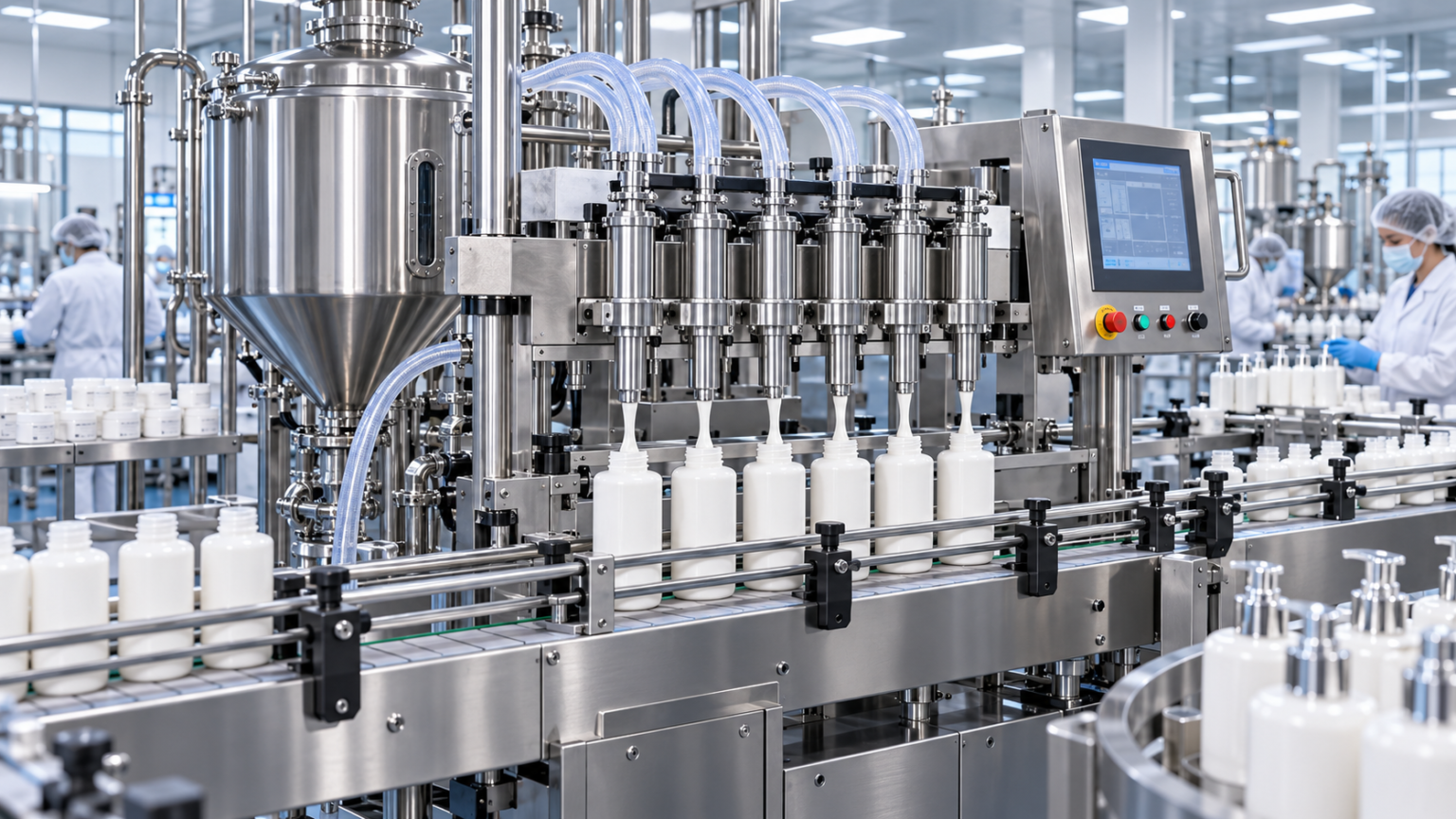
The cosmetics and personal care industry depends on consistent product quality, efficient manufacturing processes, and attractive packaging. From everyday body lotions and moisturisers to premium facial creams and skincare treatments, manufacturers must fill containers accurately while maintaining product quality and controlling operational costs. A modern Lotion Filling Machine helps businesses automate this essential production stage, manage different product viscosities, reduce unnecessary waste, and prepare packaged products for distribution.
Filling lotions and creams presents particular challenges because these products rarely behave like ordinary water-based liquids. Their viscosity, texture, temperature sensitivity, and tendency to trap air can affect how smoothly they move through manufacturing equipment.
A lightweight body lotion may flow easily, while a thick moisturising cream or petroleum jelly formulation can require more specialised handling.
Manufacturers must also consider container sizes, product contact materials, cleaning requirements, production volume, and compatibility with other packaging machinery.
Choosing suitable filling technology is therefore about more than purchasing an automated machine. It requires understanding the complete manufacturing process and selecting equipment that supports reliable performance.
This guide explores how automatic lotion filling systems work, their main benefits, important technical features, and practical considerations when investing in cosmetic packaging equipment.
What Is a Lotion Filling Machine?
A lotion filling machine is industrial equipment designed to transfer measured quantities of lotion, cream, gel, or similar products into bottles, jars, tubes, and other suitable containers.
Depending on the product and equipment design, filling may be controlled by piston displacement, pumps, weighing systems, or other measurement technologies.
The objective is to deliver a consistent quantity of product into each container while limiting spillage, contamination risks, and unnecessary handling.
How Automatic Lotion Filling Equipment Works
In a typical automated production system, empty containers move along a conveyor towards the filling station.
A detection sensor identifies when containers reach the required position.
The machine then activates its dispensing mechanism and delivers the programmed quantity through one or more filling nozzles.
After the filling cycle, containers move towards the next packaging stage.
Depending on the production line, this may involve cap placement, sealing, labelling, inspection, or packing.
Modern equipment can incorporate programmable controls, servo motors, adjustable conveyor systems, and product handling features.
Why Lotions Require Specialised Filling Technology
Cosmetic lotions vary considerably in consistency.
Some behave as relatively free-flowing liquids, while others are highly viscous emulsions.
Certain formulations also change their flow behaviour when mixed, pumped, or exposed to different temperatures.
These characteristics influence how a filling machine measures and transfers the product.
A machine designed primarily for thin liquids may struggle to handle dense cream efficiently.
Similarly, equipment suitable for thick pastes may require adjustments before it can accurately dispense lower-viscosity formulations.
Proper selection begins with understanding the actual product.
1. A Lotion Filling Machine Improves Filling Accuracy
One of the most important advantages of automated filling equipment is its ability to control the amount of product delivered into each container.
Manual filling can be affected by operator technique, inconsistent timing, and variation in product flow.
An appropriately selected automated system can provide more repeatable dispensing.
Understanding Quantitative Filling
Quantitative filling refers to controlling the amount of material dispensed during a production cycle.
In piston-based equipment, a measured volume is displaced through a mechanical pumping arrangement.
The actual delivered quantity depends on equipment calibration, product characteristics, operating conditions, and machine design.
For example, a manufacturer producing 250 ml body lotion bottles needs a filling process that repeatedly delivers quantities within the established product specification.
Consistency helps reduce underfilled containers and unnecessary overfilling.
Servo-Controlled Piston Technology
Servo motors can provide precise control over piston movement.
By controlling piston travel, an automated filling system can adjust the volume dispensed during each cycle.
Operators may use a touchscreen interface to enter required filling parameters.
This reduces the need for repeated mechanical adjustments when changing between supported container sizes.
However, accuracy should always be verified using the actual product and packaging.
Maintaining Consistent Product Quantities
Accurate filling contributes to manufacturing consistency.
When containers receive quantities within defined tolerances, quality control becomes easier to manage.
This is particularly important when products are sold by declared net quantity.
Manufacturers must ensure that their filling procedures meet applicable weights and measures requirements.
A machine’s advertised accuracy specification should not be treated as proof that every filled container will automatically comply with local packaging regulations.
Reducing Product Giveaway
Overfilling can become expensive when large quantities of premium cosmetic products are produced.
A few unnecessary millilitres in each bottle may represent significant material consumption over a large production run.
Accurate calibration can help manage this issue.
The goal is not to fill containers as close to an absolute minimum as possible, but to meet the declared quantity and applicable tolerances reliably.
2. Automatic Lotion Filling Machines Increase Production Efficiency
Packaging speed is an important consideration for manufacturers supplying retailers, wholesalers, and eCommerce businesses.
Manual filling may be practical for small batches, but it becomes increasingly labour-intensive as demand grows.
Automated filling can help standardise production and reduce repetitive manual work.
Multi-Head Filling Systems
A multi-head machine fills several containers during one operating cycle.
For example, a six-head system can dispense product into six appropriately positioned containers simultaneously.
This configuration may support greater throughput than a comparable single-head system.
However, the actual production speed depends on more than nozzle count.
Product viscosity, fill volume, container movement, pump capacity, and cycle timing all influence output.
Continuous Conveyor Operation
Automatic conveyors transport containers through the filling station.
Sensors and control systems coordinate container positioning with the dispensing cycle.
This arrangement can reduce the need for operators to move every bottle manually.
It also creates an opportunity to connect filling with downstream packaging equipment.
Reduced Repetitive Handling
Manual production may require employees to repeatedly position containers, operate dispensing equipment, and move filled products.
Automation can reduce some of these repetitive tasks.
Employees can instead focus on material supply, quality checks, equipment monitoring, cleaning, and changeovers.
Automation does not eliminate the need for trained personnel.
Its value comes from supporting a more organised and controlled production process.
Evaluating Real Production Speed
Manufacturers should be cautious about interpreting maximum machine speed as guaranteed factory output.
Published throughput may be based on specific test conditions.
A thicker lotion or larger container can require a longer filling cycle.
The available capacity should therefore be tested using representative product samples and the planned packaging format.
3. Modern Filling Equipment Handles Different Lotion Viscosities
The ability to process products with different flow characteristics is one of the most useful features of advanced cosmetic filling machinery.
A company may produce several lotions under one brand, each with a different texture and consistency.
Some products contain oils, emulsifiers, thickeners, and other ingredients that influence their behaviour during pumping.
Understanding Viscosity
Viscosity describes a fluid’s resistance to flow.
Low-viscosity liquids move relatively easily.
High-viscosity materials require more force to transfer through pipes and dispensing components.
Cosmetic formulations can also be non-Newtonian, meaning their apparent viscosity may change under different flow conditions.
This makes real product testing especially important.
Filling Body Lotions
Many body lotions are designed to spread easily across the skin.
Their flow properties may allow relatively straightforward pumping, depending on the formulation.
A suitable machine should deliver the required volume without unnecessary splashing or product residue.
Filling Thick Face Creams
Thicker creams may require pumps, nozzles, and feed systems designed for more resistant materials.
The machine must transfer the product without creating excessive pressure, trapped air, or inconsistent dosing.
The correct equipment configuration should reflect the formulation’s flow behaviour.
Handling Petroleum Jelly and Dense Products
Petroleum jelly and similar materials can become difficult to dispense at lower temperatures.
Certain manufacturing processes use controlled heating to support movement through the filling system.
However, heating requirements depend on the product.
Manufacturers should establish an appropriate processing temperature using formulation data and stability testing.
Temperature-Sensitive Formulations
Some cosmetic products may be affected by excessive heat or prolonged exposure to elevated temperatures.
Heating can change viscosity, but inappropriate heating may also affect fragrance, appearance, stability, or other characteristics.
Temperature settings must be validated for each formulation.
Why Product Testing Matters
Two products that appear similarly thick may behave differently during filling.
A sample trial can reveal issues involving pump feeding, air entrapment, nozzle dripping, or incomplete container filling.
This practical information is more useful than selecting equipment solely from a general viscosity description.
4. A Lotion Filling Machine Can Reduce Product Waste and Mess
Unnecessary product loss affects material costs, cleaning time, and production efficiency.
Losses can occur through dripping nozzles, container misalignment, splashing, inaccurate fills, or residual product left inside equipment.
Carefully designed filling systems can help control these problems.
Anti-Drip Filling Nozzles
Anti-drip nozzles are intended to reduce the amount of material escaping after the programmed filling cycle ends.
This can help keep container exteriors and conveyor surfaces cleaner.
Their effectiveness depends on product consistency, nozzle design, pressure, and timing.
A nozzle suitable for one cream may need adjustment for another.
Bottom-Up Filling
Certain products are more likely to foam, splash, or trap air when dispensed from a height.
Bottom-up filling uses a nozzle that enters or approaches the lower part of the container during dispensing.
The nozzle then moves in a controlled manner as the container fills.
This technique may reduce splashing and air entrainment for compatible products.
It should be tested against the container shape and formulation.
Adjustable Filling Speeds
Some equipment allows different dispensing speeds during a single filling cycle.
A faster initial stage followed by a slower finishing stage can help control product movement near the top of a container.
This may be useful when filling products prone to foaming.
The correct settings depend on the material and desired fill quantity.
Better Container Positioning
Photoelectric sensors and conveyor guides help ensure containers reach the filling station in the intended position.
Proper alignment can reduce missed fills and accidental dispensing outside the container.
However, operators should still inspect the process and respond to faults.
Managing Residual Product
Even advanced machines may retain product inside hoppers, lines, pumps, and nozzles.
The amount of product remaining depends on system design and operating procedures.
Manufacturers should evaluate how easily the equipment can be drained, recovered, and cleaned between batches.
5. Automated Filling Supports Consistent Hygiene and Quality Control
Cosmetic manufacturing involves more than achieving the correct fill volume.
Production equipment must also support appropriate sanitation, contamination prevention, and consistent product handling.
An automatic filling system can help standardise operations, but it cannot independently guarantee product safety.
Selecting Suitable Product Contact Materials
Components that contact lotion should be compatible with the formulation and intended cleaning process.
Stainless steel is commonly used for selected cosmetic processing applications.
However, the specific grade, surface finish, gasket material, and construction details should be verified.
The supplier should identify the actual materials used in product contact areas.
Cleaning Between Production Batches
Different products may contain different fragrances, colours, oils, preservatives, or active ingredients.
Inadequate cleaning can lead to unwanted carryover between formulations.
A suitable cleaning procedure should address accessible product contact surfaces, pumps, lines, and nozzles.
Cleaning methods must be developed and verified according to the products and production risks.
Avoiding Cross-Contamination
Manufacturers sometimes produce multiple cosmetic products using shared equipment.
Before changing formulations, they should evaluate possible cross-contamination.
A cleaning cycle that removes visible residue may not be sufficient for every product.
Appropriate inspection and verification procedures are necessary.
Understanding Cosmetic Good Manufacturing Practices
Cosmetic production is commonly guided by good manufacturing practice principles.
ISO 22716 provides internationally recognised guidance for the production, control, storage, and shipment of cosmetic products.
In the United States, the FDA’s cosmetic GMP inspection guidance discusses equipment design, sanitation, product identification, and processing controls.
The Modernization of Cosmetics Regulation Act of 2022 also introduced additional US cosmetic regulatory requirements.
Specific obligations and exemptions depend on the business and products involved.
A compliant manufacturing operation requires suitable procedures, training, documentation, and quality controls rather than simply purchasing an automated machine.
Maintaining Batch Traceability
Production records can help link filled products to their manufacturing batches.
Important information may include batch identifiers, equipment settings, quantities, cleaning records, and inspection results.
Well-organised records make it easier to investigate quality complaints or manufacturing discrepancies.
6. A Lotion Filling Machine Can Integrate With Complete Packaging Lines
Many manufacturers need more than a standalone filling station.
After lotion enters the container, the packaging process may include inserting a pump, tightening a cap, sealing, labelling, coding, inspecting, and packing.
Automatic filling equipment can form part of a coordinated production line.
Connecting Filling and Capping Machines
A capping machine can apply or tighten closures after filling.
Depending on the container, this may involve screw caps, pump dispensers, or other closure formats.
The line must ensure containers arrive correctly positioned and that closures are compatible with the application equipment.
Automatic Labelling Equipment
Labelling machines apply product labels to suitable containers.
These labels may contain product identification, ingredients, directions, and other required information.
Accurate placement helps maintain a professional appearance.
Labelling accuracy and regulatory compliance remain the manufacturer’s responsibility.
Batch Coding and Identification
Manufacturers may use coding equipment to print or apply batch information.
Depending on the market and product, other required information may include dates or traceability details.
Coding systems should be compatible with packaging surfaces and production speed.
Conveyor Synchronisation
Connecting several machines requires appropriate coordination.
A filler operating faster than the downstream capping machine may create a bottleneck.
Likewise, irregular container feeding can reduce overall efficiency.
The production line should be balanced according to the realistic operating capacity of each stage.
Quality Inspection Systems
Some facilities use checkweighers, vision systems, or other inspection equipment to identify packaging problems.
A checkweigher may help detect fill quantity variation, subject to the relationship between product density, container tare weight, and the measurement process.
These systems can support quality assurance when appropriately configured.
Planning for Future Expansion
A business that currently requires only filling equipment may eventually add automated capping or labelling.
Choosing a system that supports suitable integration can simplify later upgrades.
However, compatibility should be confirmed through technical specifications, not assumed from the term automatic.
7. Automatic Lotion Filling Machines Can Improve Long-Term Manufacturing Economics
Industrial equipment should be evaluated as a long-term production investment.
The purchase price is important, but it is only one part of the financial decision.
Operating costs, product waste, maintenance, training, output capacity, and downtime all affect the overall value.
Reducing Cost Per Filled Unit
Automation may allow more containers to be filled with consistent staffing and production arrangements.
This can reduce labour requirements per unit when the machine is appropriately utilised.
However, an expensive system that operates only occasionally may not provide the same benefit.
Production volume matters.
Improving Output Consistency
Repeatable filling supports easier production planning.
Manufacturers can estimate the time required for a batch more accurately when machine performance is stable.
This helps coordinate packaging materials, employees, and delivery commitments.
Controlling Product Loss
Cosmetic formulations can contain relatively expensive ingredients.
Reducing unnecessary overfilling or spillage may improve material utilisation.
Savings should be measured against actual production records rather than assumed from manufacturer claims.
Considering Maintenance Costs
Every filling machine requires inspection and servicing.
Pumps, seals, nozzles, sensors, belts, and other components may need attention.
Buyers should examine maintenance accessibility and replacement part availability before purchase.
Evaluating Return on Investment
A practical investment calculation compares the total costs and benefits of the proposed equipment.
Relevant factors include:
- Purchase and installation expenses
- Expected production volume
- Labour requirements
- Product material losses
- Cleaning and changeover time
- Electricity and compressed air consumption
- Maintenance and replacement components
- Expected equipment utilisation
The most economical choice is not necessarily the fastest or most expensive machine.
It is the one that meets the production requirements at an acceptable total cost.
Understanding Servo Piston Filling Technology
Servo piston technology is commonly associated with automated filling of viscous liquids and pastes.
Its controlled displacement mechanism makes it useful for products that require repeatable volumetric dosing.
How the Filling Cycle Works
A piston filling arrangement draws a quantity of product into a chamber and then displaces it through the dispensing pathway.
The piston movement determines the nominal displaced volume.
A servo-driven arrangement provides electronically controlled movement.
The complete machine coordinates the piston, valves, nozzles, conveyor, and container detection system.
Why Servo Control Is Useful
Electronic control can make it easier to change filling settings.
Operators may store different production recipes for different container sizes.
This can reduce setup time when changing between supported products.
Accuracy Versus Repeatability
Accuracy describes how close the delivered quantity is to the target.
Repeatability describes how consistently the machine produces similar results under the same conditions.
A machine may be highly repeatable but require calibration to eliminate a systematic filling error.
Both characteristics should be evaluated during acceptance testing.
Calibration With Real Products
Water testing can help assess basic machine operation, but it may not represent the behaviour of a thick cream.
Viscosity, temperature, density, and trapped air can affect performance.
Manufacturers should use actual production materials when verifying fill quantities.
For products sold by weight, volumetric settings may require conversion and verification using the product’s actual density.
SUNHAN Six-Head Lotion Filling Machine: Features and Technical Specifications
A practical example of modern cosmetic packaging equipment is the SUNHAN six-head servo piston filling system.
SUNHAN lists its SH-YT6T-6PX model as an automatic machine for viscous liquids and thick pastes.
According to the manufacturer’s published specifications, the standard machine includes six filling heads and a servo piston pumping arrangement.
Manufacturer-Listed Specifications
The published product information includes:
- Model: SH-YT6T-6PX
- Filling heads: Six, with customisation available
- Standard filling range: 100 to 1000 ml, with customisation options
- Advertised filling accuracy: ±1%
- Advertised filling speed: Approximately 30 to 70 bottles per minute, depending on material and container size
- Pump system: Servo piston pump
- Hopper capacity: 120 litres for the listed filling configuration
- Electrical supply options: 110V or 220V, 50 to 60Hz
- Listed power: 2kW
- Required air pressure: 0.5 to 0.8 MPa
- Stored production settings: Available
These are manufacturer-published figures rather than independently verified performance results.
Actual operation should be confirmed using the intended formulations, containers, and production conditions.
Optional Mixer and Heating Features
The manufacturer describes mixer and heating options for products that require additional material handling.
Mixing can help maintain a more consistent product distribution where appropriate.
Heating may help certain dense products flow more readily.
However, both functions must be selected and configured according to the formulation.
An optional feature should not be assumed to be included in every machine configuration.
Anti-Drip and Diving Nozzles
SUNHAN describes anti-drip nozzle arrangements and optional diving nozzles.
These features may be useful for reducing dripping, splashing, or foaming during compatible filling operations.
A production trial should confirm the best configuration.
Touchscreen and Memory Functions
The machine’s control system allows operators to enter settings and save multiple production configurations.
This may be helpful for businesses producing several lotion varieties or packaging sizes.
The actual changeover process can still involve mechanical adjustments, calibration, and cleaning.
Cleaning Function
The manufacturer describes a one-button function that can pump water through the equipment for five cycles.
This may help with preliminary flushing.
However, it should not be treated as proof of complete cleaning or sanitisation.
Each manufacturer must establish cleaning procedures appropriate to its products and contamination risks.
Warranty and Technical Support
SUNHAN advertises a one-year warranty, user manual, installation and debugging videos, and video-based support for this product.
Buyers should confirm current warranty coverage, replacement parts, shipping responsibilities, and after-sales arrangements before ordering.
Which Products Can a Lotion Filling Machine Handle?
A versatile filling machine may support several product categories when properly configured.
Body Lotion and Moisturiser
Body lotions are common applications for automatic cosmetic filling equipment.
The machine should maintain consistent dispensing without damaging the formulation.
Face Cream and Skincare Products
Face creams may be packaged in jars, bottles, or other suitable containers.
Their higher viscosity can require careful pump and nozzle selection.
Hand Cream and Body Gel
Hand creams and body gels vary in thickness and composition.
Testing is needed to confirm accurate dosing and manageable product flow.
Shampoo and Body Wash
Some filling equipment can handle shampoo and body wash formulations.
Products that foam easily may benefit from appropriate nozzle designs and controlled dispensing speeds.
Petroleum Jelly
Petroleum jelly products can require specialised handling because of their consistency and temperature sensitivity.
Heating arrangements may be considered when supported by the formulation and equipment.
Other Industrial and Food Products
Certain piston filling systems can also process compatible sauces, honey, and thick pastes.
However, food and cosmetic applications have different sanitation and regulatory considerations.
A machine suitable for cosmetics should not automatically be considered appropriate for food production without verifying its materials, design, cleaning procedures, and compliance.
How to Choose the Right Lotion Filling Machine for Your Factory
Selecting suitable machinery begins with the actual manufacturing requirements.
Identify Product Viscosity
Provide the equipment supplier with representative samples and technical details about the formulation.
If viscosity changes with temperature or shear, explain the expected production conditions.
Establish Container Specifications
Record container shape, height, diameter, opening size, and material.
The supplier should confirm whether the conveyor and nozzles can accommodate these dimensions.
Determine Production Capacity
Estimate the number of containers required per hour and per shift.
Include realistic allowances for material supply, cleaning, changeovers, and downtime.
Select the Filling Range
A machine should support the planned container volumes with suitable accuracy.
Avoid purchasing equipment based only on a wide advertised range.
The intended operating range should be verified for the actual product.
Consider Heating and Mixing Requirements
Some formulations need temperature control or continuous mixing.
Others should avoid unnecessary heating.
The formulation’s stability requirements should guide these decisions.
Check Cleaning Accessibility
Review how easily the hopper, pumps, lines, and nozzles can be inspected and cleaned.
Ask whether the equipment can be disassembled safely and whether replacement seals are readily available.
Confirm Utility Requirements
Industrial filling equipment may need electricity and compressed air.
Verify the required voltage, frequency, power, air pressure, and air quality.
The facility should provide utilities compatible with the chosen machine.
Request a Factory Acceptance Test
Before shipment, buyers may request a factory acceptance test using representative containers and products.
This provides an opportunity to examine accuracy, throughput, controls, and operating behaviour before final delivery.
Installation and Commissioning of Automatic Lotion Filling Equipment
Correct installation is essential for dependable performance.
Even a well-designed machine may operate poorly if it is installed without suitable utilities, positioning, or calibration.
Preparing the Production Area
The machine should be positioned on an appropriate surface with enough space for operation, maintenance, cleaning, and material movement.
The layout should allow employees to work without unnecessary congestion.
Connecting Utilities
Electrical and pneumatic services should meet the manufacturer’s requirements.
Appropriately qualified personnel should complete relevant connections.
The installation should follow applicable local electrical and machinery safety regulations.
Calibrating Filling Parameters
Technicians should test the desired filling quantity.
Measurements should be repeated under representative operating conditions.
Adjustments may be necessary for different lotions, containers, or temperatures.
Testing Conveyor Coordination
Containers must arrive beneath the correct filling positions.
Sensors and conveyor settings should be adjusted to ensure consistent operation.
The line should be observed for missed containers, collisions, and irregular movement.
Training Production Employees
Operators need to understand machine controls, approved operating procedures, emergency stopping, and reporting of faults.
Maintenance personnel require additional training appropriate to their responsibilities.
Verifying Safe Operation
Machinery should have suitable guarding and safety arrangements.
In the United States, OSHA requirements address machine guarding and control of hazardous energy during servicing.
Unexpected movement, pneumatic pressure, and heated components can create hazards.
Qualified personnel must follow appropriate isolation procedures when performing maintenance or cleaning tasks that expose them to dangerous energy.
Maintenance Tips for Long-Term Filling Performance
Preventive maintenance helps reduce avoidable downtime.
The appropriate schedule depends on the machine, production volume, operating environment, and manufacturer’s instructions.
Inspect Filling Nozzles
Nozzles should be examined for blockage, wear, and dripping.
Residue accumulation may affect dispensing accuracy.
Maintain Pumps and Seals
Piston seals and related components are important for consistent filling.
Wear or damage can cause leakage and inaccurate dosing.
Use manufacturer-approved replacement parts.
Check Sensors and Conveyor Components
Dirty sensors or incorrectly adjusted conveyor guides can affect container positioning.
Periodic inspection helps identify potential faults.
Verify Filling Accuracy
Filling accuracy should be checked at appropriate intervals and after significant changes.
Measurements should use a documented procedure and suitable equipment.
Review Heating and Mixing Functions
Where fitted, heating and mixing systems require appropriate maintenance.
Temperature sensors, mixers, and protective devices should be checked according to the equipment documentation.
Follow Safe Cleaning Procedures
Cleaning procedures should address product residues, potential contamination, and equipment safety.
Do not bypass guards or expose employees to moving machinery during cleaning.
Maintain Service Records
Document calibration, servicing, repairs, and replacement components.
Records can help identify recurring problems and support production planning.
Common Problems With Lotion Filling Machines
Understanding typical filling problems helps production teams respond more effectively.
Inconsistent Fill Volumes
Possible causes include incorrect calibration, air in the product pathway, worn seals, or changing product conditions.
The source should be identified before adjustments are made.
Excessive Foaming
Foaming may occur because of formulation characteristics, dispensing speed, or nozzle positioning.
Suitable bottom-up filling or revised settings may help in some applications.
Nozzle Dripping
Dripping can be associated with product behaviour, valve performance, pressure, or nozzle condition.
The solution depends on the cause.
Slow Production
Actual output may decrease when filling larger containers or dense products.
Bottlenecks elsewhere in the packaging line may also limit production.
Product Separation
Some formulations may separate when held under unsuitable processing conditions.
Mixing can help with certain products, but it is not a substitute for a properly developed and stable formulation.
Cleaning Difficulties
Residual product inside pumps and lines can increase changeover time.
Cleaning procedures and equipment design should be evaluated together.
How Much Does an Automatic Lotion Filling Machine Cost?
The cost depends on machine configuration, production capacity, technical features, and the supplier.
A compact semi-automatic filler and a multi-head automatic production system have different engineering and operating requirements.
Number of Filling Heads
Additional heads can increase throughput, but they also affect machine complexity and maintenance requirements.
Filling Technology
Servo-controlled piston systems, alternative pump arrangements, and other filling technologies have different component costs.
Heating and Mixing Options
Integrated heating and mixing may increase the initial investment.
The added cost should be justified by the product’s processing needs.
Conveyor and Automation Features
Advanced container handling, sensors, controls, and integration capabilities influence the overall price.
Installation and Shipping
International machinery purchases may involve freight, customs duties, taxes, installation, commissioning, and employee training.
Buyers should request a complete quotation.
Long-Term Operating Expenses
Maintenance, electricity, compressed air, consumables, and replacement parts should be included in the total cost of ownership.
The correct purchasing decision depends on the machine’s expected contribution to production rather than its purchase price alone.
The Future of Automatic Lotion Filling Technology
Cosmetic packaging equipment continues to develop in response to changing manufacturing demands.
Smarter Production Controls
Modern systems may offer stored recipes, improved monitoring, and more flexible parameter adjustments.
These features can make it easier to manage multiple products.
Greater Line Integration
Manufacturers increasingly consider filling, capping, labelling, and inspection as connected stages.
Coordinated equipment can improve workflow and reduce unnecessary handling.
Data-Driven Maintenance
Some industrial systems support monitoring of operating conditions.
This information may help maintenance teams identify abnormal performance.
However, monitoring does not replace inspections or preventive servicing.
Flexible Small-Batch Manufacturing
Cosmetic companies often introduce new formulations and packaging variations.
Equipment that supports manageable changeovers can be valuable for businesses with diverse product portfolios.
Improved Material Efficiency
Reducing product loss, using appropriate packaging sizes, and improving production consistency can support more efficient material use.
Any environmental benefit should be evaluated through real operational evidence rather than broad sustainability claims.
Frequently Asked Questions
1. What is a Lotion Filling Machine used for?
A Lotion Filling Machine dispenses measured quantities of lotions, creams, gels, and compatible viscous products into bottles, jars, or other containers during packaging.
2. Can an automatic lotion filling machine handle thick creams?
Yes. Suitable piston filling systems can handle many viscous creams and pastes, although performance depends on formulation properties, pump design, and operating conditions.
3. How accurate are servo piston lotion filling machines?
Accuracy varies by model and application. SUNHAN advertises ±1% accuracy for its six-head servo piston model, but actual results should be verified with the intended product.
4. Why do some lotion filling machines have mixers and heaters?
Mixers can help maintain product consistency, while controlled heating may improve the flow of certain dense formulations. Both features must be compatible with the product.
5. Can a Lotion Filling Machine connect with capping and labelling equipment?
Many automatic machines can be integrated with suitable conveyors, capping machines, and labelling systems, provided the equipment and production speeds are compatible.
6. How do I choose the right lotion filling machine?
Evaluate product viscosity, filling volume, target output, container dimensions, sanitation requirements, equipment accuracy, available utilities, and after-sales support.
Conclusion
A Lotion Filling Machine plays an important role in modern cosmetic and personal care manufacturing by supporting accurate dispensing, consistent packaging, and efficient production. Servo piston technology, adjustable nozzles, and optional mixing or heating features can help businesses handle a variety of formulations. Selecting the right equipment requires careful attention to product properties, hygiene, technical specifications, and realistic operating costs. With proper commissioning, maintenance, and quality control, automated filling can support reliable production as a business grows.
