
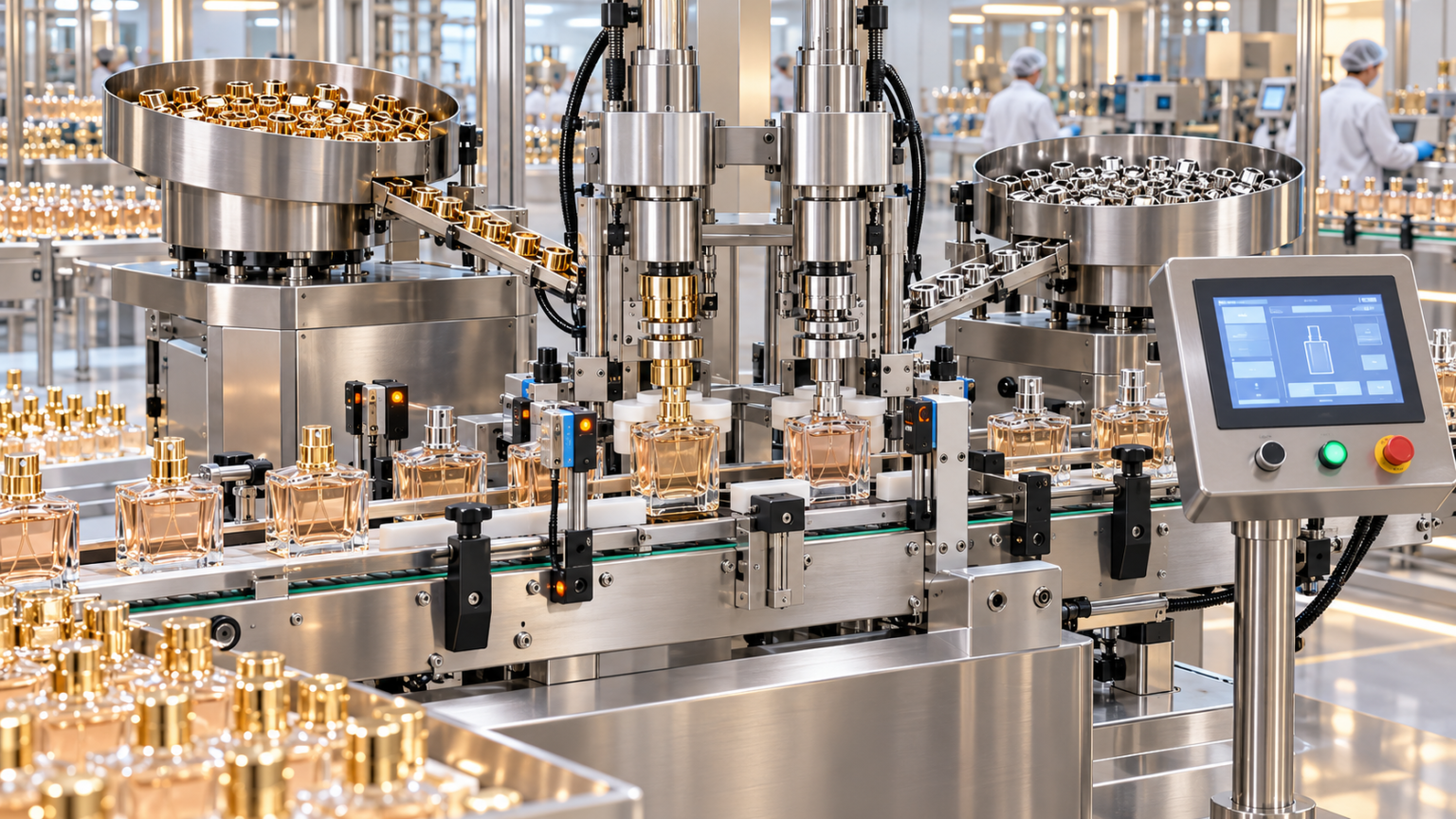
The fragrance industry depends on more than attractive bottles and distinctive scents. Behind every professionally packaged perfume is a carefully managed manufacturing process that combines filling accuracy, secure closures, consistent presentation, and reliable quality control. A modern Perfume Bottle Crimping Machine helps fragrance manufacturers attach spray pumps, secure crimp closures, and fit collar rings with greater consistency while reducing repetitive manual packaging tasks.
Whether producing luxury fragrances, private-label perfumes, travel-sized scents, or large commercial product collections, manufacturers must ensure that bottles are properly assembled before they reach customers.
An incorrectly secured spray pump can lead to leakage, loose components, product evaporation, and an unsatisfactory customer experience. Poorly aligned decorative collars can also affect how a premium perfume looks on retail shelves.
As production volumes increase, manually attaching and securing each component becomes more challenging. Automatic crimping equipment offers an opportunity to standardise this process while supporting larger packaging operations.
However, selecting suitable equipment requires careful consideration of bottle dimensions, spray pump compatibility, production capacity, operator safety, and maintenance.
This guide explains how automatic perfume crimping systems work and explores seven important benefits for modern fragrance manufacturers.
What Is a Perfume Bottle Crimping Machine?
A Perfume Bottle Crimping Machine is specialised packaging equipment used to secure compatible spray pumps, collars, and other closure components onto perfume bottles.
Many fragrance bottles use a crimp-type spray pump that is mechanically secured around the bottle neck.
During crimping, a correctly shaped tool applies controlled pressure to the appropriate part of the pump assembly, creating a mechanical connection with the bottle finish.
Other bottle systems use press-fit components that require a different closing action.
The specific operation depends on the bottle, spray pump, collar, and machine configuration.
Understanding the Perfume Bottle Closure System
A typical spray perfume package may contain several separate components.
The glass bottle holds the fragrance liquid.
A spray pump assembly controls how the perfume is dispensed.
A dip tube extends into the bottle, allowing liquid to reach the pump.
A ferrule or other securing component connects the pump assembly to the bottle neck.
A decorative collar or outer cover may conceal part of the mechanism and create a refined appearance.
Finally, an actuator or external cap completes the packaging design.
Not every perfume bottle contains these components in the same arrangement.
Manufacturers must therefore verify compatibility between the complete closure system and the selected crimping equipment.
How Automatic Crimping Works
In an automatic system, bottles are transported into position, normally through a conveyor arrangement.
Sensors identify the container, and a positioning mechanism aligns it with the closing station.
The machine then performs the required pressing or crimping action using a suitable tool.
Depending on the equipment, a subsequent station may place and press a decorative collar ring.
After assembly, the bottle moves to the next production stage.
The entire process depends on accurate positioning, suitable tooling, controlled movement, and consistent component feeding.
1. A Perfume Bottle Crimping Machine Improves Closure Consistency
One of the main reasons fragrance manufacturers invest in automatic crimping equipment is to achieve more consistent closure assembly.
Manual operations can produce variable results when different employees apply different amounts of pressure or position components slightly differently.
Automation helps standardise the mechanical action.
Consistent Crimp Formation
A properly configured crimping machine applies a controlled closing movement through tooling designed for the particular closure.
The objective is to produce a uniform mechanical connection without damaging the pump or container.
The required settings depend on the dimensions, materials, and design of the bottle neck and ferrule.
A stronger crimp is not always a better crimp.
Excessive force can damage the glass finish, deform the closure, or interfere with pump operation.
Insufficient force may result in a loose assembly.
The correct process must therefore be established through product testing.
Reducing Misaligned Spray Pumps
A spray pump should sit correctly on the bottle before the closing operation begins.
Misalignment can cause irregular crimping or cosmetic defects.
Modern packaging machinery may use guide structures, bottle holders, and positioning mechanisms to maintain alignment.
These components are particularly important when glass bottles have complex shapes or narrow neck finishes.
Supporting Reliable Sealing
A secure mechanical connection is part of effective perfume packaging.
However, crimping alone does not guarantee a leak-free bottle.
Seal performance also depends on the gasket, pump assembly, glass neck dimensions, material compatibility, and condition of the complete package.
Manufacturers should verify sealing performance through appropriate quality tests.
Improving Production Repeatability
Once a machine has been properly set up for a particular bottle and closure combination, the same operating parameters can be used across repeated production runs.
This can make quality control more manageable.
Repeatability is especially valuable when producing thousands of identical perfume bottles for commercial distribution.
2. Automatic Crimping Equipment Increases Packaging Efficiency
Fragrance manufacturers often need to package substantial quantities of perfume within planned production schedules.
A manual crimping process may become a bottleneck when bottle filling and other packaging activities are already automated.
Automatic equipment can help improve the flow of products through the facility.
Reducing Repetitive Manual Tasks
Manually positioning spray pumps, operating closing tools, and attaching collar rings can require repeated handling.
Automated equipment may reduce these tasks by coordinating component positioning and crimping operations.
Employees can then concentrate on material replenishment, quality inspection, equipment monitoring, and production changeovers.
Automation does not eliminate the need for trained operators.
Instead, it changes the type of work needed to maintain a consistent production process.
Dual-Head Crimping Systems
Some advanced machines use two closing heads.
Depending on the design, these heads may operate simultaneously or alternately.
This configuration can support different production arrangements.
For example, one station may secure the spray pump while another handles a decorative collar ring.
The exact operating sequence depends on the machine and packaging components.
Automatic Component Feeding
Vibratory bowl feeders are commonly used to organise and supply small packaging components.
A feeder can orient compatible collars or pump components and deliver them towards a positioning station.
This reduces the need for manual placement of every individual component.
However, the feeder must be matched to the shape, size, and handling characteristics of the parts.
Coordinating the Conveyor
The conveyor transports bottles between relevant stations.
Accurate movement is important because a glass bottle must be correctly positioned before pressure is applied.
Adjustable guides and suitable sensors can help maintain alignment.
The overall machine must operate at a pace compatible with the filling and downstream packaging equipment.
Understanding Actual Production Speed
The manufacturer’s advertised maximum speed is not the same as guaranteed production output.
Bottle dimensions, cap handling, crimping cycles, operator interventions, and quality checks affect throughput.
A representative production trial is the best way to determine whether the equipment meets the required output.
3. A Perfume Bottle Crimping Machine Enhances Luxury Packaging Appearance
Perfume packaging carries strong visual expectations.
Customers often evaluate a fragrance through its bottle design, spray mechanism, decorative collar, and overall presentation before experiencing the scent.
Poor assembly can undermine the intended premium appearance.
Creating a Uniform Bottle Finish
A properly fitted collar can conceal the fastening area and create a clean transition between the glass bottle and spray assembly.
When components are aligned consistently, the finished products look more uniform.
This becomes particularly important when several bottles are displayed together in retail stores.
Preventing Crooked Decorative Collars
Decorative rings may be made from metal or other suitable materials.
Their positioning affects the visible finish of the package.
A tilted collar or uneven gap can create an obvious defect even when the perfume itself is correctly filled.
Controlled pressing and positioning can help reduce such irregularities.
Supporting Premium Brand Identity
Luxury fragrance brands often use distinctive closures, polished collars, and precisely aligned decorative components.
These details communicate attention to manufacturing quality.
An automatic crimping machine supports this presentation by applying a consistent assembly process.
However, product quality also depends on component manufacturing tolerances and inspection.
Automation cannot correct every defect in poorly manufactured packaging materials.
Reducing Cosmetic Damage
Improper tooling can scratch metal collars or damage the surface of decorative closures.
Suitable contact materials and correct tool geometry help limit these problems.
Manufacturers should approve finished samples under the same conditions expected during routine production.
4. Automatic Crimping Machines Support Different Bottle Designs
The perfume market includes an enormous variety of packaging formats.
Some fragrance brands use classic cylindrical bottles, while others prefer square, rectangular, oval, or irregularly shaped designs.
Closure dimensions also vary.
Manufacturers producing several product ranges may therefore benefit from equipment that supports carefully controlled changeovers.
Interchangeable Crimping Moulds
Certain machines use removable or replaceable tooling.
This allows the closing mechanism to accommodate different approved bottleneck and closure sizes.
However, changing the tool may also require adjustments to the bottle guides, positioning system, pressure settings, or production sequence.
The ability to change moulds should not be interpreted as universal compatibility.
Different Spray Pump Specifications
Spray pumps vary in construction and dimensions.
Crimp ferrules and press-fit systems have different installation requirements.
A manufacturer should provide samples of the intended pump and bottle before purchasing a machine.
This helps establish whether the closing head can assemble the components safely and consistently.
Working With Glass Perfume Bottles
Glass bottles require particular care because excessive mechanical stress can cause cracking or breakage.
A suitable holding arrangement should support the container without introducing harmful pressure.
The machine’s operating settings must be compatible with the glass finish and closure design.
Supporting Multiple Product Collections
A fragrance manufacturer may package several bottle sizes using the same production facility.
Equipment with documented changeover procedures can offer useful flexibility.
For example, a company producing both everyday fragrance collections and premium limited editions may need different collar designs.
A flexible machine can support these variations when suitable tooling and operating configurations are available.
Evaluating Changeover Time
Changeovers influence production efficiency.
Time may be required to replace moulds, adjust guides, test sensors, and approve sample bottles.
Businesses handling frequent small batches should pay particular attention to setup time rather than evaluating maximum production speed alone.
5. A Perfume Bottle Crimping Machine Helps Reduce Packaging Defects
Packaging defects can result in product waste, rework, delays, and customer complaints.
A poorly secured closure may require the bottle to be inspected or rejected.
In some cases, attempting to remove and replace a crimped closure may damage the packaging.
Consistent assembly is therefore an important quality objective.
Common Perfume Crimping Defects
Defects that may occur during closure assembly include:
- Loose or improperly secured spray pumps
- Uneven crimp formation
- Damaged glass bottle necks
- Crooked decorative collars
- Scratched metal components
- Incorrectly positioned spray mechanisms
- Leakage around the pump assembly
- Malfunctioning spray actuators
Not every defect originates from the crimping machine.
Problems can also arise from unsuitable packaging components, inconsistent glass dimensions, or incorrect assembly procedures.
Detecting Closure Problems Early
Manufacturers should inspect representative samples during production.
Some facilities may use automated inspection equipment, while others rely on trained quality control personnel.
The inspection plan should reflect the product’s risk and manufacturing requirements.
Performing Leakage Tests
Leakage testing helps determine whether the complete container closure system performs as intended.
The appropriate method depends on the package design and the expected distribution conditions.
Possible evaluations include controlled orientation, pressure, or other validated tests.
No single test guarantees that every package will remain leak-free under all conditions.
Checking Spray Performance
A completed perfume bottle should also dispense fragrance correctly.
Relevant checks may include spray activation, actuator fit, pump priming, and the appearance of the spray pattern.
The actual acceptance criteria should be established using the spray pump supplier’s specifications and product requirements.
Reducing Rework
When packaging defects are detected early, manufacturers can investigate their causes before larger quantities are affected.
A properly monitored automatic process may reduce variations associated with manual assembly.
However, regular inspection remains necessary.
6. Automatic Crimping Equipment Integrates With Complete Perfume Packaging Lines
Modern fragrance production often includes several interconnected packaging stages.
A crimping machine can form one part of a larger automated system.
Bottle Preparation
Empty perfume bottles must arrive clean and suitable for filling.
The preparation process may include supplier inspection, approved cleaning methods, or other controls according to the packaging specification.
The objective is to prevent contamination and avoid damaged containers entering the production line.
Automatic Perfume Filling
A liquid filling machine transfers the specified amount of perfume into each bottle.
Filling accuracy is important because consumers expect the declared quantity.
The filling system must be compatible with the formulation, including its alcohol content and other relevant properties.
Spray Pump Placement
After filling, the correct spray pump assembly is positioned on the bottle.
Depending on the system, this may be completed manually or automatically.
The pump must be appropriately oriented before securing the closure.
Perfume Bottle Crimping
The crimping station secures the compatible spray pump assembly.
Tooling and pressure settings must match the bottle neck and closure specifications.
Decorative Collar Placement
Some products use a separate decorative collar ring.
An additional pressing station may apply the collar after the spray pump has been secured.
The operation must not interfere with the function of the spray mechanism.
Cap Placement and Labelling
After closure assembly, bottles may move towards decorative cap placement, labelling, coding, or inspection equipment.
The production line should ensure components are correctly positioned before moving to the next stage.
Cartoning and Final Packing
Finished perfume bottles may be packed into individual retail cartons and larger shipping cases.
Appropriate protective packaging helps reduce breakage during transportation.
The packaging process should be designed around the product’s weight, glass construction, and distribution conditions.
7. A Perfume Bottle Crimping Machine Can Improve Manufacturing Economics
Industrial packaging equipment is a long-term investment.
Its financial value depends on production volume, material costs, operational efficiency, and maintenance requirements.
A machine that performs well in a high-volume factory may not offer the same economic benefits for a business producing only a few small batches.
Reducing Labour Requirements Per Unit
Automation can reduce the amount of repetitive handling required for each perfume bottle.
This may allow the factory to use its labour more effectively.
However, equipment still requires operators, technicians, material replenishment, and quality control.
Improving Production Planning
A stable packaging process helps manufacturers estimate batch completion times.
This supports better coordination between fragrance production, bottle filling, packaging, and shipping.
Consistent output also makes it easier to manage packaging material requirements.
Controlling Component Waste
Damaged spray pumps, glass bottles, and decorative collars can be expensive.
Correctly configured equipment may reduce some defects associated with inconsistent manual assembly.
Savings should be verified using actual rejection and rework records.
Evaluating Total Equipment Cost
The total investment may include purchase price, shipping, installation, changeover tooling, operator training, maintenance, and spare parts.
Manufacturers should also consider the cost of downtime.
Planning for Future Growth
Businesses expecting higher production volumes may benefit from equipment that can be integrated into additional automation.
However, buying more capacity than necessary can increase investment without delivering immediate value.
The best selection balances current requirements with reasonable future demand.
SUNHAN Perfume Bottle Crimping Machine: Features and Specifications
A practical example of automatic fragrance packaging equipment is the SUNHAN SH-YG11U perfume crimping and capping machine.
The manufacturer’s published product information describes a system designed for perfume spray pump crimping and collar ring pressing.
It supports compatible crimp-type and press-fit bottle neck arrangements, with interchangeable tooling for different approved closure dimensions.
SUNHAN SH-YG11U Published Specifications
According to the manufacturer’s product page, the listed specifications include:
- Machine model: SH-YG11U
- Electrical supply: 110V or 220V, 50–60Hz
- Rated power: 1.5 kW
- Advertised capping speed: Approximately 20 bottles per minute, depending on bottle and cap dimensions
- Suitable bottle height: 50–200 mm
- Bottle cap diameter: 15–22 mm
- Bottle mouth diameter: 14–20 mm
- Suitable bottle diameter: 40–110 mm
- Approximate machine dimensions: 2600 × 760 × 1700 mm
These are manufacturer-published reference values.
Buyers should confirm the exact configuration and performance of the machine being quoted.
Dual-Head Operation
SUNHAN describes a system with two heads that can operate simultaneously or alternately.
This arrangement allows different operating configurations depending on the production setup.
The manufacturer also describes single-head and double-head customisation options.
Vibratory Feeding Systems
The product can be configured with automatic component feeding.
The manufacturer describes two vibratory feeders, one for spray cap components and another for collar rings.
An automatic feeder can improve material delivery consistency when properly adjusted for the intended parts.
The product page offers variants with and without a vibrating feeding system, so purchasers should confirm the exact equipment included.
PLC Control System
The machine features a programmable logic controller, commonly known as a PLC.
Its control panel allows operators to manage relevant machine settings.
The manufacturer indicates that the interface language can be customised.
Operators should receive adequate training before adjusting production parameters.
Photoelectric Bottle Detection
A photoelectric sensor identifies bottles and helps coordinate automatic operation.
Accurate detection is important for preventing closing cycles when a container is incorrectly positioned or absent.
The sensor must be properly adjusted and maintained.
Interchangeable Moulds
SUNHAN describes replaceable moulds and customised pressing heads for different cap and bottle dimensions.
This feature may help manufacturers handle multiple fragrance packaging formats.
The actual compatibility and changeover procedure should be confirmed through testing.
Warranty and Support
The manufacturer advertises a one-year warranty, user manual, video-based installation guidance, and one-to-one video support.
Buyers should review the current written warranty terms, replacement parts availability, technical support arrangements, and any additional service costs.
Important Safety Considerations for Perfume Crimping Equipment
Perfume production presents particular safety considerations because many fragrance formulations contain substantial amounts of alcohol.
Alcohol-based perfumes may produce flammable vapours under relevant operating conditions.
A factory should therefore assess both machinery hazards and the potential hazards associated with the product.
Machinery Guarding
Crimping and pressing equipment contains moving parts capable of causing injuries.
Closing heads, conveyor mechanisms, and other operating components may present pinch or crushing hazards.
Appropriate physical guarding, interlocks, emergency stopping arrangements, and safe operating procedures should be incorporated where required.
In the United States, OSHA standard 29 CFR 1910.212 addresses machine guarding requirements.
Managing Flammable Vapours
Where perfume formulations contain flammable solvents, suitable ventilation and ignition-source controls may be necessary.
The workplace should assess the actual liquid classification, vapour exposure, electrical installation, and process conditions.
OSHA’s flammable liquids standard, 29 CFR 1910.106, addresses relevant handling and fire-safety precautions.
An automatic perfume crimping machine should not be assumed suitable for a hazardous atmosphere merely because it is marketed for fragrance production.
The appropriate electrical protection and any required hazardous-location certification must be established before installation.
Control of Hazardous Energy
Maintenance can expose employees to unexpected machine movement, electrical energy, or stored pneumatic pressure.
In the United States, OSHA standard 29 CFR 1910.147 addresses the control of hazardous energy during covered servicing and maintenance activities.
Employees should follow applicable isolation and lockout procedures.
Glass Breakage Protection
Glass bottles can break if subjected to inappropriate pressure or impact.
Machine guards, suitable container supports, and established procedures should account for this possibility.
Workers must use appropriate protective equipment and safe methods for handling broken glass.
Operator Training
Operators should understand machine controls, approved operating parameters, emergency procedures, and reporting of defects.
Training should include safe changeovers and the correct procedure when a bottle becomes jammed.
Production targets should never justify bypassing essential safety devices.
How to Choose the Best Perfume Bottle Crimping Machine
Selecting suitable equipment begins with the bottle and closure specification.
Verify Bottle Neck Dimensions
The bottle neck must be compatible with the proposed pump and crimping system.
Manufacturers should provide accurate drawings and representative samples.
Nominal dimensions alone may not be enough to guarantee compatibility.
Confirm Spray Pump and Collar Compatibility
The spray pump, ferrule, decorative collar, and actuator should be evaluated as a complete package.
A machine may correctly fit one component but be unsuitable for another.
Suppliers should confirm which closure combinations have been tested.
Assess Production Capacity
Determine the required output per hour and per shift.
Include allowances for material feeding, inspection, equipment adjustments, and cleaning.
The desired throughput should be measured using representative containers.
Examine Changeover Requirements
If the business produces several fragrance collections, ask how moulds and bottle guides are changed.
Confirm whether additional tooling must be purchased.
Review Safety Requirements
Evaluate machine guarding, electrical protection, and suitability for the facility’s operating environment.
For alcohol-based perfume production, conduct a specific flammable-vapour hazard assessment.
Check Integration Capabilities
A standalone crimping machine and a fully integrated production line have different requirements.
Confirm conveyor heights, communication signals, bottle transfer arrangements, and upstream and downstream capacities.
Request Practical Testing
The supplier should ideally demonstrate the machine using the intended bottle, pump, collar, and other relevant components.
Actual samples provide more reliable information than general performance claims.
Installation and Commissioning of Perfume Crimping Equipment
Correct installation helps support long-term machinery performance.
The production area should have adequate space for the equipment, material feeding, operator access, and maintenance.
The machine should be positioned and secured according to the manufacturer’s instructions.
Electrical and other utility connections must be completed by appropriately qualified personnel.
Before routine production, the machine should be tested with representative bottles.
Initial Setup
Technicians should verify bottle positioning, tooling alignment, sensor settings, and closing movement.
These settings must match the specified packaging components.
Trial Production
A trial run helps identify incorrect alignment, component feeding problems, and inconsistent closures.
The production team should inspect completed bottles before approving larger quantities.
Quality Approval
Quality control personnel should establish acceptance criteria for crimp appearance, component positioning, leakage performance, and spray operation.
The requirements should be based on the approved packaging design.
Production Documentation
Machine settings, tooling identification, inspection results, and relevant batch information should be recorded.
These records can help reproduce approved settings for future production runs.
Maintenance Tips for Reliable Perfume Bottle Crimping
Preventive maintenance can help reduce avoidable downtime and maintain packaging consistency.
The appropriate schedule depends on the manufacturer’s recommendations and actual production conditions.
Inspect Crimping Heads
Closing tools should be inspected for wear, damage, and alignment problems.
Worn tooling may produce irregular closures.
Maintain the Conveyor
Check the conveyor for improper movement, damaged guides, or loose components.
Correct bottle positioning is essential for consistent operation.
Clean Sensors and Positioning Components
Dust, packaging residue, and product contamination may interfere with sensors.
Cleaning should follow approved equipment procedures.
Check Vibratory Feeders
Where installed, feeding systems should be monitored for blocked tracks, incorrectly oriented components, or excessive vibration.
The equipment must be isolated safely before maintenance.
Monitor Closure Quality
Routine sample checks can reveal gradual changes in crimping performance.
Investigate repeated defects instead of simply increasing the closing force.
Keep Spare Parts Available
Important spare parts may include approved crimping tools, sensors, belts, and other machine-specific components.
The supplier should identify recommended spare parts for the expected production volume.
Common Perfume Crimping Problems and Their Causes
Recognising common packaging problems helps production teams investigate issues systematically.
Loose Spray Pumps
Possible causes include incorrect ferrule dimensions, incompatible bottle necks, worn tools, or inappropriate closing settings.
The complete assembly should be inspected.
Broken Glass Bottles
Excessive pressure, misalignment, poor bottle support, or defects in the glass may contribute to breakage.
The equipment should be stopped and the cause investigated before production resumes.
Uneven Crimping
An uneven closure may indicate tooling wear, off-centre positioning, or variation in packaging components.
Adjustments should be supported by inspection and testing.
Crooked Collar Rings
Incorrect feeding, positioning, or pressing can produce visibly tilted collars.
A suitable alignment system can help address the problem.
Conveyor Jams
Bottle spacing, guide adjustment, and inconsistent container dimensions can affect movement.
Jams must be cleared using safe operating procedures.
Inconsistent Production Speed
Changes in component feeding, bottle dimensions, or downstream equipment performance may reduce output.
The complete line should be assessed rather than assuming the crimping head is responsible.
How Much Does a Perfume Bottle Crimping Machine Cost?
The cost of perfume crimping machinery depends on its configuration and the intended application.
A simple manually operated device may have different investment requirements from a fully automated dual-head system.
Factors Affecting Purchase Price
Important factors include the number of crimping heads, automatic feeding arrangements, interchangeable tooling, production capacity, control technology, and machine customisation.
The extent of integration with other packaging equipment can also affect the total cost.
Additional Tooling Costs
Manufacturers handling several bottle formats may need additional moulds and positioning components.
These should be included in the procurement budget.
Installation and Freight
International purchases may involve freight, customs duties, taxes, installation, and commissioning expenses.
The supplier should provide a clear quotation showing which services are included.
Long-Term Operating Costs
Maintenance, electricity, replacement components, operator training, and downtime can influence total ownership cost.
Buyers should consider these factors alongside the initial purchase price.
The Future of Automatic Perfume Packaging Technology
Fragrance packaging equipment continues to develop as manufacturers seek more flexible and efficient production systems.
Improved Sensor Technology
More capable detection and positioning systems may help improve bottle handling accuracy.
Their actual value depends on reliable operation in the intended production environment.
Flexible Production Configurations
Manufacturers producing many fragrance variants may benefit from equipment that supports manageable changeovers.
Interchangeable tooling and configurable machine settings can contribute to this flexibility.
Better Quality Inspection
Automated vision systems may help identify visible packaging defects.
Such equipment can supplement physical closure and leakage testing but cannot replace every quality control method.
Integrated Production Monitoring
Some packaging lines collect data on machine status, production counts, and rejected containers.
This information can help identify recurring problems and support maintenance planning.
Greater Emphasis on Packaging Consistency
As fragrance brands introduce new bottle designs and product collections, precise assembly becomes increasingly important.
Manufacturers must balance visual innovation with practical production requirements.
Frequently Asked Questions
1. What is a Perfume Bottle Crimping Machine used for?
A Perfume Bottle Crimping Machine secures compatible spray pumps and crimp closures onto perfume bottles. Some configurations also press decorative collar rings into position.
2. Can an automatic perfume crimping machine handle different bottle sizes?
Yes, certain models support different approved bottle and neck sizes through interchangeable moulds and adjustments. Compatibility must be verified.
3. How fast can a perfume bottle crimping machine operate?
Speed depends on the machine and packaging components. SUNHAN advertises approximately 20 bottles per minute for its SH-YG11U model under suitable conditions.
4. Can a perfume crimping machine connect to an automatic filling line?
Yes. Compatible machines can be integrated with perfume fillers, conveyors, collar placement systems, labelling equipment, and other packaging machinery.
5. What causes leakage after perfume bottle crimping?
Leakage may result from incorrect crimp formation, incompatible neck dimensions, damaged seals, faulty pump components, or manufacturing defects.
6. How do I choose the right perfume bottle crimping machine?
Compare bottle and closure compatibility, production capacity, tooling options, operator safety, quality testing, technical documentation, and after-sales support.
Conclusion
A Perfume Bottle Crimping Machine plays an important role in modern fragrance manufacturing by supporting secure closure assembly, consistent packaging appearance, and efficient production. Automatic positioning, dual-head configurations, and adaptable tooling can help manufacturers handle different perfume bottle designs. Choosing suitable equipment requires attention to product compatibility, machinery safety, realistic output, and quality control. With proper installation and maintenance, automated crimping can become a valuable part of a reliable perfume packaging line.
