
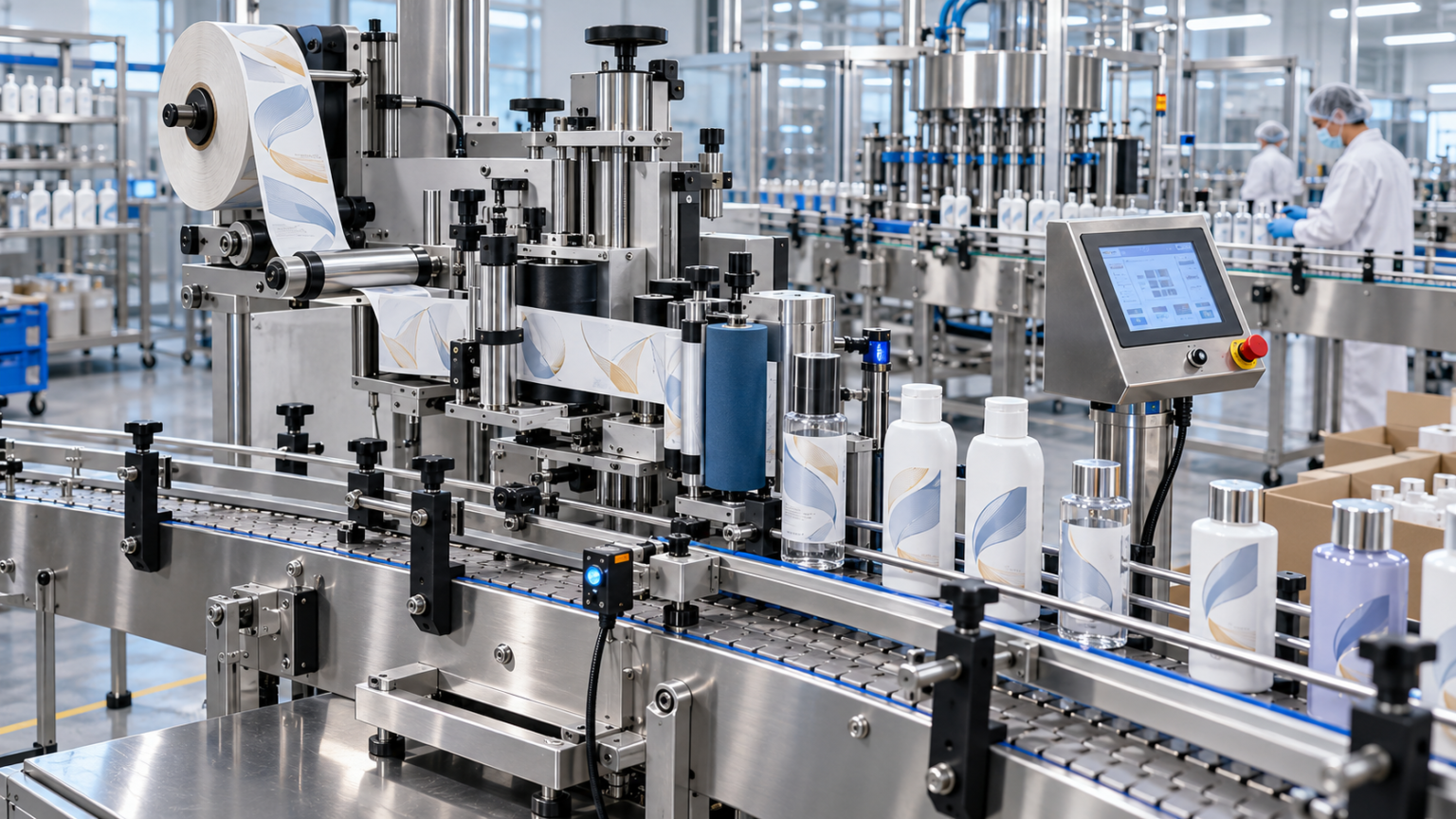
In modern manufacturing, packaging plays a critical role in product presentation, brand recognition, regulatory compliance, and customer satisfaction. Whether a company produces beverages, cosmetics, personal care products, household chemicals, or industrial lubricants, every bottle needs an accurately applied label that communicates essential product information. An advanced Bottle Labeling Machine helps manufacturers automate this important packaging stage, improve label positioning, reduce repetitive manual tasks, and maintain a consistent appearance across large production batches.
Consumers often notice packaging before they evaluate the product itself. A properly aligned label, clear product information, and professional presentation can influence the overall impression of a brand.
However, achieving this consistency becomes challenging when hundreds or thousands of bottles must be labeled every hour.
Manual labeling may be suitable for small production runs, but variation in placement, application pressure, and handling can create uneven results.
Automatic labeling technology offers manufacturers a more controlled process for applying self-adhesive labels to bottles of different sizes and shapes.
From round shampoo containers to flat detergent bottles, modern systems can support multiple labeling configurations when correctly specified.
Understanding how these machines work, their main benefits, and the factors that influence performance helps businesses invest in packaging equipment that meets their long-term production requirements.
What Is a Bottle Labeling Machine?
A bottle labeling machine is industrial packaging equipment designed to apply printed labels to suitable bottles and containers.
Depending on the machine’s configuration, labels can be positioned on the front, back, side, or around the circumference of a bottle.
Most automatic self-adhesive labeling systems use a label roll, dispensing mechanism, sensors, conveyor, and application components to complete the process.
The equipment separates each pressure-sensitive label from its backing material and transfers it onto a correctly positioned container.
The label is then pressed or rolled into place to promote suitable adhesion.
How Automatic Bottle Labeling Works
The labeling process typically begins when filled and capped bottles enter the machine on a conveyor.
A bottle detection sensor identifies the arriving container.
The control system coordinates conveyor movement with label dispensing.
As the label separates from its backing liner, an applicator or positioning mechanism transfers it onto the bottle surface.
Depending on the design, rollers, belts, or pressure components help secure the label.
Once the application is complete, the bottle moves towards the next production stage.
Accurate results depend on bottle positioning, label feed control, container geometry, and consistent operating settings.
Automatic Versus Manual Labeling
Manual labeling requires workers to position and apply labels individually.
This may be practical for small-scale production or frequently changing products with limited order volumes.
Automatic equipment reduces the amount of repeated handling and provides more controlled label positioning.
However, automation requires suitable setup, trained operators, maintenance, and compatible packaging materials.
The most appropriate choice depends on production volume, budget, bottle type, and operational requirements.
1. A Bottle Labeling Machine Improves Label Placement Accuracy
Accurate label placement is one of the most important requirements in professional packaging.
A crooked label or inconsistent positioning can make a product appear poorly manufactured even when its contents meet quality standards.
Automatic labeling equipment is designed to control the relationship between container movement and label dispensing.
Consistent Label Positioning
A correctly configured machine applies labels at a predetermined position.
This helps manufacturers maintain consistent spacing from bottle shoulders, bases, and other packaging features.
For example, a cosmetic manufacturer may require the front label to sit at the same height on every lotion bottle.
A machine with suitable guides and application controls can help maintain that position across repeated cycles.
Bottle Detection Sensors
Photoelectric sensors are commonly used to detect incoming containers.
The sensor sends a signal to the control system, which initiates the appropriate labeling sequence.
Correct sensor adjustment is essential.
If the sensor identifies the bottle too early or too late, the label may be positioned incorrectly.
Transparent and highly reflective containers can require particular attention to sensing arrangements.
Controlled Label Dispensing
The label feeding mechanism must release each label at the correct moment.
Small variations in feeding or application timing can affect alignment.
Modern labeling equipment may use programmable controls and adjustable dispensing positions to improve consistency.
Maintaining Alignment Across Production Batches
Once approved settings are established, manufacturers can use them as a reference for future production.
However, operators should still verify label position after roll changes, adjustments, and production interruptions.
A machine’s stated positioning accuracy describes specified operating conditions, not a guarantee that every label will be perfect.
Reducing Packaging Rejection
Improved label consistency may reduce the number of bottles requiring rework.
Fewer crooked or misplaced labels can save packaging materials and employee time.
Actual savings depend on the original defect rate, product mix, and machine performance.
2. Automatic Labeling Equipment Increases Production Speed
As manufacturers expand, packaging operations must keep pace with filling and capping.
A slow labeling stage can restrict the output of an otherwise efficient production line.
Automatic machines can reduce this bottleneck by applying labels continuously while containers move through the system.
Continuous Conveyor-Based Operation
A conveyor allows bottles to pass through the labeling station at a controlled speed.
Operators do not need to place and remove every container by hand.
The machine coordinates label delivery with bottle movement.
This can improve production flow when upstream and downstream machines operate at compatible speeds.
Higher Output Than Manual Application
In suitable applications, automatic equipment can label significantly more containers per hour than manual methods.
The precise improvement depends on the machinery, label arrangement, and production process.
For example, a single wrap-around label may involve a different operating cycle from front-and-back labeling.
The appropriate comparison should use realistic production conditions.
Understanding Bottles Per Minute
Labeling machine capacity is often expressed in bottles per minute.
This is a convenient measure, but it should not be considered in isolation.
Production speed can change according to bottle diameter, label length, container stability, and application method.
Machines should be evaluated using the actual bottles and labels intended for production.
Reducing Repetitive Labor
Manual labeling requires frequent handling and precise placement.
Automation can reduce some of this repetitive work.
Employees can focus on label roll replacement, quality checks, machine monitoring, and troubleshooting.
The result may be better use of labor rather than the elimination of operator responsibilities.
Improving Production Scheduling
Stable machine output helps manufacturers estimate batch completion times.
This supports more accurate planning for filling, capping, labeling, and distribution.
However, scheduled output should include realistic allowances for changeovers, maintenance, inspections, and unexpected interruptions.
3. A Bottle Labeling Machine Supports Different Bottle Shapes
Manufacturers rarely use identical packaging across every product.
A personal care company may sell shampoo in cylindrical bottles and conditioner in flatter containers.
A chemical manufacturer may use square bottles for one formulation and round containers for another.
Flexible labeling equipment can help businesses manage these variations.
Round Bottle Labeling
Round bottles are common in beverages, cosmetics, pharmaceutical-related packaging, and household products.
A round bottle labeling machine may rotate the container as the label is applied.
This allows the label to follow the curved surface.
Proper bottle rotation and label feeding are essential for consistent positioning.
Flat Bottle Labeling
Flat bottles provide relatively broad surfaces for front and back labels.
Examples include certain shampoo, conditioner, detergent, and lubricant containers.
The labeling equipment must keep these bottles correctly oriented during movement.
Side guides and top holding mechanisms may help prevent rotation or instability.
Square and Rectangular Containers
Square and rectangular bottles can create additional positioning requirements.
Edges and corners may affect where the label begins and ends.
The machine must be configured for the intended application surface and label dimensions.
Oval and Irregular Shapes
Some manufacturers use unusually shaped bottles to distinguish their products.
These containers may require specialised handling.
Not every labeling machine can accommodate irregular shapes without customised guides, tools, or additional mechanisms.
Compatibility should be demonstrated before purchasing equipment.
Adjustable Bottle Guides
Adjustable guides help accommodate supported bottle widths and diameters.
They can maintain bottle alignment while allowing the production line to handle different product formats.
However, adjustments must remain within the machine’s approved operating range.
4. Modern Bottle Labeling Machines Support Multiple Labeling Methods
Different products require different label arrangements.
Some need a single front label, while others use separate front and back labels.
Certain round bottles have one label that wraps around most or all of the container.
A versatile labeling system may support several methods.
Single-Side Labeling
Single-side labeling applies a label to one selected surface.
It may be appropriate for simple cosmetic packaging, promotional products, or containers with limited information requirements.
The product and applicable labeling regulations determine whether additional information must appear elsewhere.
Double-Side Labeling
Double-side labeling applies labels to two designated surfaces, often the front and back.
This configuration can be useful when manufacturers want to separate branding information from detailed instructions.
For example, the front of a shampoo bottle may feature the product name and identity, while the back contains ingredients and directions.
Correct orientation is essential so that both labels appear in their intended positions.
Wrap-Around Labeling
Wrap-around labeling is commonly used on cylindrical bottles.
The label follows the container’s curved surface, creating a continuous or nearly continuous branded appearance.
Careful adjustment is necessary to prevent wrinkles, uneven overlap, or misalignment.
Transparent Labels
Transparent pressure-sensitive labels can create an appearance in which printed graphics seem integrated with the bottle.
However, clear labels can introduce sensor detection challenges.
A manufacturer should verify compatibility with the selected label material and backing liner.
Specialty and Decorative Labels
Some products use textured labels, metallic finishes, or unusual shapes.
These materials may behave differently during dispensing and application.
Adhesive performance, liner construction, label stiffness, and container surface properties should be evaluated.
5. Automatic Labeling Improves Product Presentation and Brand Consistency
Packaging is an important part of how customers recognise products.
A well-positioned label helps maintain a consistent visual identity across retail shelves, online product photography, and distribution channels.
Creating a Professional Appearance
Consistent label placement gives products a more uniform appearance.
This is especially valuable when multiple bottles from the same range are displayed together.
A clean presentation can support the impression of an organised manufacturing process.
Supporting Brand Recognition
Labels communicate brand names, colours, logos, and product distinctions.
When labels are consistently positioned, customers can more easily recognise the brand’s visual system.
The benefit is strongest when label design and application quality work together.
Improving Shelf Presentation
Retail products often compete for attention in limited display space.
A properly applied front label helps the intended graphics remain visible.
For products with transparent or curved containers, correct alignment may be particularly important.
Maintaining Consistency Across Product Variants
Brands frequently offer multiple fragrances, colours, sizes, or formulations.
Using consistent label dimensions and positioning where appropriate can make a collection appear coordinated.
A machine that supports manageable changeovers can help maintain this consistency across different production runs.
Supporting Premium Packaging
Premium cosmetic and beverage products often depend on carefully finished packaging.
Wrinkled, bubbling, or crooked labels can reduce the quality of the final presentation.
An appropriately configured labeling machine can help minimise these defects.
However, high-quality labels and proper surface preparation remain essential.
6. A Bottle Labeling Machine Can Reduce Material Waste
Label waste can occur when labels are damaged, misapplied, incorrectly dispensed, or rejected during inspection.
Although each individual label may have a small cost, repeated defects can become expensive across large production volumes.
Automatic labeling equipment can help reduce certain avoidable losses.
Reducing Misapplied Labels
Accurate container detection and controlled dispensing help reduce labels being released at the wrong time.
This may lower the number of labels wasted during normal operation.
However, machines still require correct setup and regular inspection.
Avoiding Wrinkles and Bubbles
Labels may wrinkle when the application surface, pressure, or dispensing angle is unsuitable.
Air bubbles can develop because of improper application, surface conditions, or material characteristics.
Correct roller pressure and label compatibility help improve results.
Managing Label Roll Changes
Poorly performed roll changes can cause alignment problems and wasted labels.
Operators should follow a documented roll replacement procedure.
After changing a roll, the first labeled bottles should be inspected before full production resumes.
Selecting Suitable Adhesives
Label adhesive performance depends on container material, temperature, surface condition, and storage environment.
For example, a label applied to a chilled beverage bottle may encounter different conditions from a label applied to a dry cosmetic container.
An adhesive that performs well on one material may be unsuitable for another.
Manufacturers should evaluate the complete label construction rather than focusing only on the printing.
Measuring Packaging Waste
A facility can calculate the number of rejected labels and bottles during a production period.
Tracking these results helps determine whether an equipment adjustment has improved performance.
Measured results provide stronger evidence of efficiency than promotional claims alone.
7. Automatic Bottle Labeling Machines Integrate With Modern Packaging Lines
Labeling is usually one stage of a larger manufacturing process.
A complete production line may include bottle preparation, filling, capping, sealing, coding, labeling, inspection, and packing.
Automatic labeling equipment can be integrated into this workflow when the machinery is technically compatible.
Connecting With Filling Machines
Filling equipment places the required amount of product into each container.
Once filling is complete, bottles may move towards a capping machine.
The labeling stage should receive containers at a pace it can process reliably.
Working With Capping Equipment
Labels are frequently applied after closures have been secured, although the correct sequence depends on the package and production design.
Improperly capped bottles can create leakage or handling problems during conveying.
Integrating Date and Batch Coding
Some packaging operations require batch identification, expiration dates, or other variable information.
Coding equipment may apply these details directly to the bottle, closure, label, or another suitable location.
The exact information required depends on the product and destination market.
Labeling equipment does not independently guarantee that printed information is legally correct.
Connecting Inspection Systems
Vision systems and other inspection devices may help identify missing labels, incorrect positioning, or unreadable codes.
These features may be integrated into the production line where appropriate.
Automated inspection can support quality control, but validation and ongoing monitoring remain important.
Managing Conveyor Speed
A production line operates most effectively when machines are appropriately coordinated.
If the filler produces containers faster than the labeler can process them, accumulation may occur.
Likewise, a labeling machine may remain idle if upstream equipment cannot supply bottles consistently.
The complete line should be evaluated rather than selecting each machine independently.
SUNHAN SH-TB300L Bottle Labeling Machine: Features and Specifications
A practical example of modern automatic labeling technology is the SUNHAN SH-TB300L.
SUNHAN describes this machine as an automatic self-adhesive labeling system designed for round and flat bottles.
The equipment supports single-side, double-side, and wrap-around labeling configurations for compatible containers.
Its published specifications provide a useful reference for businesses comparing industrial bottle labelers.
Manufacturer-Published Technical Specifications
According to the product information provided by SUNHAN, the SH-TB300L has the following characteristics.
Machine Model: SH-TB300L
Power Supply: 110V/60Hz or 220V/50Hz
Rated Power: 2 kW
Advertised Labeling Speed: Approximately 30–100 bottles per minute
Advertised Labeling Accuracy: ±2 mm
Suitable Label Width: Up to 150 mm, with customisation options
Label Roll Inner Diameter: 75 mm
Label Roll Outer Diameter: 320 mm
Supported Bottle Diameter: Up to 100 mm
Supported Bottle Height: Up to 350 mm
Conveyor Dimensions: Approximately 2500 × 100 mm
Published Machine Dimensions: Approximately 2000 × 1300 × 1350 mm, using the manufacturer’s stated order
These figures are manufacturer-published specifications and should be confirmed for the exact configuration being purchased.
Actual operating speed and accuracy may vary according to bottle size, label material, application method, and production conditions.
Adjustable Handwheel Mechanism
The machine includes a handwheel adjustment mechanism for fine-tuning the label dispensing position.
This allows operators to make controlled alignment adjustments during setup.
The required settings depend on the container and label.
Bottle Guiding Structure
SUNHAN describes an adjustable guiding arrangement intended to position bottles during conveying.
Correct bottle guidance helps maintain stable movement through the labeling station.
It is particularly useful when changing between supported container sizes.
Top Pressure Structure
The machine also includes a top holding or pressure structure.
This helps stabilise bottles and limit unwanted movement during the labeling process.
The correct pressure should support the container without damaging its surface or shape.
Conveyor System
The product features a chain plate conveyor.
Its purpose is to transport containers consistently through the machine.
SUNHAN also describes customisation options for conveyor dimensions to suit different production layouts.
Control Panel
The machine includes a control interface for adjusting relevant operating parameters.
Operators should receive suitable training to understand the machine’s settings and fault indications.
Warranty and Technical Assistance
SUNHAN advertises a one-year warranty, user manual, installation and debugging videos, and one-to-one video support.
Buyers should verify the current warranty terms, available replacement parts, and responsibilities for service or repair before ordering.
Applications of Bottle Labeling Machines Across Different Industries
Automatic bottle labeling technology is useful in many manufacturing sectors.
The appropriate machine depends on the products, containers, labels, and regulatory requirements.
Cosmetics and Personal Care
Cosmetic manufacturers frequently use bottles for shampoos, conditioners, body lotions, facial cleansers, and skincare products.
Labels may communicate product identity, ingredients, directions, warnings, and other information.
Accurate positioning helps preserve the intended appearance and readability.
Beverage Manufacturing
Beverage companies package water, juice, soft drinks, and other liquids in bottles of different shapes.
Labeling equipment can support consistent application when matched to container materials and storage conditions.
Products that experience condensation or refrigeration may need specifically qualified label adhesives.
Food Packaging
Food producers use bottles and jars for sauces, honey, dressings, condiments, and related products.
Food labels may need to include legally required information about ingredients, allergens, net quantity, and other matters.
In the United States, FDA food labeling regulations and guidance establish requirements for covered products.
A properly operating labeler supports placement but does not replace label-content review.
Household Cleaning Products
Cleaning products are often packaged in round, flat, or rectangular bottles.
Labels may need to withstand moisture, handling, and contact with cleaning chemicals.
Adhesive selection and surface compatibility are important.
Lubricants and Industrial Chemicals
Industrial lubricants, engine oils, and related products may require durable labels suited to demanding environments.
Manufacturers should evaluate label resistance to the expected product exposure and storage conditions.
Applicable hazard communication requirements must also be considered where relevant.
Healthcare and Supplement Packaging
Certain healthcare and supplement products are packaged in small or medium-sized bottles.
Labeling accuracy is important, but these products may have additional regulatory requirements.
Equipment selection and validation should reflect the applicable category and manufacturing controls.
How to Choose the Right Bottle Labeling Machine for Your Business
The best equipment is the machine that can consistently handle the actual production requirements.
Buyers should begin with the packaging specifications rather than purchasing solely on advertised speed.
Identify Bottle Shape and Material
Confirm whether the line will handle round, flat, oval, square, or unusually shaped containers.
The material may be glass, PET, HDPE, or another suitable packaging substrate.
Container shape and rigidity influence the labeling method.
Measure Bottle Dimensions
Provide the supplier with accurate bottle height, width, diameter, and available labeling area.
Even bottles with similar capacities may have different external dimensions.
Confirm Label Specifications
Label width, length, material, adhesive, liner, and roll dimensions are important.
The manufacturer should verify that the label construction is compatible with the machine.
Establish Production Requirements
Estimate the target number of bottles per hour.
Include realistic allowance for inspection, roll replacement, product changeover, and downtime.
A machine should be selected for sustainable production performance rather than an idealised maximum speed.
Consider Label Positioning Tolerance
Some packaging designs require precise alignment with existing printed features, bottle seams, or decorative elements.
Ask the supplier to demonstrate whether the machine can meet the required tolerances.
Evaluate Future Product Variations
Businesses may add new bottle designs or product sizes over time.
Adjustable guides and flexible labeling configurations can provide useful options for expansion.
However, future compatibility should be supported by technical evidence.
Request Sample Labeling Tests
A manufacturer should ideally test the intended bottles and labels.
Sample testing helps identify wrinkles, alignment problems, sensor limitations, and adhesive issues before a full production order.
Installation and Commissioning of an Automatic Bottle Labeler
Correct installation contributes to accurate labeling and reliable machinery performance.
Preparing the Production Space
The machine should be positioned on a suitable floor with sufficient clearance for material handling, maintenance, and operator movement.
Installation should follow the manufacturer’s requirements.
Connecting Electrical Services
Confirm the correct voltage and frequency for the supplied equipment.
Electrical connections should be completed by appropriately qualified personnel.
Adjusting Bottle Guides
Set the guide rails and holding mechanisms for the intended containers.
Incorrect adjustment can create unstable movement or damage bottles.
Loading the Label Roll
Load the approved label roll according to the documented threading arrangement.
Correct liner tension and tracking help maintain reliable label dispensing.
Setting Label Position
Adjust the label dispensing point and relevant machine parameters.
Use representative production containers for initial testing.
Conducting Trial Runs
Start with controlled trial production.
Inspect bottles for position, straightness, adhesion, and other relevant quality characteristics.
Adjustments should be recorded once acceptable results are achieved.
Approving Routine Production
Before increasing to the target production rate, verify that label quality remains acceptable.
Operators should continue monitoring the process during normal operation.
Machinery Safety and Regulatory Considerations
Automatic labeling systems include moving conveyors, rollers, belts, and other mechanical components.
These can create pinch points and entanglement hazards.
Manufacturers and facility operators should assess the specific machine and comply with applicable safety requirements.
Machine Guarding
In the United States, OSHA standard 29 CFR 1910.212 addresses safeguarding workers from machinery hazards.
Appropriate guards and protective arrangements may be required depending on the equipment.
Guards should not be removed or bypassed during normal production.
Hazardous Energy Control
Maintenance and jam clearing may expose employees to unexpected movement or electrical hazards.
OSHA standard 29 CFR 1910.147 addresses hazardous-energy control during covered servicing and maintenance activities.
Employees must follow the applicable energy isolation procedures.
Product Labeling Compliance
Different industries have different labeling requirements.
US cosmetic labels, for example, are subject to FDA requirements covering product identity, net quantity, business information, ingredients, and other applicable statements.
Food labeling requirements differ from those for cosmetics or industrial chemicals.
The machine applies the label; the manufacturer remains responsible for ensuring the label’s content and presentation meet the applicable legal requirements.
Barcode Placement and Scanning
Products sold through retail channels may use GS1 identification and barcode standards.
Curved bottle surfaces can affect barcode readability.
GS1 guidance addresses barcode placement and orientation on bottles and jars.
Manufacturers should verify scanning performance using finished packaging rather than assuming a printed barcode will always scan correctly.
Maintenance Tips for Reliable Bottle Labeling Performance
Preventive maintenance helps maintain label consistency and reduce equipment downtime.
Clean the Labeling Mechanism
Adhesive residue, dust, and liner debris can accumulate around dispensing components.
Cleaning should follow manufacturer instructions and appropriate safety procedures.
Inspect Rollers and Belts
Worn rollers or belts may contribute to poor label application.
Inspect components at recommended intervals.
Check Label Sensors
Sensors should remain clean and properly aligned.
Dirt or damage may affect label detection.
Maintain Conveyor Alignment
Conveyor movement should remain smooth and consistent.
Loose guides and worn components can cause bottle movement problems.
Verify Label Positioning
Conduct periodic inspections using approved reference samples.
Positioning should also be checked after product or label roll changes.
Record Maintenance Activities
Maintenance records help identify recurring problems and support future equipment planning.
Common Bottle Labeling Problems and Practical Solutions
Crooked Labels
Misaligned guides, incorrect dispensing positions, or unstable bottle movement may cause crooked labels.
The machine setup should be inspected.
Wrinkles or Air Bubbles
Improper application pressure, bottle shape, or label material may contribute to wrinkles and bubbles.
Correct roller settings and suitable label construction can help.
Missing Labels
Missing labels may result from detection problems, improper label feeding, or control faults.
Operators should investigate the cause rather than simply increasing machine speed.
Labels Peeling Away
Poor adhesion may result from contamination, condensation, unsuitable adhesives, or incompatible surfaces.
The label supplier and equipment manufacturer may need to evaluate the application.
Irregular Label Spacing
Incorrect label roll specifications, sensor adjustment, or liner tracking can affect dispensing consistency.
Frequent Production Stops
Bottle jams, incorrectly loaded labels, worn components, and upstream production interruptions can cause downtime.
A systematic maintenance and troubleshooting programme can help identify recurring issues.
How Much Does a Bottle Labeling Machine Cost?
The price of automatic labeling equipment depends on its configuration and technical requirements.
A basic semi-automatic tabletop system and a fully automatic dual-purpose labeler involve different levels of investment.
Machine Automation Level
Fully automated systems generally include additional conveying, sensing, and control components.
Their cost should be compared with expected productivity.
Labeling Configuration
Single-side, double-side, and wrap-around applications may require different mechanisms.
The selected combination affects machine complexity.
Production Capacity
Higher-speed equipment may involve different engineering requirements and component specifications.
Customisation Requirements
Unusual bottle shapes, special labels, and non-standard conveyor layouts may require custom engineering.
Shipping and Installation
International orders can involve freight, import duties, taxes, commissioning, and employee training.
Long-Term Ownership Costs
Maintenance, replacement parts, electricity, label waste, and equipment utilisation should be considered.
The right financial decision depends on the complete operating requirements.
The Future of Bottle Labeling Technology
Modern packaging systems continue to evolve as manufacturers seek more consistent output and flexible production arrangements.
Smarter Label Detection
Advances in sensors can support improved detection of certain label and bottle materials.
However, compatibility still requires testing.
Integrated Inspection
Vision systems can help identify missing or misplaced labels and provide an additional quality control layer.
Faster Product Changeovers
Adjustable machinery and stored operating parameters may reduce setup time for different products.
Improved Production Monitoring
Connected packaging equipment may collect information about output, downtime, and rejected items.
This can help production teams understand recurring problems.
Flexible Manufacturing Systems
As manufacturers introduce new packaging formats, equipment capable of handling different supported containers may become increasingly valuable.
Future improvements should continue balancing speed, accuracy, operator safety, and maintainability.
Frequently Asked Questions
1. What is a Bottle Labeling Machine used for?
A Bottle Labeling Machine automatically or semi-automatically applies product labels to suitable bottles and containers, helping improve positioning accuracy and packaging consistency.
2. Can a bottle labeling machine handle round and flat bottles?
Yes. Certain dual-purpose automatic labeling machines support both round and flat bottles, provided their dimensions and label requirements fall within the equipment’s specifications.
3. How fast can an automatic bottle labeling machine work?
Speed varies by equipment and application. SUNHAN advertises approximately 30–100 bottles per minute for its SH-TB300L model under suitable operating conditions.
4. What types of labels can automatic labeling machines apply?
Many systems apply self-adhesive labels, including single-side, double-side, and wrap-around formats. Material and adhesive compatibility should be confirmed before production.
5. How can I improve bottle labeling accuracy?
Use correctly specified labels, properly adjusted bottle guides, suitable sensor settings, consistent conveyor movement, and regular sample inspections.
6. How do I choose the best Bottle Labeling Machine?
Compare bottle dimensions, labeling method, production speed, accuracy requirements, label specifications, safety features, customisation options, and after-sales support.
Conclusion
A Bottle Labeling Machine is an important investment for manufacturers seeking accurate, consistent, and efficient packaging operations. Modern automatic systems can support different bottle shapes, multiple labeling methods, and integration with filling and capping equipment. Choosing the right model requires attention to label compatibility, realistic production capacity, machinery safety, and long-term operating costs. With proper installation, regular maintenance, and effective quality control, automated bottle labeling can help businesses deliver professional packaging as production demands grow.
