
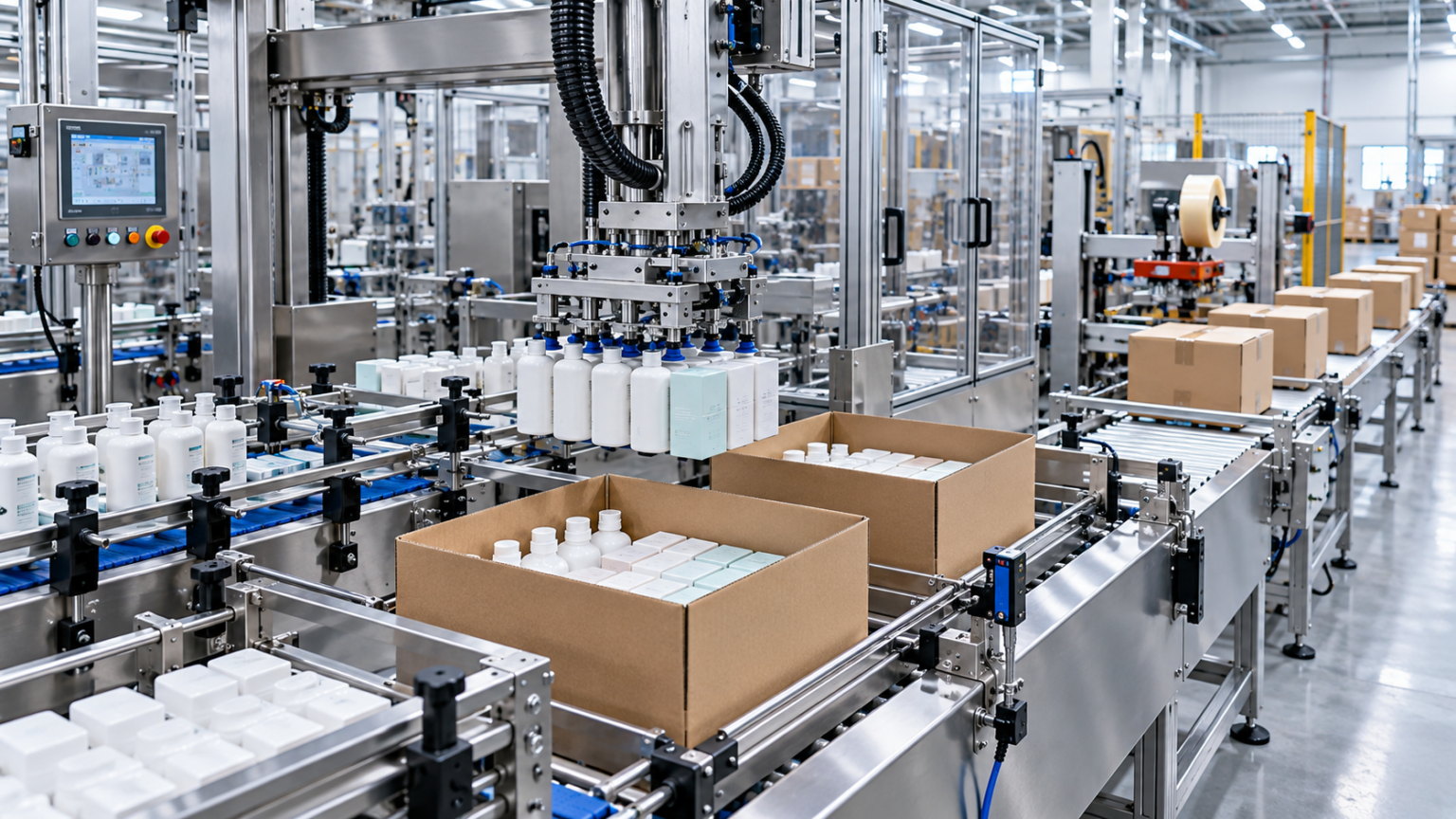
Modern manufacturing relies on speed, accuracy, product protection, and dependable packaging operations. Whether a company produces beverages, cosmetics, medicines, household products, or packaged food, finished products must be organised into suitable shipping cartons before reaching warehouses, distributors, and retail stores. An advanced case packer machine helps manufacturers automate this important stage by grouping products, transferring them into corrugated cases, and preparing completed cartons for the next part of the distribution process.
End-of-line packaging may appear straightforward compared with filling, processing, or product assembly. However, it can become one of the most challenging parts of a production facility when volumes increase.
Workers must handle products repeatedly, maintain correct case quantities, avoid damaged packaging, and ensure that cartons are prepared according to customer requirements.
If the case packing stage cannot keep pace with upstream machinery, production delays can affect the entire manufacturing operation.
Automatic case packing equipment addresses these problems through controlled product handling, programmable movements, suitable gripping mechanisms, and integrated conveying systems.
Modern machinery can accommodate different packaging formats, including bottles, pouches, cartons, jars, cans, and other compatible products.
Selecting suitable equipment, however, requires careful consideration of production capacity, packaging dimensions, material handling requirements, factory layout, safety, and long-term maintenance.
This guide explores the seven major benefits of automated case packing, explains different machine configurations, and examines how manufacturers can select reliable equipment for modern production lines.
What Is a Case Packer Machine?
A case packer machine is industrial equipment used to arrange and place finished products into corrugated shipping cases, cartons, trays, or other approved secondary packaging formats.
The equipment may operate automatically or semi-automatically, depending on its design.
Its main function is to transfer products from the production conveyor into a specified case arrangement.
Some systems also include carton erecting, case sealing, or other packaging operations.
How Automatic Case Packing Works
A typical automatic case packing process begins when finished products arrive on an infeed conveyor.
Sensors and guide rails help control their movement towards the grouping station.
The machine organises the products into the required packing pattern.
Once the correct arrangement has been formed, a mechanical pusher, robotic gripper, vacuum device, or another suitable transfer mechanism moves the products into an open case.
The completed carton then moves towards sealing, inspection, coding, or palletising.
The exact sequence depends on the selected machine.
Why Secondary Packaging Matters
Primary packaging contains or directly protects the product.
Secondary packaging groups these finished units for handling and distribution.
For example, a bottle of shampoo is a primary packaged product, while the corrugated carton containing twelve bottles is part of the secondary packaging arrangement.
Accurate case packing supports inventory management, transportation, warehouse operations, and customer order fulfilment.
A defective secondary package can create problems even when the individual products inside are manufactured correctly.
Manual Versus Automatic Case Packing
Manual case packing relies on employees to collect, arrange, and place products into shipping cartons.
This can be suitable for small-scale production or applications with frequent changes and limited quantities.
Automatic equipment provides controlled, repeatable movements and can reduce repetitive handling.
However, automated packaging still requires trained employees, regular maintenance, and appropriate quality inspections.
The correct choice depends on production volume and overall operating requirements.
1. A Case Packer Machine Improves Packaging Speed and Production Efficiency
One of the most important reasons manufacturers invest in automatic case packing is to improve end-of-line production efficiency.
High-speed filling, wrapping, and labelling systems can produce significant quantities of finished products.
If those products must be packed into shipping cartons manually, the packing station may restrict the output of the entire factory.
Reducing Production Bottlenecks
A bottleneck occurs when one part of a production process cannot keep pace with the other stages.
For example, a production line may deliver hundreds of finished bottles every minute, but a manual packing team may struggle to load them into cases at the same rate.
Containers can accumulate on conveyors, creating interruptions and additional handling.
An automatic case packer can help align packing capacity with the preceding operations.
The expected improvement should be verified under real production conditions.
Understanding Cases Per Minute
Case packing speed is often measured in cartons or cases per minute.
This metric describes how many completed shipping cases the machine can produce during a specified period.
However, it does not reveal the complete production capacity by itself.
A carton containing six bottles represents a different product quantity from one containing twenty-four bottles.
Manufacturers should therefore compare the expected case output with the number of individual units per case.
Coordinated Product Grouping
Automatic machinery uses controlled feeding and grouping mechanisms to arrange products into the intended pattern.
Once the group is complete, the loading mechanism transfers it into the shipping case.
This coordinated process reduces the need to handle each item separately.
Stable Production Scheduling
Repeatable machine cycles can help manufacturers estimate packaging times.
This supports better planning for employee schedules, raw material supply, carton inventory, and shipping commitments.
However, actual production planning must include downtime, inspections, format changeovers, and routine maintenance.
Measuring Actual Efficiency
A manufacturer’s rated machine speed should be considered alongside equipment availability and acceptable output.
Overall Equipment Effectiveness, commonly called OEE, is one framework used to examine these factors.
A machine capable of high maximum speed may not deliver the best practical performance if frequent stoppages reduce production time.
The objective is dependable output, not simply the highest advertised number.
2. Automated Case Packing Improves Product Handling Accuracy
Incorrect packing can lead to missing items, damaged products, or packaging that does not match the customer’s order.
Consistent product positioning is therefore essential.
Maintaining Correct Product Quantities
A shipping carton should contain the approved number of units.
For example, a manufacturer may specify twelve bottles arranged in three rows of four.
An automatic system can organise products according to this pattern.
Sensors, counters, and approved inspection methods can help detect incorrect groupings.
However, product counting features differ between machines and should be verified before purchase.
Uniform Carton Arrangement
Consistent positioning can help products fit correctly into cases.
It also supports predictable handling during storage and transportation.
A uniform arrangement is particularly valuable when the same carton format is used throughout a large production batch.
Controlling Placement Accuracy
Servo motors, guide rails, positioning devices, and programmable control systems can help transfer products accurately.
These technologies are useful where items must fit into a limited carton opening.
The actual placement accuracy depends on the complete mechanical arrangement.
Reducing Product Damage
Incorrect handling may cause dents, scratches, cracked containers, or damaged product labels.
Suitable loading equipment can help reduce unnecessary impacts.
For fragile products, the machine should use an appropriate gripping method and controlled movement profile.
Supporting Quality Inspection
Packaging teams should still inspect representative finished cases.
Checks may include carton counts, product arrangement, external damage, and closure quality.
Automation provides a repeatable process, but it does not eliminate the possibility of defects.
3. A Case Packer Machine Reduces Repetitive Manual Work
Manual case packing often involves repeated reaching, lifting, bending, and positioning.
Employees may perform similar motions throughout a production shift.
Automatic equipment can reduce certain repetitive manual activities.
Reducing Frequent Product Handling
A case packer transfers groups of products through a coordinated mechanical process.
This can reduce how often employees must lift or position individual containers.
The benefit depends on the previous packing method and the chosen automation arrangement.
Improving Workstation Organisation
An automatic case packing station combines product grouping and carton loading within a defined process.
Employees can focus on monitoring production, replenishing cartons, inspecting finished cases, and handling approved changeovers.
This can create a more structured working environment.
Supporting Ergonomic Improvements
Reducing repetitive lifting may help address some ergonomic risks associated with manual packing.
However, the complete workplace must still be assessed.
Employees may continue handling carton blanks, finished cases, and other materials.
A properly designed automation project should consider all remaining tasks.
Changing Employee Responsibilities
Automation does not necessarily eliminate the need for workers.
Instead, it changes the activities required to operate the packaging line.
Operators may need training in machine settings, inspection procedures, fault reporting, and basic troubleshooting.
Maintenance personnel may need additional knowledge of servo drives, sensors, and pneumatic systems.
Maintaining Operational Safety
Automated equipment introduces hazards such as moving mechanisms, pinch points, and unexpected machine starts.
These hazards require appropriate guards, controls, and operating procedures.
Improved efficiency should always be supported by effective risk management.
4. Automatic Case Packers Support Different Packaging Formats
Modern factories often produce products in several container sizes and shapes.
A beverage manufacturer may package cans and glass bottles, while a personal care company may use cartons, pouches, and plastic containers.
Flexible case packing technology can support these different requirements when appropriately configured.
Packing Bottles
Bottles are commonly found in beverage, food, cosmetic, and chemical production.
Their dimensions, material, weight, and closure design affect handling.
A plastic bottle may deform under excessive gripping pressure, while a glass bottle can break if subjected to impacts.
The selected loading system should account for these characteristics.
Packing Cartons and Boxes
Rectangular products can be suited to side-loading equipment.
A machine can form groups of boxed items and transfer them horizontally into a corrugated case.
The packaging arrangement should match the case dimensions and required product orientation.
Handling Pouches and Flexible Packs
Flexible packaging can present different challenges from rigid containers.
Pouches may vary in shape or become unstable during handling.
The machine may require appropriate supports, controlled feeding, or specialised gripping equipment.
Packing Jars and Cans
Jars and cans can also be handled by suitable case packing systems.
The appropriate solution depends on size, surface geometry, weight, and the intended arrangement.
Customised Product Formats
Some manufacturers use unusual packaging designs.
These may require special grippers, adjustable guides, modified conveyors, or customised machinery.
A supplier should demonstrate compatibility using representative samples.
Managing Product Changeovers
A factory producing multiple products may need to change between different carton sizes or product configurations.
The required adjustments can involve mechanical guides, gripping components, and control parameters.
A flexible machine can reduce changeover complexity when its design supports the intended products.
However, no case packer should be assumed compatible with every package format.
5. A Case Packer Machine Supports Better Packaging Consistency
Packaging consistency is important for warehousing, transport, and distribution.
Cases that vary in product arrangement, dimensions, or closure quality can create handling difficulties.
Standardising Case Formation
Some integrated systems include automatic case erecting.
This helps produce cartons according to the selected blank and machine settings.
Correct case formation is important because distorted cartons may interfere with loading and downstream handling.
Accurate Product Grouping
A case packer can arrange products according to a predefined pattern.
This helps maintain consistency throughout the production run.
However, the arrangement must be supported by appropriate counting and inspection procedures.
Reliable Secondary Packaging
Shipping cartons should be suitable for the products they contain.
Corrugated board quality, dimensions, protective inserts, and sealing methods all influence the finished package.
The case packer must be compatible with these requirements.
Supporting Warehouse Operations
Consistent cases may be easier to stack, count, identify, and transfer.
Uniform packaging can also help downstream palletising equipment operate correctly.
Improving Distribution Preparation
Manufacturers often ship products through several stages before they reach customers.
A stable secondary package helps the product withstand routine handling.
However, packaging integrity must be evaluated through suitable transport performance testing.
A correctly loaded case does not automatically guarantee protection against every distribution hazard.
6. Automatic Case Packing Integrates With Complete Production Lines
A modern manufacturing facility may use several interconnected packaging machines.
A case packer is frequently positioned near the end of the line, after products have completed their primary packaging stages.
Integration With Filling Machines
Filling equipment measures and dispenses product into bottles, jars, or other containers.
The completed containers move through closing, labelling, and inspection operations before secondary packaging.
The case packer should be able to process products at a rate compatible with the rest of the line.
Working With Cartoning Machines
Some products are placed into retail cartons before being grouped into shipping cases.
In these applications, the case packer receives finished retail cartons rather than individual bottles or loose products.
The distinction between retail cartoning and secondary case packing is important when planning equipment.
Connecting Case Erectors
A case erector converts flat corrugated blanks into open cases.
These cases may be supplied automatically to the case packing station.
Reliable coordination prevents the loader from operating without a properly prepared case.
Case Sealing Equipment
After loading, a case may be closed using tape or hot-melt adhesive, depending on the packaging design.
Some compact systems integrate sealing into the same machine.
Others use a separate downstream case sealer.
Inspection and Identification
Finished cases may require a product label, batch code, barcode, or shipping identification.
The required information depends on the product and distribution system.
Inspection equipment can help identify missing or incorrect markings.
Palletising and Warehousing
Once sealed and approved, cases can move towards palletising equipment.
Palletising may be performed manually or automatically.
Consistent carton dimensions and structural quality support stable pallet arrangements.
Production Line Communication
Integrated machines may exchange signals relating to product availability, carton supply, operating faults, and readiness.
The communication arrangement depends on the equipment and control system.
Integration should be verified through engineering documentation and commissioning tests.
7. A Case Packer Machine Can Reduce Long-Term Manufacturing Costs
Capital equipment should be evaluated over its expected operating life.
A lower purchase price does not always mean lower total cost, and higher automation does not automatically guarantee a better investment.
Understanding Total Ownership Cost
The total cost of owning a case packer can include equipment purchase, shipping, installation, utilities, maintenance, training, and replacement parts.
Factories should also consider the cost of downtime and changes to the existing production layout.
Improving Labour Efficiency
Automation may reduce the number of manual packing hours required for each shipping case.
The actual financial impact depends on production demand and the staffing arrangement.
Reducing Packaging Waste
Incorrect case loading can damage products or cause carton rejection.
A properly configured automatic system may reduce some of these losses.
However, savings should be measured using actual production data.
Supporting Production Growth
Businesses expecting higher demand may benefit from machinery that can support additional output.
The investment should match a realistic production forecast.
Oversized equipment may create unnecessary capital costs if it operates well below its capacity.
Evaluating Return on Investment
A purchasing analysis should compare current packaging costs with the expected costs after automation.
Useful measures include labour hours per case, damaged products, rejected cartons, operating expenses, and effective output.
Maintenance and production interruptions must be included.
The financial benefit should be demonstrated rather than assumed.
Types of Case Packer Machines Used in Modern Manufacturing
Several different machine configurations are available.
Each type uses a different loading or case-forming method.
Understanding these differences helps manufacturers select equipment suited to their products.
Side Load Case Packer
A side-load machine transfers products horizontally into an open shipping case.
The products are usually arranged into a defined group before loading.
A mechanical pusher or similar arrangement moves the group through the side opening.
Side loading is often appropriate for cartons, boxes, and other products that can withstand the approved horizontal transfer process.
Top Load Case Packer
A top-load machine places products vertically into an open case.
It may use a mechanical gripping head, vacuum arrangement, or robotic pick-and-place mechanism.
This approach can be suitable for bottles, jars, pouches, and other compatible containers.
The gripper and product positioning must be selected according to the intended application.
Wraparound Case Packer
Wraparound equipment forms a case around an arranged group of products using a corrugated blank.
The machine coordinates product positioning with case formation.
This can be an alternative to using a separately erected regular slotted carton.
The packaging design should be evaluated for product protection and material usage.
Robotic Case Packer
Robotic systems use programmable movement to transfer products into cases.
Depending on the arrangement, they may handle different product shapes or packing patterns.
Some systems incorporate vision equipment to identify and locate products.
Robotic flexibility depends on the chosen robot, tooling, sensors, and controls.
Compact Case Packer
Compact machines combine multiple functions within a limited footprint.
Some designs integrate carton erecting, product loading, and sealing.
They can be useful where factory floor space is restricted.
However, capacity and maintenance access must still be considered.
Integrated Case Packing Line
A complete end-of-line arrangement may include product grouping, case erecting, loading, sealing, coding, and palletising.
The system must be balanced so that one stage does not create avoidable delays for the others.
JOCHAMP Case Packer Machine Range: Features and Specifications
JOCHAMP supplies different automatic case packing configurations for end-of-line manufacturing applications.
Its published product range includes side-load, wraparound, robotic, double-station pick-and-place, compact, and integrated case packing systems.
Different models are designed for different products, carton dimensions, and production volumes.
The following details are based on the manufacturer’s published information.
JC-500S Side Load Case Packer
The JC-500S is designed for automatic side loading of suitable rectangular or regularly shaped products.
It uses PLC controls and servo-driven movement.
The manufacturer identifies packaged health supplements, oral liquids, biscuits, and other boxed products as potential applications.
Its advertised capacity is approximately 5–15 cartons per minute.
Supported carton dimensions are listed as 200–450 mm in length, 150–400 mm in width, and 100–350 mm in height, depending on the configuration.
This model can be relevant where products are already in retail cartons and need to be grouped into corrugated shipping cases.
JC-501 Wraparound Case Packer
The JC-501 forms corrugated cases around arranged products.
JOCHAMP lists an advertised maximum capacity of 12 cases per minute.
The published carton size range is 200–500 mm in length, 150–500 mm in width, and 100–350 mm in height.
Potential applications include compatible beverages, cans, and boxed products.
Actual production performance depends on the intended packaging arrangement.
JC-502 Double Station Pick and Place Case Packer
The JC-502 uses servo-controlled grippers with a dual-station arrangement.
JOCHAMP describes applications involving fragile products such as glass bottles and infusion bottles.
The manufacturer advertises a maximum output of 600 boxes per hour.
Supported case dimensions are listed from approximately 300 × 250 × 200 mm to 600 × 500 × 500 mm.
The correct configuration should be confirmed through product-specific testing.
JC-503 Robot Case Packer
The JC-503 combines a robotic picking mechanism with a vision inspection system.
It is intended for applications requiring flexible product identification and handling.
JOCHAMP lists support for products up to 7 kg, with advertised picking rates of 80–120 pieces per minute for a single configuration and 160–240 pieces per minute for a double configuration.
These figures describe pieces handled, not necessarily completed shipping cases.
The achieved case packing speed depends on the number of pieces per carton and the complete operating sequence.
JC-504 Compact Case Packer
The JC-504 integrates carton opening, product packing, and sealing functions within a compact machine arrangement.
The manufacturer presents it as an option for facilities where production space is limited.
Buyers should request a model-specific specification sheet showing the supported products, cartons, machine dimensions, and production capacity.
JC-600 Case Packing Line
The JC-600 is described as an integrated system incorporating stacking, case packing, sealing, and palletising functions.
JOCHAMP lists an output of fewer than 200 boxes per hour.
Its stated carton range is approximately 300 × 250 × 200 mm to 550 × 500 × 400 mm.
This model illustrates how different end-of-line functions can be combined into a coordinated production arrangement.
What Buyers Should Verify
These model specifications are manufacturer-published figures.
They should be confirmed through current technical documentation and representative testing.
Custom configurations may have different operating limits.
A prospective buyer should request exact carton dimensions, product compatibility, utility requirements, guarding details, available accessories, and warranty terms.
How to Choose the Right Case Packer Machine
Selecting suitable equipment begins with understanding the actual packaging operation.
Identify Product Characteristics
Record product dimensions, weight, material, shape, and orientation requirements.
For fragile products, identify acceptable handling forces and possible damage risks.
Define Case Specifications
The carton dimensions, board construction, opening arrangement, and closure method should be established before selecting equipment.
Different case styles require different forming and loading processes.
Calculate Required Throughput
Determine the required number of products per minute and cases per minute.
Both measurements matter.
For example, a line producing 240 individual items per minute and packing twelve items per case requires a nominal packing capacity of twenty cases per minute to match continuous upstream output.
The actual equipment selection should also consider operating variation and suitable capacity allowance.
Review Loading Methods
Top-load, side-load, wraparound, and robotic systems offer different advantages.
Choose the method that matches product handling requirements and available factory space.
Consider Changeover Requirements
Facilities processing several products should evaluate how machine adjustments are completed.
Check whether tools must be changed and how approved settings are recorded.
Examine Maintenance Accessibility
Machinery should allow suitable inspection, cleaning, adjustment, and replacement of service components.
Safe access is especially important for equipment with multiple moving mechanisms.
Request Sample Testing
Where practical, ask the supplier to conduct a trial using representative products and shipping cases.
This helps confirm packing patterns, operating capacity, and potential damage risks.
Machinery Safety and Quality Assurance
A case packer contains moving components that can create crushing, pinching, and entanglement hazards.
Appropriate safety measures are essential.
Machine Guarding Requirements
The US Occupational Safety and Health Administration addresses machinery safeguarding under 29 CFR 1910.212.
Relevant protective arrangements may include fixed guarding, interlocked access doors, and other risk-appropriate controls.
The machine’s specific hazards should determine the safeguards used.
Hazardous Energy Control
Maintenance employees may encounter unexpected machinery movement, electrical energy, or stored pneumatic pressure.
OSHA 29 CFR 1910.147 establishes requirements for controlling hazardous energy during covered servicing and maintenance work.
Appropriate isolation procedures are essential before performing maintenance that exposes workers to dangerous energy.
ISO 12100 Risk Assessment
ISO 12100:2010 provides general principles for machinery safety, risk assessment, and risk reduction.
It supports a systematic approach to identifying hazards and selecting appropriate controls.
Legal requirements should be confirmed for the installation country.
Understanding Certification Claims
JOCHAMP advertises CE-related conformity, ISO 9001 quality management, and SGS inspection or certification claims.
Buyers should request current, applicable documentation for the exact machinery being supplied.
An ISO 9001 certificate relates to quality management processes and is not equivalent to product-specific safety approval.
CE marking also requires assessment of the applicable legislation and conformity documentation.
Factory Acceptance Testing
A Factory Acceptance Test, or FAT, evaluates equipment against agreed requirements before shipment.
Testing may assess cycle speed, case accuracy, product damage, operator controls, and safety functions.
Site Acceptance Testing
After installation, a Site Acceptance Test verifies operation in the actual factory environment.
It may include checks of utilities, conveyor integration, safety systems, and production performance.
Installation and Commissioning of a Case Packing Machine
Professional commissioning helps establish that the machine functions as intended.
Factory Layout Planning
The production area should have sufficient space for material flow, operators, maintenance, and emergency access.
The machine footprint alone does not establish total space requirements.
Electrical and Pneumatic Connections
Installation technicians should confirm electrical supply, air pressure, air quality, and any other required services.
Connections should be completed by qualified personnel.
Conveyor Alignment
Incoming products and outgoing cartons must move smoothly between stations.
Poor alignment can cause jams, unstable products, or interruptions.
Gripper and Pusher Adjustments
The handling mechanism must match the product.
Incorrect pressure, alignment, or movement settings can damage containers.
Initial Production Trials
The machine should be tested with representative products and approved cases.
Inspect completed cartons for quantity, arrangement, damage, and closure quality.
Operator Training
Employees should learn the approved operating sequence, permitted adjustments, fault response, emergency procedures, and maintenance reporting process.
Documentation
Retain approved settings, installation drawings, service manuals, test results, and inspection records.
These documents help support reliable long-term operation.
Maintenance Tips for Reliable Case Packing Performance
Preventive maintenance helps limit unexpected downtime and supports consistent packing quality.
Inspect Conveyors
Check belts, chains, guide rails, and associated components for wear or misalignment.
Maintain Servo and Motion Components
Motion systems should be inspected according to manufacturer instructions.
Unusual vibration or positioning errors require investigation.
Check Grippers and Vacuum Systems
Damaged suction cups, worn gripping components, or unsuitable vacuum conditions can affect product handling.
Inspect Sensors
Sensors should remain clean and correctly positioned.
Incorrect detection can cause product grouping errors.
Examine Case Forming Components
Carton magazines, suction equipment, and flap-handling mechanisms should operate reliably.
Damaged blanks or incorrect adjustments can create jams.
Review Safety Devices
Guards, interlocks, and emergency stopping systems must remain functional.
Safety devices should never be bypassed to increase output.
Maintain Service Records
Document inspections, repairs, replacements, and recurring faults.
These records help identify maintenance trends and support spare-parts planning.
Common Case Packer Machine Problems and Solutions
Incorrect Case Counts
Potential causes include sensor faults, product accumulation, or incorrect grouping settings.
The counting and transfer sequence should be checked.
Products Become Damaged
Damage may result from excessive gripping force, unsuitable handling tools, impacts, or insufficient carton clearance.
The cause should be identified before changing machine settings.
Cartons Become Jammed
Jams may occur because of damaged carton blanks, misaligned guides, or incorrect case dimensions.
Operators must follow safe procedures when clearing them.
Inconsistent Loading Position
Positioning problems may involve guides, motion controls, sensors, or tooling wear.
Inspect the relevant mechanical system.
Reduced Production Speed
Actual throughput may be limited by upstream production, carton supply, product changeovers, or downstream sealing.
The complete line should be assessed.
Frequent Unexpected Stops
Faults may arise from electrical components, pneumatic systems, interlocks, or mechanical problems.
Only appropriately authorised personnel should diagnose and repair the equipment.
How Much Does a Case Packer Machine Cost?
The price depends on equipment type, automation, production capacity, and customisation requirements.
A compact side-load machine and a fully integrated robotic case packing line have different engineering and financial requirements.
Main Factors Affecting Price
Important variables include loading method, number of handling stations, servo and robotic components, case size range, conveyor arrangement, and the required production speed.
Additional Equipment
Case erectors, sealers, inspection systems, printers, and palletisers may increase project cost.
A quotation should clearly identify what is included.
Installation and Integration
Factory modifications, electrical connections, commissioning, and control-system integration can affect the total investment.
Operating Expenses
Electricity, compressed air, spare parts, maintenance, and operator training should be considered.
Long-Term Value
Businesses should evaluate their expected production volume, existing labour requirements, product rejection rates, and maintenance costs.
The most appropriate machine is the one that meets the application requirements at a sustainable total cost.
Future Trends in Automatic Case Packing Technology
The packaging industry continues to develop more flexible and connected equipment.
Increased Robotic Automation
Robotic handling can support different product arrangements when suitable tooling and control systems are available.
Vision-Based Inspection
Vision systems may help identify product position, orientation, and some visible defects before loading.
Faster Product Changeovers
Adjustable mechanisms and stored production settings may reduce changeover complexity.
Integrated Packaging Lines
Manufacturers increasingly coordinate case erecting, product grouping, packing, sealing, and palletising.
Production Data Monitoring
Machine operating data can help identify recurring faults, downtime, and performance variation.
More Efficient Packaging Material Use
Well-designed case packing arrangements can support more appropriate carton dimensions and reduced unnecessary packaging space.
However, distribution protection must remain adequate.
Greater Focus on Safety and Maintainability
Future equipment development should continue prioritising appropriate guarding, safer access, simpler maintenance, and reliable fault detection.
Frequently Asked Questions
1. What is a case packer machine used for?
A case packer machine automatically or semi-automatically arranges finished products and places them into shipping cartons, corrugated cases, or compatible secondary packaging.
2. What is the difference between a top-load and side-load case packer?
A top-load machine places products into cases vertically from above, while a side-load machine moves arranged products horizontally through an opening in the case.
3. Can a case packer machine handle different products?
Yes. Depending on its design, suitable equipment can pack bottles, jars, cans, boxes, pouches, and other products using approved handling and loading configurations.
4. How fast do automatic case packing machines operate?
Capacity varies by model and application. JOCHAMP advertises 5–15 cartons per minute for its JC-500S side-load model, while other systems have different output ranges.
5. Can case packing equipment integrate with existing production lines?
Yes. Compatible machinery can connect with conveyors, filling lines, case erectors, sealers, inspection systems, and palletisers when properly engineered.
6. How do I choose the best case packer machine?
Compare product dimensions, carton specifications, loading method, required throughput, automation features, machinery safety, changeover requirements, and after-sales support.
Conclusion
A case packer machine is an important component of modern end-of-line packaging, helping manufacturers improve production consistency, manage repetitive handling, and prepare finished products for distribution. Different technologies, including side-load, top-load, robotic, and wraparound systems, serve different packaging requirements. Choosing suitable equipment requires careful evaluation of product compatibility, realistic throughput, maintenance, and safety. With proper installation and quality control, automatic case packing can support efficient and dependable manufacturing operations.
