
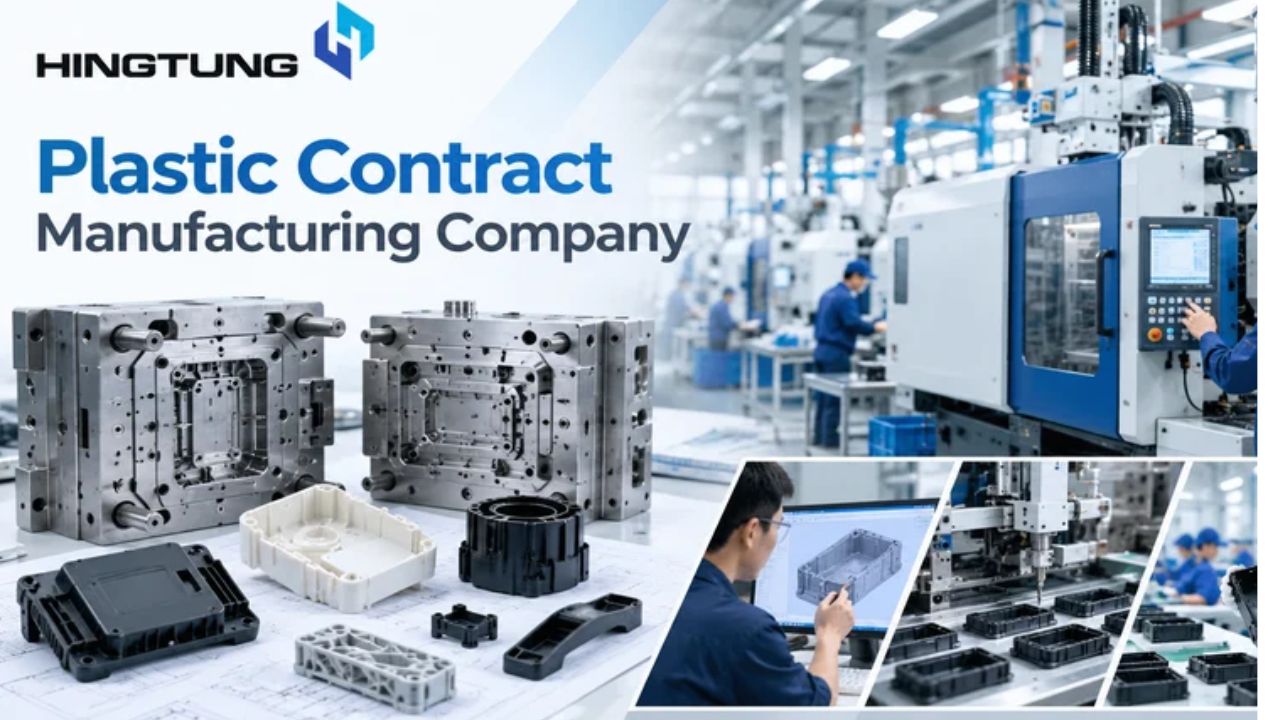
Choosing a plastic contract manufacturing company is not just about getting the lowest molding quotation. A project can look inexpensive at the start and become costly once tooling changes, inspection, secondary operations, and assembly are added.
For OEM projects, I would first check how the manufacturer connects engineering with production. HingTung, a China-based injection molding manufacturer established in 2011, combines DFM, in-house mold making, plastic molding, and assembly within one manufacturing workflow. That approach is particularly relevant when several production stages need to stay coordinated.
What Does a Plastic Contract Manufacturing Company Handle?
Contract manufacturing can cover much more than operating injection molding machines. The scope depends on the supplier and the finished component.
Some companies specialize in molding parts from customer-owned tools. Others take responsibility for tooling development, production, inspection, and downstream assembly.
| Manufacturing Stage | Typical Responsibility | Why It Matters |
| DFM review | Evaluate geometry, material, and molding risks | Reduces avoidable design changes |
| Mold manufacturing | Build and validate production tooling | Establishes production capability |
| Injection molding | Produce repeatable plastic components | Controls part consistency |
| Secondary processing | Machining, marking, joining, or finishing | Meets finished-part requirements |
| Quality inspection | Verify dimensions and functional criteria | Supports production approval |
| Assembly and packaging | Combine components and prepare shipment | Reduces separate supplier coordination |
For an OEM ordering a simple plastic cover, molding alone may be enough. An electronic enclosure with threaded inserts, a matching lid, and final assembly requirements needs a more coordinated process.
The difference becomes important when something goes wrong.
Where HingTung Fits into OEM Contract Manufacturing
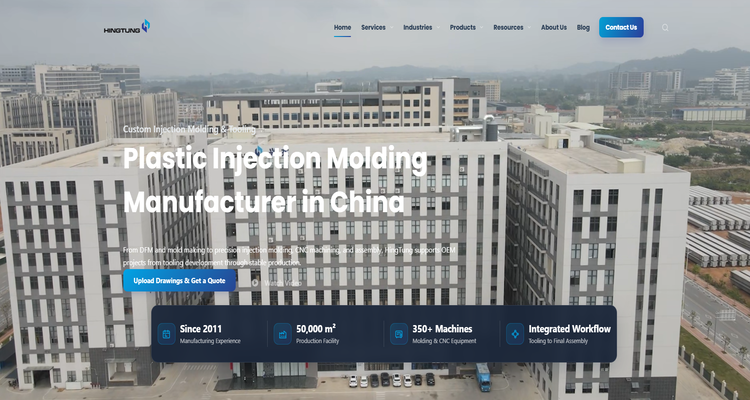
HingTung provides integrated custom plastic injection molding services with supporting mold manufacturing, CNC machining, secondary operations, inspection, and assembly.
Its manufacturing facility covers approximately 50,000 m² and contains more than 350 pieces of equipment, including over 80 injection molding machines with clamping capacities up to 650 tons.
The main advantage is not simply production capacity. It is the ability to coordinate multiple manufacturing operations without treating each one as an independent project.
Tooling and Molding Under One Workflow
Consider a plastic equipment housing that develops warpage during its first production trial.
The issue may involve wall thickness, gate location, mold cooling, packing pressure, or material behavior. Changing only the injection settings may not solve it.
When tooling and molding teams work within one manufacturing operation, engineers can review the mold, molded samples, and processing conditions together.
HingTung supports DFM, mold trials, tooling adjustments, and repeat production through this coordinated approach.
That does not eliminate the need for mold corrections. It can make responsibility and communication clearer when changes are necessary.
Secondary Operations and Assembly
Many OEM components are not finished when they leave the molding machine.
A housing may require ultrasonic welding, marking, hardware installation, inspection, and final packaging.
HingTung can coordinate these operations alongside injection molding. For projects involving several plastic parts or assembly steps, that reduces the number of separate production interfaces the customer must manage.
This is a practical reason to evaluate integrated plastic injection molding contract manufacturing rather than comparing molding prices alone.
Integrated Manufacturing vs. Multiple Suppliers
Using several specialized suppliers can work well. It may even be preferable when a project requires unusual finishing processes or geographically distributed production.
However, splitting tooling, molding, machining, and assembly across different companies introduces additional coordination.
| Evaluation Factor | Integrated Manufacturer | Multiple Specialized Suppliers |
| Engineering communication | More centralized | Requires cross-company coordination |
| Mold corrections | Tooling and molding teams work together | May require transfers and separate approvals |
| Production scheduling | Coordinated within one workflow | Depends on multiple schedules |
| Quality responsibility | Easier to establish one primary interface | Must be divided between suppliers |
| Specialized processes | Limited to available capabilities | Greater freedom to select specialists |
| Logistics | Potentially fewer intermediate shipments | More transfers between facilities |
An integrated approach is attractive when several manufacturing steps depend on one another.
But I would still verify which operations the supplier actually performs in-house and which are subcontracted. A company offering a one-stop service does not necessarily own every process it advertises.
What to Check Before Signing a Manufacturing Contract
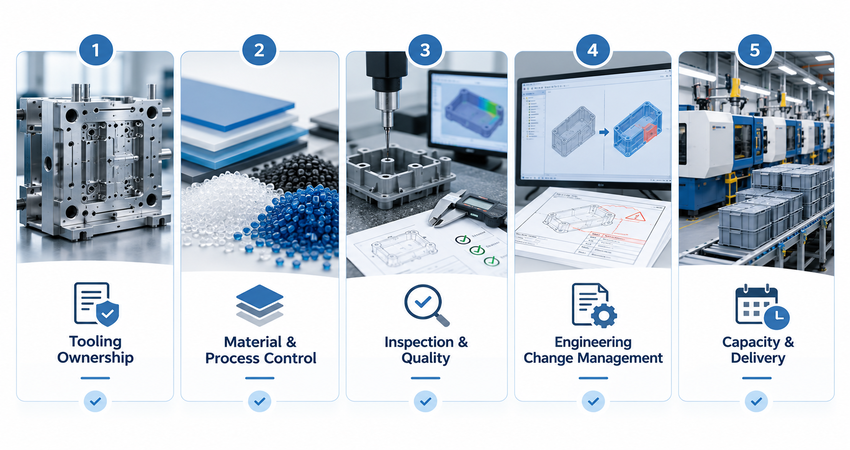
A capable plastic contract manufacturing company should be able to explain how it controls engineering changes, production quality, and commercial responsibilities.
I would review five areas before placing an OEM production order.
1. Tooling Ownership and Maintenance
Who owns the mold after the tooling invoice is paid?
The agreement should define mold ownership, storage, maintenance, repairs, and transfer rights.
It should also clarify who pays for modifications caused by engineering changes and how replacement tooling will be handled.
These details matter because the mold may remain in production for years.
2. Material and Process Control
The manufacturer should work from a defined resin grade rather than a generic description such as “ABS” or “nylon.”
A change in material supplier, filler content, or drying conditions can affect shrinkage, appearance, and mechanical properties.
For precision OEM parts, I would expect documented material requirements and agreed procedures for evaluating substitutions.
3. Inspection and Quality Responsibility
A visually acceptable plastic part may still fail assembly.
Critical dimensions should be identified on the drawing, with appropriate measurement methods and acceptance limits.
The supplier should also explain how nonconforming parts are identified, contained, investigated, and corrected.
For assemblies, testing should include functional fit rather than dimensional inspection alone.
4. Engineering Change Management
Design changes are common during product development and sometimes continue after production begins.
A reliable manufacturer should confirm which drawing revision is in production, how changes are approved, and whether old inventory remains.
Without this control, two visually similar versions of a plastic part can become mixed during assembly.
5. Production Capacity and Delivery Planning
Ask about machine availability, mold cavities, expected cycle time, material lead times, and the planned production schedule.
A supplier’s total machine count is useful background information, but it does not guarantee capacity for your particular mold or delivery window.
Why Total Project Cost Matters More Than Unit Price
The quoted cost per molded part is only one part of the manufacturing budget.
For example, a supplier offering a lower unit price may require separate arrangements for insert installation, inspection, assembly, or transportation between facilities.
A more useful comparison includes:
| Cost Element | What to Include |
| Tooling | Mold construction, trials, maintenance, modifications |
| Materials | Resin, additives, handling, and scrap |
| Molding | Cycle time, labor, setup, and machine use |
| Secondary operations | Machining, welding, marking, inserts |
| Quality control | Dimensional and functional inspection |
| Assembly | Labor, fixtures, and verification |
| Logistics | Packaging, shipping, inventory, and customs |
This is where an integrated manufacturer such as HingTung may offer value.
When tooling, molding, secondary operations, and assembly are coordinated, some intermediate handling and supplier-management costs can be reduced.
However, overseas shipping, inventory requirements, communication, and replenishment lead times must still be considered. A China-based supplier will not be the best fit for every short-notice local delivery requirement.
Choosing the Right Manufacturing Model
Not every OEM project needs the same supplier structure.
I would match the manufacturing model to the part complexity, production volume, and number of operations involved.
| OEM Requirement | Manufacturing Approach to Consider |
| Simple molded part using an existing tool | Dedicated injection molding supplier |
| Complex new plastic component | Tooling-led contract manufacturer |
| Several secondary operations | Integrated manufacturing provider |
| Molded components requiring assembly | Contract manufacturer with assembly support |
| Frequent local replenishment | Manufacturer near the assembly location |
| Multiple manufacturing processes | Coordinated multi-process supplier |
For tooling-intensive programs, I would favor a manufacturer that can explain the transition from mold trials to approved production.
For products requiring frequent engineering changes, technical communication and revision control may matter more than a small difference in quoted unit price.
What to Include in an OEM Manufacturing RFQ
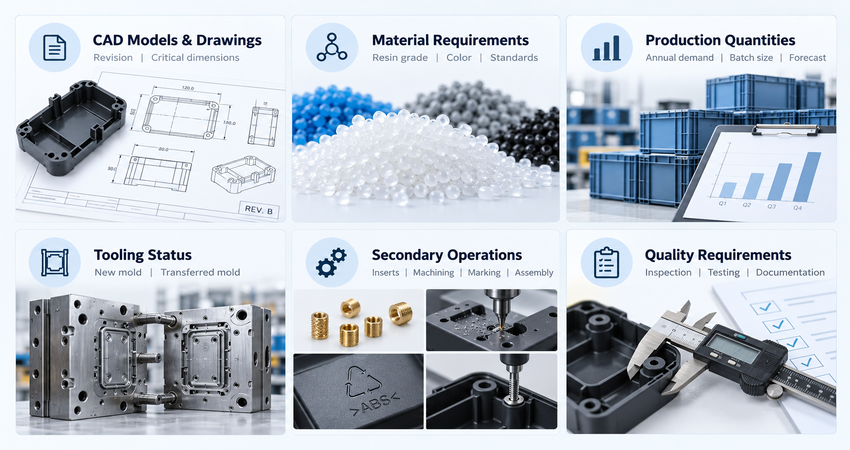
A good quotation starts with complete project information.
Before approaching plastic manufacturing companies, prepare:
- CAD models and drawings: Include the current revision and critical dimensions.
- Material requirements: Specify the resin grade, color, and applicable standards.
- Production quantities: Provide annual demand, batch sizes, and forecasts.
- Tooling status: Identify whether new tooling is needed or an existing mold will be transferred.
- Secondary operations: List inserts, machining, marking, joining, and assembly.
- Quality requirements: Define inspections, testing, documentation, and acceptance criteria.
For a project involving several processes, ask the supplier to separate one-time tooling costs from recurring production charges.
HingTung can review these requirements through its combined DFM, tooling, molding, and assembly workflow, helping establish the manufacturing scope before quotation.
FAQs
Can a contract manufacturer use customer-owned molds?
Often, yes. The manufacturer should first review machine compatibility, mold condition, cooling connections, hot-runner requirements, and maintenance history.
Should an OEM require a manufacturing agreement?
For ongoing production, a written agreement is advisable. It should address tooling ownership, confidentiality, approved specifications, quality responsibilities, change control, and commercial terms.
Can contract manufacturers manage packaging requirements?
Many can coordinate custom packaging and labeling. The OEM should provide packaging specifications, labeling information, handling requirements, and any relevant shipment testing criteria.
How can OEMs reduce supply disruption?
Qualified alternate materials, documented process settings, realistic demand forecasts, safety stock, and contingency plans can reduce exposure. The right measures depend on the component’s importance and replenishment lead time.
Conclusion
The right plastic contract manufacturing company should provide more than molding capacity. Engineering communication, tooling responsibility, quality control, and production coordination all influence the success of an OEM project.
HingTung combines DFM, mold manufacturing, injection molding, secondary operations, and assembly within one workflow. For OEM components involving several manufacturing stages, that integration is worth evaluating alongside total cost, delivery requirements, and actual production capability.
