
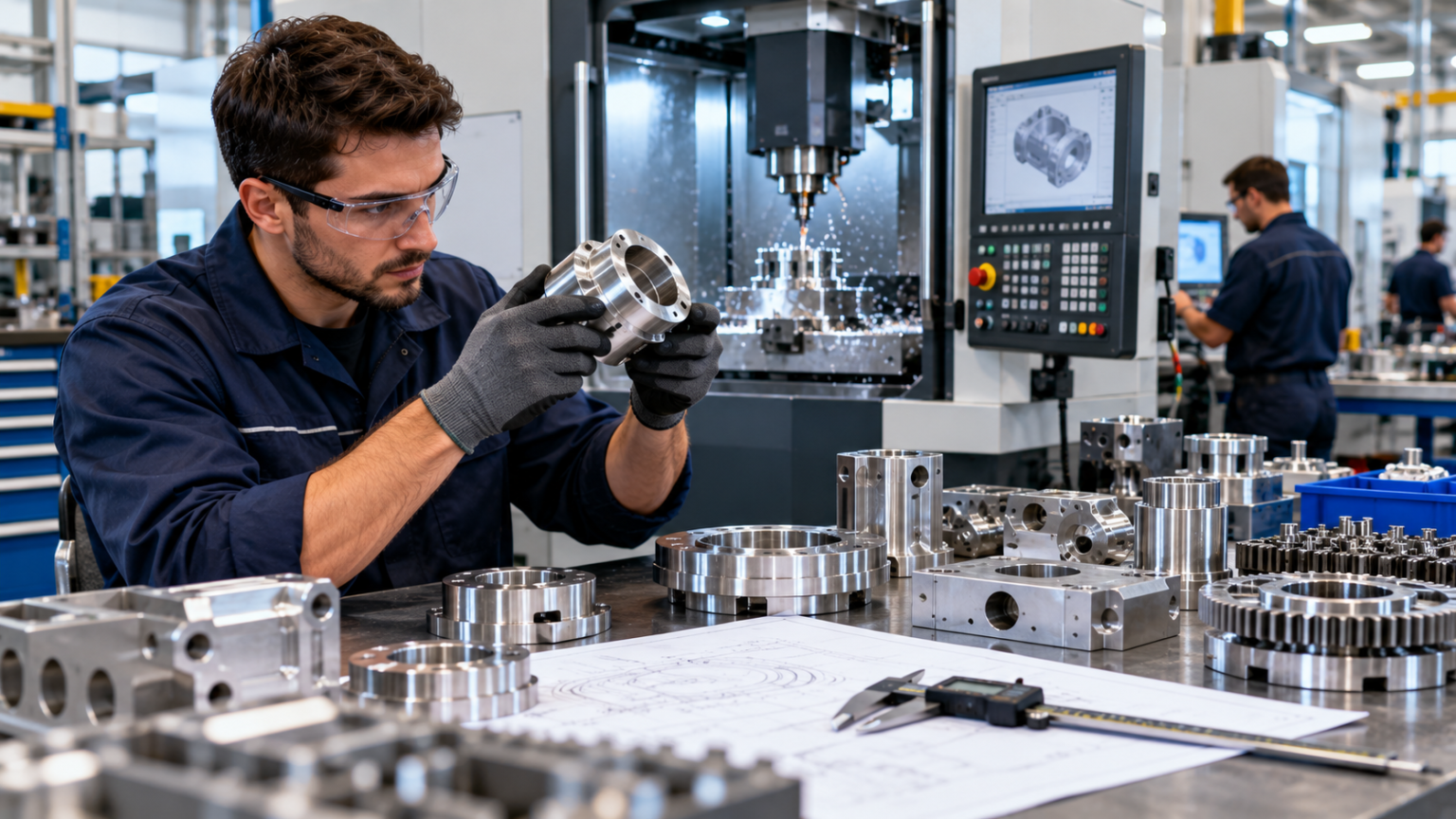
Many manufacturers struggle to meet tight part tolerances and keep costs low. Precision metalwork creates exact shapes and sizes down to tiny measurements. This article shows key techniques like CNC machining, laser cutting, and automation, and explains how they boost quality and speed.
Read on to learn practical steps.
The Role of Precision Metalwork in Modern Manufacturing
Precision metalwork plays a vital role in modern manufacturing. It ensures parts fit perfectly and last longer, which is crucial for many industries.
Ensuring Microscopic Dimensional Accuracy
Machines cut parts to tolerances as tight as 0.001 inch, about 25 microns. Computer numerical control, or CNC machining, keeps those sizes constant. Laser metrology and in-line probes check parts during runs.
Quality control teams stop defects before shipment.
Tight dimensions improve assembly in aerospace and medical devices. Metal fabrication shops use automation to repeat exact shapes. That practice lowers scrap and boosts production efficiency.
Supply chain partners expect consistent parts for final products.
Enhancing Structural Integrity and Durability
Precision engineering controls stress points in metal parts. CNC machining and advanced materials tighten tolerances. Metal fabrication teams follow strict quality checks to remove weak spots.
This raises structural integrity and extends service life.
Automated processes cut human error and keep dimensions exact. Robotic welding and precise joins improve durability in harsh use. Manufacturers tie quality checks to the supply chain to keep parts consistent.
Next, we look at industries that rely on this work.
Key Industries Relying on Precision Metalwork
Metal fabrication companies utilize advanced technologies to enhance their production efficiency and maintain high standards of quality.
Many industries depend on precision metalwork to thrive. These sectors use it for safety, efficiency, and innovation in their products.
Aerospace and Defense
Aerospace and defense parts demand tight tolerances down to microns. Precision engineering and CNC machining produce components that meet those strict specs.
High-strength alloys and advanced materials require exact metal fabrication and strict quality control. Automation and manufacturing technology speed production, reduce waste, and support the supply chain.
Automotive and Transportation
The automotive and transportation sectors depend heavily on precision metalwork. Parts like engine components and structural frames require high accuracy to function properly. Precision engineering helps create these parts with tiny measurements that ensure safety and performance.
Quality control is crucial in making sure that each piece meets strict standards.
Manufacturers use techniques like CNC machining for efficiency in production processes. This technology allows for fast, accurate cuts, improving productivity. Automation also plays a key role; it reduces labor costs while maintaining quality.
Together, these methods enhance the ability to produce reliable vehicles and transport systems efficiently. Advanced techniques in precision metalwork further improve manufacturing outcomes.
Medical Devices and Healthcare
Medical devices require high precision for safety and function. Precision metalwork plays a vital role in making these devices reliable. Products like surgical instruments, implants, and diagnostic machines depend on accurate measurements.
Even small errors can lead to serious problems in healthcare.
Manufacturers use advanced techniques to create medical devices that meet strict quality standards. CNC machining cuts materials with exactness, ensuring each part fits perfectly. Automation increases production speed while maintaining quality control.
This focus on precision supports the growing demand for innovative healthcare solutions and enhances patient care through dependable technologies.
Electronics and Technology
Precision metalwork plays a key role in electronics and technology. It ensures the tiny parts fit perfectly. These small components are crucial for devices like smartphones, laptops, and tablets.
Quality control is vital in this field. Manufacturers use techniques like CNC machining to create precise pieces consistently. Advanced materials can make products lighter and more durable.
This improves efficiency while keeping production costs low. As technology advances, the demand for high-quality metal fabrication will only grow stronger.
Advanced Techniques in Precision Metalwork
Advanced techniques in precision metalwork include laser cutting and CNC machining, which create precise parts quickly. These methods improve production speed and quality. Explore how these innovations are shaping the future of manufacturing.
Laser Cutting and CNC Machining
Laser cutting is a precise method for shaping metal. This technique uses focused lasers to cut through materials with great accuracy. It creates clean edges and thin cuts, reducing waste.
Laser cutters can handle various metals like steel and aluminum quickly.
CNC machining stands for Computer Numerical Control machining. It uses computers to control tools that carve out shapes from metal blocks. CNC machines work fast and ensure uniformity in production runs.
Both laser cutting and CNC machining support precision engineering in manufacturing technology today. These advanced methods lead to better quality control and improved efficiency in factories.
Robotic Welding and Automation
Robotic welding improves production efficiency in factories. Robots perform welding tasks faster than humans and with high precision. They work in a controlled environment, reducing errors and waste.
This technology allows manufacturers to produce more parts in less time.
Automation streamlines various processes beyond welding. Machines can handle loading, unloading, and quality checks without breaks. This constant operation lowers labor costs while enhancing consistency in output.
With robotic systems, companies adapt quickly to changes in demand as well.
3D Metal Printing for Prototyping
3D metal printing makes prototyping faster and cheaper. This method allows engineers to create parts quickly, directly from digital models. With this technology, they can test designs before moving to mass production.
It reduces waste by using only the needed materials.
Many industries benefit from 3D metal printing. Aerospace and automotive sectors use it for complex components that need precision. Medical device makers also find it useful for creating custom implants or tools.
This technique supports innovation in manufacturing while keeping costs down and speeding up production timelines.
Benefits of Precision Metalwork in Manufacturing
Precision metalwork boosts efficiency in manufacturing. It helps produce high-quality parts quickly and at lower costs.
Improved Efficiency and Productivity
Efficiency and productivity improve greatly with precision metalwork. This process ensures that parts fit together perfectly. High-quality parts reduce waste during production. Companies can produce more in less time, making their operations smoother.
Automation plays a key role too, speeding up tasks like cutting and welding.
Cost savings also come from improved efficiency. Less material waste means lower costs for manufacturers. Quick production times allow companies to meet customer demands promptly. Industries using precision engineering can adapt easily to changes in the market while maintaining high standards of quality control.
Cost-Effective Production Processes
Precision metalwork lowers production costs. Efficient methods, like CNC machining and robotic welding, speed up processes. These techniques reduce waste and save materials. Less waste means less spending on raw materials.
Automation plays a key role in cost savings. Robots work faster than humans and can run longer hours without breaks. This helps factories produce more goods at lower prices. Precision engineering also improves quality control, leading to fewer defects and reworks, which keeps costs down further.
Conclusion
Precision metalwork is essential to modern manufacturing. It ensures high accuracy and strength in products. Many industries depend on it, from aerospace to healthcare. Advanced techniques like CNC machining and 3D printing enhance efficiency.
In summary, precision metalwork fuels innovation and productivity in today’s factories.
