
Reliable electricity is essential for everyday life. From running ceiling fans and refrigerators to supporting computers, lighting, and internet connections, households depend on a steady power supply. When electricity interruptions occur, a practical backup solution can help families continue important activities without unnecessary disruption.
A solar IPS BD system offers an approach that combines battery backup with solar energy. Instead of relying exclusively on grid electricity to recharge batteries, a compatible solar IPS can use electricity generated by rooftop solar panels. Depending on the system design, this can improve energy independence and reduce reliance on purchased electricity.
However, selecting the right solar backup solution involves more than comparing inverter prices. Buyers need to understand appliance loads, battery capacity, solar panel compatibility, inverter efficiency, installation requirements, and long-term maintenance expenses.
A system that is too small may struggle to support essential appliances. An oversized system can increase initial costs without providing meaningful additional value.
This guide explains seven practical considerations for choosing a reliable solar IPS system in Bangladesh, including equipment types, sizing calculations, market prices, and installation recommendations.
What Is a Solar IPS System?
A solar IPS is a power backup system that combines inverter technology, battery storage, and compatible solar charging equipment.
In Bangladesh, IPS commonly refers to an Instant Power Supply system that provides electricity from batteries when grid power becomes unavailable.
A traditional IPS generally charges its battery using electricity from the utility grid.
A solar IPS adds the ability to use energy generated by solar panels.
Depending on its design, the system may support charging from sunlight, the electricity grid, or both.
How Does a Solar IPS Work?
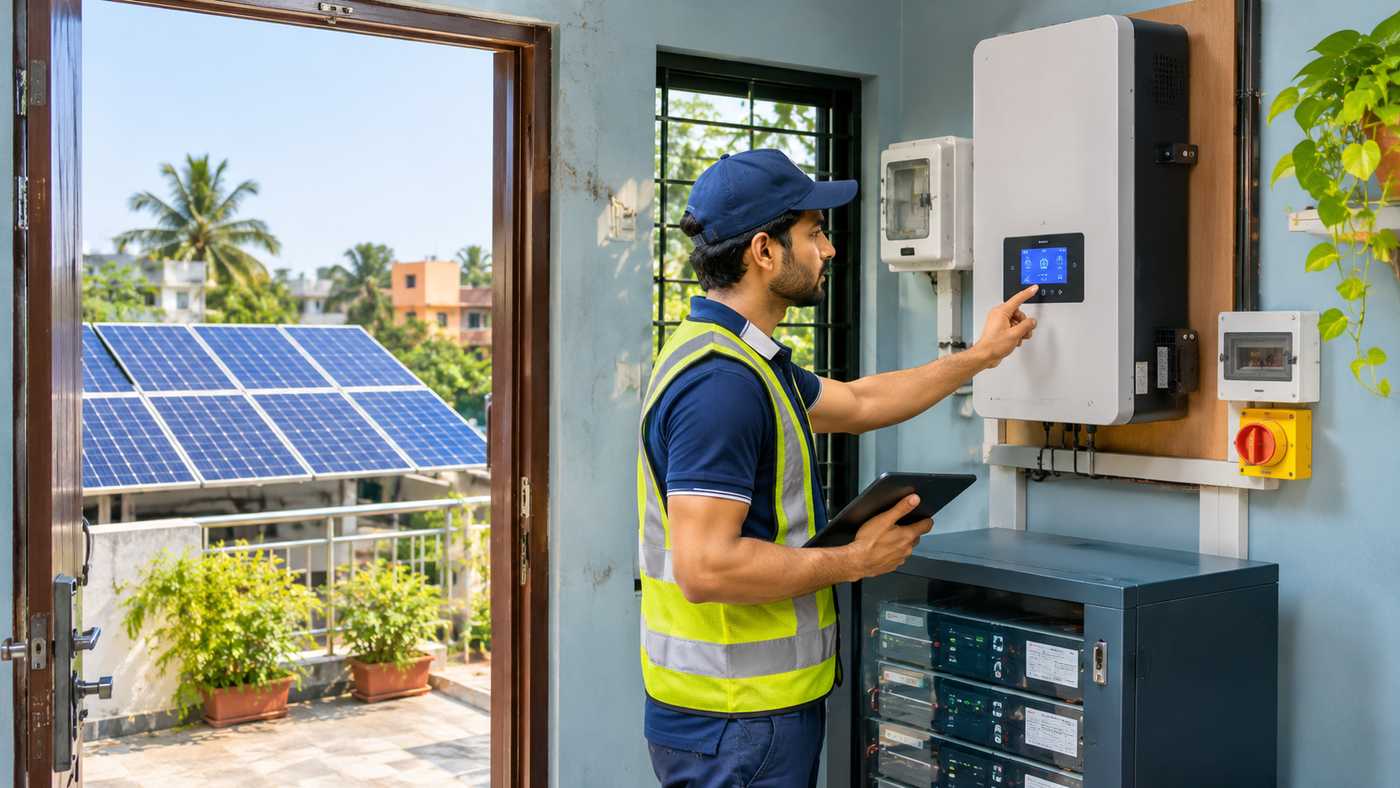
A typical solar backup system includes several interconnected components.
Solar panels: Photovoltaic panels convert sunlight into direct current electricity.
Solar charge controller: A compatible controller regulates energy delivered from the panels to the battery. Some inverters include this function internally.
Battery storage: Batteries store electrical energy for later use.
Inverter: The inverter converts direct current electricity into alternating current suitable for compatible household appliances.
Grid charging connection: Hybrid systems may also use utility power to charge batteries or supply household loads.
During daylight hours, solar electricity may power supported appliances, recharge batteries, or perform both functions, depending on the system configuration.
When sunlight is unavailable, the battery can provide backup power until its usable energy is depleted.
Why Solar IPS Is Popular for Backup Applications
Solar backup systems can be useful for homes, offices, small shops, and locations where maintaining essential electrical services is important.
They may support lighting, fans, routers, computers, and certain appliances during interruptions.
Actual performance depends on system capacity, environmental conditions, battery state of charge, and equipment specifications.
1. Calculate Your Household Electricity Requirements
The first step in selecting a solar IPS BD system is determining how much electricity your appliances require.
Buyers sometimes choose an inverter based on its advertised power rating without calculating the total load.
This can result in poor performance or unnecessary expense.
Create an Appliance Load List
Begin by identifying the devices that must operate during a power interruption.
For example:
| Appliance | Quantity | Estimated power | Total |
|---|---|---|---|
| LED lights | 5 | 10 W | 50 W |
| Ceiling fans | 3 | 65 W | 195 W |
| Wi-Fi router | 1 | 12 W | 12 W |
| Laptop | 1 | 60 W | 60 W |
| Television | 1 | 80 W | 80 W |
| Total estimated load | 397 W |
These values are illustrative. Actual appliance consumption should be checked using manufacturer labels, specifications, or appropriate measurements.
Include Starting Power Requirements
Some appliances require more electricity when starting than during normal operation.
Refrigerators, pumps, and motor-driven equipment can create temporary power demands.
The inverter must be capable of handling both continuous power requirements and relevant starting surges.
A system rated for a certain continuous load may not support every appliance whose normal operating power falls below that figure.
Allow Practical Capacity Headroom
Operating an inverter continuously near its maximum rated output may reduce flexibility.
A reasonable capacity margin can help accommodate changing loads, although the appropriate margin depends on the equipment and expected usage.
Work with a qualified supplier or installer to determine the necessary output rating.
2. Understand Different Types of Solar IPS Inverters
Not every inverter sold for solar applications performs the same functions.
Understanding the main categories makes product comparisons easier.
Off-Grid Solar Inverters
Off-grid inverters are designed to supply electricity without depending on a continuous utility-grid connection.
Many configurations use batteries to stabilize power availability.
These systems can be useful for remote properties and locations requiring independent electrical supply.
However, their performance depends on adequate solar generation, battery storage, and correct system sizing.
Hybrid Solar Inverters
Hybrid systems can coordinate multiple energy sources, such as solar panels, batteries, and grid electricity.
Their exact operating modes vary by model.
Some provide automatic source switching, programmable charging priorities, and battery management features.
A hybrid inverter may be appropriate for households that want both daytime solar energy and backup functionality.
Grid-Tied Solar Inverters
Conventional grid-tied inverters are designed to operate alongside the electricity grid.
Many standard grid-tied systems automatically stop exporting power during outages for safety.
Therefore, buying a grid-tied solar inverter does not automatically provide battery backup.
If uninterrupted operation is required, the system must include compatible backup hardware and appropriate electrical isolation.
Pure Sine Wave vs. Modified Sine Wave
Inverters also differ in their output waveforms.
Pure sine wave inverters produce output designed to closely resemble conventional AC power.
They are often preferable for a broad range of household electronics and motor-driven appliances.
Modified sine wave equipment may be less expensive but can create compatibility problems with certain devices.
Always confirm appliance compatibility and manufacturer requirements before choosing an inverter.
3. Choose the Right Battery for Your Solar IPS BD System
Battery selection plays an essential role in determining backup duration, maintenance needs, and long-term ownership costs.
Even a powerful inverter cannot provide extended backup without sufficient usable battery capacity.
Lead-Acid Batteries
Lead-acid batteries are widely used in backup applications.
Their main advantage is that certain types have a relatively affordable initial purchase price.
However, they can be heavy and may require more frequent replacement than suitable lithium alternatives.
Some flooded lead-acid batteries also require electrolyte maintenance and appropriate ventilation.
Tubular Batteries
Tubular batteries are a form of lead-acid technology often used in inverter and backup applications.
They are designed for repeated charging and discharging.
Their durability depends on operating conditions, charging configuration, temperature, and discharge depth.
Lithium Iron Phosphate Batteries
Lithium iron phosphate, commonly called LiFePO4, is used in many modern energy storage systems.
Potential advantages include high usable capacity, relatively low routine maintenance, and long cycle life under suitable operating conditions.
However, lithium batteries generally require appropriate battery management systems and compatible charging equipment.
They may also have a higher initial cost.
Compare Battery Options
| Feature | Lead-acid/tubular | LiFePO4 |
|---|---|---|
| Initial cost | Often lower | Often higher |
| Weight | Generally heavier | Generally lighter |
| Usable energy | Typically more limited | Often higher |
| Maintenance | Depends on battery type | Usually lower |
| Cycle life | Depends on design and operation | Can be substantially longer |
| Compatibility | Requires correct charging settings | Requires compatible inverter and BMS |
Neither battery type should be selected solely by its advertised ampere-hour rating.
Voltage, usable energy, permitted discharge depth, and supported current are equally important.
How to Estimate Battery Backup Time
Battery energy can be approximated using:
Battery energy (Wh) = Battery voltage (V) × Capacity (Ah)
For example, a 12V, 200Ah battery has a nominal capacity of:
12 × 200 = 2,400 Wh.
This does not mean that all 2,400 Wh will be available to household appliances.
Actual usable energy depends on battery chemistry, permitted discharge depth, inverter losses, battery age, and operating conditions.
For an illustrative lead-acid arrangement with 50% usable discharge and 85% inverter efficiency:
2,400 × 0.50 × 0.85 = 1,020 Wh.
At a constant 400W load, the estimated backup duration would be:
1,020 ÷ 400 = 2.55 hours.
This is only a simplified planning estimate. Real performance can differ significantly.
4. Select Compatible Solar Panels and Charging Technology
Solar panels determine how much energy a solar IPS system can harvest from sunlight.
Panel selection should reflect both household energy needs and the inverter’s technical limits.
Understand Solar Panel Wattage
Solar panels are commonly rated in watts under standardized testing conditions.
Actual power generation changes with sunlight intensity, temperature, shading, dust, and installation angle.
A panel rated at 550W will not continuously generate 550W throughout the day.
Estimate Daily Solar Energy Production
A simplified estimate uses:
Daily energy (Wh) ≈ Panel capacity (W) × Peak sun hours × Performance factor
Suppose a system uses 1,100W of solar panels.
If the site receives an illustrative 4 peak sun hours and the overall performance factor is 0.75:
1,100 × 4 × 0.75 = 3,300 Wh.
The approximate daily output would be 3.3 kWh under those assumptions.
Actual production in Bangladesh varies with location, season, cloud cover, shading, panel orientation, and equipment.
Professional solar design should use relevant site-specific information rather than relying on a single generic estimate.
MPPT vs. PWM Charge Controllers
Solar charging equipment commonly uses maximum power point tracking (MPPT) or pulse-width modulation (PWM) technology.
MPPT controllers can adjust operating conditions to extract more useful power from the solar array under appropriate conditions.
PWM controllers are generally simpler but may be less efficient in certain panel and battery combinations.
The correct choice depends on the complete system design.
Check Voltage Compatibility
Solar panels and inverters must operate within compatible voltage and current limits.
Check:
- Maximum photovoltaic input voltage
- MPPT operating voltage range
- Maximum solar charging current
- Supported battery voltage
- Maximum permitted solar array capacity
- Solar connector and protection requirements
Incorrect electrical configurations can damage equipment or create serious hazards.
A qualified installer should verify the design before connecting components.
5. Compare Solar IPS Prices in Bangladesh
The price of a solar IPS system depends on its inverter rating, included features, battery technology, solar panels, and installation requirements.
When comparing products, distinguish between an inverter-only listing and a complete solar backup package.
Example Market Prices
IPS Bazar BD lists several solar inverter models across different capacity ranges.
Examples displayed on its solar IPS category page include:
| Solar inverter model | Listed price |
|---|---|
| Microtek 1450 Solar IPS | ৳15,960 |
| Luminous Solar Home UPS NXG 1450 | ৳20,425 |
| SAKO E-SUN 2K 12V MPPT | ৳32,775 |
| Anern SCI-EVO-3200 Hybrid Solar IPS | ৳44,000 |
| SUNON Pro 5.5kW Off-Grid Solar IPS | ৳59,375 |
| Growatt SPF 3500 ES Off-Grid IPS | ৳80,750 |
These are advertised examples from the seller’s page, not guaranteed current transaction prices. Specifications, availability, discounts, and included accessories should be confirmed directly before purchasing.
Where to Compare Available Models
Buyers researching solar IPS BD can explore the IPS Bazar BD solar inverter category to compare models from brands such as Microtek, Luminous, Anern, Growatt, and SUNON.
The retailer also provides information on solar panels, batteries, charge controllers, and related components.
Comparing different equipment categories can help buyers understand the complete cost of building a suitable backup system.
What Affects Total Installation Cost?
Major expenses may include:
- Inverter unit
- Solar panels
- Battery storage
- Panel mounting structures
- DC and AC protection equipment
- Wiring and connectors
- Installation labor
- Battery enclosure or cabinet
- Maintenance and future replacements
A lower-priced inverter may require additional equipment before it can operate as a complete solar backup solution.
Request a detailed quotation that clearly identifies all included components.
6. Prioritize Professional Installation and Electrical Safety
Solar backup systems involve DC electricity, AC power, batteries, and switching equipment.
Improper installation can cause equipment failure, electric shock, fire, or unsafe interaction with the utility grid.
Conduct a Site Assessment
A professional installer should evaluate roof conditions, available space, shading, electrical distribution, and battery placement.
The assessment should also consider ventilation, access for maintenance, and structural suitability.
Install Correct Electrical Protection
Appropriate system designs may require circuit breakers, fuses, disconnects, surge protection, grounding, and other protective components.
The exact requirements depend on the system configuration and applicable standards.
Electrical protection should not be improvised or omitted to reduce installation costs.
Prevent Unsafe Grid Backfeeding
Backup inverters must be connected using appropriate switching and isolation arrangements.
Improper connections can energize circuits unexpectedly and endanger occupants or utility workers.
Grid-connected solar systems should comply with applicable utility and regulatory requirements in Bangladesh.
Ensure Suitable Battery Installation
Battery systems need appropriate physical protection.
Flooded lead-acid batteries require attention to ventilation and maintenance requirements.
Lithium systems require compatible charging arrangements, battery management, and protection according to their design.
Installers should follow the battery manufacturer’s instructions and applicable electrical safety standards.
Test the System Before Use
Commissioning should include verification of protection devices, charging behavior, inverter output, backup transfer, and system settings.
Homeowners should also receive practical instructions explaining safe operation and emergency shutdown procedures.
7. Maintain Your Solar IPS for Long-Term Performance
Regular maintenance helps preserve system reliability.
Although solar backup systems can automate many daily functions, they are not entirely maintenance-free.
Keep Solar Panels Clean
Dust, dirt, and debris can reduce the sunlight reaching the solar cells.
Cleaning requirements depend on local conditions.
Use manufacturer-approved cleaning procedures and appropriate fall protection.
Do not access rooftops or electrical equipment without suitable training and precautions.
Monitor Battery Condition
Battery performance can decline over time.
Unexpected reductions in backup duration may indicate battery aging, incorrect charging, excessive loads, or other problems.
Some modern systems provide monitoring through a display or mobile application.
Check Inverter Warnings
Many solar inverters display warnings when they detect abnormal operating conditions.
Common alerts may relate to battery voltage, temperature, overloads, or charging problems.
Consult the manufacturer’s instructions and contact qualified service personnel when necessary.
Schedule Periodic Inspections
A qualified technician can inspect connections, ventilation, mounting components, protective devices, and overall system operation.
Maintenance intervals should follow manufacturer recommendations and local site conditions.
Plan for Future Energy Requirements
Household electricity demand may increase when families add appliances or change their daily routines.
Before expanding the system, confirm whether the inverter, batteries, wiring, protection equipment, and solar charging components can support the additional load.
Solar IPS vs. Normal IPS: Which Is Better?
Both options can provide useful backup power, but their capabilities differ.
| Feature | Normal IPS | Solar IPS |
|---|---|---|
| Primary charging | Grid electricity | Solar, grid, or both depending on design |
| Solar panel compatibility | Not always supported | Supported in suitable configurations |
| Initial cost | Often lower | Often higher |
| Backup storage | Battery-based | Battery-based |
| Grid electricity reduction | Limited | Possible with sufficient solar generation |
| Installation | Generally simpler | More components and design considerations |
| Best suited for | Straightforward backup | Backup combined with solar energy use |
When a Normal IPS Makes Sense
A conventional IPS may be suitable when electricity interruptions are relatively short and the homeowner needs a simple battery-based backup system.
The initial cost may be lower, especially when rooftop solar installation is impractical.
When a Solar IPS Makes Sense
A solar IPS may be preferable when the property has suitable solar exposure and the household wants to use solar electricity alongside backup storage.
However, financial savings depend on actual solar generation, system costs, electricity consumption, and grid tariffs.
Neither option is automatically better for every household.
How to Choose a Solar IPS for Different Household Needs
Small Apartment or Compact Home
A smaller system may be sufficient for essential lights, fans, and internet equipment.
Focus on accurate load calculations and sufficient battery backup rather than purchasing excessive inverter capacity.
Medium-Sized Family Home
A medium-sized household may need to support multiple fans, lighting circuits, televisions, and other essential appliances.
The appropriate configuration will depend on simultaneous power demand and required backup duration.
Home Office
People working remotely may prioritize internet routers, laptops, monitors, and communication equipment.
Power quality and transfer behavior are important, especially for sensitive electronics.
A suitable UPS may still be necessary for devices that cannot tolerate even brief switching interruptions.
Small Business or Retail Shop
Shops and offices may need backup for lighting, billing terminals, security systems, and computers.
A professional energy assessment can help determine whether separate circuits or higher-capacity equipment are required.
Common Mistakes to Avoid When Buying a Solar IPS
Ignoring Battery Capacity
A large inverter rating does not guarantee extended backup.
Battery capacity and usable stored energy determine how long loads can operate.
Choosing Incompatible Equipment
An inverter, battery, and solar array must operate within the required electrical limits.
Always verify specifications before purchasing.
Assuming Every Solar Inverter Provides Backup
Some grid-tied inverters do not operate during outages unless compatible backup equipment is installed.
Check the exact features.
Buying Based Only on Price
Low-cost equipment may not provide the required power capacity, electrical protection, warranty support, or reliability.
Compare the complete system rather than one component.
Overestimating Electricity Savings
Actual savings depend on solar production, electricity usage, installation expenses, and system design.
Avoid relying on promotional savings claims without calculations.
Solar IPS Buying Checklist for Bangladesh
Before purchasing, review the following:
| Requirement | What to verify |
|---|---|
| Load capacity | Total running watts and starting demand |
| Inverter type | Off-grid, hybrid, or grid-tied |
| Output waveform | Appliance compatibility |
| Battery type | Lead-acid, tubular, or lithium |
| Battery capacity | Required usable backup energy |
| Solar panels | Capacity, location, and shading |
| Charge controller | MPPT/PWM and electrical limits |
| Electrical protection | Appropriate breakers, fuses, and isolation |
| Installation | Qualified design and testing |
| Warranty | Coverage and service conditions |
| Budget | Complete installed cost |
| Maintenance | Accessibility and replacement availability |
The Future of Solar Backup Power in Bangladesh
Solar backup technology continues to evolve through improvements in battery storage, inverter electronics, and energy management software.
Lithium batteries, hybrid inverters, and digital monitoring features are creating additional options for households seeking more flexible backup arrangements.
As equipment becomes more sophisticated, consumers will need clear information about compatibility, usable capacity, safety, and long-term costs.
The most successful solar backup installations will not necessarily be the largest or most expensive.
They will be systems designed around realistic electricity requirements, suitable solar conditions, and dependable maintenance.
Frequently Asked Questions
1. What is the price of solar IPS in Bangladesh?
Solar IPS prices vary by inverter rating, brand, battery capacity, and included equipment. Some inverter-only models are listed from approximately ৳14,000, while larger inverters and complete battery-and-panel packages can cost substantially more.
2. Can a solar IPS run fans, lights, and a refrigerator?
Yes, a properly sized system may support these appliances. Refrigerator starting requirements, inverter surge capability, and usable battery capacity must be considered.
3. Is lithium battery better than tubular battery for solar IPS?
LiFePO4 batteries can offer longer cycle life and more usable capacity under suitable conditions, while tubular lead-acid batteries may have a lower initial cost. The best choice depends on budget, compatibility, and expected usage.
4. Can solar IPS work at night?
Yes, if the system includes appropriately charged batteries. Nighttime backup duration depends on stored energy, inverter efficiency, and connected electrical loads.
Conclusion
A solar IPS BD system can provide practical backup electricity while making use of renewable solar energy.
Choosing the right inverter, battery, and panel configuration requires accurate load calculations, safe installation, and realistic budgeting.
By comparing specifications, understanding maintenance requirements, and working with qualified installers, households in Bangladesh can select a solar backup system suited to their everyday energy needs.
