
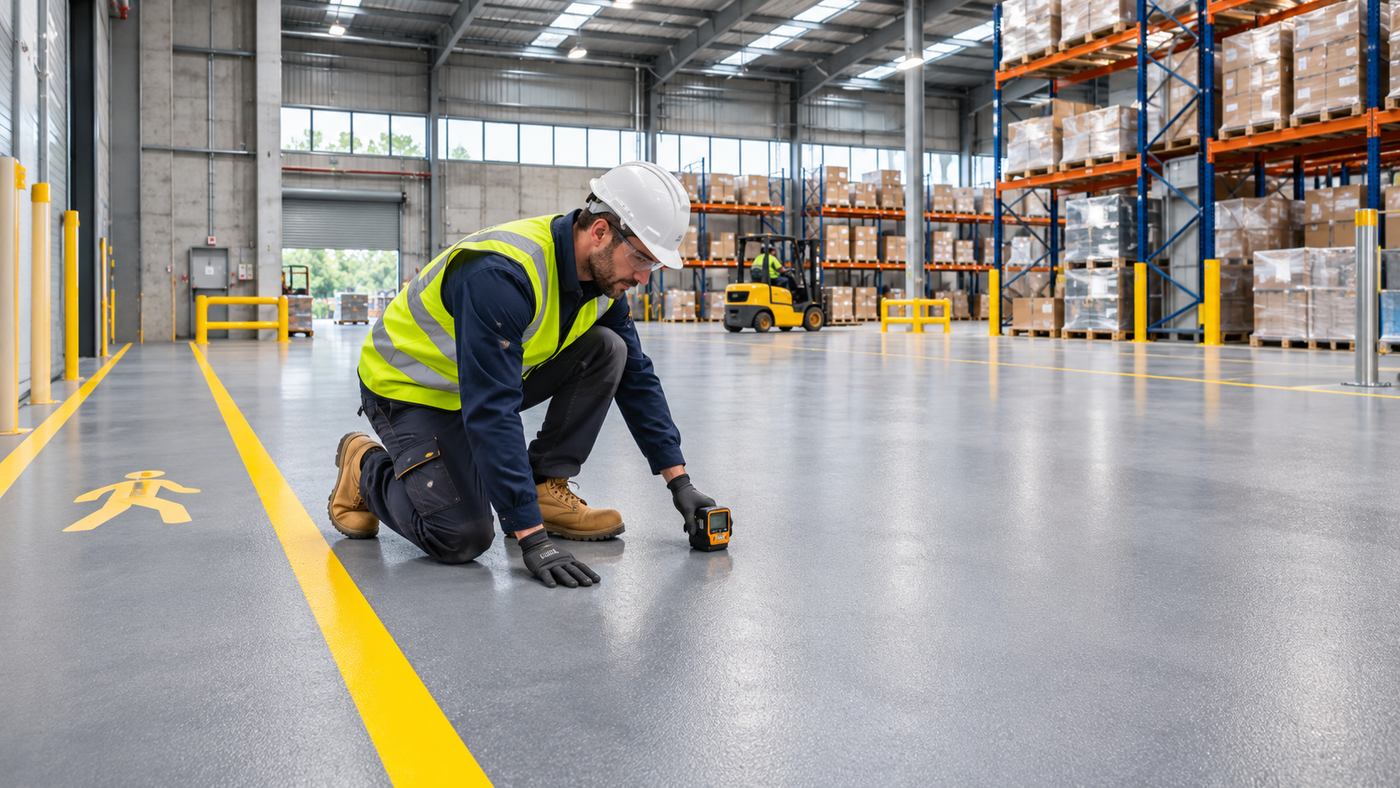
Warehouses are demanding industrial environments where flooring must withstand constant movement, heavy equipment, stored goods, and frequent cleaning. From distribution centres and manufacturing facilities to storage warehouses and logistics hubs, the condition of the floor can influence safety, productivity, maintenance costs, and operational reliability.
Choosing the right warehouse flooring is therefore more important than selecting a surface that simply looks clean and professional. Industrial floors must be appropriate for forklifts, pallet jacks, shelving systems, chemical exposure, and the everyday activities taking place inside the facility.
In Australia, warehouse operators must also consider workplace safety requirements, slip resistance, surface durability, and the condition of the underlying concrete.
Modern flooring options include industrial epoxy coatings, polyurethane cement, polyaspartic systems, methyl methacrylate (MMA) coatings, and mechanically treated concrete surfaces.
However, no single coating is ideal for every warehouse. The right solution depends on traffic intensity, loading conditions, environmental exposure, cleaning requirements, and available installation downtime.
This guide explains seven important factors when choosing industrial warehouse flooring, compares popular materials, and outlines practical ways to improve floor performance and long-term value.
What Is Warehouse Flooring?
Warehouse flooring refers to the structural floor and any surface treatment or coating used in industrial storage, distribution, and manufacturing facilities.
Most modern warehouses use concrete slabs because concrete provides a strong foundation for industrial operations.
However, untreated concrete may generate dust, absorb certain contaminants, develop surface wear, or require repairs over time.
Specialized flooring systems can improve selected surface properties and make the floor more suitable for particular operating conditions.
Why Warehouse Flooring Matters
A warehouse floor supports several essential activities, including:
- Forklift and pallet-jack movement
- Heavy inventory storage
- Racking and shelving systems
- Loading and unloading operations
- Employee and visitor movement
- Industrial cleaning procedures
- Equipment positioning
- Manufacturing and packaging activities
The floor must perform reliably under these conditions.
An unsuitable surface can increase maintenance requirements, affect equipment movement, and introduce safety hazards.
Common Warehouse Flooring Materials
Popular industrial flooring options include epoxy resin, polyurethane cement, polyaspartic coatings, MMA systems, polished concrete, and grind-and-seal finishes.
Each provides different characteristics.
The selection should follow a detailed assessment of the warehouse’s operating requirements.
1. Choose Flooring That Can Withstand Heavy Industrial Traffic
Traffic intensity is one of the most important factors affecting industrial floor performance.
A warehouse handling occasional light deliveries requires different surface characteristics from a busy distribution centre operating forklifts throughout the day.
Forklift Traffic
Forklifts apply concentrated wheel loads to the floor.
Repeated movement can contribute to surface wear, particularly in turning zones, loading areas, and frequently used routes.
The flooring specification should account for vehicle types, wheel materials, loading patterns, and operating frequency.
A coating’s abrasion resistance does not automatically establish that the underlying concrete slab can support structural loads.
Pallet Jacks and Material Handling
Manual and powered pallet jacks also create repeated contact with the surface.
Uneven concrete, damaged joints, and surface defects can affect equipment movement.
Repairing these problems may be necessary before installing a new coating.
Heavy Storage Systems
High-bay racking systems can create substantial loads at individual support points.
The floor’s structural design must accommodate those loads.
A decorative or protective coating cannot correct an inadequate slab foundation.
Where structural capacity is uncertain, consult an appropriately qualified engineer.
Selecting a Suitable Surface
For high-traffic facilities, consider systems designed for industrial abrasion and impact resistance.
Ask suppliers for technical data relevant to the actual operating environment.
Do not select a material solely because it is described as heavy-duty.
2. Compare Different Warehouse Flooring Systems
Understanding the main industrial flooring options helps businesses identify suitable materials.
Epoxy Warehouse Flooring
Epoxy flooring uses a resin-based coating system applied to a properly prepared substrate.
Depending on the formulation and installation, epoxy can provide abrasion resistance, chemical resistance, and a cleanable surface.
It is commonly used in warehouses, workshops, factories, and commercial environments.
However, different epoxy systems have different thicknesses and performance characteristics.
A basic coating should not be confused with a heavy-duty industrial flooring specification.
Polyurethane Cement Flooring
Polyurethane cement, sometimes called PU cement, combines resin technology with cementitious components.
Selected systems can be suitable for demanding industrial conditions involving moisture, chemical exposure, and temperature changes.
Certain formulations offer strong resistance to thermal shock.
This can make them useful in food-processing areas, industrial washdown facilities, and selected manufacturing environments.
Product-specific performance must be verified.
Polyaspartic Floor Coatings
Polyaspartic coatings are often selected for their curing characteristics and surface protection properties.
Depending on formulation, they can provide abrasion resistance and decorative finishing options.
Some systems are suitable for commercial and industrial traffic.
Installation conditions and substrate preparation remain critical.
Methyl Methacrylate Flooring
MMA systems are known for rapid curing when applied under appropriate conditions.
They may be useful when a facility cannot tolerate prolonged shutdowns.
However, application requires appropriate ventilation, professional handling, and compliance with product safety requirements.
Polished Concrete
Polished concrete involves mechanically grinding and refining the concrete surface.
It can provide a durable appearance and reduce certain maintenance concerns when designed appropriately.
However, polishing changes the surface characteristics and does not automatically produce the chemical resistance of a purpose-designed resin system.
Warehouse Flooring Comparison
| Flooring type | Main advantage | Important consideration |
|---|---|---|
| Epoxy coating | Durable, cleanable surface | Preparation and curing |
| PU cement | Chemical and thermal resistance | Correct system specification |
| Polyaspartic | Surface protection and curing options | Product and substrate compatibility |
| MMA flooring | Rapid return-to-service potential | Specialist installation |
| Polished concrete | Mechanically refined concrete | Slip and contamination conditions |
| Grind and seal | Surface protection with simpler finish | Maintenance and wear requirements |
There is no universally superior option.
The correct system depends on actual warehouse operations.
3. Prioritize Slip Resistance and Workplace Safety
Warehouse floors must support safe movement by workers and equipment.
Slip resistance is an important consideration, particularly in environments exposed to moisture, dust, grease, and cleaning products.
Understand Slip Hazards
A floor may become slippery because of:
- Water spills
- Oil or grease contamination
- Dust accumulation
- Incorrect cleaning products
- Worn surface textures
- Smooth coatings
- Changes in floor level
Slip resistance should be evaluated under relevant operating conditions.
A surface that performs adequately when dry may behave differently when wet.
Follow Australian Safety Guidance
Safe Work Australia advises that floor surfaces should suit expected work activities and be inspected and maintained regularly.
WorkSafe Victoria also identifies the importance of choosing finishes appropriate for both the environment and the intended use.
These principles support a risk-based approach rather than assuming that one texture or coating is safe for every application.
Consider Slip-Resistant Additives
Some industrial coatings can incorporate suitable aggregates or textured finishes to increase grip.
However, additional texture can make cleaning more difficult.
The best balance depends on the contaminants, footwear, pedestrian activities, and cleaning procedures.
Clearly Mark Operational Zones
Warehouse floors can also support visual safety arrangements.
Appropriate markings may identify pedestrian routes, vehicle lanes, storage areas, and restricted zones.
Floor markings should complement physical separation, training, safe traffic management, and other controls.
They are not a substitute for a comprehensive workplace safety system.
Maintain the Surface
Even well-specified flooring can become hazardous when contaminants accumulate.
Regular cleaning, inspection, and prompt spill management remain essential.
4. Evaluate Chemical Resistance and Surface Protection
Warehouses may be exposed to oils, cleaning chemicals, industrial fluids, and other contaminants.
The severity of exposure varies by industry.
For example, a general storage warehouse may have limited chemical exposure, while a manufacturing or food-processing facility may need a specialized protective surface.
Understand Chemical Resistance
Different resin systems resist different chemicals.
An epoxy coating suitable for mild cleaning products may not withstand prolonged exposure to aggressive acids, solvents, or other industrial substances.
Always examine the manufacturer’s chemical resistance information.
Consider Exposure Duration
Brief contact with a chemical may produce a different result from continuous exposure.
Concentration, temperature, and cleaning frequency also influence performance.
Assess Moisture Conditions
Concrete substrates can contain moisture.
If moisture conditions are unsuitable for the selected coating, adhesion problems or other failures may occur.
Professional contractors should assess the substrate before installation.
Use Appropriate Coving
Certain industrial environments may benefit from coving at wall-floor junctions.
Coving can help create smoother transitions that are easier to clean.
It is often relevant in hygiene-sensitive facilities, although the requirements vary by application.
Plan for Cleaning Procedures
Before choosing a coating, confirm that it is compatible with the facility’s cleaning chemicals and equipment.
The wrong cleaning method can damage a surface or reduce its slip resistance.
5. Work With Experienced Warehouse Flooring Specialists
Industrial flooring installation requires an understanding of substrate conditions, material compatibility, and operating demands.
A system that performs well in one environment may fail in another if installed incorrectly.
Urban Concrete Floors — Warehouse Flooring Melbourne
Businesses seeking professional warehouse flooring can explore Urban Concrete Floors, a Melbourne-based provider of commercial and industrial concrete flooring solutions.
The company offers heavy-duty coatings and resurfacing systems for warehouses, workshops, factories, and related environments.
Its published flooring options include:
- Industrial epoxy coatings
- Polyurethane cement systems
- Polyaspartic flake finishes
- Methyl methacrylate flooring
- Concrete resurfacing
- Coving and specialized finishes
Urban Concrete Floors emphasizes selecting flooring according to the operating environment rather than treating every warehouse as identical.
The company serves Greater Melbourne and considers projects elsewhere in Victoria and interstate depending on scope.
Why Professional Assessment Matters
Before recommending a product, a flooring contractor should consider the existing slab, traffic patterns, contamination risks, operating temperatures, and required finish.
For example, a busy forklift warehouse may require different abrasion properties from a workshop exposed to frequent chemical spills.
Ask About Surface Preparation
Proper preparation is essential for coating adhesion.
Depending on the concrete’s condition, preparation may involve grinding, shot blasting, cleaning, crack repair, or other suitable processes.
The appropriate method depends on the specified flooring system.
Review Previous Industrial Projects
Ask contractors about comparable projects involving similar operational demands.
Relevant experience can help determine whether the proposed materials and procedures are appropriate.
Confirm Project Documentation
A useful quotation should describe the preparation work, coating system, application thickness where applicable, curing requirements, exclusions, and expected maintenance.
Avoid vague proposals that simply promise an indestructible floor.
6. Plan Installation to Minimize Warehouse Downtime
Warehouse operations can be disrupted when large floor areas are unavailable.
Installation schedules therefore matter, especially for distribution facilities operating extended hours.
Assess Operational Requirements
Before work begins, determine which areas can be isolated.
Consider whether staff, vehicles, and materials can be safely redirected.
Divide the Project Into Sections
Some facilities may be able to install coatings in stages.
This can allow other areas to remain operational, provided safe separation and environmental controls are maintained.
However, phased work may not suit every project.
Understand Curing Times
Different flooring materials have different curing characteristics.
Temperature, humidity, coating thickness, and product formulation can affect when the surface is ready for use.
A floor may become walkable before it can safely support loaded forklifts or heavy equipment.
Consider Fast-Curing Systems
MMA flooring may provide a shorter return-to-service period than some alternatives under suitable conditions.
Urban Concrete Floors describes MMA as an option for projects where rapid curing is important.
However, exact reopening times must follow the product’s technical documentation and contractor assessment.
Coordinate With Contractors
Before installation, agree on project milestones, restricted areas, ventilation arrangements, and reopening conditions.
A clear schedule can help reduce operational uncertainty.
7. Consider Long-Term Maintenance and Total Flooring Costs
The cheapest installation quote is not always the most economical option.
A warehouse floor may remain in service for years, making maintenance and performance important financial considerations.
Understand What Influences Cost
Industrial flooring costs depend on several factors, including:
- Total floor area
- Existing concrete condition
- Surface preparation
- Repairs and crack treatment
- Coating material
- System thickness
- Chemical resistance requirements
- Slip-resistant finishes
- Installation access
- Operational downtime
The cost of correcting a badly damaged substrate may be substantial.
Compare Initial and Ongoing Costs
A low-cost coating may require more frequent repairs or replacement.
A more durable system may involve greater upfront expenditure but lower maintenance over its useful service life.
Neither outcome is guaranteed.
Calculate Lifecycle Value
A useful comparison includes installation expenses, cleaning, repairs, expected replacement intervals, and disruption costs.
Consider a hypothetical example:
| Cost component | System A | System B |
|---|---|---|
| Initial installation | AUD $30,000 | AUD $45,000 |
| Repairs over assessment period | AUD $15,000 | AUD $5,000 |
| Other maintenance | AUD $10,000 | AUD $7,000 |
| Illustrative total | AUD $55,000 | AUD $57,000 |
These figures are hypothetical and exclude other factors such as time value of money and operational downtime.
The example demonstrates why a complete cost comparison can produce a different conclusion from comparing installation prices alone.
Establish a Maintenance Plan
Cleaning methods and inspection schedules should match the selected surface.
Follow contractor and manufacturer guidance.
Promptly address damage around joints, high-traffic turning areas, and loading zones.
How to Choose the Best Warehouse Flooring in Australia
The correct flooring system depends on the facility’s actual requirements.
A warehouse storing packaged consumer goods may prioritize abrasion resistance and cleaning efficiency.
A food production facility may require stronger chemical resistance and hygienic detailing.
A workshop handling aggressive industrial fluids may need specialist coatings.
A distribution centre operating heavy forklifts may place additional demands on surface wear and joint maintenance.
Before choosing a coating, identify the main operating conditions and ask whether the proposed system has supporting technical data.
Common Warehouse Flooring Problems
Cracking
Cracks can develop because of concrete movement, shrinkage, loading, or structural issues.
Coatings do not necessarily prevent cracks from reappearing.
Investigate the underlying cause before repair.
Surface Dusting
Untreated or deteriorating concrete may produce dust.
Certain surface treatments can reduce dust generation, but the correct approach depends on concrete quality.
Coating Delamination
Delamination occurs when a coating loses adhesion.
Potential causes include unsuitable substrate preparation, moisture, contamination, or incorrect application conditions.
Surface Wear
Repeated industrial traffic can gradually wear down coatings.
High-stress zones may require more frequent inspection.
Slippery Conditions
A floor may become slippery when wet, contaminated, excessively smooth, or poorly maintained.
Address both the surface and the conditions producing the hazard.
Warehouse Flooring Installation Process
A typical project may include the following stages.
Site Inspection
The contractor reviews the existing concrete, operating conditions, and performance requirements.
Substrate Assessment
Testing may be necessary to identify moisture, contamination, surface strength, and other conditions relevant to the proposed system.
Surface Preparation
The concrete is prepared using methods specified for the coating or treatment.
Repairs
Cracks, joints, and damaged areas are addressed according to the approved repair plan.
Flooring Application
The selected system is installed following the manufacturer’s technical requirements.
Curing and Inspection
The contractor verifies that the surface meets the required conditions before it is released for use.
Handover
Facility managers receive appropriate maintenance instructions and relevant project documentation.
Warehouse Flooring Maintenance Checklist
| Maintenance activity | Purpose |
|---|---|
| Routine cleaning | Remove dust and contaminants |
| Spill management | Reduce slip and chemical exposure |
| Surface inspection | Identify early wear |
| Joint inspection | Locate movement or damage |
| Coating assessment | Detect peeling or delamination |
| Equipment route checks | Identify high-wear areas |
| Slip-risk review | Assess changing conditions |
| Scheduled repairs | Limit deterioration |
A maintenance plan should be based on actual site conditions, not a fixed universal schedule.
Warehouse Flooring Trends in Industrial Facilities
Industrial floor design continues to evolve as businesses seek improved durability, easier maintenance, and more efficient installations.
Modern systems include specialist resin formulations, rapid-curing coatings, improved surface preparation technologies, and customized finishes.
Some warehouses are also adopting clearer floor zoning to support traffic management and operational organization.
However, new materials should be evaluated according to verified performance rather than marketing claims alone.
The best solution remains one that meets the facility’s operational and safety requirements.
Frequently Asked Questions
1. What is the best warehouse flooring material?
Concrete with an appropriate industrial finish is common in warehouses. Epoxy, polyurethane cement, polyaspartic, MMA, and polished concrete systems may be suitable depending on loading, chemicals, slip resistance, and maintenance requirements.
2. Is epoxy flooring suitable for warehouses?
Yes. Industrial epoxy systems can provide abrasion resistance and a cleanable surface in suitable warehouses. The coating must be specified and installed according to the actual operating conditions.
3. How long does warehouse flooring last?
Service life varies according to the flooring system, substrate condition, traffic, chemical exposure, installation quality, and maintenance. No universal lifespan applies to every warehouse.
4. Can damaged warehouse concrete be resurfaced?
Yes, some damaged concrete floors can be repaired and resurfaced. However, structural defects, serious moisture problems, and inadequate slabs may require more extensive assessment or work.
Conclusion
Selecting suitable warehouse flooring is essential for creating a durable, efficient, and safer industrial environment.
The best results come from understanding operational loads, comparing appropriate flooring systems, assessing slip and chemical risks, and preparing the concrete correctly.
Working with experienced industrial flooring specialists and maintaining the finished surface can help businesses reduce avoidable repairs and protect long-term investment.
