
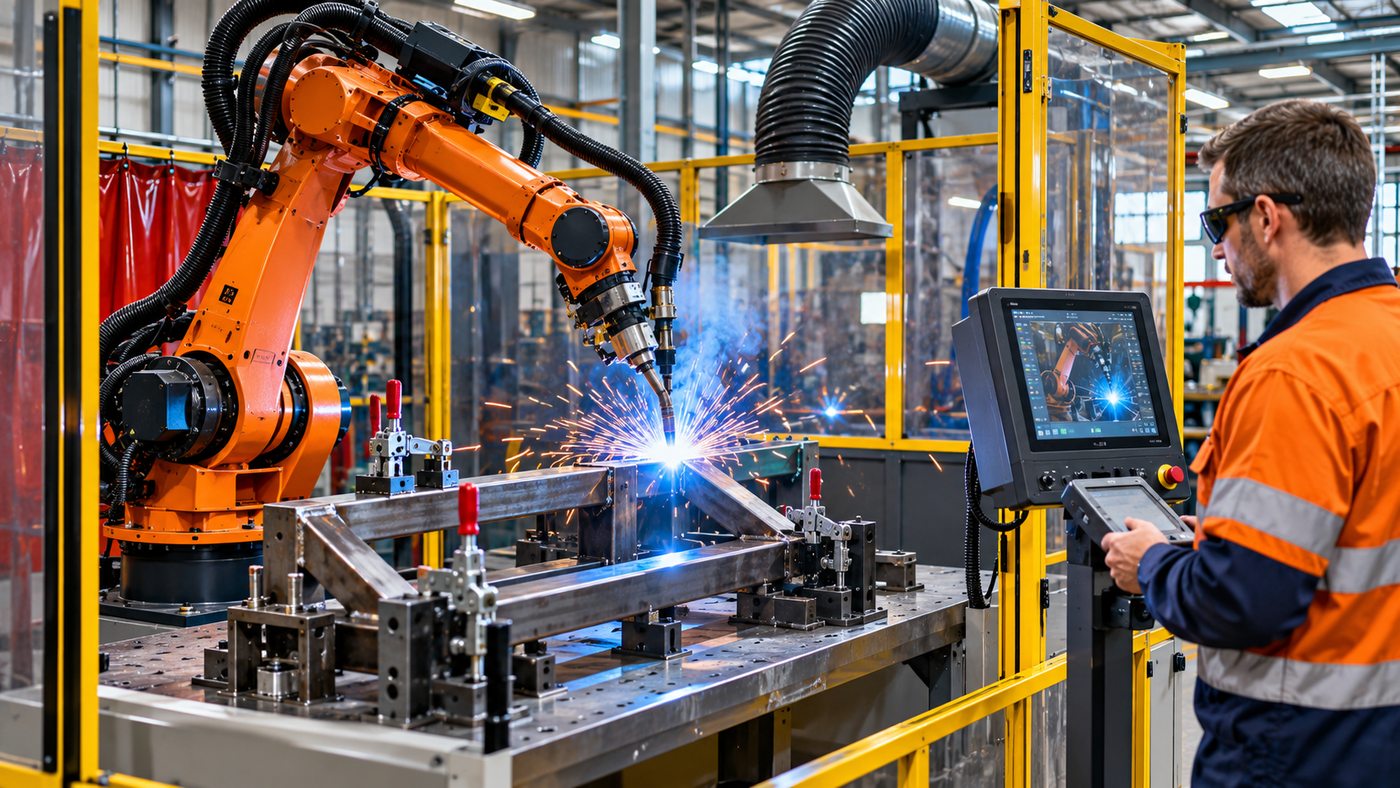
Manufacturing businesses increasingly rely on automation to improve production consistency, manage demanding workloads, and compete in markets where quality and delivery schedules matter. Among the technologies supporting this transformation, Robotic welding has become a valuable solution for producing metal components with repeatable welding processes.
Traditional welding continues to play an essential role in industrial manufacturing. Skilled welders are particularly important for repairs, complex assemblies, and projects requiring flexible human judgment. However, repetitive production tasks can benefit from automated systems capable of following programmed welding paths under controlled conditions.
Modern industrial welding robots combine mechanical precision, welding power sources, programmable controls, and specialized fixtures. When properly configured, these systems can help manufacturers improve productivity, maintain consistent weld geometry, and reduce repetitive manual work.
Australian businesses working in agriculture, construction, automotive components, mining equipment, and general metal fabrication may benefit from these capabilities.
Nevertheless, automation is not automatically the best option for every project. Production volumes, material characteristics, component design, safety requirements, and setup costs must all be considered.
This guide explores seven major benefits of robotic welding, explains how automated systems operate, and outlines the important factors manufacturers should evaluate before adopting the technology.
What Is Robotic Welding?
Robotic welding is a manufacturing process in which a programmable industrial robot positions and operates welding equipment to join materials according to a defined sequence.
The robot controls movements such as torch positioning, travel speed, and welding path.
Other parameters, including current, voltage, wire-feed speed, and shielding gas, are managed through the associated welding equipment and control systems.
The objective is to produce welded joints that meet specified design and quality requirements.
How Does Robotic Welding Work?
A typical robotic welding system includes several integrated components:
- Industrial robotic arm
- Welding power source
- Welding torch and consumables
- Robot controller
- Workpiece fixtures and positioning equipment
- Safety guarding and interlocks
- Fume extraction equipment
- Operator interface
- Inspection and quality-control procedures
The operator or programmer creates a welding sequence based on the component design.
The workpiece is positioned within an appropriate fixture, and the system performs the programmed operation.
Welded components are then inspected according to the required acceptance criteria.
Is Robotic Welding Fully Automatic?
Not always.
Some systems perform repetitive welding cycles with limited operator intervention after setup.
Others require workers to load parts, verify positioning, inspect welds, and supervise equipment operation.
More advanced systems may include automatic material handling, seam tracking, or adaptive welding functions.
The automation level depends on the equipment and production environment.
1. Improve Welding Precision and Consistency
One of the strongest advantages of robotic welding is repeatability.
An industrial robot can follow programmed movements with consistent positioning under suitable operating conditions.
Why Repeatability Matters
Manufacturers often need to produce many identical or similar components.
If welding conditions vary considerably between parts, the resulting joints may require additional inspection, repair, or rework.
Robotic systems can reduce certain forms of operator-related variation by executing repeatable movements.
Controlled Welding Paths
A programmed robotic arm can maintain a defined torch angle, position, and travel path.
These factors influence weld formation and consistency.
However, stable robot movements alone do not guarantee an acceptable weld.
Joint preparation, fit-up, materials, consumables, and welding parameters must also be correct.
Better Process Standardization
Once a welding program has been validated, manufacturers can use it for approved repeat production runs.
This reduces the need to manually recreate the entire movement sequence for every component.
Quality Still Requires Verification
Robotic welding cannot automatically correct every defect.
Poor workpiece positioning, contamination, unsuitable parameters, and damaged equipment can still cause welding problems.
Inspection and qualified process oversight remain essential.
2. Increase Manufacturing Efficiency and Production Capacity
Production efficiency is another reason manufacturers consider welding automation.
A robot can repeat a defined operation without the same physical fatigue experienced during sustained manual welding.
Reduce Repetitive Work
For high-volume manufacturing, repeated welds can require substantial manual effort.
An automated system may complete these tasks with consistent cycle times.
Employees can then focus on programming, inspection, fixture preparation, and other valuable activities.
Improve Cycle-Time Planning
Robotic systems allow manufacturers to measure and refine the time required for specific operations.
Once a stable process has been established, production scheduling may become more predictable.
Support Longer Production Runs
Suitable robotic cells can operate across extended production periods.
However, equipment availability still depends on maintenance, consumable replacement, material handling, and operator supervision.
Understand Total Cycle Time
The time required to produce a part involves more than the welding arc itself.
Manufacturers should account for loading, unloading, fixture adjustments, inspection, and equipment movement.
A fast welding operation provides limited value if surrounding production stages create bottlenecks.
3. Reduce Rework and Improve Material Efficiency
Welding defects can increase material consumption and manufacturing expenses.
Depending on the problem, a defective joint may require grinding, repair welding, additional inspection, or complete component replacement.
How Automation Can Reduce Rework
A validated robotic welding program can reduce variation associated with inconsistent torch positioning and travel speed.
More consistent operation may reduce certain defect rates.
The actual improvement depends on process control and the quality of incoming components.
Reduce Unnecessary Material Use
Accurate welding procedures can help control the amount of filler metal deposited.
Excessive welding may increase consumable costs and processing time.
However, welding parameters must always satisfy design requirements.
Reducing weld size below the specified limits is not an acceptable efficiency measure.
Improve Process Monitoring
Manufacturers may record production parameters, cycle counts, alarms, and quality information.
This data can help identify recurring problems.
Measure Scrap and Rework
Useful indicators include:
- First-pass acceptance rate
- Weld repair frequency
- Material scrap
- Consumable consumption
- Cycle time per component
- Equipment downtime
Monitoring these metrics provides a clearer understanding of whether automation is delivering meaningful improvements.
4. Support Safer Welding Work Environments
Welding presents hazards involving fumes, ultraviolet radiation, heat, electricity, fire, and moving machinery.
Automation can help reduce certain direct exposures by keeping workers farther from the welding arc during normal operation.
However, robotic welding introduces additional mechanical and control-system hazards.
Reduce Direct Arc Exposure
Enclosed welding cells can separate workers from welding sparks and radiation.
Physical guarding and suitable welding screens help prevent unintended exposure.
Control Welding Fumes
Welding fumes can contain hazardous substances.
Australian workplace guidance emphasizes the need to assess exposures and implement suitable controls.
Automated welding cells may use local exhaust ventilation and enclosures.
Automation alone does not eliminate harmful fumes.
Manage Robot Movement Hazards
Industrial robotic arms can move rapidly and exert substantial force.
Hazard controls may include:
- Protective guarding
- Interlocked access doors
- Emergency stop systems
- Safe operating procedures
- Appropriate maintenance isolation
- Worker training
- Risk assessments
Safety systems must be designed for the equipment and relevant tasks.
Follow Australian Safety Requirements
Safe Work Australia’s Model Code of Practice for Welding Processes provides guidance on managing welding risks.
The model code was updated on 6 November 2026, including terminology changes associated with workplace exposure limits scheduled to take effect on 1 December 2026.
Businesses must check the applicable legal requirements in their state or territory.
A robotic system should undergo suitable risk assessment before commissioning and whenever significant modifications occur.
5. Improve Production Flexibility Through Programming
Robotic welding systems are often associated with high-volume manufacturing.
However, modern programming methods can also support smaller production batches and selected custom applications.
Change Welding Programs
A properly configured system can store programs for different components.
This may reduce setup effort when a manufacturer repeatedly produces several established designs.
Use Different Welding Fixtures
Fixtures position workpieces so that welding operations can be performed consistently.
Different component designs may require dedicated fixtures or adjustable positioning systems.
Support Complex Welding Paths
Industrial robots can move welding torches through controlled multi-axis trajectories.
This is useful when a joint has a geometry that can be reached consistently by the robot.
However, accessibility and collision risks must be considered during programming.
Combine Human Expertise With Automation
Robotic welding is not a replacement for engineering expertise.
Skilled personnel are required to develop procedures, select welding parameters, validate results, and resolve production issues.
For highly variable repairs or one-off assemblies, manual welding may remain more practical.
6. Access Specialist Robotic Welding and Metal Fabrication Services
Not every business needs to purchase its own robotic welding system.
Outsourcing suitable projects to an experienced manufacturer can provide access to automation without requiring the customer to operate the equipment.
National Industries Robotic Welding Services
Australian businesses looking for professional Robotic welding can explore National Industries.
The company provides industrial metal manufacturing services, including automated welding and custom fabrication.
Its published information describes robotic MIG and MAG welding, programmable manufacturing equipment, and project-specific quality-control procedures.
National Industries also offers related capabilities involving metal pressing, laser cutting, spring manufacturing, and wire-form production.
With manufacturing teams operating in Victoria and Queensland, the company works on industrial metal components for a range of applications.
Custom Manufacturing
National Industries describes a project workflow that begins with understanding customer requirements.
The company then considers suitable materials, finishing requirements, production quantities, and manufacturing processes.
This approach is relevant when a business needs components manufactured to specific drawings or performance requirements.
Quality-Control Practices
The company reports that components undergo manual and mechanical inspections at multiple stages of production.
It also describes the use of Kanban scheduling to manage production work.
These are supplier-reported practices; buyers should confirm the inspection records, specifications, and acceptance requirements relevant to their particular order.
What to Discuss With a Supplier
Before requesting a quotation, prepare information about:
- Component drawings
- Material grades
- Joint specifications
- Required quantities
- Welding requirements
- Dimensional tolerances
- Inspection expectations
- Surface finishes
- Delivery schedules
Clear documentation helps suppliers assess technical feasibility and pricing.
7. Improve Long-Term Manufacturing Cost Efficiency
Robotic welding can involve significant initial investment.
A complete system may require more than a robotic arm and welding power source.
Understand Capital Costs
Potential expenses include:
- Robot and controller
- Welding equipment
- Fixtures and positioners
- Guarding and safety systems
- Fume extraction
- Installation and integration
- Programming
- Worker training
- Maintenance resources
The total cost depends on system complexity and production requirements.
Consider Operating Costs
Operating expenses can include electricity, shielding gas, filler wire, consumables, replacement parts, and servicing.
Manufacturers should also consider programming and setup time.
Calculate Return on Investment
A simple ROI assessment compares the costs of the proposed system with measurable savings or additional contribution generated over time.
Potential benefits may include reduced processing time, lower rework, improved production capacity, and more efficient use of skilled labour.
However, savings should be based on realistic operating assumptions.
Illustrative ROI Example
Suppose a manufacturer invests AUD $300,000 in a suitable robotic welding system.
After accounting for additional operating expenses, it estimates net annual operational benefits of AUD $75,000.
A simplified payback calculation would be:
AUD $300,000 ÷ AUD $75,000 = 4 years
This is a hypothetical example, not an industry average or a supplier quote.
Actual financial results will depend on utilization, downtime, maintenance, financing, production demand, and other costs.
When Outsourcing May Be Better
For businesses with limited or irregular welding volumes, buying a complete robotic system may not be economical.
Contract manufacturing can provide a more flexible alternative.
Compare internal production with outsourcing based on total cost, lead time, quality, and technical control.
Robotic Welding vs. Manual Welding
Both approaches have important roles in manufacturing.
| Factor | Robotic welding | Manual welding |
|---|---|---|
| Repetitive production | Often advantageous | More operator-dependent |
| Initial setup | Requires programming and fixtures | Generally less automation setup |
| Process repeatability | High when controlled | Depends on operator and conditions |
| One-off repairs | May require substantial setup | Often more flexible |
| Operator expertise | Programming and welding expertise | Welding expertise |
| Equipment cost | Usually higher | Often lower |
| Safety | Can reduce arc proximity; introduces robot hazards | Requires direct welding controls |
| Best use | Repeatable, suitable components | Variable and complex tasks |
The optimal choice depends on the application rather than assuming that automation is always superior.
Robotic MIG and MAG Welding Explained
MIG and MAG processes are both forms of gas metal arc welding.
They use a consumable wire electrode and shielding gas.
The terminology differs according to shielding gas characteristics.
MIG commonly refers to inert gas shielding, while MAG refers to active gas shielding.
In industrial practice, precise welding procedure descriptions should identify the actual process, consumables, and gas composition.
Why Gas Metal Arc Welding Suits Automation
A continuous wire-feed process can be integrated with programmable motion and control systems.
This allows repeatable welding of components that can be fixtured consistently.
Typical Applications
Automated MIG/MAG welding may be used for:
- Steel frames
- Fabricated brackets
- Agricultural components
- Automotive assemblies
- Industrial equipment structures
- Repetitive metal products
Suitability depends on joint design, material thickness, production quantity, and process qualification.
Common Robotic Welding Challenges
Inconsistent Part Fit-Up
Robots follow programmed paths, but incoming parts may vary.
Inaccurate fit-up can affect weld position and quality.
Programming Requirements
New components may require programming, simulation, and validation.
Setup effort can reduce the economic advantage of automation for very small batches.
Fixture Costs
Complex components may require specialized fixtures.
These costs should be included in project planning.
Maintenance and Downtime
Robotic systems require inspection, calibration, cleaning, and servicing.
Unexpected failures can interrupt production.
Workforce Training
Operators need appropriate technical and safety training.
Automation changes workforce responsibilities rather than eliminating the need for skilled people.
How to Choose a Robotic Welding Supplier in Australia
A supplier should be evaluated on its ability to deliver components that meet documented requirements.
Consider its manufacturing experience, supported materials, welding procedures, quality assurance, capacity, and communication.
Ask whether the proposed system suits the part geometry and batch quantity.
Discuss inspection records and any applicable welding standards.
For critical components, determine what procedure qualification, operator competency, traceability, and test results are required.
A useful quotation should explain deliverables, lead times, assumptions, and exclusions.
Robotic Welding Quality-Control Checklist
| Quality factor | What to verify |
|---|---|
| Drawings | Approved dimensions and weld requirements |
| Materials | Correct grade and condition |
| Joint preparation | Appropriate cleanliness and fit |
| Fixtures | Repeatable component positioning |
| Welding parameters | Validated settings |
| Robot program | Verified path and operation |
| Safety | Guards, interlocks and risk controls |
| Inspection | Defined acceptance criteria |
| Traceability | Records where required |
| Maintenance | Equipment condition and calibration |
The Future of Robotic Welding in Australia
Robotic welding technology continues to evolve through improved sensors, machine vision, offline programming, and production-data analysis.
Some systems can use seam-tracking information to adjust welding paths within defined operating limits.
Digital simulation may help engineers evaluate robot movements before production.
Collaborative robotic technologies are also being explored for selected welding tasks, although welding hazards and robot movement risks still require proper controls.
Artificial intelligence may support monitoring and process optimization, but such systems must be validated before being relied upon for quality-critical operations.
For Australian manufacturers, future opportunities will depend on selecting automation that matches real production needs.
Successful adoption requires engineering expertise, reliable equipment, workforce training, and ongoing quality management.
Frequently Asked Questions
1. What is robotic welding used for?
Robotic welding is used to join metal components through programmable automated systems. Common applications include automotive components, industrial fabrication, agricultural equipment, and repeatable steel assemblies.
2. Is robotic welding better than manual welding?
Robotic welding can be advantageous for consistent, repeated production. Manual welding remains useful for repairs, variable assemblies, and work requiring flexible operator judgment.
3. Does robotic welding improve weld quality?
It can improve repeatability when components, welding parameters, fixtures, and maintenance are properly controlled. However, every weld must still meet the applicable quality requirements.
4. Are robotic welding systems safe?
Robotic welding can reduce certain direct exposures, but it introduces hazards involving moving machinery, electricity, fumes, and heat. Appropriate guarding, extraction, training, and risk assessment are essential.
Conclusion
Robotic welding can help Australian manufacturers improve repeatability, production efficiency, and process control when applied to suitable metal fabrication tasks.
The strongest results depend on correct programming, material preparation, safety systems, and qualified inspection.
By evaluating production requirements and working with experienced suppliers, manufacturers can adopt welding automation in ways that support reliable quality and long-term operational value.
