
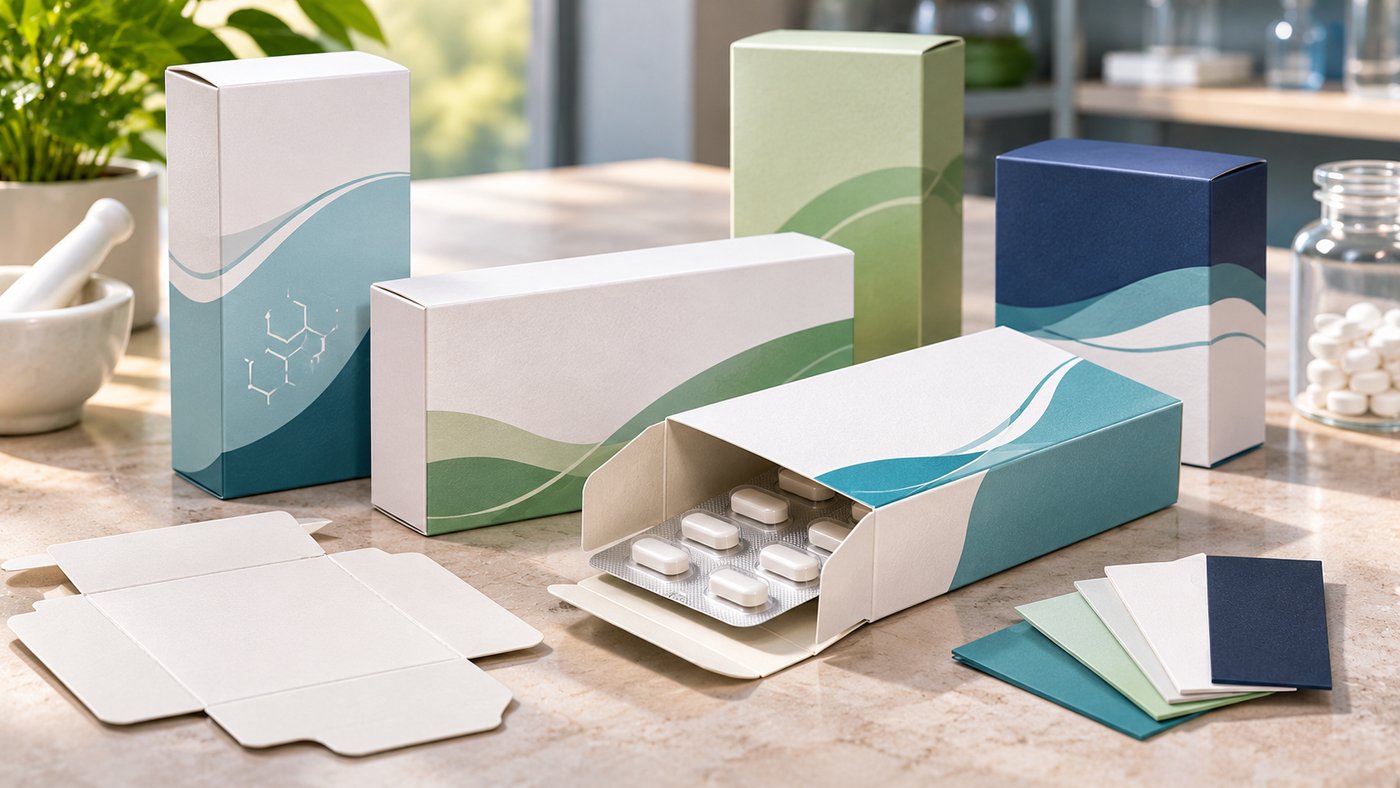
Pharmaceutical packaging plays an important role in protecting medicinal products, communicating essential information, and maintaining a professional brand identity. From prescription medications to over-the-counter healthcare products, packaging must support safe handling, clear identification, convenient storage, and reliable distribution. Choosing the right packaging design can influence both operational efficiency and the experience of healthcare professionals and patients.
Well-designed Custom Medicine Boxes allow pharmaceutical brands to tailor carton dimensions, materials, printing, and structural features to specific product requirements. Unlike generic packaging, custom cartons can accommodate bottles, blister packs, tubes, and other medicine containers while providing suitable space for product identification and required information.
However, pharmaceutical packaging is more than a branding opportunity. Manufacturers must consider applicable regulatory requirements, product stability, packaging integrity, and the needs of people who handle or use medicines.
This comprehensive guide explores seven important benefits of custom medicine packaging, popular materials and box styles, design considerations, printing techniques, and practical ways to choose suitable packaging for pharmaceutical products.
What Are Custom Medicine Boxes?
Custom medicine boxes are specially designed cartons used to package, organize, and present pharmaceutical or healthcare products.
These boxes are usually manufactured from paperboard, cardboard, Kraft stock, or other suitable materials. Their dimensions, structure, printing, and finishing can be tailored to match the product’s requirements.
Custom pharmaceutical cartons may be used for tablets, capsules, syrups, topical preparations, and other medicinal products.
In many applications, the carton serves as secondary packaging surrounding a primary container, such as a blister pack, bottle, tube, or vial.
The distinction is important because a paperboard carton does not automatically provide the moisture, oxygen, or contamination protection supplied by a validated primary packaging system.
The US Food and Drug Administration distinguishes between primary packaging components that directly contact a drug product and secondary components that do not. U.S. Food and Drug Administration
Why Pharmaceutical Packaging Requires Special Attention
Medicines must be appropriately identified, handled, stored, and distributed.
Poor packaging design can create problems involving damaged cartons, difficult-to-read information, product confusion, and inefficient handling.
Effective packaging should therefore balance several priorities:
- Appropriate protection for the packaged product
- Accurate and readable medicine information
- Suitable dimensions and structural strength
- Efficient manufacturing and distribution
- User-friendly opening and handling
- Consistent pharmaceutical branding
- Applicable regulatory compliance
The best packaging solution depends on the medicine, its approved labeling, intended market, and distribution requirements.
1. Improve Product Protection During Handling and Transportation
One important benefit of custom medicine boxes is the ability to create packaging that fits the intended product.
Oversized cartons may allow internal containers to move unnecessarily, while undersized boxes can damage blister packs or make assembly difficult.
Reduce Unnecessary Movement
Accurate carton dimensions help maintain a more secure fit around the primary packaging.
Manufacturers can consider suitable inserts, partitions, or other structural features when additional support is needed.
For example, a glass medicine bottle may require a different carton structure from a flat blister strip.
The design should reflect the product’s weight, shape, and handling requirements.
Choose Suitable Board Strength
Paperboard thickness and construction influence how a carton performs during packing, stacking, and transportation.
Heavier products may require stronger materials, while lightweight products may be adequately supported by thinner grades.
The appropriate material should be selected through packaging specifications and relevant testing rather than appearance alone.
Protect Printed Information
Pharmaceutical cartons often carry important identification and usage information.
Damage caused by abrasion, moisture exposure, or poor handling can make this information difficult to read.
Appropriate printing systems, coatings, and distribution packaging can help preserve legibility.
Understand Protection Limitations
Secondary cartons may contribute to light protection or physical protection when properly designed and qualified.
However, their performance must be assessed for the actual product.
A decorative cardboard box should never be assumed to provide a validated barrier against moisture, air, microorganisms, or other hazards.
2. Support Clear Pharmaceutical Labeling and Product Identification
Accurate labeling is one of the most important aspects of medicine packaging.
Healthcare professionals and patients may need to distinguish between products with similar names, strengths, or appearances.
A well-organized carton layout can make critical information easier to locate.
Use a Clear Information Hierarchy
Pharmaceutical labels may need to communicate the product name, active ingredient, strength, dosage form, route of administration, warnings, and other relevant details.
Which information is required depends on the product, regulatory category, and market.
For US prescription medicines, the FDA emphasizes carton and container labeling that supports safe dispensing, administration, and use. FDA
Make Important Information Easy to Read
Label design should consider typography, contrast, spacing, and layout.
Small text, excessive decoration, or crowded panels can make information difficult to understand.
Manufacturers should ensure that required statements remain readable after printing, folding, and carton assembly.
Distinguish Similar Products
A pharmaceutical company may offer several strengths or formulations within one product family.
Using distinguishable, appropriately designed packaging can help reduce confusion.
However, color should not be the only method used to differentiate products.
The medicine name, strength, dosage form, and other important information must remain clear.
Follow Applicable Regulatory Requirements
The FDA’s guidance on container labels and carton labeling focuses on design principles intended to minimize medication errors.
Manufacturers and responsible regulatory teams should review the requirements applicable to their specific products before approving artwork. FDA
Custom printing does not automatically make packaging regulatory-compliant.
Compliance depends on the complete product, labeling, packaging system, and applicable regulatory framework.
3. Strengthen Pharmaceutical Brand Identity
Packaging can help customers and healthcare professionals recognize a product and its manufacturer.
Consistent packaging design contributes to brand identification and may improve the professional presentation of a pharmaceutical product.
Develop a Recognizable Visual Identity
Manufacturers can use consistent color palettes, typography, layout systems, and appropriate brand marks across product families.
For example, a healthcare company may use a coordinated design for several related products while clearly distinguishing different strengths or formulations.
This helps maintain visual consistency without compromising identification.
Create a Professional Appearance
Neat printing, accurate folding, consistent color reproduction, and appropriate material selection can contribute to a polished presentation.
However, attractive packaging should never take priority over patient safety or legally required information.
Decorative elements must not obscure instructions, warnings, or other important content.
Support Brand Recognition
Repeated exposure to a consistent design can make products easier to recognize.
For healthcare products, brand recognition should be based on accurate information and legitimate product quality rather than exaggerated medical claims.
Build Trust Through Transparency
Trust in pharmaceutical products depends on product quality, appropriate regulatory oversight, truthful labeling, and reliable distribution.
Professional packaging can support clear communication, but it cannot independently establish that a medicine is safe or effective.
Brands should avoid using unverified claims, misleading certification symbols, or unsupported promises.
4. Offer Flexible Materials and Structural Designs
Different medicines require different types of packaging.
Custom manufacturing allows companies to choose carton designs that suit product dimensions, production processes, and distribution requirements.
Cardboard and Paperboard Medicine Boxes
Paperboard is commonly used for folding pharmaceutical cartons.
It offers a printable surface and can be converted into different shapes through cutting, scoring, and folding.
Possible applications include blister-pack cartons, small bottle boxes, and other secondary packaging.
Material selection should account for stiffness, folding performance, printing quality, and production compatibility.
Kraft Medicine Packaging
Kraft-based cartons may be appropriate for certain packaging designs.
Their natural appearance can support a minimalist visual style.
However, environmental claims should be assessed carefully.
A package’s recyclability depends on its materials, coatings, adhesives, local recycling infrastructure, and other factors.
No material should be described as having zero environmental impact without credible supporting evidence.
Corrugated Packaging
Corrugated board may be useful for stronger outer packaging or distribution applications.
It can provide cushioning and stacking strength when correctly specified.
Corrugated shipping boxes serve a different purpose from lightweight retail medicine cartons.
Tuck-End Medicine Boxes
Tuck-end cartons are common because they can be economical to manufacture and convenient to assemble.
Straight tuck-end and reverse tuck-end designs are both available.
The best configuration depends on the product, required labeling surfaces, and manufacturing process.
Custom Inserts and Compartments
Inserts may help organize multiple components inside a package.
However, inserts must be designed to avoid damaging the primary container or interfering with required information.
Any feature used for functional protection should be qualified for its intended purpose.
5. Improve Patient Convenience and Packaging Usability
Medicine packaging is handled by people with different needs and abilities.
Some users may have reduced vision, limited hand strength, or difficulty understanding complex instructions.
Thoughtful design can improve usability without compromising required safety features.
Consider Opening and Closing
Cartons should be practical for their intended users.
Designers can evaluate flap structure, opening resistance, and ease of removing the primary package.
However, easy opening is not always the primary objective.
Certain products require child-resistant packaging or other specific safety systems.
Include Appropriate Safety Features
Tamper-evident packaging helps provide visible evidence if a package has been opened or interfered with.
In the United States, many over-the-counter human drug products are subject to tamper-resistant packaging requirements under 21 CFR 211.132, with specified exceptions.
The FDA also outlines expectations for identifying the tamper-resistant feature to consumers. FDA
An ordinary tuck-end carton does not automatically satisfy these requirements.
Improve Information Accessibility
Good packaging design considers readable text, appropriate contrast, and logical placement of important information.
Product-specific requirements may also involve accessibility features or additional patient information.
Manufacturers should evaluate these needs during the artwork approval process.
Reduce Handling Difficulties
A carton should allow users to access the medicine’s primary package without unnecessary damage or confusion.
Suitable dimensions, consistent folding, and clear opening orientation can make the product easier to handle.
6. Increase Efficiency in Manufacturing and Distribution
Packaging design influences manufacturing speed, packing operations, warehousing, and transport.
A visually attractive carton may create unnecessary costs if it is difficult to assemble or incompatible with production equipment.
Design for Manufacturing
A well-planned carton should account for die-cutting, scoring, folding, gluing, printing, and assembly.
Manufacturers should verify that the design works with the intended production machinery.
Poorly specified dimensions or fold lines may lead to waste and production delays.
Reduce Unnecessary Material Use
Right-sized packaging can help limit excess paperboard consumption.
However, reducing material thickness too far may weaken the carton.
The objective is to use an appropriate amount of material while maintaining required functionality.
Improve Storage Efficiency
Efficient carton dimensions may allow more products to fit into designated storage or shipping configurations.
Flat-packed cartons can also be convenient before assembly.
Packaging suppliers should provide accurate specifications so manufacturers can assess compatibility with existing operations.
Support Reliable Inventory Identification
When applicable, pharmaceutical packaging may contain barcodes, product identifiers, lot information, and other traceability elements.
For certain US prescription drug products, requirements under the Drug Supply Chain Security Act involve package-level product identifiers and other supply chain controls.
The responsible manufacturer or trading partner must determine the requirements applicable to the specific product and transaction. FDA
Maintain Quality Consistency
Packaging production should include appropriate inspection and quality control procedures.
These may involve checking print accuracy, dimensions, board quality, folding performance, and approved artwork versions.
For pharmaceutical applications, errors in labeling or product identification can have consequences beyond ordinary commercial packaging defects.
7. Support Responsible and Cost-Effective Packaging Decisions
Cost management is important for pharmaceutical manufacturers, particularly when producing multiple products or packaging sizes.
Custom packaging can support cost efficiency when specifications are aligned with actual production needs.
Compare Material Options
Different board grades have different costs and performance characteristics.
A premium finish or heavier material may be suitable for some applications but unnecessary for others.
Selection should prioritize functional requirements before decorative features.
Evaluate Printing Methods
Digital and offset printing can each be appropriate depending on order size, artwork, and production needs.
Digital printing may be useful for samples or certain shorter runs.
Offset printing may provide economies of scale for larger production quantities, depending on the supplier’s equipment and requirements.
Plan Order Quantities Carefully
Large orders may reduce certain per-unit production costs, but excessive inventory can create waste.
This is especially relevant when packaging artwork requires revision because of a formulation, labeling, or regulatory change.
Manufacturers should balance unit price against storage needs, version control, and potential obsolescence.
Compare Total Packaging Costs
The lowest quoted carton price does not necessarily represent the best value.
Consider tooling, artwork preparation, proofs, sampling, shipping, production lead time, inspection requirements, and potential waste.
A supplier offering a well-controlled process may provide better overall value than one offering only a low initial price.
Popular Types of Custom Medicine Boxes
Pharmaceutical companies use several carton structures depending on the product.
Tablet Packaging Boxes
Tablet cartons commonly hold blister packs or other primary tablet containers.
The design should accommodate the packaged product and required labeling without damaging the contents.
Capsule Packaging Boxes
Capsule cartons may contain blister packs or bottles.
Their structure and dimensions should suit the primary packaging and distribution requirements.
Medicine Bottle Boxes
Bottle cartons require attention to height, width, weight, and possible movement during handling.
Additional support may be appropriate for fragile containers.
Syrup Packaging Boxes
Cartons for liquid medicines may need to accommodate bottles and approved dosing accessories.
Any additional components should be positioned securely and remain consistent with the product’s validated packaging configuration.
Topical Medicine Boxes
Creams, ointments, and gels may be supplied in tubes or other containers.
The secondary carton can provide space for required instructions and product identification.
Medicine Display Boxes
Some retail packaging formats are designed to organize approved products at the point of sale.
Any display or promotional use must remain consistent with applicable medicine advertising and labeling rules.
How to Design Effective Custom Medicine Boxes
Successful pharmaceutical packaging design begins with clear specifications.
Step 1: Identify Product Requirements
Determine the product category, intended market, primary container, and applicable packaging requirements.
The responsible regulatory and quality teams should confirm which standards apply.
Step 2: Measure the Primary Package
Accurately measure the bottle, blister pack, tube, or other container.
Include any approved inserts, leaflets, or accessories that must fit inside the carton.
Step 3: Select an Appropriate Structure
Choose a carton design based on functionality, manufacturing requirements, and usability.
Consider board strength, closure method, and packing equipment compatibility.
Step 4: Develop the Artwork
Create a layout that accommodates the approved product information.
Use consistent design elements while ensuring that essential warnings and identification details remain prominent.
Step 5: Review Printing and Finishing
Select printing techniques and coatings appropriate for the product and production process.
Avoid finishes that make critical text difficult to read.
Step 6: Request Proofs and Samples
Digital mockups can support early design review.
Physical samples are useful for evaluating fit, folding, assembly, and appearance.
Where required, conduct additional packaging qualification or performance testing.
Step 7: Approve the Final Specification
Before production, confirm dimensions, material grade, artwork version, printing requirements, and quality expectations.
Pharmaceutical manufacturers should use appropriate document control and approval procedures.
Custom Medicine Box Printing and Finishing Options
Printing and finishing affect how a carton looks and performs.
CMYK Printing
CMYK printing uses cyan, magenta, yellow, and black to reproduce a wide range of colors.
It is commonly used for detailed graphics and multi-color artwork.
Pantone Color Matching
Pantone or other specified spot-color systems can help maintain consistent brand colors.
Color accuracy should be evaluated under appropriate production conditions.
Matte Finishing
Matte coatings can create a subtle appearance and may reduce certain reflections.
However, the choice of finish should not compromise label readability.
Gloss Finishing
Gloss coatings provide a reflective surface that can emphasize visual elements.
Designers should evaluate glare, handling characteristics, and suitability for the application.
Embossing and Debossing
These processes create raised or recessed surface details.
They may be appropriate for selected branding elements but should not interfere with essential product information.
Foil Stamping
Metallic foil can be used decoratively where suitable.
For medicine packaging, functional clarity and regulatory requirements should take priority over ornamental presentation.
Choosing a Custom Medicine Box Packaging Supplier
Selecting a suitable packaging company requires evaluating technical capabilities, material quality, service arrangements, and production consistency.
Review Manufacturing Capabilities
Confirm whether the supplier can produce the required carton dimensions, board grades, printing specifications, and finishes.
Ask about production tolerances and quality inspection procedures.
Understand Available Customization
Packaging suppliers may provide structural design support, artwork assistance, dielines, and samples.
For example, Packaging Mania advertises customizable medicine cartons with cardboard, Kraft, and corrugated stock options, as well as CMYK and PMS printing, matte or gloss coatings, and physical sampling on request. Packaging Mania
These options can support early packaging development, but pharmaceutical compliance and final approval remain the responsibility of the appropriate qualified parties.
Request Samples Before Bulk Production
Physical samples allow businesses to evaluate dimensions, appearance, construction, and handling.
For pharmaceutical products, samples may also support additional quality assessment where required.
Confirm Production Lead Times
Lead times vary according to order volume, materials, finishing processes, and production complexity.
Manufacturers should allow time for proofing, approvals, quality checks, and shipping.
Check Documentation and Quality Controls
Where pharmaceutical packaging is involved, ask about material specifications, inspection procedures, traceability, change control, and relevant quality certifications.
Do not assume that a supplier’s promotional statements establish regulatory compliance.
Common Mistakes to Avoid in Medicine Packaging Design
Even small design errors can create unnecessary expenses or potential usability problems.
Choosing Appearance Over Functionality
A visually striking carton is not useful if it is difficult to assemble, damages the primary packaging, or obscures important information.
Function and safety should guide design decisions.
Using Incorrect Dimensions
Poorly sized cartons may create movement, waste material, or interfere with packing machinery.
Accurate measurement and physical testing help reduce these problems.
Overcrowding the Design
Too many decorative elements can make labels difficult to read.
Clear information hierarchy is particularly important in healthcare packaging.
Making Unsupported Environmental Claims
Claims such as fully sustainable, biodegradable, or zero carbon footprint require appropriate evidence.
Use accurate, specific descriptions of materials and their environmental attributes.
Skipping Quality Checks
Printing mistakes, outdated artwork, or manufacturing defects can create serious complications.
Maintain documented approval and inspection procedures throughout production.
Treating Secondary Packaging as a Complete Safety Barrier
A carton alone does not replace validated primary packaging.
Medicine stability and protection must be evaluated for the complete packaging system.
Future Trends in Pharmaceutical Packaging
The pharmaceutical packaging industry continues to evolve through changing technology, environmental priorities, and supply chain requirements.
Smarter Packaging Identification
Machine-readable codes and serialization systems can support traceability and inventory management where required.
However, technical solutions must be implemented according to applicable regulatory requirements.
Greater Attention to Accessibility
Packaging developers are considering clearer typography, improved information organization, and usability features for people with different abilities.
These improvements should be evaluated alongside product-specific safety obligations.
Material Optimization
Manufacturers increasingly assess ways to reduce unnecessary packaging materials without compromising required performance.
Decisions should consider the complete product lifecycle rather than relying on a single environmental claim.
More Efficient Digital Workflows
Digital artwork management, controlled proofing, and automated inspection systems can help reduce version-control errors.
These tools are most valuable when integrated with effective quality procedures.
Personalized and Short-Run Production
Digital printing may make certain limited-volume packaging applications more practical.
However, customization must not undermine labeling controls, traceability, or applicable product requirements.
Frequently Asked Questions About Custom Medicine Boxes
1. What are custom medicine boxes used for?
Custom medicine boxes are used to package and identify pharmaceutical products, including tablets, capsules, bottles, and topical medicines. They can provide physical support for primary packaging, carry required information, and support consistent product presentation.
2. Which material is best for custom medicine packaging?
Paperboard and cardboard are common materials for secondary pharmaceutical cartons. The appropriate grade depends on product dimensions, structural requirements, manufacturing processes, and any functional protection the carton must provide.
3. Can custom medicine boxes include logos and special finishes?
Yes. Custom cartons can incorporate approved branding, specified colors, coatings, embossing, and other finishes. However, decorative elements must not compromise required labeling, medicine identification, or applicable regulatory requirements.
4. Are custom medicine boxes required to meet FDA regulations?
Medicine packaging intended for the US market must meet the requirements applicable to the specific drug and packaging system. Relevant rules may address labeling, tamper resistance, product identification, and quality. A custom carton design or packaging supplier alone does not guarantee FDA compliance.
Conclusion
Custom Medicine Boxes provide pharmaceutical brands with flexible options for product presentation, identification, and secondary packaging. Choosing appropriate materials, carton structures, and printing methods can improve handling, usability, and production efficiency. However, clear labeling, verified packaging performance, and applicable regulatory requirements must remain the highest priorities. With thoughtful design and qualified oversight, custom medicine packaging can support both operational needs and a better experience for users.
