
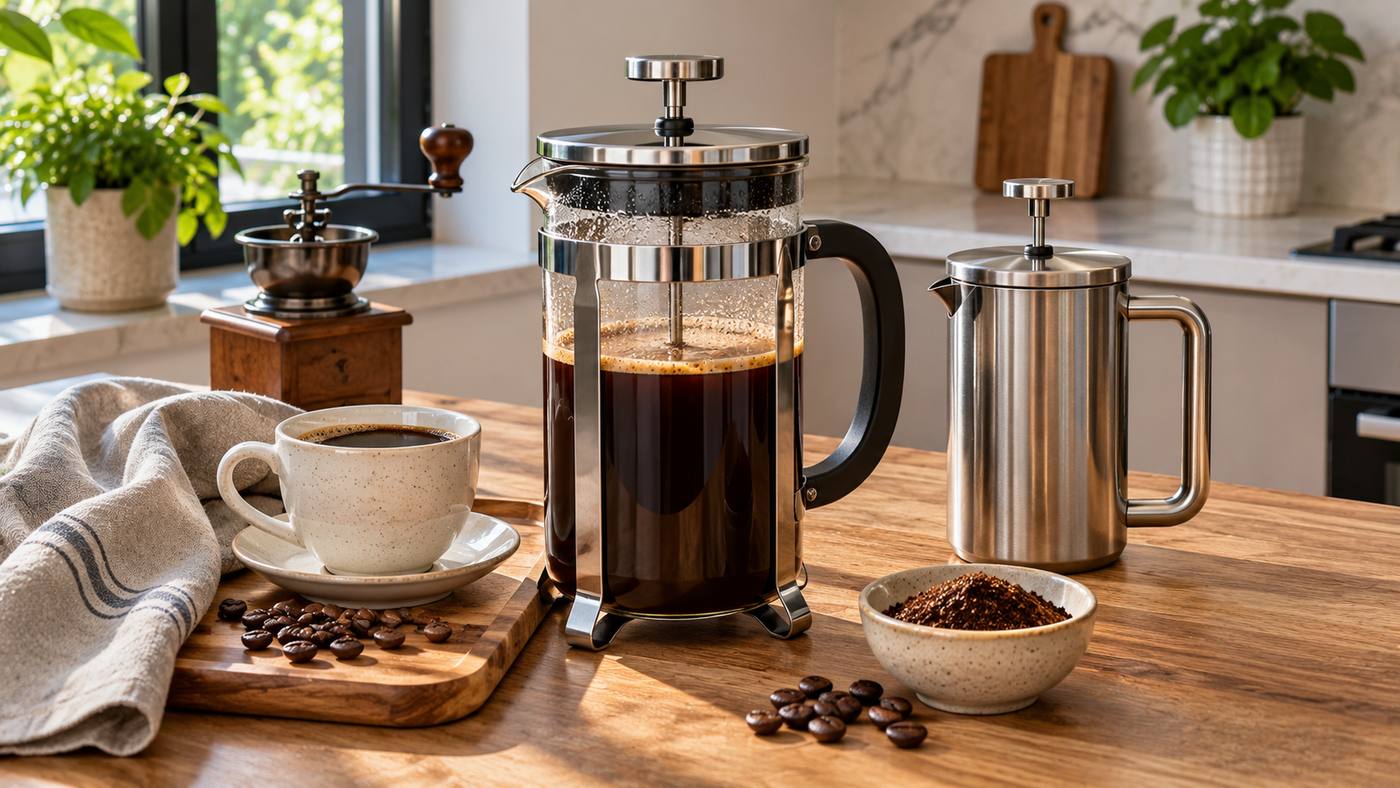
A good cup of coffee does not require a complicated machine. With a kettle, freshly ground beans, and a simple plunger, French press coffee makers can produce a rich, aromatic brew with very little equipment. Their appeal comes from full-immersion brewing: ground coffee sits in hot water for several minutes before a metal filter separates most of the grounds from the drink. The result typically has more body and texture than paper-filtered coffee, with a small amount of sediment that some coffee drinkers enjoy and others prefer to minimize.
Choosing a press, however, involves more than deciding between glass and stainless steel. Capacity labels can be misleading, fine mesh filters vary in design, and heat retention depends on both materials and brewing technique. Grind size, water temperature, coffee dose, cleaning habits, and safe plunger operation all affect the experience.
This guide explains how French press brewing works, the main types of presses, 17 practical buying and brewing tips, size and material comparisons, common mistakes, and maintenance advice. The brewing recommendations are practical starting points based on guidance from the National Coffee Association, specialty coffee educators, and manufacturer instructions. Adjust the recipe to your coffee and taste rather than expecting one setting to work for every bean.
What Are French Press Coffee Makers?
French press coffee makers are manual immersion brewers made from a carafe, lid, plunger rod, and filtering assembly. Coffee grounds are mixed directly with hot water in the carafe. After steeping, a mesh filter is lowered through the liquid to hold most of the particles near the bottom while the brewed coffee is poured into cups.
French press coffee makers may also be sold as cafetières, coffee presses, press pots, or plunger coffee makers. Designs differ, but the defining feature is the combination of immersion and a manually operated filter. Most standard presses require no electricity, disposable paper filters, or built-in heating system. You still need a safe way to heat water.
How Does Immersion Brewing Change Flavor?
During immersion, coffee and water remain together instead of the water flowing quickly through a bed of grounds. Brew strength depends on how much coffee is added relative to water, while extraction also depends on grind size, temperature, contact time, and agitation. A metal mesh filter lets more coffee oils and tiny particles pass than a typical paper filter, which can create a heavier mouthfeel.
What Parts Make Up a French Press?
A basic assembly includes the vessel, pouring spout, handle, lid, plunger shaft, metal mesh, and supporting filter plates. Some products use several layers of mesh or a silicone-edged filter. Replacement screens and glass vessels are available for certain brands, making spare-part availability worth checking before purchase.
Types of French Press Coffee Makers
Different French press coffee makers suit different users. The best design for someone who values visibility and easy replacement may not be ideal for someone packing a press for camping.
| Type | Advantages | Limitations | Suitable for |
|---|---|---|---|
| Glass carafe | Visible brewing, classic appearance, often replaceable vessel | Breakage risk, limited heat retention | Everyday home use |
| Double-wall stainless steel | Better thermal insulation, durable body, travel-friendly design | Heavier and opaque, may cost more | Busy households and outdoor use |
| Ceramic or stoneware | Attractive presentation, some thermal mass | Can chip, often heavier, model-specific care | Serving and home dining |
| Plastic or lightweight composite | Portable and often less fragile | Temperature and food-contact specifications vary | Travel when rated for hot brewing |
| Travel press or mug | Brews and serves in a compact vessel | Coffee may remain in contact with grounds | Commuting and one-person use |
Glass French Presses
A transparent carafe makes it easy to watch the grounds bloom and settle. Many use heat-resistant borosilicate glass, although the exact material and thermal limits depend on the manufacturer. Glass does not automatically mean the vessel can go on a stovetop or withstand every temperature change. Check for cracks before each brew and follow the specific product instructions.
Stainless Steel French Presses
Double-wall insulated French press coffee makers can keep brewed coffee warm longer than typical uninsulated glass vessels. Insulation may be useful for leisurely breakfasts or brewing for multiple people. Still, leaving the beverage in prolonged contact with grounds can change its flavor, so transferring it to a separate serving carafe is often preferable.
Ceramic and Specialty Designs
Ceramic presses appeal to buyers who value a distinctive tabletop presentation. Some modern designs feature precision mesh screens, removable filter baskets, or unusual spout systems. Evaluate whether the parts can be cleaned thoroughly and replaced, rather than judging performance by appearance alone.
How to Choose the Right Size
Capacity is one of the most misunderstood features of French press coffee makers. Some manufacturers count a small coffee serving of around 4 ounces as one cup. Consequently, an advertised eight-cup press might hold roughly one liter, not eight large mugs. The named size and the amount you can safely brew are also not always identical because the vessel needs room for grounds, the lid, and headspace.
| Approximate nominal capacity | How it may be marketed | Practical buying consideration |
|---|---|---|
| 350 mL / 12 fl oz | Often three small cups | Good for one modest serving |
| 500 mL / 17 fl oz | Often four small cups | One larger mug or two smaller pours |
| 800 mL / 27 fl oz | Often six small cups | Two or three servings, depending on mug size |
| 1,000 mL / 34 fl oz | Often eight small cups | Households making several cups |
| 1,500 mL / 51 fl oz | Often twelve small cups | Groups, subject to safe handling and fill limits |
For French press coffee makers, use the manufacturer’s actual milliliter or fluid-ounce specification when comparing products. A press is not necessarily designed to hold its entire stated nominal volume of water plus coffee grounds while leaving safe space for the plunger.
17 Smart Tips for Buying and Brewing Better French Press Coffee
1. Choose Capacity Around Your Daily Routine
Think about how many people drink coffee at the same time and how large their mugs are. A small press minimizes waste for one person, while a larger model is helpful for guests. Brewing a very small dose in an oversized press can be awkward if the filter cannot operate effectively at the required depth. When comparing French press coffee makers, verify both nominal capacity and the manufacturer’s minimum recommended brew volume.
2. Look for a Sturdy, Comfortable Handle
A full carafe contains hot liquid, so grip and balance matter. The handle should be secure, large enough for comfortable pouring, and positioned away from hot metal surfaces where practical. Test whether the lid stays aligned during pouring. A beautiful carafe that feels unstable when full may be inconvenient or unsafe in daily use.
3. Compare Glass and Insulated Steel Honestly
Among French press coffee makers, glass provides visibility and a classic serving experience, while double-wall steel generally offers greater resistance to accidental knocks and improved heat retention. Neither material guarantees better flavor. The coffee dose, grind, water, extraction, and cleaning may matter more. Choose the body material based on use conditions, durability, weight, and whether replacement parts are available.
4. Inspect the Mesh Filter Design
The filter needs to separate coffee from liquid without catching or folding. Check the fit against the vessel walls, the number of components, and whether the screen can be removed for washing. Multiple mesh layers may help retain more particles in some designs, but they do not make every brew sediment-free. A filter that is difficult to disassemble can trap old oils and affect the next cup.
5. Check for Replacement Screens and Carafes
A damaged screen, bent filter plate, or broken glass jug should not force you to replace an otherwise usable product. Some manufacturers sell replacement parts by capacity or model number. Ask whether the parts are still available locally. Long-term repairability can make a moderately priced press more economical than a disposable-looking design.
6. Buy Fresh Coffee and Grind It Near Brewing Time
Whole beans generally retain aromatic compounds better than coffee that has been ground and stored for long periods. Grinding just before brewing can improve aroma, although roast date, packaging, and storage conditions also matter. Choose beans you genuinely enjoy; a press can be used with light, medium, or dark roasts. There is no single roast required for French press coffee makers.
7. Start With a Coarse, Even Grind
A coarse grind is a widely recommended starting point because larger particles are easier for the mesh to retain and generally suit a multi-minute steep. Aim for a relatively uniform texture rather than a mixture of powder and large chunks. A capable burr grinder can offer more repeatable results than inconsistent grinding methods. If the coffee tastes weak, a slightly finer grind may help, but avoid making it so fine that the plunger becomes difficult to move.
8. Measure Coffee and Water by Weight
Scoops differ in size and bean density, so using a scale improves consistency. The National Coffee Association gives a broad French press starting range of roughly one gram of coffee to 10–16 grams of water. For an approachable everyday recipe, try a 1:15 ratio: 30 grams of coffee with 450 grams of water. Adjust to your preferred strength, roast, and grinder rather than treating the ratio as a rule.
9. Use Hot Water Within a Sensible Range
The National Coffee Association recommends approximately 93°C, with several degrees of flexibility, for French press brewing. Manufacturer and specialty coffee recipes may vary slightly. Water that is much cooler can produce a flat, underdeveloped cup; very hot water can accentuate undesirable flavors in some coffees. Follow your press’s heat limits and avoid unsafe handling of boiling water.
10. Fully Wet the Grounds
Add the measured coffee to the vessel and pour hot water carefully so the grounds are saturated. A gentle stir can break apart dry pockets and improve consistency. You do not need an elaborate pouring pattern for immersion brewing. Use a suitable nonmetal utensil when recommended by the manufacturer to avoid chipping or scratching a glass carafe.
11. Begin With Around Four Minutes of Steeping
Four minutes is a widely used starting point in guidance from the National Coffee Association and several coffee educators. Start timing when water meets the grounds, keeping the lid positioned as instructed. Longer or shorter brews can work, but change one variable at a time. If the result is unpleasantly harsh or thin, review grind and dose as well as time instead of automatically assuming the steep was wrong.
12. Press Gently and Never Force the Plunger
In French press coffee makers, a properly assembled plunger should travel smoothly through the coffee. Excessive resistance can mean the grind is too fine, the filter is misassembled, or the device is unsuitable for the dose. Manufacturer instructions warn that forcing the plunger can eject hot liquid and create a scalding hazard. Stop if it resists strongly, set the carafe securely on a heat-resistant surface, and allow it to cool before examining the cause.
13. Pour the Brew Promptly
Lowering the filter does not remove the grounds from the vessel. The liquid remains in contact with them until it is poured out. Serving immediately or transferring coffee to a separate carafe helps preserve the intended flavor and prevents prolonged contact. This is especially useful when preparing a larger batch that will not be consumed all at once.
14. Leave Heavy Sediment Behind if Desired
Some fine particles are normal with metal-filter immersion brewing. To reduce grittiness, grind more consistently, press gently, and pour without shaking the carafe. Stop before the final muddy portion if you prefer a cleaner cup. A paper filter used as an additional step can reduce particles and oils, but it also changes the characteristic mouthfeel of the beverage.
15. Clean the Filter Assembly After Every Use
Rinsing only the glass jug may leave old coffee oils trapped between mesh screens and metal plates. Follow the maker’s instructions for disassembling and washing the plunger. Remove grounds, use suitable dishwashing products, rinse thoroughly, and dry components before reassembly. Not all presses or finishes are dishwasher-safe, so check the exact model rather than assuming all French press coffee makers can be washed identically.
16. Follow the Manufacturer’s Safety Instructions
Set the press on a dry, stable, non-slip surface, keep hot equipment away from young children, and inspect glass for cracks or chips. Do not put an ordinary press on a burner unless its manufacturer explicitly rates it for that purpose. Many glass presses are intended only for brewing with water heated separately. Do not overfill above the specified level or operate the plunger with excessive force.
17. Choose for Long-Term Value Instead of Marketing Claims
Compare materials, capacity, handle comfort, filter replacement, cleaning effort, warranty terms, and the supplier’s support. Advertisements may promise zero sediment or professional-level results, but actual brewing depends on technique and bean quality. The best French press coffee makers are the ones you can use safely, clean easily, and replace parts for without unnecessary expense.
How to Brew French Press Coffee Step by Step
This beginner recipe is an adjustable example, not a mandatory formula for every brewer.
Starting recipe: 30 grams of coarse-ground coffee, 450 grams of hot water, approximately 93–96°C, and a steep of about four minutes. Choose a press with enough capacity for the water, grounds, and required headspace.
Step 1: Prepare Clean Equipment
Disassemble and clean the filter if needed. Assemble it correctly, inspect the carafe, and position the press on a stable surface. Have a scale, timer, kettle, and cup ready. Prewarming the empty vessel with warm water is optional; discard that water before adding coffee.
Step 2: Grind and Weigh the Coffee
Weigh 30 grams of whole beans and grind coarsely. A consistent grind is more useful than an exact comparison to salt or breadcrumbs, since grinders produce different particle distributions. Add the grounds to the carafe and set it on the scale.
Step 3: Add the Water
Heat water to the chosen safe brewing temperature. Tare the scale and pour 450 grams gently, aiming to saturate all the grounds. If a dry crust develops, stir gently with a suitable utensil. Maintain the headspace required by the manufacturer’s instructions.
Step 4: Steep for Approximately Four Minutes
Fit the lid as instructed, leaving the plunger raised while the grounds steep. Use a timer so the result can be repeated. Taste changes from one brew to another are easier to diagnose when the starting recipe stays consistent.
Step 5: Lower the Filter Slowly
Press the plunger with steady, modest pressure. It should not require force. If it sticks, stop rather than pushing harder, especially with a glass carafe. Follow the product’s safety instructions for any needed adjustment.
Step 6: Decant and Enjoy
Pour the brewed coffee into cups or a separate serving vessel. Avoid leaving a large remaining batch over the grounds for an extended period. Note the flavor and texture so that your next adjustment has a clear purpose.
French Press Coffee-to-Water Ratio Chart
For French press coffee makers, the following amounts give a straightforward 1:15 starting ratio. Water weights are recipe inputs, not guaranteed beverage yields, and they must fit within the actual safe working capacity of the brewer.
| Ground coffee | Water | Approximate ratio | Typical use |
|---|---|---|---|
| 15 g | 225 g | 1:15 | Small serving |
| 20 g | 300 g | 1:15 | Modest mug |
| 30 g | 450 g | 1:15 | One large or two small servings |
| 40 g | 600 g | 1:15 | Two generous servings |
| 60 g | 900 g | 1:15 | Larger batch |
If you prefer more intensity, a 1:13 ratio uses 30 grams of coffee and 390 grams of water. A 1:16 ratio uses 30 grams with 480 grams of water. These are practical adjustments, not claims that a stronger or weaker brew is automatically better extracted.
French Press vs Drip, Pour-Over, and Espresso
French press coffee makers occupy a distinctive place among manual and automatic brewing methods. Understanding their differences helps buyers choose based on preferred flavor and daily convenience.
| Method | Brewing mechanism | Typical texture | Main trade-off |
|---|---|---|---|
| French press | Immersion with metal filtration | Rich, heavier, sometimes lightly silty | Manual pouring and filter cleaning |
| Paper-filtered drip | Water passes through coffee and paper | Often clearer and lighter-bodied | Filters and equipment requirements |
| Pour-over | Controlled percolation through a filter | Clean and expressive when well made | More attention to pouring technique |
| Espresso | Pressurized extraction | Concentrated with a different mouthfeel | Specialized equipment and adjustment |
| Cold brew | Long immersion in cool water | Smooth, often served chilled | Long preparation and storage time |
Is French Press Coffee Stronger?
When comparing French press coffee makers with other brewing devices, the word strong can mean concentration, bitterness, body, or caffeine. A press tends to deliver more oils and sediment than paper-filtered coffee, producing a fuller sensation. However, caffeine concentration depends on the actual dose, water amount, coffee, and extraction. It is not accurate to say that every press serving has more caffeine than every drip or espresso drink.
Is a French Press Better Than Pour-Over?
Neither is universally better. A press is appealing for someone who likes a rounded body and forgiving immersion technique. Pour-over suits drinkers who prefer cleaner filtration and want to control flow. Those preferences are subjective; both methods can produce excellent coffee when the recipe and beans are well matched.
How Much Do French Press Coffee Makers Cost?
Prices for French press coffee makers change by country, retailer, capacity, construction, and brand. Rather than treating a specific online listing as a universal price, compare the full value of the product. Glass presses can be relatively accessible, while insulated steel and specialty filter designs may cost more. A large price tag does not guarantee better flavor.
Features That Commonly Affect Price
Premium finishes, heavy-gauge metal, double-wall insulation, high-quality filters, replacement-part support, and warranty coverage can increase the purchase cost. Shipping and import duties may also matter. Pay attention to the cost of a replacement glass jug or mesh screen, not just the initial checkout total.
When Is a Budget Press Enough?
If you brew occasionally, handle glass carefully, and do not need long heat retention, a simple model with a well-fitting filter may serve you perfectly. A more expensive model can make sense for frequent use, travel, or shared households where durability and easy replacement are worth the extra expense.
What Should Be on a Buying Checklist?
Confirm the vessel’s usable capacity, plunger smoothness, material, thermal limitations, dishwasher instructions, filter accessibility, warranty, and availability of consumable or replacement parts. Where possible, inspect whether the lid, handle, and spout can be operated comfortably when the brewer is full.
Choosing the Best Coffee Beans and Grind
French press coffee makers do not require beans specially labeled French press. You can use beans from different origins and roast levels. Medium and darker roasts are often selected for their chocolate, caramel, or roasted notes, while some lighter roasts can offer fruit and floral character when extracted appropriately. Personal taste is the deciding factor.
Why a Burr Grinder Helps
Uniform grounds make brewing easier to adjust. A burr grinder is designed to produce a controlled particle-size range, although the quality and consistency vary. Too much powder can increase sediment and resistance at the filter. Grind settings marked French press are a starting point, not an exact universal measurement.
Storage and Freshness
Store coffee in an appropriate sealed container away from excessive light, heat, and moisture. Avoid keeping a daily-use container open beside the stove. Buy quantities you can use while they remain enjoyable, and keep notes on roast and grind to learn which combinations you prefer.
Common French Press Problems and How to Fix Them
Coffee Tastes Bitter or Harsh
Check whether the dose is too high for your taste, the grind is excessively fine, or the coffee remains in contact with the grounds for too long after brewing. Also consider the bean’s roast and age. Try a modest adjustment to one variable per batch so you can identify the cause.
Coffee Tastes Weak or Sour
With French press coffee makers, a low dose, very coarse grind, cool water, or short contact time may make the cup seem thin or underdeveloped. Verify the recipe before buying new equipment. Try a slightly finer grind or a more suitable dose while keeping the water and timing consistent.
Too Many Grounds in the Cup
A metal filter allows some fines to pass. Ensure the screen is seated correctly, use a more consistent coarse grind, and pour gently. Avoid pressing repeatedly or tipping the vessel aggressively at the end. If an extremely clear drink is your priority, a paper-filtered method may be more suitable.
Plunger Is Hard to Push
Stop pressing immediately. Fine grounds, a clogged mesh, or an incorrectly fitted filter can increase resistance. Never use force to overcome a blockage in hot liquid. Let the brewer cool, examine it safely, and follow the maker’s troubleshooting instructions before the next use.
Coffee Cools Too Quickly
Warm the serving cups, brew an appropriate batch size, and consider an insulated model or separate thermal carafe. Avoid storing brewed coffee over the grounds simply to keep it warm, because extended contact can change the flavor.
Coffee Has a Stale or Rancid Taste
Old coffee oils trapped in the filter can affect the next batch. Disassemble and clean the mesh and supporting components, rinse thoroughly, and allow them to dry. Replace worn or damaged filters when cleaning no longer restores normal performance.
How to Clean and Maintain French Press Coffee Makers
Good maintenance of French press coffee makers supports flavor, hygiene, and a longer service life. Begin by allowing the pot to cool enough for safe handling, then separate the lid and filter assembly according to the instructions. Remove spent grounds without sending large quantities down a sink drain. Wash accessible surfaces and filter components with suitable mild detergent, rinse, and dry fully.
Daily Cleaning Routine
Clean the carafe, plunger, mesh screen, and spout after each use. Check for trapped particles around filter edges and hinges or threaded connections. Reassemble the mesh and support plates in the specified order; missing or reversed components can prevent proper filtration.
Periodic Inspection
Inspect glass for chips, scratches, and cracks, and check metal parts for deformation or loose threads. Replace a visibly damaged vessel. Do not assume a dishwasher-safe claim applies to a wooden handle, painted finish, or every part of a different model. Follow the exact manufacturer’s care instructions.
Can You Use a French Press for Tea?
Many French press coffee makers can steep loose-leaf tea, provided the materials and manufacturer permit that use. The mesh filter can separate large leaves from liquid, though very fine tea particles may pass through. Clean thoroughly between coffee and tea to reduce flavor transfer, and observe appropriate steeping temperatures for the tea.
Health and Safety Considerations
Because French press coffee makers typically use metal rather than paper filtration, some coffee oils pass into the drink. Research has examined diterpenes such as cafestol and kahweol, which can raise LDL cholesterol when consumed in substantial amounts. A 2025 study measuring coffee-brewing methods reported higher concentrations in French press coffee than in conventional paper-filtered coffee. People monitoring cholesterol may wish to discuss their coffee habits with a clinician or consider paper filtration. The study does not establish that an occasional French press cup is harmful to everyone.
With French press coffee makers, hot water is the more immediate household safety concern. Manufacturer instructions warn against forcing a blocked plunger, overfilling, using cracked glass, and placing an ordinary press directly on a heat source. Keep the brewer stable and away from children while hot. A sensible brewing setup is more important than any claim of professional-level extraction.
Frequently Asked Questions
1. Are French press coffee makers good for beginners?
Yes. They require only coffee, hot water, a timer, and a way to separate the grounds. A simple 1:15 ratio, coarse grind, and approximately four-minute steep provide a useful starting point. Follow the manufacturer’s safety instructions and adjust the recipe to taste.
2. Which is better: glass or stainless steel French press?
Glass makes brewing visible and has a classic appearance, while double-wall stainless steel generally improves insulation and durability. Neither guarantees a better-tasting cup. Choose based on capacity, handling, cleaning, and how you plan to use it.
3. What grind size works best for French press coffee?
A coarse, reasonably even grind is a sensible starting point. Excessively fine particles may pass through the screen and make plunging difficult. Adjust gradually according to flavor and your grinder’s performance.
4. How long should French press coffee steep?
About four minutes is a widely recommended starting time, but the ideal result varies with beans, dose, grind, temperature, and preference. Press gently and pour promptly once brewing is complete rather than leaving coffee sitting on the grounds.
Conclusion
French press coffee makers combine straightforward equipment with a flexible, full-bodied brewing style that suits many home coffee drinkers. Choosing a sensible size, a reliable filter, comfortable handling, and replaceable parts often matters more than decorative features. Begin with freshly ground coffee, measured water, a consistent steep, and safe plunger use, then make small adjustments based on taste. With regular cleaning and proper care, a French press can become a dependable part of your daily coffee routine.
