
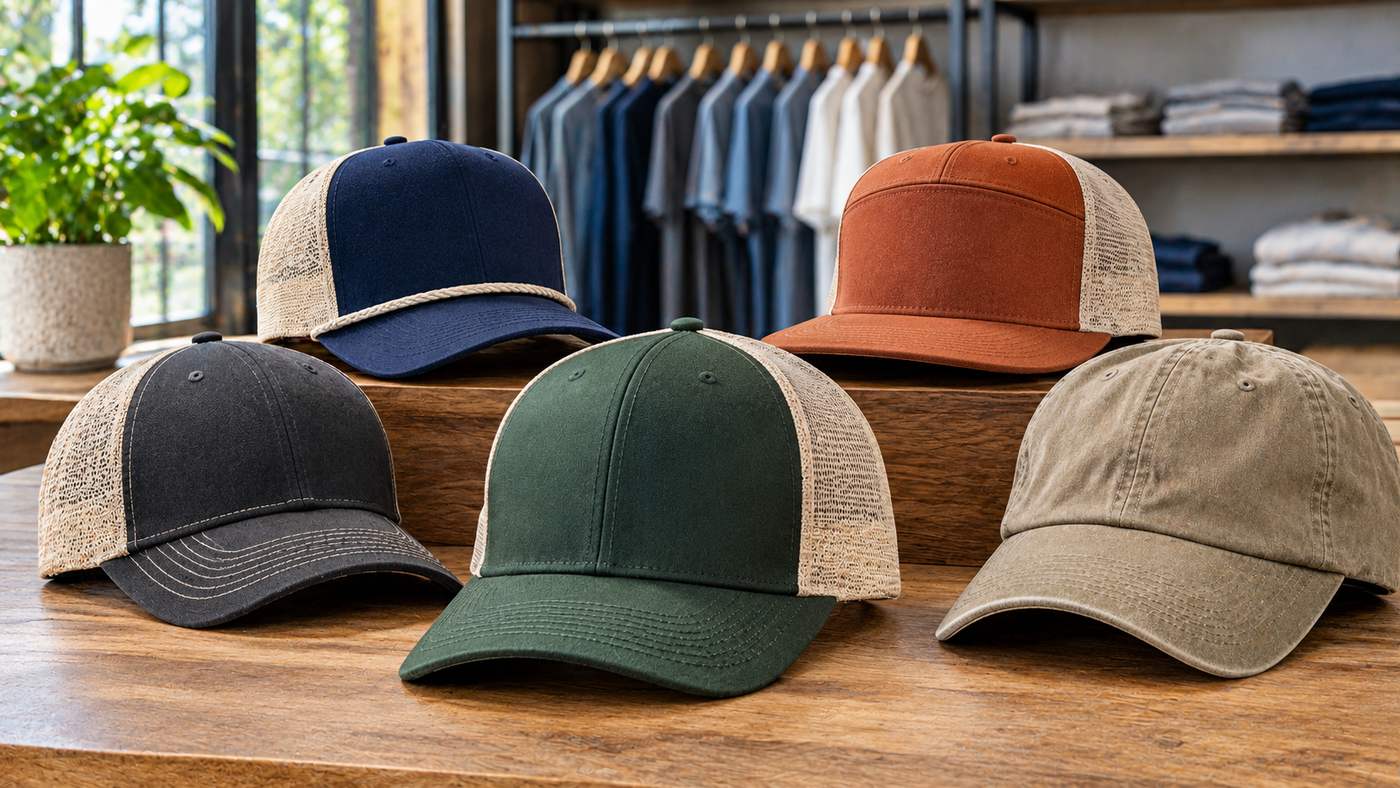
A great cap should fit comfortably, complement the way you dress, and hold up to the activities you use it for. Richardson caps are known for their trucker-inspired silhouettes, athletic headwear, and extensive choices for custom embroidery and patches. From the familiar 112 Trucker to lower-profile, relaxed, and seven-panel designs, the brand offers styles for everyday use, baseball teams, outdoor groups, businesses, and promotional merchandise.
Shopping for a hat becomes confusing when product descriptions use terms such as Mid Pro, Low Pro, structured, unstructured, snapback, and performance fabric. Two caps can share a similar color and mesh back while sitting very differently on the head. A decoration that looks attractive on a wide five-panel front may also be difficult to reproduce on a six-panel design with a center seam.
This guide explains what sets the major models apart, how to find the right size and crown shape, and 19 useful considerations for purchasing or customizing headwear. It also covers fabric choices, group orders, realistic pricing, authorized retailers, and cleaning. Product specifications and minimum order quantities are based on Richardson’s published resources; availability, colors, and dealer prices should be confirmed before buying.
What Are Richardson Caps?
Richardson is a family-owned American headwear and apparel brand with roots in Eugene, Oregon. According to its company history, the Richardson family purchased an established sporting-goods business in 1970. Baseball equipment and team apparel became important parts of its development before headwear grew into a major focus. Today, the brand supplies stock and customizable caps through dealers, distributors, and decoration businesses.
Its range includes traditional trucker hats, fitted baseball caps, stretch-fit performance models, low-profile casual caps, seven-panel designs, outdoor styles, and knit or brimmed headwear. The official catalog differentiates products by shape, construction, fabric, bill, closure, and size instead of treating every baseball cap as the same item.
Why Is the Richardson 112 So Popular?
The brand dates the development of the 112 Trucker to 2004 and describes it as a defining product. The original 112 combines a structured, medium-height crown, a precurved bill, breathable mesh back panels, and an adjustable snapback closure. Its recognizable shape and generous color range make it a common choice for embroidered logos, team merchandise, and everyday casual wear. These are brand-reported design attributes, not a guarantee that the 112 will fit everyone best.
Are All Richardson Hats Trucker Caps?
No. Although trucker styles are prominent, Richardson caps also include on-field baseball, performance, golf, workwear, and casual options. Some models have solid fabric throughout rather than a mesh rear panel. Others use fitted sizing or stretch construction instead of plastic snap closures. Start with your use case rather than selecting a model solely because it has the Richardson name.
Popular Richardson Cap Models Compared
A model number tells you more than a general description such as mesh hat. The following examples show different directions within the manufacturer’s published range.
| Model | Style and shape | Notable features | Useful for |
|---|---|---|---|
| 112 Original Trucker | Mid-profile, structured six-panel | Mesh back, precurved bill, snapback | Everyday wear, teams, prominent logos |
| 115 Low Pro Trucker | Lower-profile structured six-panel | Shallower crown, curved bill, mesh back | Wearers who dislike taller fronts |
| 111 Garment Washed Trucker | Relaxed, unstructured six-panel | Soft washed twill, mesh, snapback | Casual, broken-in appearance |
| 112FP Five Panel Trucker | Five-panel version of the 112 family | Broad front without a vertical center seam | Large patches and clean front designs |
| 112FPR Five Panel Trucker with Rope | Five-panel trucker with a rope detail | Distinctive trim above the visor | Retro-inspired retail or event merchandise |
| 168 Seven Panel Mesh Back | Smart 7 shape, flatter bill | Large seamless front panel, snapback | Modern graphic and patch decoration |
| 112RE Recycled Trucker | Mid-profile six-panel | Recycled polyester twill and mesh | Buyers prioritizing recycled content |
| 256 Umpqua Gramps | Gramps collection silhouette | Heritage-inspired casual styling | Lifestyle collections and relaxed looks |
The table is a starting point rather than a universal feature list for every variation. Check exact style numbers, material compositions, colorways, and size options on the selected product page.
Richardson 112 vs. 115: Which Fits Better?
The main difference is crown shape. The 112 has Richardson’s Mid Pro silhouette, a structured front with moderate depth. The 115 is a Low Pro trucker with a shallower, more sloped front and a standard precurved bill. People who prefer a cap that sits closer to the head may find the 115 more appealing. Those wanting a more prominent front for a logo may prefer the 112. Actual comfort depends on head shape, size, and how the closure is adjusted.
Richardson 112 vs. 168: Six Panels or Seven?
The 112 resembles a classic baseball-inspired trucker cap, while the 168 uses a modern seven-panel design and flatter bill. Richardson describes the 168’s large, seamless front as suitable for decoration. The right choice depends on the look you want, the design’s dimensions, and whether the wearer prefers a curved or flatter visor.
19 Smart Tips for Choosing Richardson Caps
1. Decide How You Will Use the Cap
A hat worn for a short commute has different requirements from one worn on the baseball field, during a fishing trip, or across a full outdoor workday. Think about ventilation, sun exposure, how often you will wash it, and whether you need a uniform appearance for a group. Richardson caps cover several categories, so an outdoor or performance style may be more appropriate than a casual trucker when you expect heavy activity. Match features to actual use instead of following a trend.
2. Understand Crown Height Before Choosing a Model
Crown profile describes how high and deep a cap sits. Richardson identifies Mid Pro, Low Pro, High Pro, Full Pro, and other shapes in its fit guidance. A taller, structured front can create a bolder silhouette but may feel oversized on some wearers. A shallow crown can look neat yet feel too tight on someone who needs more depth. Comparing side-profile photos can help, but trying the cap on is the most reliable test.
3. Choose Structured or Unstructured Construction
Structured caps have reinforcement that helps the front maintain its shape even when the hat is not being worn. Unstructured styles generally feel softer and follow the head more closely. The 112 is a recognizable structured option, while the 111 Garment Washed Trucker is officially described as unstructured and relaxed. Neither is inherently higher quality. For Richardson caps, construction affects both appearance and how an embroidered logo sits on the front.
4. Compare Five-, Six-, and Seven-Panel Designs
A six-panel cap often has a seam running through the middle of its front. Five-panel styles can offer a continuous decoration surface, and Richardson’s seven-panel models also provide broad front areas with different seam placement. The official brand style guide explicitly highlights decoration versatility for five- and seven-panel fronts. If you are planning an embroidered patch or artwork with fine symmetry, examine the seams before ordering.
5. Measure Your Head Instead of Guessing
Richardson advises measuring around the head about half an inch above the eyebrows, where the hat will sit. Keep the tape level and not twisted. If no tape measure is available, use a string and ruler. Compare the measurement with the exact model’s size chart, because adjustable, youth, stretch-fit, and fitted ranges are not interchangeable. Choosing Richardson caps by appearance alone often produces avoidable sizing mistakes.
6. Check Whether Adjustable Really Fits You
A snapback closure provides a useful range, but one size fits most is not the same as one size fits all. Some popular models offer additional small or extra-large variants, while others have narrower ranges. A hat adjusted to its last available snap may feel different from one centered in the adjustment range. Look for a size option that allows comfortable movement and does not pinch the forehead.
7. Consider Mesh Ventilation Without Overpromising Cooling
A trucker cap’s mesh back allows more airflow than a solid, tightly woven panel under similar conditions. That can be appealing during warm-weather use. Nevertheless, mesh does not make a cap temperature-proof or eliminate sweating. Front fabric, sweatband, fit, humidity, and activity all influence comfort. If you expect long periods of exercise, compare Richardson’s performance offerings rather than assuming every mesh-backed model has the same moisture-management properties.
8. Match Fabric to Your Work and Lifestyle
Cotton twill can feel familiar and casual, while polyester blends may offer different durability, drying, and performance characteristics. Richardson’s 112 family includes varied fabrics and prints; the 112RE is listed as 100% recycled polyester. The 111 uses cotton twill and soft polyester mesh. Review each model’s technical specifications rather than relying on broad claims that all Richardson caps use one material or provide identical performance.
9. Choose a Bill Shape You Will Actually Wear
A precurved bill provides a classic baseball-cap appearance. A flatter bill may suit more contemporary streetwear or a larger seven-panel silhouette. Richardson describes the 168 with a flat bill and the 112 with a precurved one. Check the length and shape of the visor too, because a familiar model name does not tell you everything about how it frames your face. Avoid sharply reshaping a visor unless the manufacturer’s guidance permits it.
10. Examine the Sweatband and Internal Comfort
The inner band sits against your forehead and has an outsized effect on everyday wear. Look for neat seams, comfortable edging, and an appropriate fit without rough pressure points. Some models use a conventional sweatband; performance-specific styles may offer different materials. If you plan to wear Richardson caps for hours at a time, prioritize how the band feels when the hat is adjusted for real use rather than choosing only the most attractive front panel.
11. Plan Logo Placement Before Selecting the Cap
Large patches, embroidered lettering, and small side marks need different amounts of usable surface. The seams and curvature of the crown affect whether a design can be reproduced cleanly. A five-panel style may provide a simpler canvas for certain artwork, while a traditional six-panel front gives a classic team look. Ask the decorator to review the exact art file, decoration size, and chosen model before approving production.
12. Know When Direct Embroidery Makes Sense
Richardson’s published standard embroidery program starts at 48 pieces, with 12 pieces per cap and thread-color combination, and the base price covers up to 10,000 stitches. These are manufacturer program requirements, not minimums imposed by every independent decorator selling a ready-stock hat. Flat embroidery suits bold designs without extremely thin lines. If your artwork is intricate, a patch or another process may be easier to reproduce.
13. Compare Embroidered, Woven, and Printed Patches
An embroidered patch gives a tactile stitched look; woven patches can handle some fine detail differently; sublimated patches are used for more complex, multi-color images. Richardson lists a 48-piece minimum for several published patch decoration programs. Each method has restrictions on tiny lettering, edge details, and color. Ask for a digital proof or physical sample when ordering a large batch, and never assume that a detailed screen graphic will reproduce identically on fabric.
14. Explore 3D Embroidery for Bold Artwork
Raised or puff embroidery can add depth to a simple logo or team mark. Richardson’s 3D embroidery program lists a 48-piece minimum with model-specific size limits, and the company warns against thin serifs and tiny details. A design that works well in flat stitches may require simplification for raised stitching. Choose the technique because it suits the artwork—not just because it sounds more premium.
15. Select Colors With Reorders in Mind
Richardson lists a wide variety of colors across the 112 family, including solid, two-tone, and printed combinations. Color names can be helpful, but physical fabric shades may differ from screen images. The brand’s FAQ notes that small dye-batch color variations can occur, so later fill-in orders are not guaranteed to match earlier batches exactly. For organizations using Richardson caps as uniforms, order samples and discuss inventory planning with the dealer.
16. Check Recycled Options Without Assuming All Caps Are Sustainable
The 112RE is a specific recycled model described by Richardson as using Global Recycled Standard-certified recycled polyester. That does not mean the entire catalog has the same materials, certifications, or environmental footprint. If recycled content matters, confirm the exact style number and technical specifications. Durability, useful lifespan, shipping, and whether the product will actually be worn are also relevant purchasing considerations.
17. Verify the Dealer and Get a Written Quote
Richardson says its products are sold through authorized dealers, wholesale distributors, and decorators rather than direct checkout from the brand website. A local embroidery shop or approved online reseller may be the simplest place to buy one hat or organize a team order. Compare cap price, decoration, setup charges, shipping, taxes, lead time, and minimums. For Richardson caps ordered in quantity, confirm the model, fit, color, and artwork in writing before paying.
18. Inspect Samples Before a Bulk Purchase
A photo does not communicate crown depth, visor rigidity, thread density, or how a hat fits different wearers. Order a sample or visit a dealer when possible. For a business or team, test the cap on several people with different head sizes. Confirm that the proposed decoration is legible, sits straight, and does not distort the fabric. Samples can prevent an expensive batch from being produced in the wrong silhouette or shade.
19. Clean and Store the Caps Carefully
Richardson recommends spot cleaning most of its caps with mild detergent and a soft cloth or sponge. The company does not recommend machine washing or drying because the process can affect shape and fit. For heavier use, gentle hand washing and room-temperature air drying are preferred. Reform the crown while drying and store hats where they will not be crushed. Follow model-specific care guidance if a special fabric, patch, or decoration is present.
How to Find the Right Richardson Cap Size
For adjustable hats, the closure is only one factor. Crown depth, panel shape, and internal band construction can all influence comfort. A person with a larger head might fit comfortably into one adjustable design yet find another model shallow or tight.
Simple Measuring Method
- Position a flexible tape around the head where the sweatband normally rests, about half an inch above the eyebrows.
- Keep it level around the back of the head without pulling too tightly.
- Record the measurement in inches or centimeters.
- Compare it with the selected model’s official size range, checking for small, youth, standard, or extra-large options.
- If between sizes, consider the larger option as the brand’s guide suggests, then verify that the actual fit is comfortable.
Richardson caps are also offered in fitted and R-Flex constructions, which follow different sizing systems. Do not assume a fitted baseball size directly corresponds to a snapback setting or stretch-fit range.
What if a Cap Feels Too Tall?
Try a Low Pro or Relaxed silhouette before forcing the bill into a different shape. The 115 has a lower crown than the 112, and the 111 offers a softer, unstructured feel. The right answer is often changing models rather than adjusting the snap closure more tightly.
What if the Snapback Feels Too Tight?
Check whether the model offers an XL or alternate size. A closure at the end of its adjustment range can cause discomfort. Loosening a cap may help, but it should still remain secure during normal movement. Consider a model designed for your actual measurement.
Richardson Caps for Teams, Businesses, and Custom Merchandise
One reason Richardson caps appeal to organizations is that the brand offers numerous styles with decoration options. A youth baseball team may need an on-field cap that works with uniforms, while a brewery might want an embroidered trucker that fits its retail merchandise identity. A landscaping company could prioritize durability and consistent availability for field crews.
Baseball and Softball Teams
Team headwear should coordinate with the intended league or organization requirements, uniform colors, and player comfort. Richardson’s Performance Team Series and on-field collections are more relevant for some competitive uses than casual mesh hats. Ask the team dealer about specific fit options, fabric, decoration, and replacement availability.
Businesses and Promotional Products
Richardson caps can carry a company name or logo for staff, events, merchandise, and branded gifts. Consider how the cap will look on different wearers and whether the artwork remains readable from a reasonable distance. A small, high-contrast design often performs better than a crowded logo with many tiny details.
Clubs, Outdoor Groups, and Retail Brands
Fishing clubs, outdoor groups, restaurants, and lifestyle brands may favor trucker or heritage-style silhouettes. A five-panel or seven-panel front can suit larger patches; relaxed designs can produce a casual aesthetic. Choose the style that fits the audience instead of treating the most familiar model as automatically appropriate.
How Much Do Richardson Caps Cost?
There is no single manufacturer retail price that applies to all Richardson caps. The company directs buyers to dealers, and prices can vary by product, region, reseller, order size, and customization. A blank cap sold individually may be priced differently from a decorated batch that includes artwork setup and stitching.
| Cost element | What to check |
|---|---|
| Base cap | Style number, size, fabric, and color |
| Decoration | Flat embroidery, raised embroidery, patch, or transfer |
| Artwork preparation | Digitizing, proofing, or setup charges |
| Minimum quantity | Manufacturer program versus retailer policy |
| Shipping | Delivery method, destination, and order volume |
| Taxes and import costs | Applicable local charges and international fees |
| Reorders | Color availability and batch-matching expectations |
Why Bulk Orders Are Not Always Straightforward
The manufacturer lists certain decoration programs with minimum quantities, such as 48 pieces for standard embroidery and several patch categories. A local decorator may separately sell a small run using in-stock blanks and a different process. Conversely, fully bespoke manufacturing can require considerably larger minimums. Ask which ordering method your quote covers.
Example of Comparing Two Quotes
Suppose a business needs 60 decorated caps. One dealer quotes a base cap charge plus embroidery and a one-time setup fee. Another gives a higher per-cap price but includes setup and shipping. Compare the complete order total, the approved decoration sample, and replacement policy rather than assuming the lower advertised cap price creates the cheaper project. These are examples of cost components, not verified current prices.
Where to Buy Authentic Richardson Caps
The official Richardson website states that it sells through authorized wholesale distributors, team sporting-goods dealers, promotional products companies, embroidery shops, and online resellers. It recommends searching by exact style number, such as Richardson 112, rather than only a generic word like trucker hat.
For a single blank cap, an authorized retailer may offer a normal checkout process. For a company logo, a decorator or promotional products dealer can handle artwork review and ordering. International buyers should verify whether the seller ships to their country and what taxes, customs charges, and return rules apply.
How to Check That a Listing Matches the Product
Compare the style number, crown profile, bill shape, closure, fabric, and listed size. Examine clear photographs of the front, back, and interior label where available. Richardson’s 112 collection page mentions Richardson branding on the snapback as one authenticity clue, but no single visual detail should replace buying through a reputable dealer.
Can You Buy Directly From the Brand?
Richardson’s FAQ says buyers purchase through its dealer and distributor network, rather than a normal direct-to-consumer checkout. Its website can still help you review specifications and identify the appropriate collection before contacting a seller.
How to Customize Richardson Caps Without Design Mistakes
Start with the artwork and the intended audience. A small sports logo, a complex multicolor badge, and a corporate wordmark may require different techniques. Ask a decorator for artwork dimensions, thread or print limitations, placement options, and a proof.
Direct Embroidery
This method stitches artwork directly into the cap front or another supported area. It suits bold, comparatively simple designs. Fine lines and small lettering can become difficult to reproduce at a limited stitch size. Check the selected crown’s seams and available embroidery field.
Patches
Patches can accommodate different textures and may be prepared separately before attachment. Embroidered, woven, rubber, and sublimated varieties have different strengths. A wide patch should be tested against crown curvature so its edges sit correctly rather than lifting.
Rope and Retro Details
A rope-style cap, such as the 112FPR family, adds a visible design element above the brim. This can look distinctive even with simple front artwork. However, the trim also becomes part of the overall visual identity, so choose compatible colors rather than adding every decorative feature at once.
Approval and Production
Before authorizing a group order, verify the exact blank model, physical color, decoration type, finished dimensions, placement, quantity per size, and expected delivery schedule. Keep the approved proof so future reorders can be compared with the original specification.
Care and Maintenance for Richardson Hats
Regular cleaning helps protect the appearance of fabric, sweatbands, and decoration. Richardson’s official FAQ recommends spot cleaning and gentle hand washing rather than washing machines or tumble dryers.
Spot-Cleaning Routine
Remove loose dust with a soft brush. Lightly dampen a cloth or sponge with water and mild detergent and gently treat the dirty area. Avoid saturating any decoration or rubbing aggressively. Remove remaining soap according to the care instructions and allow the cap to dry naturally while maintaining its shape.
Handling Heavy Sweat or Odor
For Richardson caps worn frequently outdoors, follow the model’s guidance for gentle hand washing. Check the sweatband and inside panels and rinse appropriately without twisting the crown or bill. Air drying at room temperature is safer for maintaining shape than a dryer or strong direct heat.
Storage and Travel
Do not leave a structured cap crushed beneath heavy objects. If packing several hats, nest them carefully without bending rigid front panels. For a decorated cap, avoid pressing hard accessories against embroidery or patches. Store clean and fully dry to reduce odors and fabric deterioration.
Common Mistakes When Choosing Richardson Caps
One mistake is buying the 112 because it is well known without considering whether a shallower 115 or relaxed 111 would fit better. Another is selecting a color from a screen and expecting every later batch to match perfectly. The manufacturer’s FAQ acknowledges minor manufacturing and dye-batch differences.
Custom buyers sometimes approve a logo before checking whether the chosen front panel supports fine details. Others compare per-cap prices without accounting for decoration minimums and setup costs. A further problem is machine washing a structured hat without checking the manufacturer’s advice, which may affect the crown and bill.
For Richardson caps, the most useful purchasing sequence is to choose the intended use, confirm the fit, review the actual material and model number, then settle on colors and decoration.
Frequently Asked Questions
1. What is the difference between Richardson 112 and 115 caps?
The 112 is a structured, mid-profile trucker with a precurved bill and mesh back. The 115 is a lower-profile structured trucker with a shallower crown. Choose based on the silhouette and comfort you prefer, not only on color.
2. Are Richardson caps available for custom embroidery?
Yes. Richardson publishes direct-embroidery and patch programs for eligible styles. Its standard embroidery program lists a 48-piece minimum, although individual decorators may offer smaller runs using their own inventory and processes.
3. How should you wash Richardson caps?
Richardson recommends spot cleaning most caps with mild detergent and a soft cloth. For heavier cleaning, gentle hand washing followed by room-temperature air drying is preferred. Machine washing and machine drying are not recommended by the brand.
4. Where can you buy authentic Richardson caps?
Buy through established team dealers, promotional products distributors, embroidery shops, or reputable online resellers. Verify the product’s exact model number, size, and listed specifications before purchasing.
Conclusion
Richardson caps offer several distinct approaches to casual, athletic, and custom headwear, from the classic 112 Trucker to low-profile, relaxed, and modern seven-panel styles. The right choice depends on crown depth, fit, material, closure, and intended decoration rather than popularity alone. Compare official specifications, order samples when possible, and confirm pricing and minimums with an established dealer. With appropriate care and thoughtful selection, a well-matched cap can remain a useful part of everyday clothing or a consistent branded collection.
