
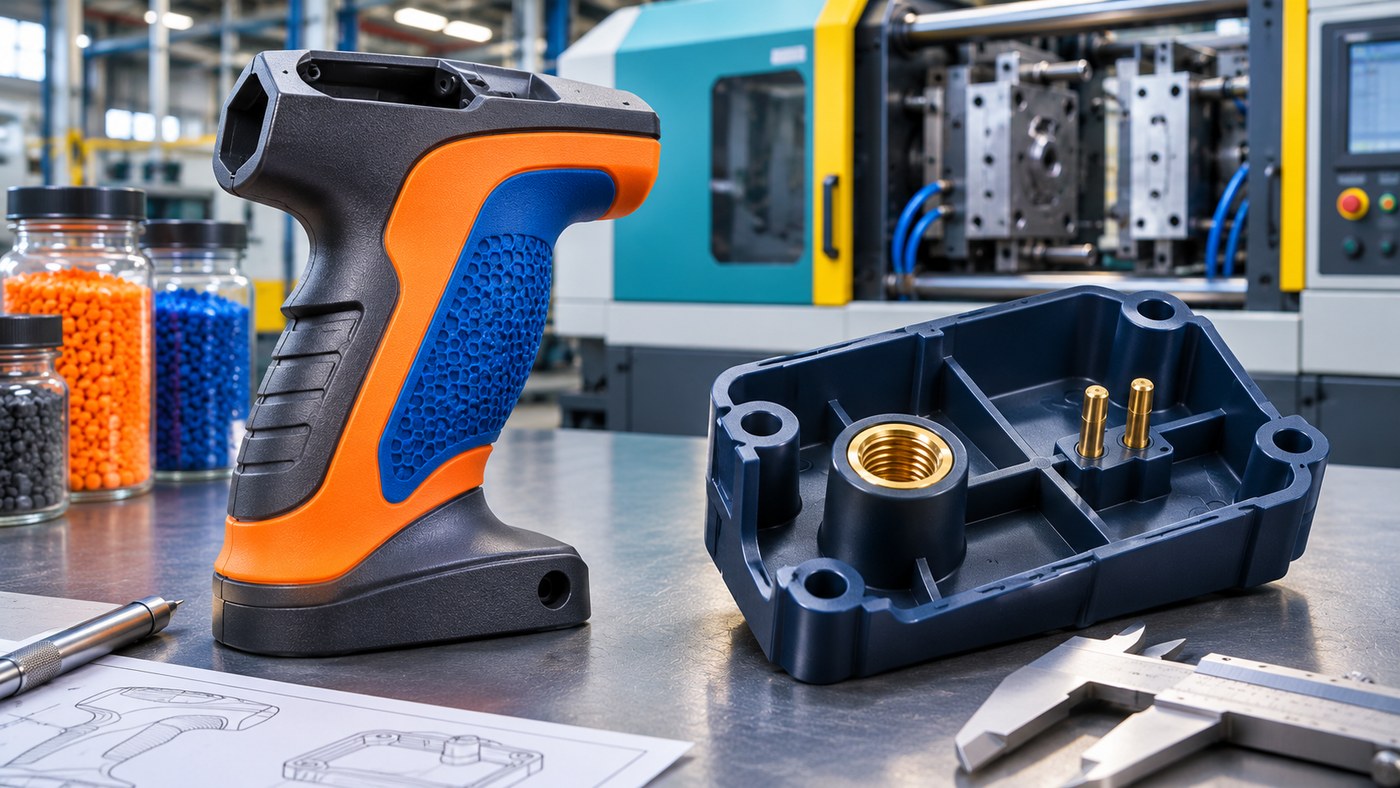
Modern manufacturing requires products that combine durability, functionality, attractive appearance, and cost-efficient production. From automotive components and medical devices to electronic housings and everyday consumer products, manufacturers increasingly use advanced injection molding techniques to integrate different materials into a single component.
Understanding overmolding vs insert molding is essential for engineers, product designers, and manufacturers deciding how to combine materials efficiently. Both processes involve molding plastic around an existing component, but their typical applications, material combinations, tooling requirements, and bonding methods differ.
Overmolding commonly adds a second plastic or elastomer layer to an existing substrate, creating features such as soft-touch grips, protective surfaces, and integrated seals. Insert molding generally places a preformed component, often metal, inside a mold before plastic is injected around it to create a unified assembly.
Neither technique is automatically better for every product. The most suitable choice depends on performance requirements, production volume, budget, material compatibility, and product geometry.
This guide explains seven important differences between the processes and provides practical recommendations for choosing the right manufacturing method.
What Is Overmolding?
Overmolding is an injection molding technique in which an additional material is molded over an existing substrate or component.
The process combines materials with different properties to produce a finished part that may offer better grip, improved appearance, additional protection, or other functional advantages.
For example, a manufacturer may produce a rigid plastic handle and then mold a softer thermoplastic elastomer over selected surfaces.
The rigid base provides structural support, while the softer material improves the user’s grip and comfort.
How the Overmolding Process Works
The manufacturing sequence generally includes several stages.
- A rigid substrate is manufactured using injection molding or another suitable process.
- The substrate is positioned inside a second mold cavity or transferred within a specialized two-shot molding system.
- A second material is injected around selected portions of the substrate.
- The material cools or cures according to its processing requirements.
- The finished component is removed and inspected for defects.
Overmolding can use separate production stages or highly automated equipment, depending on the manufacturing arrangement.
Common Overmolding Materials
Frequently used materials include:
- Thermoplastic elastomers (TPE)
- Thermoplastic polyurethane (TPU)
- Acrylonitrile butadiene styrene (ABS)
- Polycarbonate (PC)
- Polypropylene (PP)
- Certain silicone rubber grades
- Other application-specific engineering plastics
Not every combination produces a strong bond.
Material compatibility, processing temperature, surface conditions, and part design must be evaluated before production.
Typical Overmolding Applications
Overmolding is commonly found in power tool handles, toothbrush grips, electronic device housings, automotive components, and selected medical devices.
It is especially useful when a product requires both structural strength and a softer external surface.
What Is Insert Molding?
Insert molding is a manufacturing process that integrates a preformed component into a plastic part during injection molding.
The insert is positioned inside a mold before molten plastic is introduced.
As the plastic flows around the insert and solidifies, the materials form a single integrated component.
Metal inserts are common, but ceramics, electrical contacts, and other suitable components may also be used.
How Insert Molding Works
A typical insert molding process involves the following steps:
- The preformed insert is manufactured or obtained from a supplier.
- The insert is inspected and positioned accurately inside the mold.
- The mold closes around the insert.
- Molten plastic is injected into the cavity.
- Plastic flows around the designated features of the insert.
- The plastic solidifies and mechanically retains or encapsulates the insert.
- The completed component is removed and inspected.
Accurate insert placement is essential because movement during injection can affect dimensional accuracy and part quality.
Common Materials Used in Insert Molding
Typical insert materials include brass, stainless steel, aluminum, ceramics, and selected electronic components.
The surrounding plastic may consist of nylon, polycarbonate, PBT, ABS, or another suitable engineering resin.
Material selection must consider operating temperature, mechanical loading, chemical exposure, and manufacturing conditions.
Typical Insert Molding Applications
Insert molding is frequently used for threaded fasteners, electrical connectors, automotive housings, industrial components, and electronic assemblies.
It is particularly valuable when a plastic component requires integrated metal features or repeated fastening capability.
Overmolding vs Insert Molding: Quick Comparison
The following comparison highlights their typical differences.
| Feature | Overmolding | Insert Molding |
|---|---|---|
| Primary purpose | Combine material properties | Integrate functional inserts |
| Typical components | Plastic and elastomer | Metal and plastic |
| Common application | Soft grips and protective layers | Threaded inserts and connectors |
| Bonding method | Chemical adhesion and/or mechanical retention | Primarily mechanical retention |
| Production approach | Two-shot or transfer molding | Insert placement followed by injection |
| Tooling | May require two-shot or separate tooling | Requires fixtures for inserts |
| Main design concern | Adhesion and interface quality | Insert positioning and retention |
| Potential advantage | Improved ergonomics and sealing | Reduced assembly and stronger attachment features |
| Typical defects | Delamination, flash, incomplete coverage | Insert movement, voids, cracking |
| Cost considerations | Tooling complexity and secondary materials | Insert cost, placement, and cycle time |
These are common patterns rather than absolute rules. The techniques overlap, and some products use both.
1. Material Selection and Bonding Compatibility
One of the most important differences between the processes involves how the materials interact.
Bonding in Overmolding
Overmolding often depends on achieving suitable adhesion between the substrate and the second material.
For example, some TPU grades can bond effectively to compatible ABS or polycarbonate substrates under appropriate processing conditions.
However, compatibility varies according to the exact resin grade, additives, processing temperatures, and surface conditions.
A combination that appears suitable in a general materials chart may still require testing.
Chemical and Mechanical Bonding
Chemical bonding can occur through interactions between compatible polymer materials.
Mechanical bonding uses physical features such as grooves, holes, undercuts, or wraparound geometry to retain the overmold.
These methods may be used together.
For applications where separation would create significant risks, mechanical retention can provide an additional safeguard.
Bonding in Insert Molding
Insert molding commonly relies on mechanical retention because metals and thermoplastics do not typically develop the same direct polymer-to-polymer adhesion.
Engineers often incorporate knurling, grooves, undercuts, or specially shaped inserts.
When the plastic solidifies around these features, the insert is held in position.
The design must account for the forces experienced during use.
Key takeaway: Overmolding often emphasizes material compatibility and adhesion, while insert molding commonly emphasizes precise positioning and mechanical retention.
2. Product Design and Functional Requirements
The intended function of a component strongly influences which process is appropriate.
When Overmolding Is Useful
Overmolding can improve surfaces that people touch or components that require additional cushioning.
For example, a handheld electric tool may benefit from a soft gripping area surrounding a rigid housing.
The material combination can provide structural strength while improving tactile performance.
Other potential benefits include vibration damping, surface protection, and integrated sealing features.
When Insert Molding Is Useful
Insert molding is often selected when a component requires integrated metal parts.
A plastic housing intended to be repeatedly assembled and disassembled may benefit from molded-in threaded brass inserts.
The metal threads can provide greater resistance to repeated fastening wear than suitable designs using plastic threads alone.
Electrical terminals and metal bushings are other examples.
Functional Design Comes First
Manufacturers should define measurable requirements before selecting a process.
These requirements may include load capacity, grip characteristics, dimensional stability, electrical performance, environmental protection, and expected service life.
The process should be selected according to these needs rather than visual appearance alone.
3. Tooling Complexity and Production Methods
Tooling requirements significantly influence manufacturing costs and project timelines.
Two-Shot Overmolding
Two-shot molding uses equipment that injects two materials during a coordinated production cycle.
The substrate is molded first, followed by the second material.
Specialized tooling and machine configurations are normally required.
This approach can reduce manual handling and support efficient high-volume manufacturing.
However, initial equipment and tooling investments may be substantial.
Transfer or Pick-and-Place Overmolding
In a separate-stage arrangement, the substrate is manufactured first and transferred to another mold.
The transfer may be completed manually or through automation.
This approach may be practical for lower production volumes, development work, or products requiring greater flexibility.
Its economic suitability depends on tooling cost, labor, cycle time, and production requirements.
Insert Molding Tooling
Insert molding requires a mold capable of holding the insert in its intended position during injection.
Fixtures, locating features, and core designs must account for insert geometry.
Manual loading may suit some production arrangements, while robotic loading can support higher volumes.
The Importance of Accurate Tooling
Poor tooling design can cause flash, incomplete filling, inaccurate component positioning, and other defects.
Manufacturers should evaluate injection pressure, mold shutoff surfaces, venting, and dimensional tolerances before production.
4. Manufacturing Costs and Long-Term Profitability
Cost is frequently a deciding factor when comparing overmolding vs insert molding.
However, the least expensive tooling arrangement is not necessarily the most economical option over a product’s full production life.
Initial Tooling Investment
Two-shot overmolding may involve more sophisticated tooling than a conventional single-shot part.
Separate-stage overmolding may require two molds but avoid some specialized machine costs.
Insert molding typically needs appropriate insert locating and retention features.
The actual investment depends on part complexity and supplier capabilities.
Material Expenses
Overmolded components use more than one material, which can influence material sourcing and production costs.
Insert-molded components require both the injected resin and the preformed insert.
Metal inserts may introduce additional purchasing, handling, and inventory expenses.
Labor and Automation
Manual substrate transfer or insert loading can increase labor requirements.
Automated processes may reduce repetitive handling but require an investment in equipment and setup.
Higher production volumes can make automation more attractive.
Calculating Total Manufacturing Cost
A useful comparison considers:
Total production cost = tooling investment + materials + processing + labor + inspection + scrap + assembly and logistics.
For example, a manufacturer producing a few hundred components may prefer flexible tooling with lower upfront costs.
A company producing hundreds of thousands of identical parts may justify more expensive automated equipment if recurring savings are substantial.
The decision should be supported by quotations and realistic production forecasts.
Consider Product Redesign Risks
Early-stage products often undergo modifications.
Investing heavily in complex tooling before design validation can create unnecessary expenses.
Prototype testing and design-for-manufacturing reviews help reduce this risk.
5. Precision, Dimensional Accuracy, and Quality Control
Both processes require accurate manufacturing, but their most critical quality concerns are often different.
Overmolding Quality Challenges
The second material must flow into the intended regions without leaving gaps or creating excessive flash.
Incorrect mold shutoffs can cause thin, unwanted material to extend beyond the required surface.
Poor bonding may result in delamination, where the overmold separates from the substrate.
Uneven coverage can also affect appearance or performance.
Insert Molding Quality Challenges
Insert placement is especially important.
An incorrectly positioned threaded insert can interfere with assembly or cause dimensional problems.
Other potential defects include voids, deformation, plastic cracking, and inadequate insert retention.
For electrical applications, the position of terminals and contacts may be critical.
Quality Inspection Techniques
Manufacturers may use dimensional measurement, visual inspection, mechanical testing, and application-specific evaluations.
Where appropriate, these may include pull-out testing, torque testing, peel testing, or environmental conditioning.
Inspection plans should reflect the consequences of product failure.
Why Design Validation Matters
A prototype that looks correct may not perform adequately under real operating conditions.
Testing should reflect expected mechanical loads, temperature changes, chemical exposure, and other environmental factors.
6. Strength, Durability, and Product Performance
Overmolding and insert molding can both improve component performance, but they generally address different requirements.
Overmolding for Surface Performance
Overmolding can provide softer contact surfaces, greater friction, cushioning, and selected protective features.
These qualities can be useful in products subjected to repeated handling.
For example, an overmolded tool handle may improve comfort during prolonged use.
However, the performance of the grip depends on material hardness, texture, geometry, and environmental conditions.
Insert Molding for Structural Features
Insert molding can improve the durability of fastening locations and integrate components requiring additional strength.
A brass threaded insert may help a plastic enclosure withstand repeated screw installation.
Metal sleeves can also support certain moving or load-bearing interfaces.
The benefits depend on appropriate insert geometry and surrounding plastic design.
Thermal Expansion Considerations
Different materials expand and contract at different rates when temperatures change.
Metal and plastic components may experience stress at their interface during heating and cooling.
If the design does not account for these differences, cracking or loss of retention may occur.
Material selection and thermal testing are particularly important for products exposed to wide temperature ranges.
Environmental Durability
Moisture, cleaning chemicals, ultraviolet exposure, and repeated mechanical loading may affect component performance.
For products requiring waterproofing or specific ingress protection, successful overmolding alone does not establish compliance.
The complete assembly must undergo appropriate testing.
7. Industry Applications and Manufacturing Suitability
Different industries use these processes to solve specific engineering problems.
Automotive Manufacturing
Automotive manufacturers may use overmolding for grips, cushioning, seals, and selected interior components.
Insert molding can integrate metal bushings, threaded features, and electrical contacts into plastic housings.
Both processes must account for vibration, temperature variation, and durability.
Medical Devices
Medical equipment may require ergonomic handling surfaces, sealed housings, or integrated functional components.
Overmolding can be useful for handles and certain protective features.
Insert molding may incorporate metal elements into device assemblies.
Material compatibility, cleaning requirements, biocompatibility where applicable, and manufacturing controls must be evaluated for the intended medical use.
Consumer Electronics
Electronic products often combine rigid housings with softer protective features.
Overmolding may help create grips, strain reliefs, and protective surfaces.
Insert molding may integrate electrical contacts, threaded mounting points, and other components.
Industrial Equipment
Industrial tools and machinery may require durable housings and secure mounting features.
Manufacturers can use overmolding for contact areas or protective surfaces and insert molding for reinforced connections.
Household Products
Toothbrushes, kitchen tools, personal care devices, and various consumer goods can benefit from multi-material manufacturing.
The selected process depends on functionality, cost, and intended service conditions.
Important Design Guidelines for Overmolding
Successful overmolding requires careful coordination between product geometry, materials, and tooling.
Select Compatible Materials
Confirm compatibility using resin supplier guidance and representative testing.
Avoid assuming all materials within the same general polymer family will bond equally well.
Design Suitable Bonding Areas
Provide enough contact area to achieve the required performance.
Where appropriate, use grooves, undercuts, or other mechanical retention features.
Consider Wall Thickness
Excessively thin overmold regions may be difficult to fill consistently.
Very thick sections can increase material use and affect cooling behavior.
The suitable dimensions depend on the material and molding process.
Control the Material Interface
Pay special attention to where the second material begins and ends.
Well-designed transitions can improve appearance and reduce the likelihood of exposed edges peeling during use.
Evaluate Gate Placement
Gate location influences how material flows through the cavity.
Poor placement can cause incomplete filling, cosmetic defects, or unwanted stress.
Manufacturers should review gate locations during tooling design.
Important Design Guidelines for Insert Molding
Insert molding introduces specific design challenges associated with holding and encapsulating preformed components.
Design Reliable Insert Positioning
The mold must locate the insert accurately and prevent movement during injection.
Locating features should allow repeatable production without damaging the insert.
Include Mechanical Retention Features
Knurling, grooves, shoulders, and undercuts can help improve retention.
Their geometry should reflect the loads the component will experience.
Maintain Adequate Plastic Around Inserts
Insufficient surrounding material may cause cracking or inadequate retention.
Engineers should evaluate wall thickness, stress concentration, insert diameter, and expected loading.
Consider Injection Temperature
Inserts must withstand the relevant manufacturing conditions.
This is particularly important when encapsulating electronic components or temperature-sensitive materials.
Prevent Trapped Air
Mold venting and material flow should be designed to reduce voids and incomplete filling around inserts.
These defects may reduce mechanical performance.
Overmolding vs Insert Molding: Which Is Better for Your Product?
The correct choice depends on the function the finished component must perform.
Choose Overmolding When:
You need a soft-touch grip, cushioning, contrasting surface material, or an integrated elastomeric feature. Material compatibility and surface performance should be primary considerations.
Choose Insert Molding When:
You need embedded metal threads, bushings, electrical contacts, or other functional components that must be securely retained within plastic.
Consider Combining Both When:
Your product needs structural inserts and a soft external surface. The processes may be combined where geometry, materials, manufacturing sequence, and production economics allow.
For example, an industrial handheld device might use insert molding to integrate threaded metal mounting points and overmolding to create a comfortable grip.
The combined design may reduce separate assembly steps, but it should be evaluated for cost, manufacturability, and durability.
How to Select a Reliable Injection Molding Manufacturer
Working with a suitable manufacturing partner can help identify design issues before tooling investment.
Evaluate Technical Experience
Ask whether the manufacturer has experience with comparable material combinations and component applications.
A supplier experienced in soft-touch overmolding may have different capabilities from one specializing in precision insert molding.
Request Design-for-Manufacturability Analysis
A design-for-manufacturability (DFM) review evaluates whether the proposed design can be produced consistently and efficiently.
It may identify material incompatibility, inadequate wall thickness, difficult mold shutoffs, or insert positioning risks.
Review Tooling Capabilities
Confirm that the supplier supports the required mold design, manufacturing tolerances, production volume, and inspection procedures.
Understand Prototype Options
Prototype and low-volume manufacturing services can help validate a design before significant production investment.
This is particularly important when the final component has demanding performance requirements.
Compare Complete Quotations
A quotation should clearly identify tooling, materials, production, secondary operations, inspection, and delivery assumptions.
Manufacturers should also clarify how design changes affect cost and lead time.
Common Mistakes to Avoid
Manufacturers can encounter expensive problems when they choose a molding process before fully evaluating product requirements.
Assuming All Plastics Bond Successfully
Overmolding performance depends on specific material grades and processing conditions.
Representative testing is essential.
Ignoring Insert Retention
A metal insert may appear securely positioned but fail when exposed to repeated torque or axial loads.
Mechanical requirements must guide the design.
Overlooking Production Volume
A tooling strategy suitable for prototypes may be inefficient for mass production.
Expected volume should influence process selection.
Focusing Only on Initial Tooling Costs
Lower tooling expenses may be offset by higher labor, scrap, or assembly costs.
Total manufacturing economics provide a more useful comparison.
Skipping Environmental Testing
Components exposed to temperature changes, chemicals, moisture, or vibration should be tested under relevant conditions.
Neglecting Quality Control
Even well-designed parts can experience production variation.
Appropriate inspection and process monitoring help maintain consistent performance.
Future Trends in Multi-Material Injection Molding
Manufacturing technology continues to develop through automation, improved engineering polymers, and more advanced production monitoring.
Greater Automation
Robotic insert loading and automated part transfer can reduce repetitive handling and improve production consistency.
The financial benefits depend on production scale and system complexity.
Advanced Material Development
New resin formulations may offer improved adhesion, temperature resistance, mechanical properties, and processing characteristics.
Manufacturers should evaluate actual material specifications rather than relying solely on broad performance claims.
Digital Manufacturing Tools
Mold-flow simulation and digital design analysis can help identify potential filling, cooling, and dimensional problems before tooling is finalized.
These tools support engineering judgment but do not replace physical validation.
Material Efficiency
Manufacturers may increasingly optimize part geometry to reduce unnecessary material and assembly operations.
However, products combining dissimilar materials can create recycling challenges.
Environmental decisions should consider durability, manufacturing waste, end-of-life handling, and other relevant factors.
Frequently Asked Questions About Overmolding vs Insert Molding
1. What is the main difference between overmolding and insert molding?
Overmolding typically adds a second plastic or elastomer layer to an existing substrate, often to improve grip, protection, or appearance. Insert molding usually embeds a preformed component, such as a metal insert, within an injection-molded plastic part to provide functional or structural features.
2. Is overmolding more expensive than insert molding?
Not necessarily. Manufacturing costs depend on tooling complexity, material selection, production volume, automation, and part geometry. Two-shot overmolding may require greater initial investment, while insert molding may introduce insert purchasing and placement costs.
3. Which process is better for manufacturing durable plastic parts?
Both can improve durability in different ways. Overmolding can provide cushioning, surface protection, and selected sealing features. Insert molding can reinforce fastening points and integrate structural components. The best choice depends on expected loads and environmental conditions.
4. Can overmolding and insert molding be used together?
Yes. Manufacturers can combine the techniques when a component requires embedded functional inserts and an additional molded material. The design must account for material compatibility, manufacturing sequence, tooling requirements, and suitable performance testing.
Conclusion
Overmolding and insert molding provide valuable solutions for manufacturing products that require more than one material or component. Overmolding is often preferred for ergonomic surfaces, soft-touch grips, and integrated protective features, while insert molding excels at incorporating metal components and reinforcing mechanical connections. Understanding material compatibility, tooling requirements, production costs, and performance expectations helps manufacturers select the most suitable method. A careful design review and representative testing can improve reliability and support more efficient production.
