
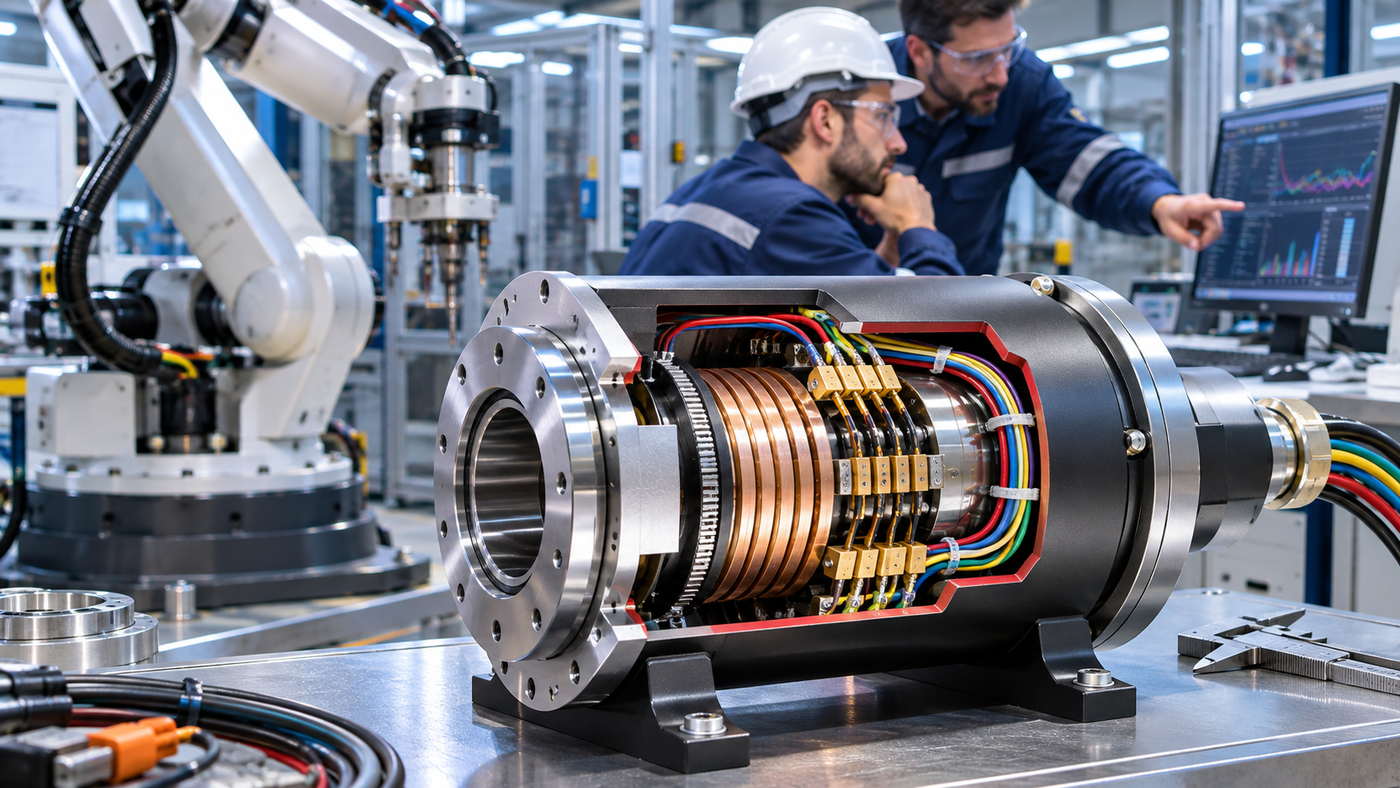
Rotating machinery creates an electrical problem that ordinary fixed wiring cannot always solve. A camera platform must turn while receiving power, a packaging machine needs feedback from its rotating section, and a wind turbine may require signals across a moving interface. slip ring solutions provide a way to transfer electrical power, signals, or data between stationary and rotating components without repeatedly winding a cable around the shaft. Their usefulness, however, depends on matching electrical requirements to mechanical loads and the operating environment. This guide explains how the devices work, the common designs, and seven engineering decisions that influence reliability. It also covers testing, maintenance, and circumstances where a different type of rotary connection may be more appropriate.
What Is a Slip Ring and How Does It Work?
A conventional electrical slip ring uses conductive rings and brushes or other sliding contacts. One side moves with the rotating assembly while the other remains stationary. Their continuing contact creates electrical paths across the rotating interface. Bearings, insulation, housing, leads, and connectors may complete the assembly, depending on the product. A channel, circuit, or way normally denotes one conductive path; a return conductor may therefore require another path.
The purpose of slip ring solutions is not to create electrical energy. It is to maintain a connection while relative rotation occurs. A carefully selected unit may transmit motor supply current, sensor readings, control signals, or digital communication. Some assemblies combine several of these functions, but they must be designed and qualified for the actual mix of circuits.
Slip Rings Versus Rotary Joints
The terminology can be confusing. An electrical slip ring transfers electricity; a fluid rotary union transfers liquids or gases; a fiber optic rotary joint transfers light through optical fibers. Integrated systems can contain several of these technologies around one rotational axis. None should be assumed to perform the function of another without the appropriate component.
Is a Slip Ring Always Necessary?
No. A machine with a limited angle of rotation may use a properly engineered flexible cable loop or other cable management system. When rotation is continuous, repeated cable twisting becomes a more serious limitation. The required angle, cycle frequency, available space, and service life should determine the approach.
1. Select the Right Slip Ring Design for the Machine
The first step in comparing slip ring solutions is deciding which physical format fits the equipment. A compact capsule contains a self-contained rotating interface, often useful in small mechanisms. A through-bore design leaves an opening along its axis for a shaft, pipe, or other equipment. A separate rotor and brush assembly can support integration into a custom machine where an enclosed capsule would not fit.
Capsule and Through-Bore Designs
Compact capsules may suit camera mechanisms, test instruments, and small automated devices, provided their electrical and speed ratings are sufficient. Through-bore slip rings suit equipment needing a central passage or concentric installation. Bore diameter, outside diameter, axial length, and mounting details must all be specified. A nominally correct bore can still be unusable if its connectors interfere with the surrounding mechanism.
Pancake and Larger Industrial Assemblies
A pancake configuration arranges contacts in a flatter axial package. It can help when installation height is restricted, although some designs introduce compromises involving contact geometry, wear, capacitance, or signal coupling. Large industrial systems may instead use robust drum arrangements with serviceable brushes and substantial conductors. There is no universally superior shape.
Check Integration Before Selecting a Catalogue Part
For slip ring solutions, request mounting drawings, rotating and stationary clearances, allowable loads on the assembly, lead orientation, and connector space. A part should not be forced to carry structural or shaft alignment loads unless it was specifically engineered for them.
2. Specify Voltage, Current, and Every Circuit Clearly
Electrical sizing starts with an inventory of what must cross the rotating interface. List each power conductor, return, protective earth, sensor channel, and data pair. For slip ring solutions, record the voltage type and level, normal current, possible startup or surge current, operating duty, and isolation requirements for each path. The rating of one high-current ring cannot be assumed to apply to every other contact in the same unit.
Continuous Load Is Different From a Peak
Motors and other loads may draw more current during starting than during normal operation. Undersized contacts can heat excessively or deteriorate. Excessive voltage may exceed the insulation system’s safe limits. Engineers should check conductor size, contact resistance, heat dissipation, insulation spacing, and the manufacturer’s permitted operating conditions as a complete system.
Separate Power and Sensitive Signals
A mixed assembly may transfer supply power and low-level measurements together, but circuit layout matters. High-current switching and electrical noise can disturb sensitive analog signals unless shielding, grounding, spacing, and appropriate contact technology are considered. For slip ring solutions carrying both types, provide the supplier with a wiring schedule rather than a simple total circuit count.
Grounding and Protection Cannot Be Assumed
A rotating interface is not automatically a reliable protective earth path. Design and validate protective bonding, overcurrent protection, isolation, and fault handling according to the relevant equipment standard. Qualified personnel should review the final electrical safety design.
3. Protect Ethernet, Sensors, and Other Data Signals
When comparing slip ring solutions for communication networks, the phrase data capable can describe very different performance levels. A basic contact may pass a low-frequency control signal yet fail to preserve the signal integrity required by a high-speed digital connection. When assessing slip ring solutions for Ethernet, fieldbus, video, encoders, or instrumentation, identify the specific protocol, bit rate, cable impedance, acceptable error rate, and length of the complete link.
Contact Noise and Signal Integrity
Sliding contacts can introduce small variations in electrical resistance as the machine turns. Their effect depends on the current, signal level, contact design, and receiving equipment. For low-voltage sensors, additional noise may matter even when the power circuits operate normally. High-speed communication also depends on impedance consistency, shielding, crosstalk, and connector quality.
Manufacturers offer specialised data-capable systems, including certain assemblies designed for 100 Mbps or 1 Gbps Ethernet. Those figures belong to defined product configurations and testing conditions, not to every slip ring. Ask whether the precise assembly has been validated for the intended protocol during continuous rotation.
When Fiber Optics Make Sense
A fiber optic rotary joint can transfer optical signals through a rotating axis. It may be suitable when electrical isolation, electromagnetic interference resistance, or demanding optical data requirements are important. Optical links do not carry ordinary electrical power, so a project may require both an electrical slip ring and a fiber optic component. Some slip ring solutions integrate the two in one package.
Validate the Complete Communication Link
Test with the planned cable, connector, network equipment, rotation speed, and adjacent power circuits. Packet errors, loss of communication, and intermittent faults may emerge only during motion or electrical switching.
4. Match Speed, Rotation Pattern, and Service Life
Mechanical operating conditions are central to reliable slip ring solutions. A slowly turning crane, a continuously rotating inspection table, and a high-speed test machine do not impose the same demands. Record typical and maximum revolutions per minute, direction changes, acceleration, vibration, and expected number of operating hours or rotations.
Speed and Diameter Work Together
The contact’s surface speed depends on rotational speed and the radius of its path. Two devices turning at the same revolutions per minute can therefore experience different contact conditions. Slip ring solutions for large diameter equipment may require particular attention to this relationship. Greater surface speed may influence friction, temperature, wear, and the contact technology required. Certain specialised products can operate at high speeds, but catalogue values must be checked for the exact arrangement and duty.
Oscillation Is Not Identical to Continuous Rotation
Some machines repeatedly swing through a limited angle. That movement can concentrate wear over a smaller contact region and may create different contact behavior from full revolutions. Give the supplier both the angular travel and switching frequency. A component qualified for steady rotation is not necessarily qualified for prolonged small-angle oscillation.
Treat Life Ratings as Conditional
A claimed number of revolutions is meaningful only alongside test conditions, loads, temperature, maintenance assumptions, and failure criteria. For slip ring solutions in unattended machinery, availability and the consequences of a fault may justify a more conservative design or planned replacement interval.
5. Choose Protection for Dust, Water, and Temperature
Slip ring solutions often operate near moving machinery, dust, moisture, or temperature extremes. Their housing should suit the actual exposure. An enclosure rated under IEC 60529 uses an IP code to describe defined protection against solid objects and water ingress. The rating applies to the tested configuration and conditions; it does not establish corrosion resistance, explosion protection, or suitability for continuous submersion unless those claims are separately supported.
Indoor Machines Versus Outdoor Installations
A controlled indoor workcell may need protection against dust generated by the process. Outdoor equipment can face rain, ultraviolet exposure, salt-laden air, and condensation. Cable exits, seals, and installation orientation can affect the protection achieved by the finished machine. Ask whether the quoted rating includes the actual connectors and mounting arrangement.
Heat, Humidity, and Vibration
Electrical loading produces heat, while extreme ambient temperatures affect seals, materials, and lubricants. Humidity may encourage condensation when equipment cools. Vibration and shock can influence brush contact stability or mounting integrity. For slip ring solutions in harsh conditions, specify the entire environmental profile rather than requesting a generic outdoor model.
Hazardous Locations Require Separate Evidence
Equipment used where flammable gases or combustible dusts may be present can require suitable hazardous-area certification for the specific installation. An ordinary sealed housing or a high IP rating does not make a slip ring explosion protected. Obtain qualified engineering review and the appropriate approval documents.
6. Plan Maintenance and Diagnose Faults Before Failure
The rotating contact is a working mechanical and electrical interface, so inspection matters. Some slip ring solutions use brush technologies intended to reduce wear and maintenance, while other designs incorporate replaceable carbon or metal brushes. The correct procedure depends on the manufacturer’s instructions and the material system. No responsible specification should promise that every slip ring is permanently maintenance free.
What Routine Checks May Include
Under an approved maintenance procedure, technicians may inspect connections, seals, cable strain relief, brush condition, temperature, and visible contamination. Some designs need periodic cleaning or brush replacement. Others are sealed and should not be opened by field personnel. Avoid improvised solvents or abrasives that could harm contact surfaces and insulation.
Recognize Symptoms Without Guessing the Cause
Intermittent data faults, abnormal resistance, unusual heat, visible contamination, or unexpected motor behavior can point toward a problem, but they do not prove the slip ring is defective. Wiring, controls, grounding, bearings, and the connected equipment should also be considered. Use qualified technicians and manufacturer-approved tests, with the machine isolated and made safe before inspection. Reliable slip ring solutions need a fault investigation process that considers the surrounding system.
Design for Service Access
For slip ring solutions installed deep within a production line, the cost of gaining access may exceed the part’s price. Provide realistic room for inspection, connector handling, and replacement. Keep spare parts and technical documentation consistent with the machine’s maintenance strategy.
7. Compare Standard and Custom Assemblies by Total Value
Standard slip ring solutions can shorten development work when their mechanical envelope, circuit ratings, and environmental performance match the project. A custom assembly may be justified when space is unusually restricted, data requirements are demanding, or power and fluid transmission must share the same rotating axis. Customization can also introduce longer development, verification, and spare-part considerations.
Build a Complete Supplier Specification
Provide a circuit schedule, drawings, rotational duty, environmental conditions, operating life target, data protocol, maintenance expectations, and acceptance tests. State which characteristics are essential and which are flexible. A supplier cannot responsibly guarantee performance from a request that specifies only the diameter and number of wires. Well-documented slip ring solutions also make future replacement and maintenance planning easier.
Understand Total Ownership Cost
Compare initial price alongside installation effort, testing, maintenance, expected replacements, production downtime, and support availability. A cheaper device that repeatedly interrupts a critical process may be more expensive over its service life. Conversely, an elaborate custom design may add little value to a simple, low-duty machine. Slip ring solutions should be judged against measurable requirements, not the longest feature list.
Ask for Evidence of Tested Performance
Request relevant electrical and mechanical test reports, quality documentation, drawings, and warranty conditions. Confirm whether results apply to the exact configuration rather than a different product family. If the assembly is safety critical, the purchaser’s validation plan must reflect that risk.
Where Are Slip Rings Commonly Used?
Industrial automation, wind energy, cranes, rotating test equipment, packaging machines, robotics, and camera platforms can all require electrical transfer across moving joints. Their requirements differ widely. In a wind turbine, control and power needs may involve large and demanding equipment. A precision instrument may instead prioritize low noise, compact size, and stable measurements. A rotating inspection platform may need power and high-speed networking simultaneously.
For slip ring solutions in these applications, the actual combination of circuit count, speed, environment, and service duty determines the design. The presence of a rotating element alone is not enough to specify the appropriate hardware.
Common Mistakes to Avoid
One mistake is treating all conductive paths as identical. Another is choosing a product advertised as Ethernet compatible without checking the actual data configuration. Buyers also overlook connector clearance, startup current, small-angle oscillation, and the environmental rating of the final installed assembly. Avoid relying on a generic maximum speed or life figure without confirming the applicable conditions.
Practical Engineering Checklist
- Define the rotating angle, speed, duty cycle, and expected operating life.
- Count all power, signal, return, and protective conductors individually.
- Record voltage, continuous current, peak current, and required isolation.
- Identify communication protocols, data rates, and acceptable errors.
- Confirm mounting space, through-bore needs, cables, and connectors.
- Specify temperature, dust, moisture, vibration, and hazardous-area requirements.
- Agree on inspection access, qualification tests, and documentation.
Frequently Asked Questions
What are slip ring solutions used for?
They transfer electrical power, signals, or data across a rotating interface in equipment such as machinery, turbines, inspection platforms, and cranes.
How does an electrical slip ring work?
Conductive rings and stationary brushes maintain electrical contact during relative rotation, allowing circuits to remain connected while one component turns.
Can slip ring solutions transmit Ethernet data?
Yes, certain specially designed assemblies support Ethernet, but the protocol, cable, data rate, and operating conditions must match their tested specifications.
What is the difference between a capsule and through-bore slip ring?
A capsule is a compact packaged unit. A through-bore design leaves an axial opening for a shaft or other equipment and requires different mounting space.
Do slip rings require regular maintenance?
It depends on the design and duty. Some sealed designs need little routine service, while others require inspection, cleaning, or brush replacement.
How do I select the correct slip ring?
Define every circuit, operating speed, data requirement, dimensions, environment, and life target, then confirm suitability with technical documentation and testing.
Conclusion
Slip ring solutions make continuous electrical connection possible in rotating machines, but reliable operation begins with a complete technical specification. Choose the physical design, contact system, data performance, and enclosure for the actual equipment rather than relying on generic ratings. Testing and maintenance planning help detect problems before they interrupt production. A well-matched rotary interface supports safer operation, more dependable signals, and practical long-term ownership.
