
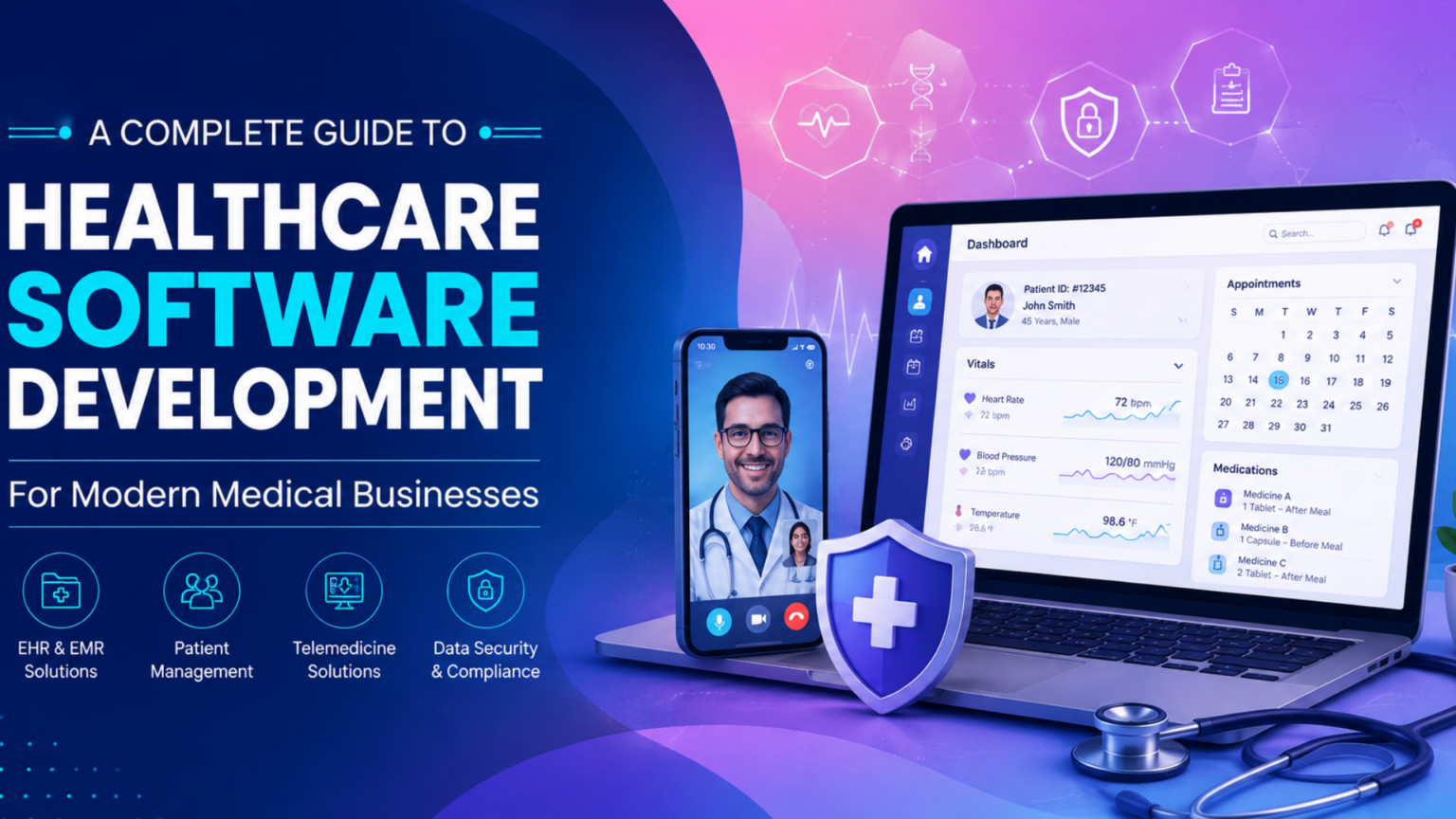
Healthcare is becoming kinda digital more and more, and it’s not slowing down. Hospitals, clinics, diagnostic centers, pharmacies, and even healthcare startups are putting money into technology to help patient care, reduce the day-to-day admin stuff, and make operations run smoother. From telemedicine platforms to AI driven diagnostics, healthcare software has changed the way medical organizations provide services, and honestly, it feels a bit faster now.
When a medical business partners with a reliable healthcare software development company, they can create secure, scalable, and compliant solutions. These solutions support better patient outcomes, plus they boost operational efficiency, in ways that are sometimes hard to notice at first.
In this guide, we’ll go through what modern healthcare organizations really need to understand about healthcare software development services. That includes the benefits, the main types, the development process, the technologies involved, the costs, and how to pick the right development partner, without turning it into a stressful guessing game.
What Is Healthcare Software Development?
Healthcare software development is basically the process where teams design, build, test, and also keep up digital tools made for the healthcare field. These tools are meant to help healthcare providers with patient records, streamline workflows, make communication less awkward , improve diagnostics, and keep everything inside the rules tied to healthcare regulations.
Modern healthcare software touches a bunch of stakeholders, like
- Hospitals and healthcare systems,
- Private clinics,
- Telemedicine providers
- Diagnostic laboratories
- Pharmacies
- Insurance companies
- Medical device manufacturers
- Healthcare startups
Nowadays, a lot of Healthcare Software Development companies provide tailored solutions that match how an organization actually works, keep pace with compliance needs, and support longer term business targets.
Why Healthcare Businesses Need Custom Software
Generic software usually does n’t really get into the specific operational quirks and compliance requirements that healthcare organizations have. Custom healthcare software, on the other hand, gives more room, it can grow when needs change, and it tends to keep data safer too in a more deliberate way.
A few real advantages are kind of obvious once you look closer, like these:
Improved Patient Care
Clinicians get faster access to up to date patient details, so diagnosis steps become quicker and treatment decisions are more informed.
Increased Operational Efficiency
When processes are automated, a lot of the busy work disappears, like paper forms, appointment scheduling slips, billing mistakes, and those repetitive admin routines.
Better Data Management
Healthcare software can keep everything in one secured place: patient records, medical history, prescriptions, imaging summaries, plus lab results.
Enhanced Security
Healthcare teams manage highly sensitive information. With custom solutions there are stronger protections, encryption, role based access controls, secure sign in methods, and compliance safeguards built in.
Seamless Integration
Healthcare platforms can connect with Electronic Health Records (EHR), wearable devices, pharmacy systems, lab workflows, insurance portals, and even payment gateways
Types of Healthcare Software Solutions
Modern medical organizations invest in a bit different set of software solutions, depending on what they actually offer and who they are aiming at. Sometimes it feels like every department wants something slightly unique.
Electronic Health Record or EHR systems
These EHR programs keep patient documentation digitally, so clinicians can open medical histories, prescriptions, clinical notes, and treatment directions quickly, with less hassle
Telemedicine Applications
Virtual visit platforms let patients reach physicians using secure video sessions, chat messaging, plus remote monitoring options too. It’s basically consults, just without being in the same building
Hospital Management Systems
Hospital software tends to cover the daily operations, patient admissions billing, workforce coordination, inventory control, appointment planning, and performance reporting all in one place
Patient Portal Solutions
Portals give patients a space to do several tasks, like
Book appointments, check health records, review lab reports, settle medical bills, and also message healthcare providers
Medical Billing Software
Automated billing tools reduce claim mistakes, boost reimbursement outcomes, and speed up payment processing, pretty effectively. For behavioral and mental healthcare providers, mental health billing services can help streamline claims and reimbursement processes.
Pharmacy Management Systems
Pharmacy platforms help with inventory visibility, prescription administration, medication dispensing, and supplier follow ups
Laboratory Information Management Systems
Labs use LIMS to run test requests, track samples, generate results, and handle quality control steps
Remote Patient Monitoring Software
IoT-based healthcare tools gather live health information from wearables and connected medical equipment, then send it back for review and follow up
Essential Features of Healthcare Software
Successful healthcare software kinda has to juggle great usability with enterprise level security and compliance, at the same time. You know, it should feel smooth for real people yet still follow strict rules. Usually the important pieces look like this: Patient intake, appointment arranging, electronic medical files, video visits, and ePrescription handling. Then there’s secure chat or secure messaging, plus online payments, laboratory results management, billing with insurance tie ins, and those little notifications and reminders that keep things on track.
Also, multi user access controls matter a lot, plus analytics dashboard views. Some teams also want AI helped diagnosis, along with cloud hosted storage so data stays available. And of course mobile friendly accessibility, so staff and patients can use it anywhere.
Technologies Used in Healthcare Software Development
Healthcare software development is basically about using modern tech that helps things run faster, stronger security, and better patient experience, kinda all at once. And yeah, it’s not only for one step but for the whole pipeline.
Some technologies you often see are these
Artificial Intelligence
AI helps healthcare professionals in multiple ways like medical imaging review, disease prediction, patient triage, clinical documentation cleanup, and even treatment suggestions.
Cloud Computing
Cloud infrastructure brings secure storage, smoother cooperation between teams, disaster recovery planning, and scalable health platforms, without too much friction.
Internet of Things (IoT)
Connected medical devices keep watching patient conditions, and they send real time information to clinicians. Continuous monitoring, that kind of thing.
Blockchain
Blockchain supports medical record security, keeps data integrity more solid, and it makes health information exchange easier between organizations that are allowed to access it.
Big Data Analytics
Healthcare groups use big datasets to spot patterns, raise the chances of better treatment results, and fine tune hospital operations.
Healthcare Software Development Process
A structured development approach, somehow, helps make project delivery successful and not end up messy.
1. Requirement Analysis
Developers get the business goals , target users , compliance needs, and the technical parts kind of mapped out.
2. Planning
Then there’s a roadmap, with architecture planning, technology selection, development timing, and how resources are actually going to be used.
3. UI/UX Design
Designers craft intuitive interfaces , so the daily workflows feel easier for doctors, nurses, administrators, and patients.
4. Development
Developers then build the frontend , backend systems, APIs , databases, plus those third party integrations that tend to be… complicated.
5. Testing
Thorough testing checks functionality, speed, security, compatibility, and compliance, before anything goes live, really.
6. Deployment
The application is pushed to cloud or on-premise infrastructure, aiming for minimal disruption, no big drama.
7. Maintenance
Ongoing maintenance means regular updates, security patches, feature enhancements, and performance tuning , so the software stays dependable and future-ready.
Compliance and Security Considerations
Healthcare software ends up touching confidential patient info, so security becomes, like, the main thing, no kidding. Medical orgs really should make sure their systems come with things that don’t leave gaps, for example: end-to-end encryption, multi-factor authentication, secure API handshakes, role based permissions for every user, and audit logs that actually keep showing what happened.
Also, automatic data backups , plus disaster recovery planning , not just “someday.” On top of that there should be continuous security monitoring, so weird events get noticed fast.
And honestly, staying in line with the rules matters just as much, like HIPAA, GDPR, or whatever regional healthcare standard applies there. That kind of compliance helps protect patient privacy and also reduces legal trouble.
How to Choose the Right Healthcare Software Development Partner
Picking the right development partner really makes or breaks whether the project actually succeeds, and yeah it tends to affect everything later on. When you’re choosing who to work with, it helps to look at a few practical things, not just vibes.
Industry Experience
Go for a team that already has real experience in healthcare technology, plus they should understand the day to day medical workflows. It’s not only about building, it’s about knowing how the process runs.
Regulatory Knowledge
Your partner needs to be comfortable with healthcare compliance, patient privacy rules, and solid security practices. If they talk in general terms only, that can be a red flag, because this area is never “generic”.
Custom Development Expertise
Every healthcare organization has its own way of doing things, so you don’t really want a one size solution that kind of fits. A dependable Healthcare Software Development company should deliver tailored work, not a product that looks good in the brochure.
Integration Capabilities
Make sure they can connect your software with EHR systems, payment processors, medical devices, insurance platforms, and even lab systems. If integration feels hard for them, it’ll become painful for you.
Scalable Architecture
Your system should be ready to grow. That means more users, more functions, and new technology later, without turning the whole thing into a rebuild.
Post-Launch Support
After release, you still need maintenance, monitoring, bug fixes, and regular software updates. Long term performance usually comes down to support, so don’t skip that part.
Future Trends in Healthcare Software Development
The healthcare technology landscape keeps evolving, pretty rapidly it seems. You can see a bunch of new directions, like AI enabled clinical decision support, and predictive analytics in healthcare too. Digital therapeutics are showing up more often, alongside personalized medicine, sometimes as just “tailored care” in plain wording.
Also there are voice-enabled healthcare assistants, and robotics across healthcare, plus Extended Reality aka XR, mostly for medical training and simulation. Wearable health monitoring is becoming commonplace, and there is generative AI used for clinical documentation. Some places are building smart hospitals powered by IoT, which is kind of the quiet infrastructure angle that people mention later.
Overall, healthcare organizations that choose to embrace these innovations, will likely end up delivering higher quality, more patient-centered care, while also improving operational efficiency, in a way that feels more streamlined day to day.
Conclusion
Healthcare software has now become this essential investment for modern medical businesses, aiming to make patient care better, streamline daily operations, and stay competitive in a digital world that keeps growing. I mean whether you are building a telemedicine platform, hospital management system, a patient portal, or even an AI powered diagnostic solution custom software gives you the flexibility and scalable approach you need, for evolving healthcare requirements, and yes also for the future.
Picking a solid Healthcare Software Development company with real experience is key… it helps make sure your solution stays secure, compliant, easy to use, and able to bend with new technological advancements as they come. So when a medical organization invests in the right healthcare software today, they can improve patient experiences, optimize workflows, and build a more connected and efficient healthcare ecosystem, instead of getting stuck in outdated processes.
