
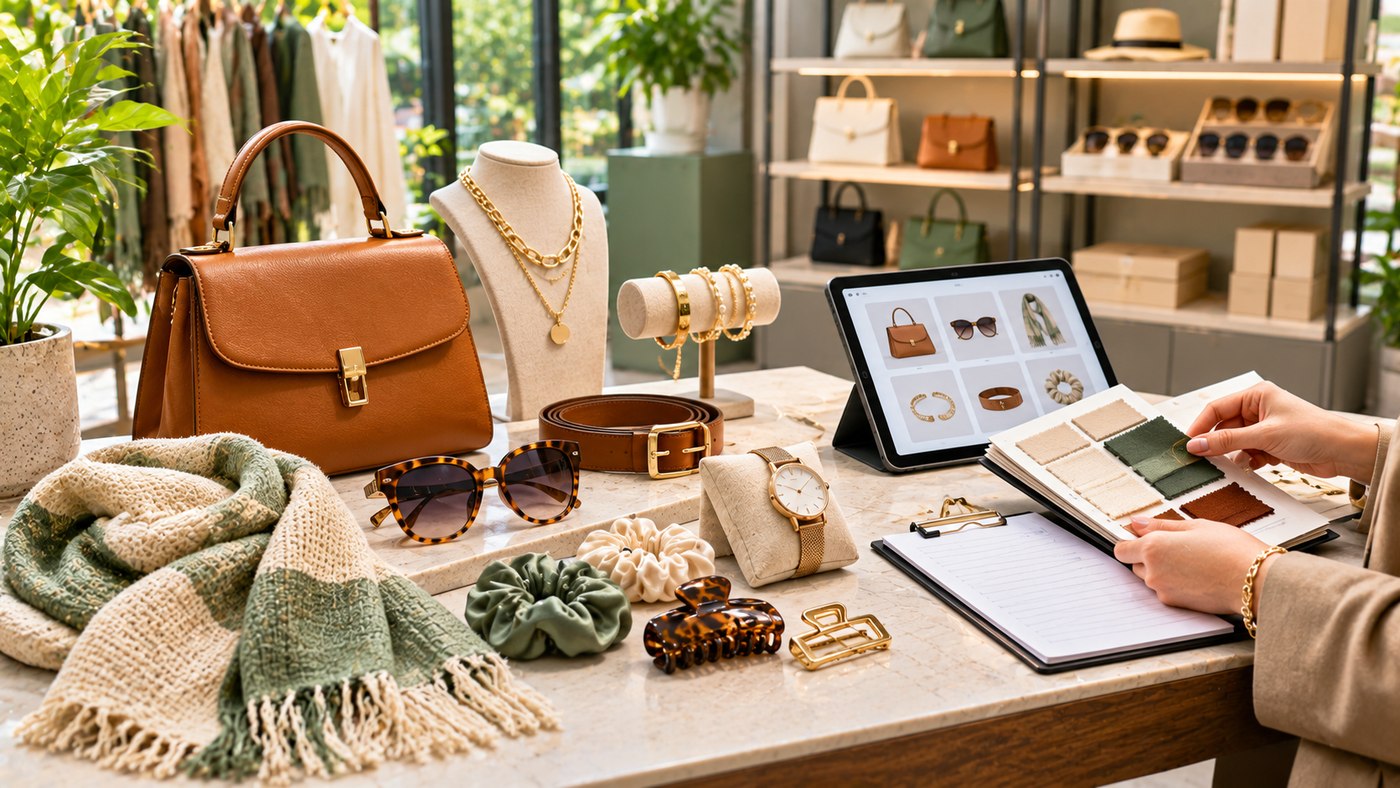
The fashion accessories industry offers valuable opportunities for retailers, boutique owners, e-commerce sellers, and emerging fashion brands. From handbags and jewelry to scarves, sunglasses, belts, and hair accessories, these products allow businesses to expand their collections and serve different customer preferences.
However, building a successful accessories business requires more than selecting attractive products. Companies must evaluate product quality, supplier reliability, manufacturing capabilities, pricing, shipping arrangements, and changing customer demand.
Choosing the right accessories supplier is one of the most important decisions for any fashion business. A dependable sourcing partner can help maintain consistent product standards, manage inventory requirements, support product customization, and coordinate international orders.
On the other hand, an unsuitable supplier may create problems involving inconsistent materials, delayed shipments, unexpected costs, and products that fail to meet customer expectations.
Wholesale fashion sourcing has also become increasingly complex as brands expand across online marketplaces, independent websites, and physical stores.
Businesses need suppliers who understand the differences between ready-made products, private-label manufacturing, and fully customized accessories.
This guide explores seven practical strategies for choosing a wholesale fashion accessories supplier, evaluating manufacturing options, managing quality, and building a reliable sourcing process for long-term business growth.
What Is an Accessories Supplier?
An accessories supplier is a business that provides fashion-related products to retailers, wholesalers, distributors, or brand owners.
Suppliers may manufacture products directly, source goods from multiple factories, or distribute finished accessories through wholesale arrangements.
Common products include handbags, wallets, jewelry, hair clips, belts, sunglasses, scarves, hats, gloves, watches, and other complementary fashion items.
Different Types of Fashion Accessories Suppliers
Not every supplier operates under the same business model.
Manufacturers produce accessories using their own facilities or coordinated production arrangements.
Wholesalers purchase products in larger quantities and resell them to retailers or other businesses.
Sourcing companies help buyers identify manufacturers, compare suppliers, manage orders, and coordinate quality control.
Private-label suppliers provide products that can be sold under a buyer’s brand, subject to customization options and agreed terms.
OEM and ODM partners support manufacturing based on customer specifications or supplier-developed designs.
Understanding these differences helps businesses choose an appropriate relationship.
Why Supplier Selection Matters
The quality of a supplier affects more than the products delivered.
It can influence customer satisfaction, profit margins, inventory availability, brand reputation, and future expansion.
A reliable sourcing process helps companies maintain consistent standards while reducing avoidable operational problems.
1. Identify the Fashion Accessories Your Business Needs
Before contacting wholesale suppliers, define the products you want to sell.
A clear product strategy helps narrow the available options and makes it easier to request meaningful quotations.
Research Your Target Customers
Consider who will purchase your accessories.
A boutique targeting premium fashion customers may prioritize elegant handbags, refined jewelry, and carefully selected materials.
A youth-oriented online store might focus on colorful hair accessories, contemporary sunglasses, and seasonal trends.
The right product mix depends on the audience.
Choose Your Main Product Categories
Popular wholesale accessory categories include:
- Handbags and crossbody bags
- Wallets and small leather goods
- Necklaces, rings, earrings, and bracelets
- Fashion watches
- Sunglasses and eyewear accessories
- Hair clips, scrunchies, and headbands
- Scarves, shawls, and gloves
- Belts and fashion hardware
- Hats and seasonal headwear
- Cosmetic bags and makeup accessories
Businesses do not need to launch every category simultaneously.
Starting with a focused collection can simplify inventory management.
Evaluate Product Demand
Research search behavior, customer feedback, competitor assortments, and sales patterns.
Avoid assuming that a product will sell successfully simply because it is popular on social media.
Demand can change quickly.
Consider Seasonal Collections
Some accessories are more relevant during particular periods.
For example, scarves and gloves may sell more frequently during colder months, while sunglasses may receive stronger attention during warmer weather.
However, seasonal demand differs by location.
International retailers should consider the climate and shopping calendar of each market.
Create a Product Specification Sheet
A specification sheet can include product dimensions, preferred materials, colors, hardware, packaging, and expected quality standards.
This gives potential suppliers a clear understanding of the requirements.
It also helps businesses compare quotations for similar products.
2. Compare Manufacturers, Wholesalers, and Sourcing Companies
Selecting a suitable supplier depends on your preferred business model.
Some brands want ready-made accessories, while others need custom-designed products.
Working With Direct Manufacturers
A manufacturer may provide greater control over product specifications and production details.
This can be useful for brands requiring specific materials, dimensions, or construction methods.
However, manufacturers may require larger minimum order quantities.
Working With Wholesale Distributors
Wholesale distributors may offer a variety of finished products without extensive development work.
This can be suitable for smaller retailers that want to test several accessories.
However, product customization may be limited.
Using Fashion Sourcing Companies
A sourcing company may coordinate communication with multiple factories.
Services can include supplier identification, sample development, product inspections, order coordination, and logistics.
This can be helpful for retailers managing several accessory categories.
Evaluate Experience
Ask prospective suppliers about their experience with the specific product category.
A company experienced in handbags may not have the same technical capabilities for jewelry or eyewear.
Product-specific knowledge matters.
Review Communication Quality
Clear communication is essential for international sourcing.
Suppliers should be able to explain product specifications, order requirements, production timelines, and available quality checks.
Repeated misunderstandings during the quotation stage may indicate future project-management problems.
Verify Business Information
Review company registration details, official contact information, and relevant business documentation.
Where appropriate, consider independent verification or a factory audit.
A professional website alone does not establish manufacturing capability or product quality.
3. Understand Wholesale Pricing and Minimum Order Quantities
Wholesale pricing is an important consideration, but the lowest unit price is not always the best deal.
Businesses should compare total purchasing costs alongside product quality and delivery reliability.
What Is a Minimum Order Quantity?
Minimum order quantity, commonly called MOQ, refers to the smallest order a supplier agrees to accept under specified conditions.
For example, a supplier might require 300 pieces of a particular handbag design.
Another supplier may accept 100 units but charge a higher price per piece.
The actual MOQ varies by product, material, customization, and manufacturer.
Why Do Suppliers Require MOQs?
Production setup, material purchasing, packaging, and labor can create fixed costs.
Manufacturers may establish minimum quantities to make production economically practical.
Custom designs often involve additional setup requirements.
Compare Unit Prices Carefully
Suppose two suppliers provide quotations for the same accessory.
| Factor | Supplier A | Supplier B |
|---|---|---|
| Unit price | $4.50 | $5.00 |
| Minimum order | 1,000 units | 300 units |
| Initial product cost | $4,500 | $1,500 |
| Custom packaging | Separate | Separate |
| Freight | Not included | Not included |
The lower unit price from Supplier A requires a larger upfront purchase.
A smaller business may prefer Supplier B if the lower initial quantity reduces inventory risk.
These figures are hypothetical examples, not actual supplier quotations.
Calculate Landed Cost
Landed cost represents the total cost of bringing a product to the destination under the relevant purchasing arrangement.
It may include:
- Product manufacturing
- Packaging
- Freight
- Cargo insurance
- Import duties
- Applicable taxes
- Customs clearance
- Handling charges
- Other relevant logistics expenses
Understanding landed cost is essential when setting retail prices.
Negotiate Based on Total Value
A supplier offering slightly higher prices may provide better packaging, more reliable quality control, or greater order flexibility.
Evaluate the complete agreement.
Avoid Excessive Initial Inventory
Ordering large quantities before testing demand can tie up working capital.
Start with a realistic order size when supplier terms allow.
Expand purchasing only when sales data supports the decision.
4. Request Samples and Establish Quality Control Standards
Product quality influences customer satisfaction, repeat purchases, and return rates.
A photograph or digital catalogue cannot fully demonstrate material durability, construction quality, or finishing details.
Why Product Samples Matter
Samples allow buyers to examine an accessory before committing to bulk production.
For example, a handbag sample can be evaluated for stitching, zipper operation, lining, hardware, and overall construction.
Jewelry samples may be checked for finish consistency, secure fastenings, and appropriate material specifications.
Inspect Materials
Ask suppliers to identify the materials used.
A product described as genuine leather, stainless steel, cotton, or another material should meet the agreed specification.
Material claims should be supported by relevant evidence when necessary.
Evaluate Product Construction
Different accessory categories require different checks.
For handbags, examine seams, handles, closures, and interior compartments.
For sunglasses, review fit, construction, and required lens-performance documentation.
For hair accessories, check springs, clips, and potential sharp edges.
Approve a Reference Sample
A signed-off or otherwise documented approved sample can establish expectations for bulk production.
The buyer and supplier should agree on which characteristics must match.
Use Pre-Shipment Inspections
For significant orders, inspection before shipping may identify defects while products are still at the manufacturing location.
A quality inspection can evaluate quantities, packaging, appearance, dimensions, and selected functional characteristics.
Understand Product Testing
Some accessories require specific tests depending on materials, intended users, and destination markets.
For example, children’s accessories and certain jewelry products may be subject to additional safety requirements.
Businesses should determine which rules apply before importing products.
Document Defect Procedures
Agree on what happens if products fail inspection.
Contracts may address replacement, rework, refunds, or other remedies.
Clear terms reduce disagreements later.
5. Explore Wholesale Fashion Accessories From MU Group
Businesses searching for an accessories supplier can explore the fashion accessories sourcing and manufacturing services advertised by MU Group.
MU Group describes itself as an international sourcing and supply chain business supporting retailers, wholesalers, and brands with product development, factory coordination, quality control, and global logistics.
Its fashion accessories division offers wholesale products along with OEM and ODM manufacturing services.
What Types of Fashion Accessories Does MU Group Offer?
According to its official product pages, MU Group advertises sourcing and manufacturing capabilities across several categories.
These include handbags, fashion jewelry, watches, sunglasses, hair accessories, scarves, hats, belts, and related products.
Its broader product listings also cover selected cosmetics, makeup tools, and packaging items.
Buyers should confirm the precise category and production capabilities relevant to their order.
Wholesale Accessories
MU Group offers ready-made and wholesale fashion accessory options.
Retailers may request product catalogues to evaluate available designs.
Product availability, quantities, and prices should be confirmed through an actual quotation.
OEM and ODM Services
MU Group advertises OEM and ODM options for businesses developing customized products.
These can involve changes to materials, colors, dimensions, designs, or packaging, depending on the project.
The company describes support from design development through manufacturing and delivery.
Product Design and Sampling
MU Group’s official website describes a design team and product sampling services.
This may help brands that want to develop new accessories or modify existing designs.
However, buyers should establish whether design services, samples, tooling, and revisions are included in the quoted price.
Quality Control
MU Group advertises manufacturing oversight and product quality management.
Its published information references factory certifications and quality assurance processes.
Businesses should request documentation relevant to their specific products and production facilities.
A general company certification does not automatically demonstrate compliance for every product.
International Logistics
The company describes coordination of global shipping and supply chain services.
This may be helpful for businesses purchasing several product categories.
However, shipping responsibilities, customs arrangements, insurance, and delivery terms should be confirmed in writing.
Requesting a Quotation
To obtain a meaningful quote, provide the expected product category, quantity, specifications, target market, packaging requirements, and delivery destination.
Ask for the MOQ, sample conditions, production lead time, pricing basis, and applicable quality control arrangements.
Why Buyers Should Compare Options
MU Group is one potential sourcing partner, but businesses should still evaluate alternatives.
Comparing suppliers helps buyers understand available quality standards, pricing, customization, and production capabilities.
A well-informed purchasing decision should be based on documented requirements rather than promotional claims alone.
6. Explore Private Label, OEM, and ODM Accessories
Custom accessories allow businesses to develop products associated with their own brand identities.
However, different manufacturing arrangements offer different levels of creative control.
What Is Private Label Manufacturing?
Private labeling commonly involves selling products under a retailer’s own brand.
Depending on the supplier, customization may include product labels, packaging, colors, or selected design details.
Private label products can help businesses develop a more recognizable brand.
What Does OEM Mean?
OEM stands for Original Equipment Manufacturer.
In fashion sourcing, it often refers to manufacturing products according to buyer-provided specifications or designs.
For example, a brand might provide technical drawings for a custom handbag.
The manufacturing partner produces the product according to the agreed requirements.
What Does ODM Mean?
ODM stands for Original Design Manufacturer.
Under an ODM arrangement, a supplier may offer an existing design that a buyer can select or customize.
This can reduce some development work compared with creating a completely new product.
The exact meaning and commercial rights depend on the supplier agreement.
Compare Manufacturing Models
| Model | Typical approach | Main consideration |
|---|---|---|
| Wholesale | Purchase existing finished products | Limited customization |
| Private label | Apply brand identity to suitable products | Branding and packaging |
| OEM | Manufacture buyer-specified designs | Development complexity |
| ODM | Use supplier-developed designs | Design rights and customization |
Create a Clear Brand Identity
Consistent colors, packaging, materials, and product presentation can help customers recognize a brand.
For example, a sustainable fashion brand may want appropriately verified recycled materials and minimal packaging.
A luxury accessories brand may prioritize precise finishing, distinctive hardware, and premium presentation.
Protect Intellectual Property
Before sharing original designs, clarify confidentiality and ownership arrangements.
Contracts should address relevant design files, molds, trademarks, and other intellectual property rights.
Businesses should also avoid copying protected designs belonging to other brands.
Review Packaging Requirements
Packaging can influence product protection, presentation, and shipping cost.
Product labels and packaging information may also need to comply with local regulations.
Do not assume that branding alone is sufficient for market readiness.
7. Manage Shipping, Compliance, and Long-Term Supplier Relationships
International sourcing continues after the products leave the factory.
Businesses must coordinate shipping, import documentation, customs obligations, and inventory planning.
Understand Shipping Methods
Common international freight options include sea freight, air freight, and express courier services.
Sea freight may be appropriate for larger shipments where delivery speed is less critical.
Air freight and courier services may provide shorter transport times at higher costs.
The best choice depends on the shipment’s size, urgency, and value.
Understand Incoterms
Incoterms are standardized trade rules published by the International Chamber of Commerce.
They help define certain responsibilities between buyers and sellers for delivery, costs, and risk transfer.
Common terms include EXW, FOB, CIF, and DDP.
The correct term depends on the agreed transaction.
Incoterms do not replace a complete purchase agreement or automatically resolve every import responsibility.
Verify Import Requirements
Product requirements vary by destination country and category.
Depending on the product, buyers may need to consider:
- Country-of-origin marking
- Material labeling
- Product safety requirements
- Customs classification
- Import duties
- Chemical restrictions
- Required testing
- Intellectual property rights
- Applicable documentation
For example, certain jewelry and children’s accessories may face specific safety rules.
Importers should obtain appropriate compliance guidance for their market.
Plan Realistic Lead Times
A production schedule may include material sourcing, sample approval, manufacturing, inspection, packaging, and transportation.
Unexpected delays can occur.
Ask suppliers to provide a realistic schedule and explain how changes will be communicated.
Maintain Inventory Buffers
Retailers should consider replenishment timing and demand variability.
Insufficient inventory can lead to missed sales, while excessive purchasing can increase storage costs.
Inventory planning should reflect actual sales patterns.
Build Strong Communication
Maintain clear records of specifications, purchase orders, approvals, and agreed changes.
Regular communication can help identify problems before they affect delivery.
Review Supplier Performance
Track product defects, delivery consistency, responsiveness, and cost changes.
A reliable accessories supplier should be evaluated through actual results over time.
Accessories Supplier vs. Fashion Accessories Manufacturer
Although these terms are sometimes used interchangeably, they can describe different functions.
| Factor | Accessories supplier | Manufacturer |
|---|---|---|
| Main role | Provides products to buyers | Produces products |
| Inventory | May carry finished stock | Depends on manufacturing model |
| Customization | Varies by supplier | Often available |
| MOQ | Varies by sourcing method | Often linked to production requirements |
| Lead time | May be shorter for stocked items | Depends on manufacturing schedule |
| Product range | Can include multiple factories | May specialize in specific categories |
| Best suited for | Sourcing flexibility | Production-specific requirements |
Some companies combine manufacturing and sourcing services.
Buyers should confirm which organization is responsible for the actual production.
How to Start a Wholesale Fashion Accessories Business
Launching an accessories business requires careful product selection and financial planning.
Step 1: Select Your Market
Identify the customers you want to serve.
Consider age groups, style preferences, budgets, and shopping behavior without relying on unsupported stereotypes.
Step 2: Choose a Focused Collection
Begin with a manageable selection of products.
This can simplify purchasing and inventory control.
Step 3: Research Potential Suppliers
Compare product categories, manufacturing capabilities, MOQs, and communication quality.
Step 4: Request Samples
Inspect materials, construction, appearance, and packaging before placing a significant order.
Step 5: Calculate Total Costs
Include product costs, freight, duties, packaging, and other relevant expenses.
Step 6: Prepare Product Listings
Create accurate photographs, descriptions, dimensions, and product specifications.
Do not make unsupported claims about materials or product performance.
Step 7: Launch Suitable Sales Channels
Depending on the business model, consider an independent website, online marketplaces, physical retail, or wholesale distribution.
Step 8: Monitor Customer Feedback
Use actual customer experiences to identify product improvements and future purchasing opportunities.
How Much Does Wholesale Fashion Accessories Sourcing Cost?
There is no universal wholesale price for fashion accessories.
Costs vary according to product type, materials, quantity, customization, manufacturing requirements, and destination.
Example Wholesale Cost Calculation
Consider a hypothetical retailer ordering 500 handbags.
| Expense | Illustrative cost |
|---|---|
| Product manufacturing | $3,000 |
| Custom packaging | $250 |
| Freight | $500 |
| Import duties and fees | $350 |
| Inspection | $200 |
| Total landed cost | $4,300 |
Dividing the total by 500 units:
$4,300 ÷ 500 = $8.60 per handbag.
This is a hypothetical example, not a current MU Group quotation or a market price estimate.
It also excludes any additional expenses not included in the assumptions.
Set Prices Using Business Economics
Retail pricing should reflect product costs, marketplace commissions, marketing expenses, returns, overhead, and desired profitability.
A low purchasing cost does not automatically guarantee a profitable product.
Common Mistakes When Choosing an Accessories Supplier
Selecting Based Only on Price
A low unit price may be offset by defects, shipping expenses, or large order requirements.
Skipping Product Samples
Samples help evaluate actual quality before bulk purchasing.
Ignoring Minimum Order Quantities
Large minimum purchases can create unnecessary inventory risk.
Using Unclear Specifications
Vague requirements can lead to products that do not match expectations.
Overlooking Compliance
Products must meet applicable requirements in the destination market.
Failing to Agree on Delivery Terms
Unclear shipping responsibilities can cause unexpected expenses.
Ignoring Intellectual Property
Custom designs and branded products require appropriate rights and agreements.
Not Reviewing Supplier Performance
Continue evaluating quality, delivery, and communication after the first order.
Wholesale Accessories Sourcing Checklist
| Requirement | What to verify |
|---|---|
| Supplier identity | Business details and contact information |
| Product category | Relevant experience |
| Product materials | Accurate specifications |
| MOQ | Minimum quantity requirements |
| Samples | Quality and approval conditions |
| Customization | Private label, OEM or ODM options |
| Pricing | Complete quotation |
| Quality control | Inspection and testing |
| Compliance | Destination-market requirements |
| Shipping | Delivery responsibilities |
| Payment | Secure agreed terms |
| Lead time | Production and transport schedule |
| Packaging | Product protection and labeling |
| Ownership | Relevant design and branding rights |
| Support | Communication and issue resolution |
The Future of Wholesale Fashion Accessories Sourcing
Fashion accessory sourcing continues to evolve as businesses adopt digital product catalogs, improved supply chain systems, and more flexible manufacturing arrangements.
Retailers increasingly need reliable information about product materials, inventory availability, production schedules, and international delivery.
Digital collaboration can make it easier to share specifications, review designs, and coordinate orders across different locations.
However, technology cannot replace physical quality inspections, accurate documentation, and responsible business relationships.
Brands should also evaluate environmental and labor-related claims carefully.
A supplier’s sustainability statement should be supported by relevant evidence, especially when the claim relates to specific materials or manufacturing processes.
As competition grows, businesses that combine strong product selection with dependable sourcing practices may be better positioned to maintain customer satisfaction and manage purchasing risks.
Frequently Asked Questions
1. What is an accessories supplier?
An accessories supplier provides fashion products such as handbags, jewelry, sunglasses, belts, scarves, and hair accessories to retailers, wholesalers, and brands. Some also offer manufacturing and customization services.
2. How do I find a reliable wholesale accessories supplier?
Research potential suppliers, verify their business information, review relevant experience, request product samples, compare written quotations, and confirm quality control and shipping arrangements.
3. Does MU Group offer private label fashion accessories?
MU Group advertises wholesale, OEM, ODM, and custom fashion accessory sourcing services. Buyers should contact the company to confirm customization options, MOQs, product specifications, and current availability.
4. What is the difference between OEM and ODM accessories?
OEM generally involves manufacturing products according to a buyer’s specifications. ODM generally involves supplier-developed designs that buyers may select or customize. Exact terms depend on the manufacturing agreement.
Conclusion
Choosing the right accessories supplier is an important step for retailers and fashion brands planning to develop reliable product collections.
A structured sourcing process should include product research, supplier evaluation, sample testing, clear pricing, quality control, and appropriate shipping arrangements.
By building dependable supplier relationships and managing inventory carefully, businesses can create stronger foundations for long-term wholesale and retail growth.
