
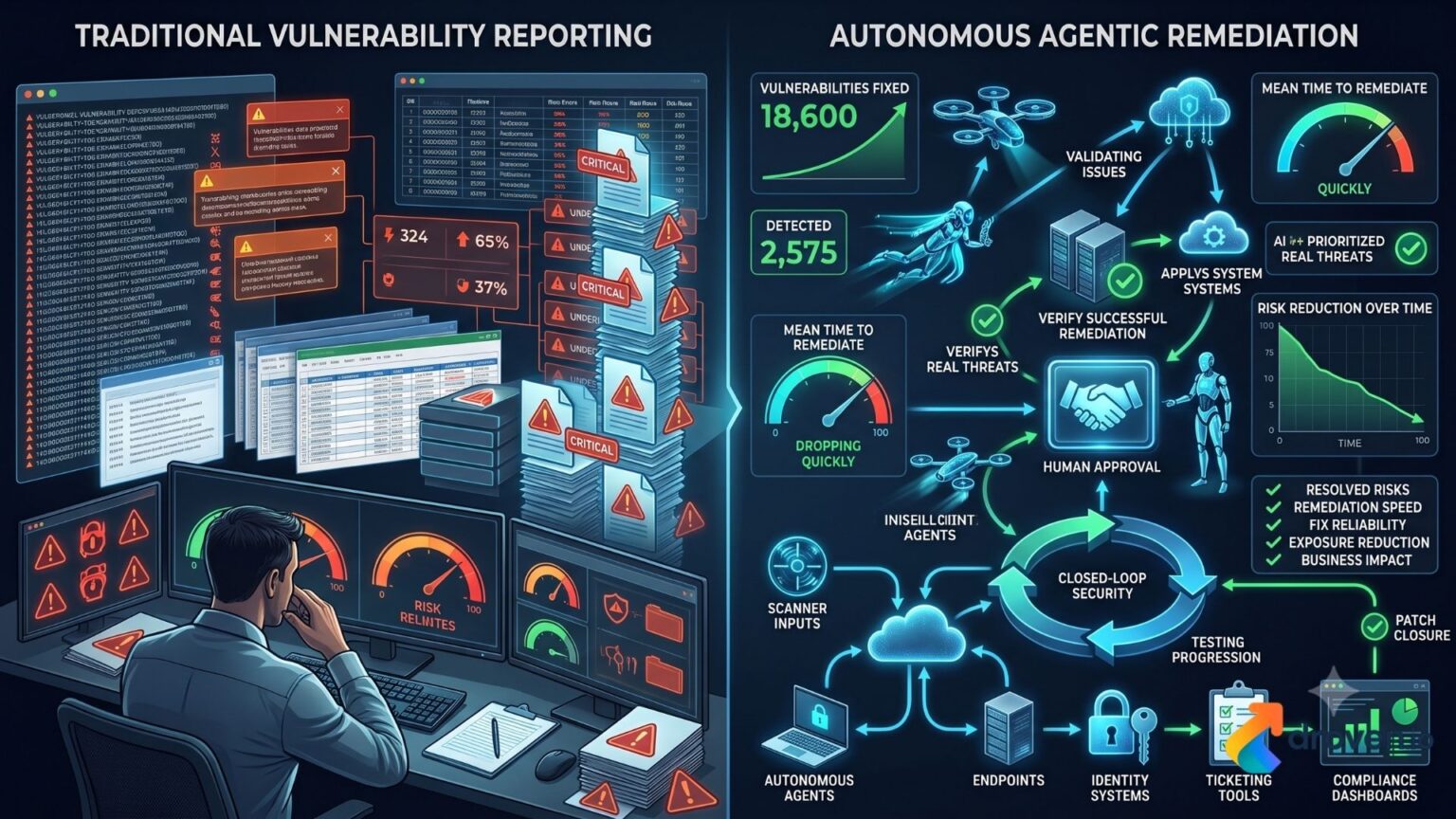
For decades, the standard for measuring the effectiveness of a cybersecurity team has been rooted in the art of the list. We track the volume of vulnerabilities identified, the number of alerts generated by the Security Operations Center (SOC), and the total count of open patches across the enterprise. These metrics—commonly known as “vanity metrics”—provide a snapshot of organizational state but often fail to offer any insight into true security posture. They measure effort rather than outcome.
As security debt continues to mount, the industry is witnessing a shift away from passive visibility toward automated action. The emergence of agentic remediation for cybersecurity teams represents a fundamental change in how we perceive the workload of a defender. By shifting the focus from simply cataloging security gaps to actively closing them, organizations are being forced to retire outdated KPIs in favor of metrics that prioritize risk reduction over volume.
The Tyranny of Mean Time to Remediate (MTTR)
Traditionally, Mean Time to Remediate (MTTR) has been the gold standard for measuring operational efficiency. While useful, it is inherently flawed because it treats every vulnerability as having equal weight. A team that patches 100 low-risk, non-exploitable vulnerabilities in 24 hours will show an excellent MTTR, while a team that spends a week remediating a critical, internet-facing RCE on a core database will look like a failure.
When teams rely on manual processes, MTTR measures the speed of human labor—a bottleneck that is increasingly unsustainable in an era where adversaries automate their reconnaissance and exploitation phases. By introducing agentic remediation for cybersecurity teams, the goal shifts from “how fast can a human patch this?” to “how effectively can the system neutralize this risk automatically?” This pivot renders traditional MTTR metrics nearly obsolete, as the delta between detection and neutralization shrinks from days to seconds.
Redefining Success Through Risk-Based Outcomes
To move beyond the list, security leaders must prioritize metrics that quantify the “blast radius.” If an automated agent can identify a vulnerability, verify its exploitability within the specific context of the company’s infrastructure, and deploy a fix without human intervention, the metric of success changes from “patches applied” to “exposure duration.”
The adoption of agentic remediation for cybersecurity teams allows security operations to move toward a model of Continuous Security Validation. In this environment, the following metrics provide a much clearer picture of actual defense health:
- Risk-Adjusted Exposure Time: The total duration a high-risk vulnerability exists in the production environment before an automated agent remediates or mitigates it.
- Human Intervention Rate: The percentage of security issues resolved by autonomous agents compared to those requiring human analyst input.
- Exploitability Coverage: The ratio of critical vulnerabilities identified versus those for which an active, verified exploit path was successfully blocked by automated systems.
- System Integrity Uptime: The percentage of time that critical infrastructure remains in a hardened, compliant state, as monitored by autonomous oversight.
These indicators shift the focus toward the reduction of the actual threat surface. When a system is capable of its own hygiene, the security team is no longer a group of ticket processors; they become architects of the automated policies that define what those agents prioritize.
Operationalizing Autonomy in Security Workflows
The transition to agentic systems requires a high level of institutional trust. Security teams often fear that automated remediation will cause system instability or downtime. However, data suggests that the risk of manual configuration error—often cited as a leading cause of downtime—frequently outweighs the risks posed by well-orchestrated, policy-driven automation.
Implementing agentic remediation for cybersecurity teams requires a robust governance framework. The agent is only as good as the policy set by the human operator. In this new paradigm, security engineers spend their time testing automated “playbooks” in staging environments rather than manually pushing patches in production.
This change in workflow dictates a new set of metrics for the security team itself: the quality of the policy, the breadth of the automation coverage, and the accuracy of the agent’s decision-making process. We are moving toward a future where the efficacy of a security department is measured by the “automation-to-human effort” ratio. If a team is still spending 80% of their time on manual remediation, they are likely not utilizing their budget or talent effectively.
The Human Impact on Security Culture
Shifting to an agent-driven model does not remove the need for human analysts; it changes the nature of their expertise. The role of the analyst evolves from that of a “firefighter”—who responds to incoming alerts—to that of an “automation engineer.”
This evolution is critical for retention. High-level security professionals are often burned out by the monotony of alert fatigue. By delegating the rote, repetitive aspects of patching and configuration management to autonomous agents, teams can redirect their focus toward threat hunting, architectural improvements, and strategic risk management. This cultural shift, while difficult to quantify, is perhaps the most significant benefit of agentic remediation. Organizations that successfully transition see higher morale and a more proactive approach to security challenges, as the team is empowered to address root causes rather than symptoms.
Final Analysis
The transition from a list-based security mindset to a fix-based autonomous model is inevitable. As the velocity of cyber threats increases, human-only remediation cycles are no longer sufficient to keep pace with modern adversaries. By embracing automated systems, security teams gain the ability to shrink the gap between vulnerability discovery and remediation, effectively nullifying the threat before it can be leveraged.
Ultimately, the goal is to stop measuring activity and start measuring outcomes. A team that manages to keep their systems clean through automated agents is far more secure than one that keeps a meticulous list of unpatched items. By evolving our metrics, we allow security teams to prioritize what matters—not the length of the task list, but the strength of the system’s defenses.
