
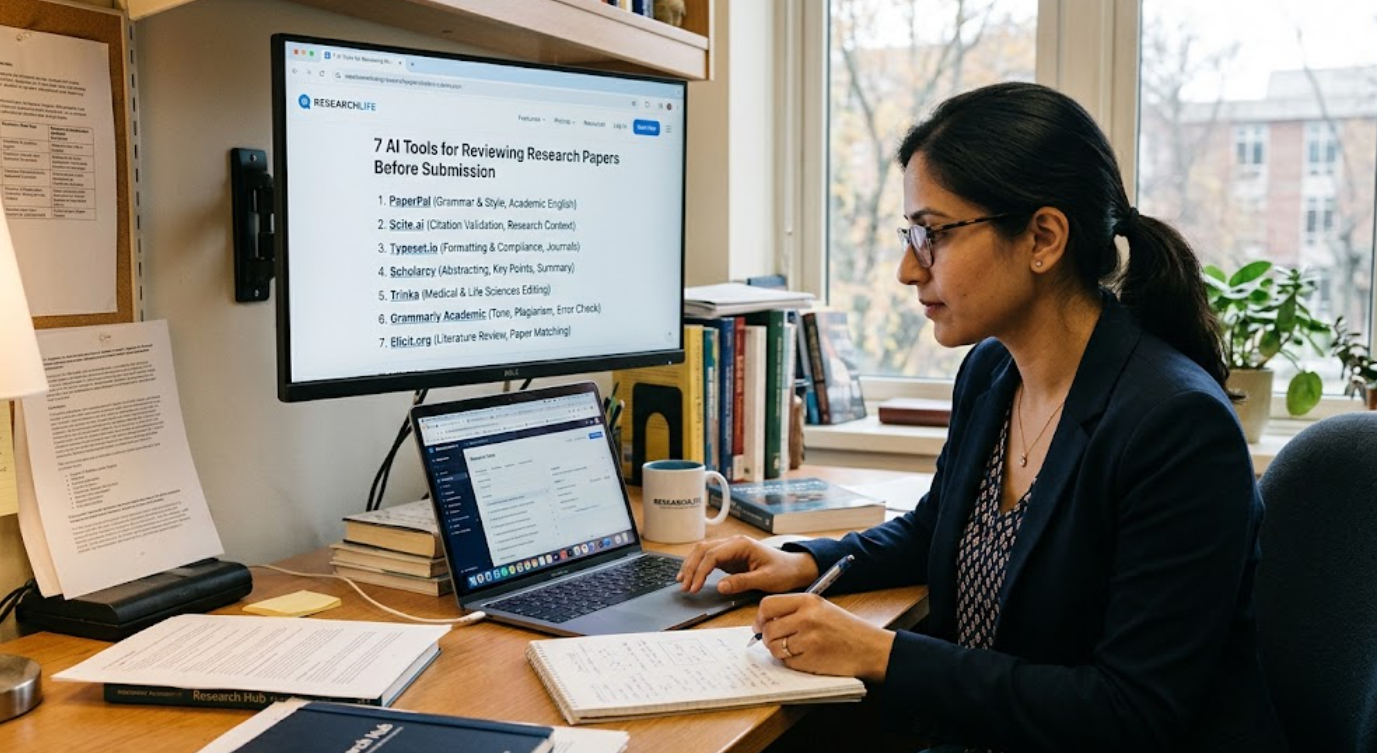
The gap between finishing a manuscript and submitting it is where most authors do the least work and stand to gain the most. The writing is done, the deadline is approaching, and the temptation is to run a spell check, format the references, and press send. Weeks later a desk rejection arrives with two sentences of explanation, and the paper starts a queue at the next journal. What makes that costly is not the rejection itself but the delay.
A manuscript that circulates through three journals before finding the right one loses the better part of a year, and in most cases the problems that caused the first two rejections were visible in the draft before anyone submitted it. Software cannot decide whether a study matters. It can, however, catch a surprising share of what reviewers and editors object to, provided authors understand which tool checks which layer of a manuscript.
What Actually Gets a Paper Rejected
Rejections arrive from two different stages, and they fail for different reasons.
- Desk rejection happens before peer review, usually within days, and typically turns on scope, significance, or presentation. The editor concludes that the paper does not fit the journal, that the contribution is not substantial enough for this venue, or that the manuscript is not in a state a reviewer could reasonably assess. Language quality matters here mostly as a proxy: an unreadable abstract suggests an unreadable paper.
- Reviewer rejection happens later and turns on substance. The methods do not support the conclusions, the statistics do not hold, key literature is missing, the claims overreach the evidence, or the analysis cannot be reproduced from what is described. These are arguments about the science, and they are the more difficult problems to fix late.
That split matters for tool selection. Language and formatting software addresses the first stage well and the second stage not at all. Checking whether conclusions follow from evidence is a different task requiring different technology, and it is the check most authors skip because it is the hardest to do on your own work.
The 7 Tools
1. QED Science
QED Science assesses the substance of a manuscript rather than its surface. Its platform evaluates the claims a paper makes, the evidence offered for them, and the reasoning connecting the two, producing a structured quality assessment through the QED Score, a validated AI-based quality metric developed for scientific evaluation.
The practical use before submission is uncomfortable and valuable. Authors are poor judges of whether their own conclusions are proportionate to their data, because they know what they meant and read that meaning into sentences that do not carry it. An external assessment of claim strength surfaces the places where a result described as suggestive in the analysis has become established in the discussion, which is among the most common reviewer objections in any field.
It also produces the kind of feedback that is actionable while revision is still cheap. Knowing which specific claims are under-supported points to concrete fixes: soften the wording, add the analysis, or acknowledge the limitation explicitly rather than hoping a reviewer overlooks it. The same assessment logic is applied elsewhere in research evaluation, including peer review support and grant assessment, which is a reasonable indication that the method generalizes beyond a single manuscript type.
What it checks:
- Whether stated conclusions are supported by the evidence presented
- Strength and proportionality of individual claims
- Coherence of the reasoning connecting methods, results, and discussion
- A structured quality assessment rather than a pass or fail verdict
- Feedback specific enough to guide revision before submission
2. Penelope.ai
Penelope.ai checks a manuscript against the technical requirements journals impose before an editor will look at it: reference formatting and completeness, presence of required sections, declaration statements, figure and table citation, and general structural conformity.
These are unglamorous checks and they account for a meaningful share of returned submissions. A missing data availability statement or a reference list that does not match the in-text citations will not sink a strong paper permanently, and it will delay it by a fortnight for no scientific reason.
What it checks:
- Reference completeness and consistency with in-text citations
- Presence of required sections and declarations
- Figure and table numbering and citation
- Structural conformity to common journal requirements
3. Paperpal
Paperpal provides language editing built for academic writing, with suggestions tuned to scholarly conventions rather than general prose. It handles the register, hedging, and terminology that generic grammar tools routinely mangle in scientific text.
For authors writing in a second language, this class of tool does real work, since reviewers who struggle to parse a sentence often attribute the difficulty to the science rather than the syntax. It improves how an argument reads and does not evaluate whether the argument holds.
What it checks:
- Grammar and phrasing appropriate to academic register
- Terminology consistency across a manuscript
- Clarity and readability of dense technical passages
- Some journal-readiness and submission checks
4. Writefull
Writefull applies language models trained on published academic text, which gives its suggestions a useful property: they reflect how phrasing is actually used in the literature rather than what a general style guide prefers. It also offers targeted feedback on titles and abstracts.
That focus matters more than it appears. The title and abstract are what an editor reads when deciding whether to send a paper out, and they are frequently written last, quickly, by an exhausted author. Testing them separately is a disproportionately efficient use of pre-submission time.
What it checks:
- Phrasing measured against patterns in published literature
- Title and abstract quality as standalone elements
- Language corrections specific to academic writing
- Integration with common writing environments
5. iThenticate
iThenticate is the similarity checking service most publishers use, and running it before submission means an author sees the same report an editor will. Matches are identified against published literature and other manuscripts.
The value is in interpretation rather than the percentage. High similarity in a methods section describing a standard protocol is usually unremarkable, while a moderate figure concentrated in the discussion is worth examining. Self-plagiarism from an author’s own earlier work is the case most often overlooked, and it is treated seriously by editors.
What it checks:
- Textual overlap with published literature and submitted manuscripts
- Source-by-source breakdown of where matches occur
- Reuse of an author’s own previously published text
- The same report editors generate at submission
6. Trinka AI
Trinka combines academic language editing with technical checks aimed at scientific manuscripts, covering usage errors common in research writing alongside consistency and style conformity to publishing conventions.
Its subject-specific handling is the practical advantage, since terminology that reads as an error in one discipline is standard in another. Like other tools in this layer, it improves the manuscript as a document rather than assessing the study it describes.
What it checks:
- Academic grammar, usage, and style conventions
- Subject-aware terminology handling
- Consistency in tense, voice, and technical vocabulary
- Formatting conformity to publishing standards
7. statcheck
statcheck is a free tool that extracts statistical results reported in a manuscript and recalculates whether the reported test statistics, degrees of freedom, and p-values are internally consistent. It exists because inconsistencies of this kind are common in published literature and almost always accidental.
It checks arithmetic rather than analytical decisions, so it will not tell an author whether the right test was used. It will catch a transcription error between an output window and a manuscript table, which is exactly the sort of correction that is trivial before submission and embarrassing afterward.
What it checks:
- Internal consistency of reported statistical results
- Mismatches between test statistics, degrees of freedom, and p-values
- Reporting format conformity for common statistical tests
- Errors introduced during transcription rather than analysis
A Sensible Order for Pre-Submission Checks
Most authors run these checks in the order the tools are convenient rather than the order that saves work, which usually means polishing sentences that will later be deleted.
- Assess the argument first. Establish whether the conclusions are supported before investing in how they are worded. Findings that need softening, additional analysis, or an explicit limitation will change the text substantially.
- Verify the numbers. Statistical consistency checks are quick and their results can alter what the paper claims, so they belong before rewriting rather than after.
- Run the similarity check. Any passages requiring rewriting are better identified now than during a language pass that would need repeating.
- Edit the language. With the argument settled, editing improves text that will actually survive to submission, and the title and abstract deserve separate attention.
- Check technical compliance last. Reference formatting, required declarations, and structural requirements are journal-specific and should be applied once the target journal is confirmed.
Reversing this order is the common mistake, and it explains why some authors spend a week on language and still receive a desk rejection three days after submission.
What No Tool Can Check for You
Being clear about the boundary is more useful than any feature comparison, and four judgments remain firmly with the author and the reviewers.
- Whether the work is novel. Establishing that a contribution is new requires domain knowledge and a current view of an entire field. Software can surface related work; deciding whether your contribution is meaningfully different is a scholarly judgment.
- Whether the journal is the right home. Fit involves scope, audience, and editorial appetite, and the most common cause of desk rejection is a paper submitted to a journal that was never going to want it.
- Whether the study answers the question it asked. A methodologically sound study can still be the wrong study, and that mismatch is visible only to someone who understands the problem well.
- Whether the ethical and reporting obligations are met. Approvals, consent, registration, conflict declarations, and reporting guideline adherence are the author’s responsibility, and editors treat lapses as serious regardless of how they arose.
Used properly, these tools free attention for exactly those judgments by clearing the mechanical problems out of the way first. A colleague reading a manuscript should be spending their goodwill on whether the argument convinces them, not on a mismatched reference list.
Frequently Asked Questions
What should a pre-submission review actually cover?
Five layers: whether conclusions follow from the evidence, whether reported statistics are internally consistent, whether text overlaps improperly with other sources, whether the writing is clear enough to review, and whether the manuscript meets the target journal’s technical requirements. Most authors check the last three and skip the first two.
Can AI tools predict whether a paper will be accepted?
No, and any tool claiming to should be treated sceptically. Acceptance depends on editorial priorities, reviewer availability, competing submissions, and judgments about significance that vary between venues. What assessment tools can do is identify weaknesses reviewers commonly raise, which improves the manuscript regardless of where it lands.
Is using AI to review a manuscript before submission acceptable?
Generally yes, since using software to check your own work is analogous to asking a colleague for comments. Policies differ on AI-generated text and on uploading manuscripts to external services, particularly where confidentiality applies. Check the target journal’s policy and any institutional rules before uploading unpublished work.
How is claim assessment different from language editing?
Language editing improves how an argument is expressed. Claim assessment examines whether the argument holds, comparing what a paper concludes against the evidence it presents. A perfectly written manuscript can overstate its findings, and that is a substantive problem no amount of editing will resolve.
What similarity percentage is too high?
There is no universal threshold, and the distribution matters more than the total. Overlap concentrated in a standard methods description is usually acceptable; the same percentage spread across the introduction and discussion is not. Editors read the source breakdown rather than the headline number.
How long should pre-submission review take?
Plan for one to two weeks between finishing a draft and submitting it. Automated checks take hours, and the revisions they prompt take longer, particularly if the argument needs adjustment. Set against the months a rejection cycle costs, it remains the highest-return time in the publication process.
