
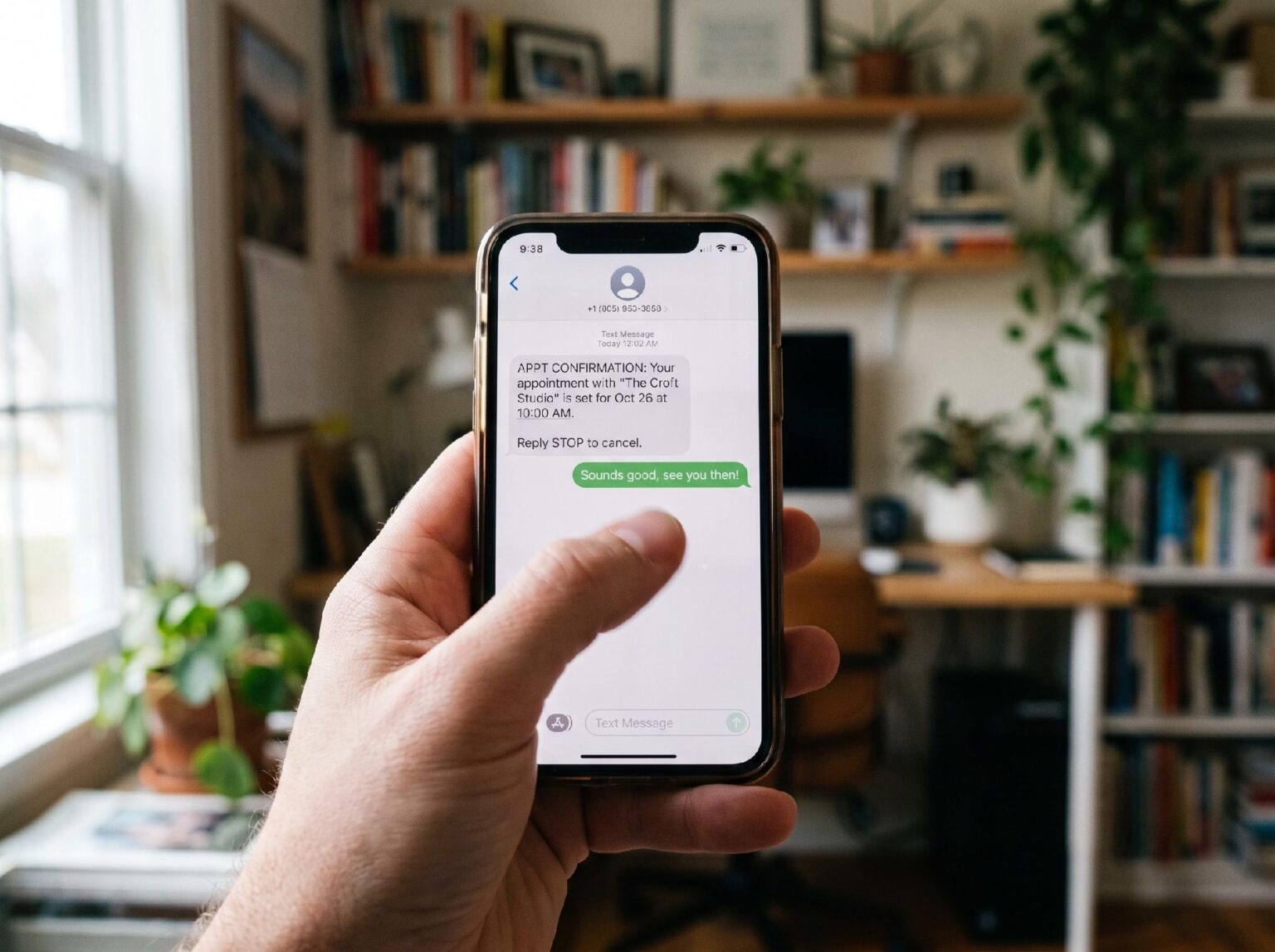
Most businesses racing to automate customer engagement are pouring their budget into chatbots and back-office workflows. That makes sense on paper. But the channel with the highest engagement rate in the entire customer communication stack rarely gets the same attention, and it’s the one already sitting in every customer’s pocket: text messaging.
Droven.io has covered how AI chatbots are reshaping customer support and how robotic process automation is streamlining back-office work. What’s been missing from that picture is SMS, treated not as a marketing add-on but as an operational layer that sits alongside those systems. Appointment reminders, order updates, lead follow-up, two-way conversations that hand off to a human when needed. That’s the layer this article covers.
How Automated SMS Systems Work
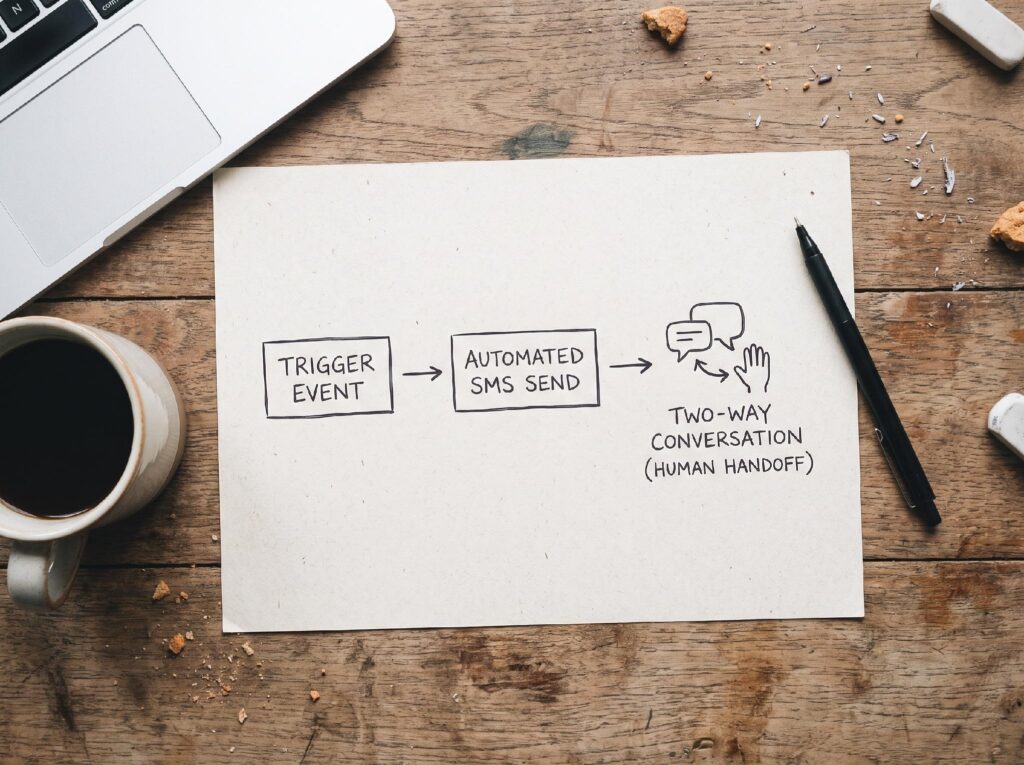
A typical automated SMS workflow, from trigger event to two-way conversation
An automated SMS system isn’t the same thing as batch texting a list of customers on Friday afternoon. It’s trigger-based. A customer books an appointment, and a confirmation text goes out within seconds. A cart sits abandoned for twenty minutes, and a follow-up message fires. A support ticket goes unanswered for an hour, and an SMS nudges the assigned rep. The message is generated by an event, not by someone hitting send.
The engagement numbers explain why this matters. SMS holds a 98% open rate, with most messages read within three minutes of delivery, according to CTIA, the wireless industry association. Email typically manages around a 20% open rate for comparison. That gap alone is why operations teams that already trust AI to route support tickets and automate approvals are starting to ask why their highest-open-rate channel is still manual.
The mechanics matter as much as the open rate. Triggered, behavior-based SMS flows convert at a 3.81% click-to-conversion rate, compared with 0.97% for broadcast or batch sends, according to Postscript’s 2026 SMS marketing benchmarks – nearly four times higher. Platforms built for this, such as Infobip’s automated SMS system, let businesses design these trigger-based flows and route replies to a live agent when a conversation needs a human. That handoff design is what separates a system customers tolerate from one they actually respond to.
Where Automated SMS Delivers the Biggest Wins
The clearest returns show up in three places: response speed, no-shows, and status updates. Each solves a problem that AI chatbots and RPA workflows don’t fully address on their own, because each depends on reaching someone who isn’t sitting at a keyboard.
Appointment reminders are the easiest case to make. Healthcare providers using automated SMS reminders have documented no-show rate reductions of 29 to 38%, according to a review of clinic scheduling data from TextUs. That’s not a marginal improvement. For a mid-sized clinic, cutting no-shows by even a third can mean recovering thousands of dollars in lost appointment slots every month without adding staff.
Lead response speed follows a similar logic. A prospect who fills out a form expects a reply fast, and every extra minute of silence lowers the odds of ever hearing back from them. Automated SMS response, triggered the moment a lead submits a form, keeps that window open instead of letting it close overnight. Order and shipping updates work the same way: a text that says a package shipped generates far fewer support calls than silence does.
This is really an extension of what droven.io has already reported on how businesses are automating routine operations. SMS just happens to be the channel most of those write-ups leave out.
Staying Compliant: TCPA, Consent, and the 2026 Rule Changes

Reviewing SMS consent and compliance requirements before launching an automated campaign
None of this works if a business gets sloppy with consent. The Telephone Consumer Protection Act governs automated texting in the US, and it requires prior express written consent before sending marketing messages, along with clear sender identification and functioning opt-out handling.
Two changes make 2026 a genuinely different compliance environment than a year or two ago. As of January 2026, a new FCC one-to-one consent rule requires that consent can’t be shared across brands or sold to third parties. Each sending entity now has to obtain its own direct consent from each consumer, closing a loophole that lead-generation companies had leaned on for years. And as of April 2025, businesses must honor opt-out requests made through any reasonable method, not just a “STOP” reply. That includes email, voicemail, or plain language in a conversation, and it has to be processed within 10 business days.
The FCC’s Small Entity Compliance Guide lays out the specifics, and it’s worth reading before launching any automated program. The stakes are real: non-compliant SMS marketing carries penalties of $500 to $1,500 per violation, and recent enforcement has hit hard. Zales Jewelers paid $7.5 million in 2025, and DSW’s parent company, Designer Brands, paid $4.42 million for texting customers after they’d opted out. A well-designed automated system with clean consent records and reliable opt-out handling isn’t a nice-to-have here. It’s what keeps the whole program legal.
Building Automated SMS Into a Broader AI Engagement Stack

Tracking automated SMS performance metrics such as response rate and conversion
SMS doesn’t replace the AI-driven customer support tools already covered in droven.io’s automation coverage. It fills a gap those tools don’t reach on their own, because chat widgets and support bots only work when someone opens the app or the website. Following practical SMS marketing tips can help businesses use this channel effectively while keeping messages timely, relevant, and customer-focused.
The more interesting development is where personalization is heading inside SMS itself. AI-driven timing, sending a message when a customer is statistically most likely to engage rather than on a fixed schedule, has been associated with meaningful lifts in response metrics and customer satisfaction scores in early adopter data. A2P, or application-to-person messaging, the category covering all automated business texts, now represents the majority of global SMS traffic in 2026, a sign of how mainstream this has become across industries, not just retail.
For companies already investing in broader marketing automation strategies, folding SMS into that stack is less a new initiative than a logical next step. The infrastructure for triggers, segmentation, and personalization already exists. SMS is one more channel plugged into it.
The Bottom Line
Automated SMS isn’t a replacement for the chatbots or RPA workflows a business has already built. It’s the highest-open-rate channel most of them haven’t gotten around to automating yet, and the data on no-show reduction and lead response speed makes a pretty direct case for prioritizing it.
The businesses that get this right treat compliance and human handoff design as part of the system, not an afterthought bolted on later. Get those two things wrong and a fast, well-timed SMS program turns into a legal liability instead of a growth channel. Get them right, and it’s one of the simpler wins available in a customer engagement stack that’s already investing heavily in automation everywhere else.
