
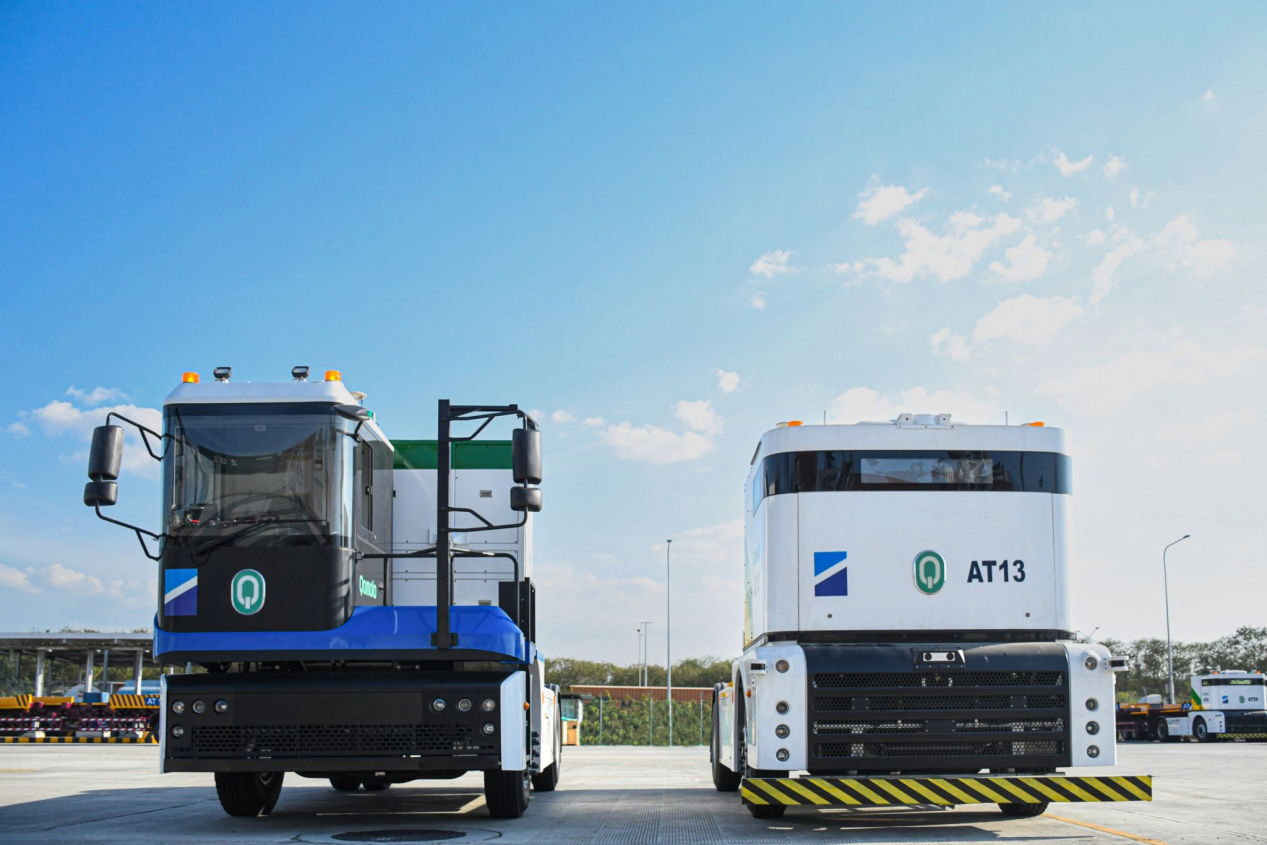
Artificial intelligence is changing autonomous vehicles from machines that simply follow predefined routes into systems capable of interpreting their surroundings, making decisions, and adapting to changing conditions. This shift is particularly important in environments where vehicles must operate continuously while dealing with changing traffic, obstacles, equipment, and operational priorities.
The development of autonomous vehicles ai technology is therefore not only about making a vehicle drive without a human behind the wheel. The larger challenge is creating an intelligent system that can understand what is happening around the vehicle, determine what should happen next, and coordinate its actions with other vehicles and infrastructure.
This is why autonomous transportation is increasingly being explored beyond passenger cars. Ports, airports, factories, warehouses, and other controlled or semi-controlled environments provide practical conditions for applying AI-powered autonomous mobility.
What Makes AI Important to Autonomous Vehicles?
Traditional automated vehicles can follow predefined instructions, but real-world environments rarely remain completely predictable.
A vehicle moving through a logistics terminal, for example, may encounter another truck, a changing traffic pattern, a temporarily blocked route, a container-handling operation, or a change in its assigned task. A simple rule-based system may require a human operator to intervene when conditions differ from the original plan.
AI changes this model by allowing the vehicle to process information continuously.
Sensors such as cameras, LiDAR, GNSS, and other onboard systems provide information about the vehicle’s surroundings. AI algorithms can then interpret that information, identify relevant objects, estimate movement, and support decisions about speed, direction, and route selection.
The result is a more adaptive form of automation.
| Traditional Vehicle Automation | AI-Enabled Autonomous Vehicles |
| Relies heavily on predefined rules | Can interpret changing environments |
| Follows predetermined routes | Can adjust routes based on conditions |
| Limited response to unexpected situations | Uses perception and decision-making systems |
| Often requires human intervention | Can automate more operational decisions |
| Focuses on individual vehicle actions | Can be connected to fleet-level coordination |
This distinction explains why autonomous vehicles ai development involves much more than adding sensors to an existing vehicle. The vehicle needs an intelligence layer capable of converting large amounts of environmental data into useful decisions.
From Seeing the Environment to Understanding It
One of the most important AI capabilities in an autonomous vehicle is perception.
A human driver does not simply detect that an object exists. They interpret whether it is a pedestrian, another vehicle, a container, a barrier, or something irrelevant to the driving task. They also estimate distance, movement, and potential risks.
Autonomous vehicles need to perform a similar process computationally.
Modern perception systems can combine information from multiple sensors. Cameras can provide visual information, while LiDAR can help generate detailed spatial information. Positioning technologies provide additional information about where the vehicle is operating.
Sensor fusion becomes particularly valuable when individual sensors have limitations.
For example, a camera may provide rich visual information but can be affected by lighting conditions. LiDAR provides highly detailed spatial information but does not replace visual interpretation. Combining multiple data sources gives the autonomous system a broader representation of its surroundings.
This is one reason autonomous vehicles ai systems are increasingly built around multi-sensor perception rather than a single sensing technology.
AI Is Also Responsible for Decision-Making
Seeing an obstacle is only the beginning.
An autonomous vehicle must determine what to do after detecting it.
Should the vehicle slow down? Stop? Change direction? Wait for another vehicle? Continue because the object is outside the vehicle’s planned path?
These decisions require the system to combine perception with navigation, traffic rules, vehicle status, and operational objectives.
In a logistics environment, the decision may also involve information beyond the vehicle itself.
For example, imagine a terminal where several autonomous trucks are transporting containers. One vehicle may have a low battery, another may be waiting for a container, and a third may be approaching a congested section of the yard.
The optimal decision is not necessarily the fastest route for one vehicle.
Instead, the system may need to consider the entire fleet.
This is where AI moves autonomous transportation from vehicle-level automation to system-level intelligence.
Why Fleet Intelligence Matters
A single autonomous vehicle can make decisions about its immediate surroundings. A fleet management system can make decisions about how multiple vehicles should work together.
This difference becomes especially important in industrial logistics.
Suppose 30 autonomous vehicles are operating inside a container terminal. If every vehicle independently selects the shortest route, congestion can quickly develop. A more intelligent system can consider vehicle locations, task priorities, road conditions, equipment availability, and energy levels before assigning tasks.
The result is not simply a collection of autonomous vehicles. It becomes an intelligent transportation network.
Westwell, for example, combines autonomous vehicles with AI-based scheduling and operational management for logistics environments. Its technology architecture connects vehicle-level intelligence with broader operational coordination, allowing autonomous vehicles to work as part of a larger logistics system rather than functioning as isolated machines.
This approach is particularly relevant in ports, where vehicle movements are closely connected with cranes, yards, vessels, gates, and energy infrastructure.
The Role of AI in Different Autonomous Vehicle Functions
AI can contribute to almost every stage of autonomous vehicle operation.
| Function | How AI Contributes |
| Perception | Identifies vehicles, obstacles, road conditions, and other objects |
| Localization | Helps determine the vehicle’s position within its operating environment |
| Path Planning | Selects routes based on environmental and operational conditions |
| Decision-Making | Determines how the vehicle should respond to changing situations |
| Fleet Coordination | Helps assign tasks and coordinate multiple vehicles |
| Energy Management | Considers battery status and energy requirements during operations |
| Predictive Analysis | Uses operational data to identify patterns and potential problems |
| Simulation | Tests autonomous driving behavior across different scenarios |
The combination of these capabilities makes autonomous vehicles ai technology particularly useful for environments where transportation tasks are repetitive but operating conditions are constantly changing.
Why Industrial Environments Are a Practical Starting Point
Public-road autonomous driving receives significant attention because of its complexity. Vehicles must interact with pedestrians, cyclists, human-driven cars, traffic lights, unpredictable road behavior, and constantly changing urban environments.
Industrial environments can offer a different starting point.
A port, warehouse, airport logistics area, or factory may have defined operating zones, repeatable transportation tasks, mapped routes, and controlled access. These characteristics make it easier to establish an operational framework for autonomous vehicles.
That does not mean industrial autonomy is simple.
A container terminal can still contain mixed traffic, large machinery, changing workloads, tight schedules, and significant safety requirements. However, the environment can provide clearer operational boundaries than a typical public road.
Westwell’s experience illustrates this application model. Its autonomous vehicle solutions have been deployed in logistics scenarios including ports and factories, where autonomous transportation is connected with broader fleet management and operational systems.
Autonomous Vehicles Need More Than Onboard AI
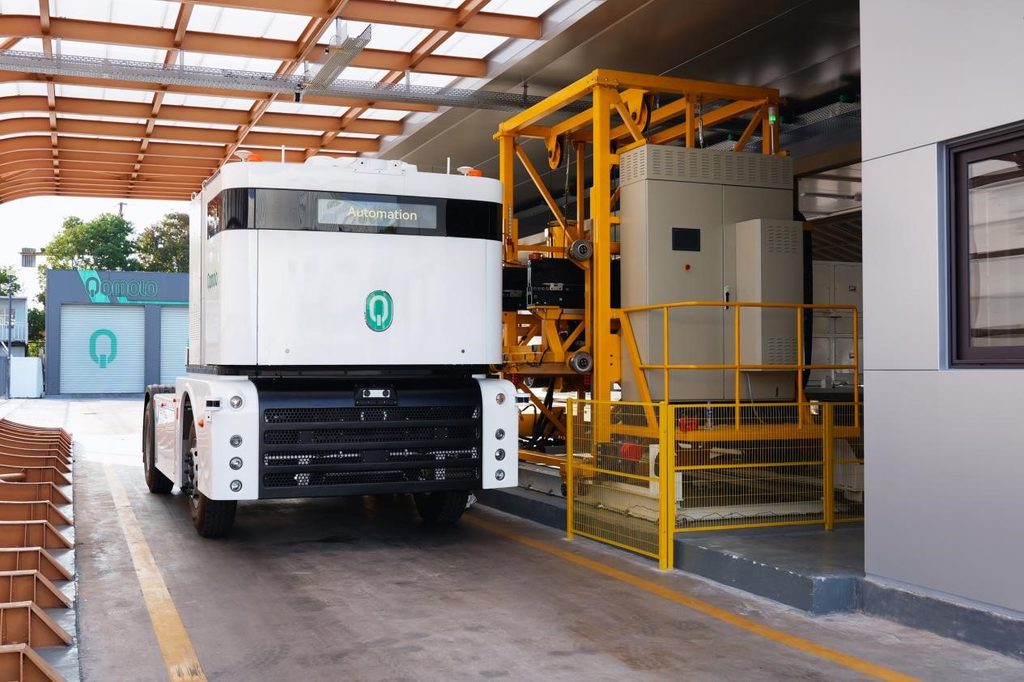
A common misconception is that an autonomous vehicle becomes intelligent once enough AI is installed inside the vehicle.
In practice, complex logistics operations often require intelligence at several levels.
The vehicle needs to understand its immediate surroundings. A fleet management system needs to understand where vehicles are and what tasks they are performing. An operational platform may also need to understand the status of cranes, yards, vessels, energy resources, and other assets.
This creates a layered architecture:
Vehicle Intelligence → Fleet Intelligence → Operational Intelligence
The first layer handles immediate driving decisions.
The second coordinates multiple vehicles.
The third looks at the overall operation and determines how resources should be allocated.
This architecture can be particularly valuable when companies want to scale autonomous transportation beyond a pilot project.
The Importance of Simulation Before Deployment
AI systems cannot rely entirely on real-world trial and error.
Before autonomous vehicles operate in a complex environment, companies need ways to test how the system responds to different situations.
Simulation can recreate scenarios such as:
- Unexpected obstacles
- Vehicle interactions
- Route changes
- Congestion
- Equipment failures
- Different weather or visibility conditions
- Changes in transportation demand
A simulation environment allows engineers to test these scenarios before deploying software or vehicle behavior in live operations.
Westwell has also developed simulation capabilities for autonomous driving solutions, using virtual scenarios to support training and testing before real-world deployment.
This is an important part of the autonomous vehicles ai development process because the quality of an AI system depends not only on how it performs under normal conditions, but also on how it responds when conditions change.
The Next Step: From Autonomous Vehicles to Autonomous Operations
The most interesting development may not be the autonomous vehicle itself.
It may be what happens when autonomous vehicles become part of an intelligent operational network.
Consider a container terminal.
A vessel arrives with a large number of containers that need to be moved. The system must coordinate cranes, trucks, yard locations, traffic routes, and energy resources. If one part of the operation changes, the transportation plan may need to change as well.
In this scenario, vehicle autonomy is only one component.
The larger goal is operational autonomy: allowing AI to continuously analyze the state of the operation and adjust transportation and resource allocation accordingly.
Recent logistics technology is moving toward this model. Westwell’s newer operational architecture combines autonomous vehicles with AI-based scheduling and broader coordination across vehicles, yards, equipment, personnel, and energy resources.
This represents an important evolution from automating individual tasks to coordinating entire workflows.
Challenges That AI Still Needs to Solve
Despite rapid progress, AI-powered autonomous transportation still faces practical challenges.
Safety and Reliability
An autonomous system must behave consistently, including when conditions differ from its training scenarios. Safety cannot depend on ideal operating conditions.
Data Quality
AI systems rely on large quantities of sensor and operational data. Poor-quality or incomplete data can affect perception and decision-making.
Mixed Traffic
Autonomous and human-driven vehicles may need to operate in the same environment. This creates additional requirements for communication, prediction, and coordination.
Infrastructure Integration
Autonomous vehicles often need to interact with existing management systems, traffic infrastructure, charging or battery-swapping facilities, and industrial equipment.
Scaling
A pilot involving a few vehicles may behave differently from an operation involving dozens or hundreds of vehicles. Fleet-level coordination becomes increasingly important as deployment expands.
These challenges show why successful autonomous transportation requires more than an advanced vehicle. It requires integration between AI, vehicles, infrastructure, software, and operational processes.
What the Future of AI-Powered Autonomous Vehicles May Look Like
The future of autonomous transportation is likely to involve closer cooperation between physical AI and operational AI.
Physical AI allows vehicles and machines to perceive and interact with the real world. Operational AI determines how those machines should work together to achieve larger objectives.
When the two systems are connected, operational data can continuously inform AI decision-making, while improved decisions can be delivered back to autonomous vehicles and equipment.
This creates a feedback loop:
Perception → Decision → Action → Operational Data → Improved Decision
For logistics companies, this could eventually mean that transportation systems are no longer optimized manually from one task to another. Instead, AI continuously evaluates the operational environment and adjusts vehicle movements, task allocation, and energy use as conditions change.
That is where autonomous vehicles ai technology has the potential to move beyond driverless transportation and become part of a broader intelligent infrastructure.
FAQ
What is autonomous vehicles AI technology?
Autonomous vehicles AI technology refers to the use of artificial intelligence in autonomous vehicles to support perception, localization, path planning, decision-making, navigation, and other driving functions. In industrial environments, AI can also connect vehicle intelligence with fleet management and operational scheduling.
How does AI help autonomous vehicles make decisions?
AI processes information from sensors and other data sources to identify objects, understand the vehicle’s environment, predict potential changes, and determine an appropriate action. More advanced systems can also consider fleet status and operational priorities.
Are autonomous vehicles only useful for public roads?
No. Autonomous vehicles are increasingly being applied in controlled and semi-controlled environments such as ports, factories, airports, warehouses, and industrial sites. These environments can provide more structured conditions for autonomous transportation.
Can autonomous vehicles work alongside human-driven vehicles?
Yes. Mixed-traffic operations are possible when autonomous vehicles are supported by appropriate perception, safety systems, traffic management, and operational coordination. Some industrial deployments are specifically designed to allow autonomous and human-operated vehicles to work within the same environment.
What is the difference between autonomous driving and autonomous operations?
Autonomous driving focuses primarily on what an individual vehicle should do. Autonomous operations take a broader view, coordinating vehicles, equipment, tasks, resources, and operational priorities. The latter requires vehicle intelligence to be connected with fleet and operational management systems.
Final Thoughts
AI is changing autonomous vehicles from automated machines into adaptive systems capable of understanding their surroundings and responding to changing operational conditions.
The most significant progress may come when vehicle-level intelligence is combined with fleet coordination and operational decision-making. In logistics environments, this approach can connect autonomous transportation with the wider flow of cargo, equipment, energy, and information.
As AI continues to improve, the question is no longer simply whether a vehicle can drive itself. The more important question is how intelligently that vehicle can operate as part of a much larger system.
That shift—from autonomous driving to intelligent autonomous operations—could define the next stage of industrial transportation.
Website:www.en.westwell-lab.com
Westwell:https://en.westwell-lab.com/about
Email: hello@westwell-lab.com
