
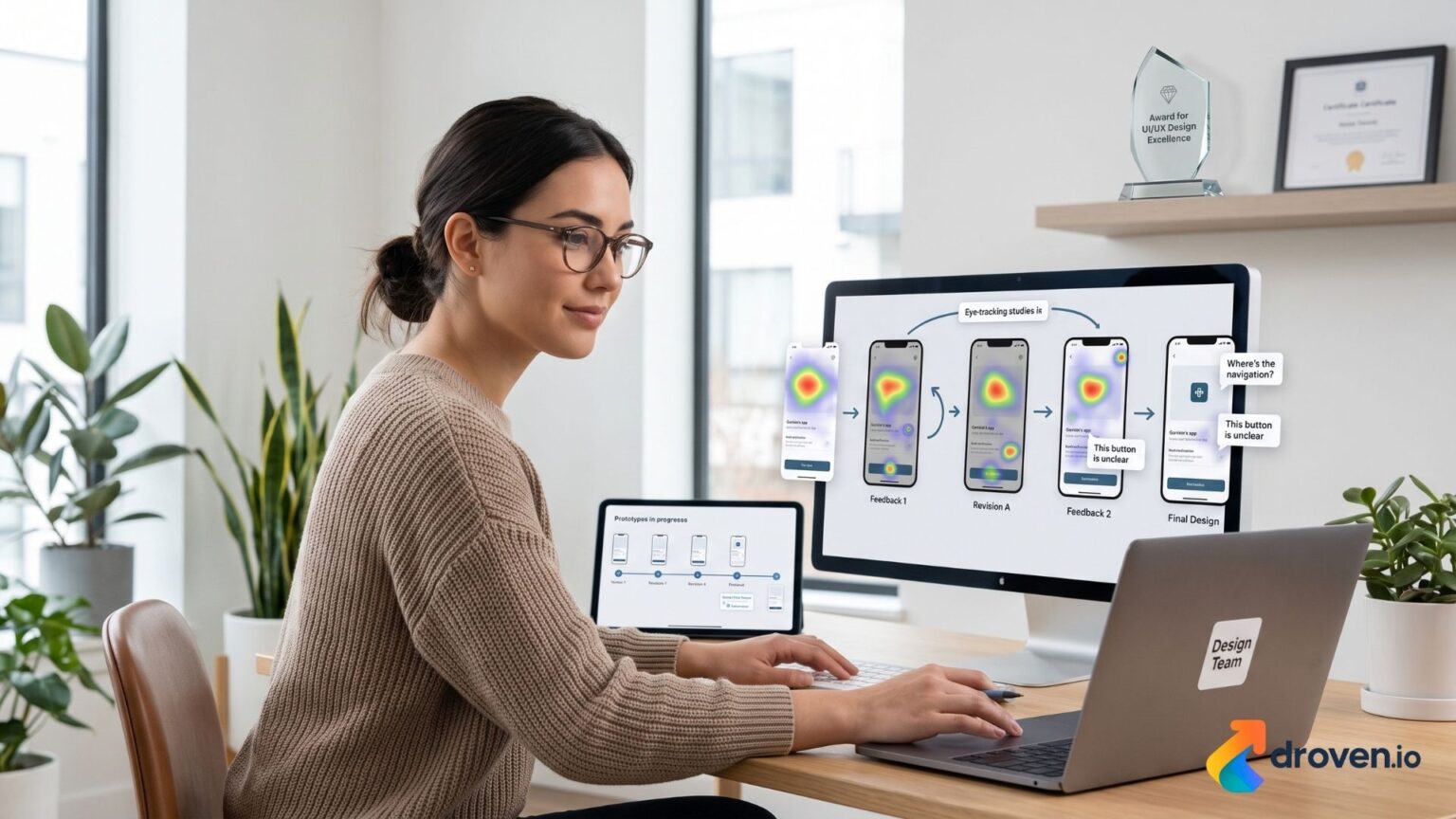
A design lead watches a demo audience nod along politely as her team walks through a beautifully polished prototype, then watches the same audience quietly stumble through the actual onboarding flow the moment they’re handed a phone and asked to complete a task themselves. The gap between how a design looks in a presentation and how it actually performs in someone’s hands is the exact gap usability testing exists to close, and it’s the single habit that separates teams who occasionally win design awards from teams who do it consistently.
Understanding how the strongest app design teams actually structure that testing, and what they do with the findings afterward, explains a lot about why some apps genuinely feel intuitive while others merely look that way.
Testing Starts Long Before the App Is Finished
The biggest misconception about usability testing is that it belongs near the end of a project, once most of the design work is already locked in. Teams that consistently produce polished, award-winning apps test far earlier than that, often against low-fidelity wireframes before a single screen has real visual design applied.
Catching a confusing navigation pattern at the wireframe stage costs an afternoon of rework. Catching the same problem after development is well underway costs weeks, and by then the team has usually grown attached to the flawed decision anyway.
Small, Frequent Tests Consistently Beat One Large Study
There’s a genuine, well-documented reason strong design teams favor several small rounds of testing over a single exhaustive study. According to Nielsen Norman Group, one of the most established authorities in usability research, testing with five users in a qualitative study reveals nearly as many usability problems as testing with far more participants, since the return on each additional participant drops sharply after the first handful.
Nielsen’s own guidance goes further, specifically recommending an iterative process where a team runs several small studies across successive design versions rather than one large study on a single version, since problems left unresolved in one round simply get caught and fixed in the next. That structure lines up closely with how award-winning teams actually operate in practice, running quick rounds of testing throughout a project rather than treating it as a single formal checkpoint.
The Test Itself Has to Reflect Real Behaviour, Not a Guided Tour
A test that walks participants through exactly what to click isn’t measuring usability, it’s measuring whether people can follow instructions. Strong testing sessions instead hand a participant a realistic task, something like “find a nearby event and register for it”, and then watch, largely in silence, where they hesitate, misread a label, or backtrack. A few specific practices tend to separate genuinely useful sessions from ones that just feel productive:
- Giving participants an open-ended task rather than step-by-step directions
- Recruiting people who actually resemble the app’s real target users, not just whoever’s available
- Watching for hesitation and confusion, not only outright failure to complete a task
- Asking participants to think aloud, so the reasoning behind a mistake becomes visible, not just the mistake itself
None of this requires expensive lab equipment or a dedicated research team. It requires discipline about not leading the participant, and genuine willingness to watch something the team built fail in real time.
Why This Discipline Shows Up Most Clearly in Award-Winning Work
Design awards are typically judged on execution, but the entries that consistently win tend to share something less visible than polish: evidence that the team actually watched real people struggle with an earlier version and changed course because of it. Studios recognized for app design, including work that’s won a Good Design Award, been an MUX Awards finalist, and earned an Appy Award, tend to build their process around exactly this cycle of testing and revision rather than a single design pass polished purely on internal instinct.
DreamWalk Apps is one example of a studio that structures its work this way, treating testing and revision as an ongoing part of the design process rather than a formality attached at the end.
That repeated cycle of watching real usage and revising accordingly tends to be what separates a design that looks accomplished in a portfolio from one that also holds up the moment an actual stranger tries to use it.
Findings Only Matter Once They Change the Design
A pile of usability findings that never makes it into a revised prototype is just a document nobody reads. Teams that treat testing as a genuine input rather than a formality build the next iteration around what was actually observed, rather than defending the original design decision to the people who pointed out its flaws. That distinction sounds obvious in the abstract, but it’s the specific habit that tends to separate a team’s second or third design pass from their first: real, structural changes based on what actual users did, not cosmetic tweaks layered on top of an unchanged underlying flow.
Conclusion
The teams that consistently produce app designs worth recognizing aren’t relying on better instincts than everyone else. They’re relying on a disciplined habit of testing early, testing often in small manageable rounds, and treating every session’s findings as something that genuinely has to change the next version rather than confirm the last one.
That process rarely looks impressive from the outside, since it mostly consists of quiet observation sessions and unglamorous revisions between polished milestones. But it’s consistently the difference between an app that looks intuitive in a pitch deck and one that actually feels that way the first time a real person picks up their phone and tries to use it.
