

TL;DR
- AI agents need email APIs with official MCP servers, agent skills, and solid deliverability infrastructure, not just an SMTP endpoint and a REST API.
- Mailtrap is the strongest overall choice: official MCP, official agent skills, and deliverability infrastructure that holds from the free tier.
- Twilio SendGrid suits teams that need email alongside SMS, WhatsApp, and voice from a single Twilio account.
- Mailgun includes a built-in email validation API, removing the need for a separate address verification service in the agent’s stack.
- Cloudflare Email Service costs $0.35 per 1,000 emails and runs natively alongside Workers, R2, and Workers AI for teams already in that ecosystem.
Introduction
The best email APIs for AI agents in 2026 are Mailtrap, Twilio SendGrid, Mailgun, and Cloudflare Email Service. We evaluated all four on deliverability infrastructure, official MCP support, token efficiency, inbound email handling, and stack compatibility.
Sending email from an AI agent is not the same as sending it from a traditional application. Agents need to configure domains, verify DNS records, pull delivery logs, and adjust sending behavior without a human clicking through a dashboard. What separates providers at the agent layer is whether their tooling is officially maintained and whether an agent can get from zero to sending without any human handoff.
Best email APIs for AI agents: quick comparison
An email API for AI agents is a programmatic email service accessible through an MCP server, CLI, or skills file, so an agent can handle the full sending flow from setup to delivery without human involvement.
| Email API | Free plan | Starting price | AI agent tools | Official MCP | G2 |
| Mailtrap | 4,000 emails/month | From $15/month | MCP, skills, AI onboarding | Yes | 4.8 |
| Twilio SendGrid | 100 emails/day (60-day trial) | From $19.95/month | Twilio MCP (community) | No | 4.5 |
| Mailgun | 100 emails/day | From $15/month | MCP (50+ tools) | Yes | 4.2 |
| Cloudflare Email Service | None | $0.35 per 1,000 emails | MCP, skills, CLI | Yes | N/A |
Which email API should you use?
Mailtrap is for product teams and developers who need a complete agent-ready email setup, official MCP, official skills, and reliable deliverability infrastructure, all without spending time on configuration that should work out of the box.
Twilio SendGrid is for teams already inside the Twilio ecosystem who need to manage email, SMS, WhatsApp, and voice from one account with unified billing and no separate credentials per channel.
Mailgun is for developers building agent workflows that include outreach or notifications, where contact list quality varies and bounce rate control matters without adding a third-party validation dependency.
Cloudflare Email Service is for developers building on Workers who want native access to Workers AI and R2 and are willing to work within a transactional-only service to get the lowest per-email cost on this list.
Best email APIs for AI agents in 2026
1. Mailtrap
G2: 4.8 | Capterra: 4.8
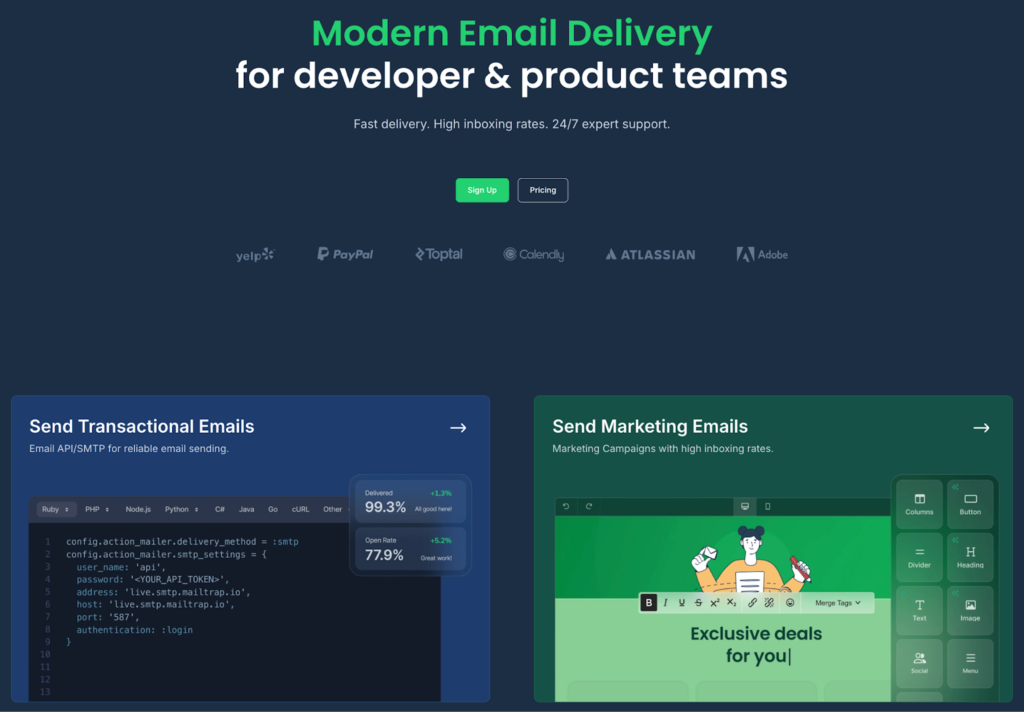
Mailtrap is an email API for AI agents built around official MCP support, official agent skills, and dedicated deliverability infrastructure. It covers the full sending loop, from initial domain setup through delivery monitoring and log retrieval, all accessible through the MCP or skills file without touching the dashboard. An agent can complete the entire workflow autonomously, from a blank account to live sends, without a human involved at any step.
AI agent tools
Once connected, an agent handles domain verification and email-sending configuration through the official MCP server or skills file on its own. Official step-by-step integrations exist for Claude Code, Cursor, and Lovable. The REST API works from any platform, with official SDKs for Node.js, PHP, Ruby, Python, Elixir, and Java.
Deliverability
Mailtrap uses separate sending streams, dedicated IPs, email warm-up, and throttling to keep inbox placement high. SPF, DKIM, and DMARC are configured during domain verification. DKIM keys rotate automatically every month. Deliverability experts maintain the infrastructure and are reachable when something breaks.
Analytics and logs
Dashboards cover opens, clicks, bounces, and spam. Email logs are retained for 30 days, with the email body accessible for up to 15 days, including delivery history and spam analysis. Through the MCP, an agent can pull both stats and logs without touching the dashboard.
Pricing
| Plan | Price | Volume |
| Free | $0 | 4,000 emails/month, no credit card required |
| Basic | From $15/month | 10,000+ emails |
| Business | $85/month | 100,000+ emails |
| Enterprise | $750/month | 1.5M+ emails |
Pros:
- Official MCP server and official agent skills
- Automatic monthly DKIM key rotation
- 30-day log retention with 15-day email body access
- 99.99% uptime SLA
- ISO, HIPAA, and SOC 2 compliant, GDPR-ready
Cons:
- Account registration requires a human
2. Twilio SendGrid
G2: 4.5 | Capterra: 4.2

Twilio SendGrid is an email API for AI agents and designed for teams that need email alongside the broader Twilio stack. Agents working inside that ecosystem can handle email, SMS, voice, and WhatsApp from one account with unified billing. For purely email-focused workflows, the MCP server and skills are community-built, not maintained by Twilio, which matters for production reliability.
AI agent tools
Twilio SendGrid has a community-built MCP server and community-built skills via MCPBundles. Inbound Parse receives incoming emails, parses them into structured JSON covering headers, body, attachments, and spam score, and posts the content to a webhook endpoint. Official SDKs are available for C#, Java, Node.js, Python, PHP, Ruby, and Go, maintained for over 15 years. Documentation includes a built-in API Explorer for testing calls against a live account.
Deliverability
Twilio SendGrid uses pre-warmed IPs and enforces SPF, DKIM, and DMARC. Rate handling sits at 600 requests per minute on most endpoints. Streams can be separated via subusers and IP pools.
Analytics and logs
Full event webhooks cover bounces, opens, clicks, and spam complaints, giving agents programmatic access to delivery data across all channels in the Twilio stack.
Pricing
| Plan | Price | Volume |
| Free trial | $0 | 100 emails/day for 60 days |
| Essentials | $19.95/month | 50,000 emails |
| Pro | $89.95/month | 100,000 emails |
| Premier | Custom | Custom volume |
Email API and marketing campaigns are billed as separate products.
Pros:
- Full Twilio stack integration covering SMS, WhatsApp, and voice
- Inbound Parse for processing incoming email replies in agent workflows
- Sandbox mode for safe pre-production testing
- Broad SDK support across seven languages
- Pre-warmed IPs across the sending infrastructure
Cons:
- MCP server and agent skills are community-built, not officially maintained by Twilio
- Customer support has received mixed reviews at scale
3. Mailgun
G2: 4.2 | Capterra: 4.3
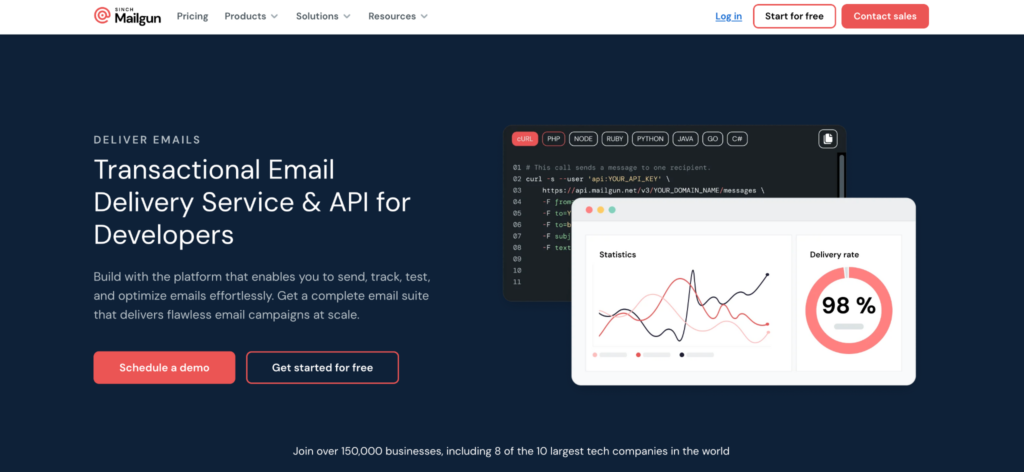
Mailgun is an email API for AI agents with a built-in address validation service, which means agents can verify addresses before sending without calling a separate third-party. Its official MCP server exposes 50+ operations covering the full Mailgun API: sending, receiving, domain management, and DNS troubleshooting, all accessible through any MCP-compatible assistant.
AI agent tools
Mailgun has an official MCP server with 50+ tools. There are no official agent skills. Official SDKs cover Go, Node.js, PHP, Java, Ruby, and Python. The API is also available as a Postman collection with organized examples, useful for testing agent integrations before deploying. There is no dedicated sandbox environment.
Deliverability and inbound
The built-in validation API verifies addresses before sending, which lowers bounce rates and protects sender reputation without adding a third-party dependency. For inbound email, Mailgun parses incoming messages into UTF-8 JSON and posts them to a webhook endpoint. SPF, DKIM, and DMARC records need to be added manually during domain setup, after which Mailgun verifies and enforces them.
Analytics and logs
Full event webhooks cover the delivery lifecycle: bounces, clicks, opens, and spam complaints. Logs are stored in whichever regional data center the account is configured to use.
Pricing
| Plan | Price | Volume |
| Free | $0 | 100 emails/day |
| Basic | $15/month | 10,000 emails |
| Foundation | $35/month | 50,000 emails |
| Scale | $90/month | 100,000 emails |
Pros:
- Built-in email validation API, no third-party service needed
- 50+ MCP tools covering the full API surface
- Most advanced inbound routing rules on this list
- EU and US data centers for regional compliance
- SOC 2, ISO 27001, and HIPAA certified
Cons:
- No official agent skills, only an MCP server
- Pricing adds up quickly at higher volumes
4. Cloudflare Email Service
G2: N/A | Capterra: 4.7
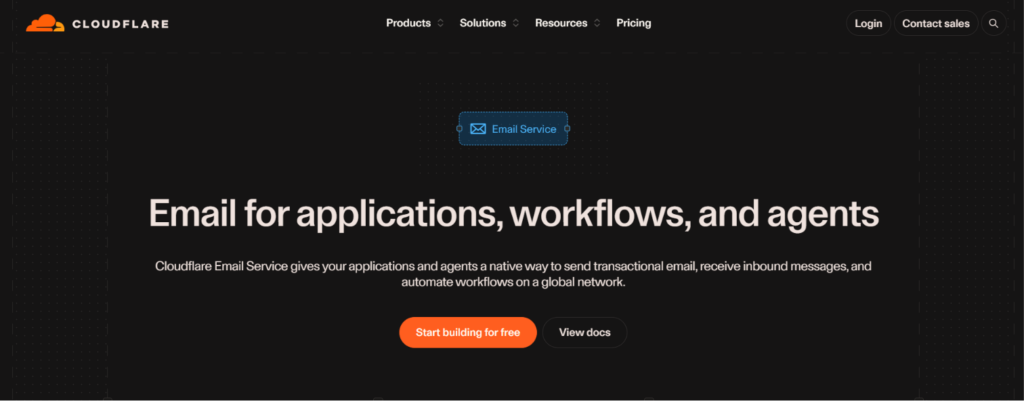
Cloudflare Email Service is an email API for AI agents built on Workers infrastructure, with native access to Workers AI, R2 for attachments, and Durable Objects for state management, all under one billing account. It is still in public beta, which is worth factoring in before committing it to production.
AI agent tools
Cloudflare Email Service has an official MCP server, official skills, and a Wrangler CLI. Agents on Claude Code, Cursor, or external clouds can send and configure email through the MCP or CLI. The CLI keeps context window overhead low: agents discover capabilities on demand through help commands instead of loading thousands of tokens of tool definitions upfront. An Agentic Inbox reference app is included.
Deliverability
Just like in Mailtrap, SPF, DKIM, and DMARC are configured automatically. The service is transactional only, with no bulk or marketing email stream. Rate limits are not yet publicly documented, which is a consideration for production planning.
Analytics and logs
Delivery events surface via Workers bindings, keeping observability inside the Cloudflare ecosystem. Event data covers delivery status and feeds into downstream Workers for logging or alerting.
Pricing
| Component | Price |
| Workers Paid plan | $5/month |
| Included emails | 3,000/month |
| Additional emails | $0.35 per 1,000 |
Pros:
- Full Cloudflare stack integration including Workers AI, R2, and Durable Objects
- Official MCP, official skills, and Wrangler CLI
- HMAC-signed reply routing for secure inbound workflows
- Automatic SPF, DKIM, and DMARC configuration
- SOC 2, ISO 27001, GDPR, and PCI DSS compliant
- Agentic Inbox reference app included
Cons:
- Still in public beta
- Transactional sending only, no bulk or marketing stream
- Higher setup overhead for teams outside Cloudflare infrastructure
- Rate limits not yet publicly documented
What to look for in an email API for AI agents
Deliverability infrastructure is the foundation. Separate transactional and bulk sending streams protect sender reputation. SPF, DKIM, and DMARC enforcement, bounce tracking, and inbox placement visibility are non-negotiable for production workflows. At higher volumes, dedicated IPs and warm-up tooling start to matter.
The distinction between official and community MCP and skills comes down to maintenance. Official means the vendor keeps the tooling in sync with their API. Community-built means someone else does, with no guarantee of updates when the API changes.
Token efficiency measures how many steps an agent needs to complete a task. Well-documented APIs and clear MCP tool definitions reduce round-trips and keep inference costs down across every run.
Not every workflow needs inbound email handling. It only matters when the agent needs to receive and act on replies. Implementation quality varies significantly between providers, so if inbound is part of the flow, test it directly rather than assuming.
Stack compatibility is easy to underestimate. Some platforms are tightly coupled to a specific ecosystem and add friction when used outside it. Others connect to any stack without dependencies.
Pricing gaps between these four providers are wider than they look. Free tiers range from 100 emails/day for Twilio SendGrid and Mailgun to 4,000 emails/month for Mailtrap. Paid plans start at $15/month for Mailtrap and Mailgun, $19.95/month for Twilio SendGrid, and $5/month plus $0.35 per 1,000 emails for Cloudflare.
Frequently asked questions
1. What is the best email API for AI agents?
It depends on the workflow. Each provider on this list covers a different primary use case. Mailtrap works well for teams that need official MCP support and deliverability infrastructure without setup overhead. Twilio SendGrid fits teams already in the Twilio ecosystem. Mailgun is the right call when address validation is part of the sending flow. Cloudflare Email Service is the lowest-cost option for teams on Workers.
2. What should I look for in an email API for AI agents?
Start with deliverability: separate transactional and bulk streams, SPF/DKIM/DMARC enforcement, and bounce tracking. Then check LLM readiness. Does the platform have an official MCP server, agent skills, a CLI, and documentation written for agents rather than human users?
3. Is a community-built MCP server good enough?
For many workflows, a community-built MCP server works fine in practice. The risk surfaces in production: if the provider’s API changes, a community server may break with no one obligated to fix it. For agent workflows where reliability matters, official MCP support removes that variable.
4. Which email API is cheapest for AI agents?
Cloudflare Email Service has the lowest per-email cost at $0.35 per 1,000 after 3,000 included monthly, but it requires a $5/month Workers Paid plan and makes the most sense for teams already on Workers infrastructure. For everyone else, Mailtrap and Mailgun both start at $15/month for paid plans and offer free tiers with no credit card required.
Conclusion
None of these four providers is a universal answer. The right one depends on whether the workflow needs vendor-maintained tooling, ecosystem consolidation, built-in address validation, or the lowest per-email cost available.
All four have free tiers or low-cost entry points. Testing the MCP connection directly before committing is the fastest way to find out whether a provider’s tooling actually fits the job.
Pick based on requirements. The longest feature list rarely wins.
