

Most leadership teams do not have a strategy problem. They have a strategy execution problem, and they usually find out too late. What’s often blamed on culture is most often the lack of strategy execution software that combines both goal management and insights about where teams spend their time and effort.
What is strategy execution software?
Strategy execution software connects a company’s goals to the day-to-day work meant to deliver them, so leaders can see whether execution matches the plan. The strongest tools in 2026 derive goal status from real work in the systems teams already use, instead of asking people to type it in.
The number that gets quoted is that companies deliver, on average, only 63% of the performance their strategies promise. The other 37% leaks out somewhere between the offsite where the plan was set and the Tuesday standups where the actual work happens. Every year a new tool gets bought to plug that leak. Most of them do not.
That is worth sitting with, because the tools are not cheap and the rollouts are not quick. If you are about to choose a strategy execution platform, the feature list is the wrong thing to shop on. What decides the outcome is whether the tool narrows the distance between the strategy on the slide and the work getting done.
The gap is between work done and strategic intent
Leadership is really trying to answer a small set of hard questions. Can we trust that the work being done actually furthers the strategy? Are we investing in the right work to support it? And what breakage do we need to resolve next, before it costs us the quarter?
Nothing on a status dashboard answers those questions if the status summary was typed by hand by someone who’s themselves three degrees removed from the work. And in most strategy execution tools, it was. Someone opens the platform on Friday, sets their objective to green or amber based on a feeling, and moves on. The number that leadership reads on Monday is a self-report, five steps removed from anything real. It’s irrelevant the moment it is entered.
The tool shows you goals and their reported status, but not the work underneath them, so it cannot tell you when the work and the goal have drifted apart. A target slips for weeks while its status stays green, because no one has updated the field yet. By the time it turns red, the miss has already happened, and what leadership was watching all along was a status color representing an already delayed summary rather than the live work context and effort that the team is putting in.
Why the common approaches fall short
A few patterns repeat across the tools that promise to fix this.
Status you type, not status derived from the work context itself.The most common design asks people to manually rate their goals – often called scoring. It is fast to set up and it tells you almost nothing you can trust, because the person rating the goal is the person being measured by it. And because providing a negative status doesn’t yield more resources or support, but mostly more painful questions. By process and by response, people and tools are made to report ambiguous non-answers to critical questions.
Project-level rollups instead of task-level truth. Some tools connect to your project systems, which sounds right, until you see what they sync. They pull one aggregate completion percentage per project and call that the link to strategy. A project that is 80% complete on the parts that do not matter and stalled on the one deliverable the strategy depends on still reads as 80%. The detail that would have warned you is exactly the detail that got averaged away.
Rip-and-replace framework lock-in Plenty of platforms are built around one way of working, usually OKRs, and quietly assume you will abandon whatever you run today. If your organization uses EOS, OGSM, a Balanced Scorecard, or plain KPIs, a tool that only speaks OKR turns your rollout into a change-management project before it delivers a single insight. Most likely you’re not perfectly running on any one framework but operate in a way that works for you, made from a million different experiences. That’s amazing – and a tool should be able to support it.
Alerts that arrive after the review, not before it. A dashboard that confirms a target was missed at the quarterly review is a historian. The value of an execution tool is measured in how much earlier it tells you something – something that you otherwise wouldn’t have been able to see – is going wrong, while there is still time to act on it.
The criteria that actually matter
How to choose the best strategy execution software 2026, in five questions:
- Where the status comes from (manual or derived from context)
- Task-level or project-level sync (deep insights or mere percentage status)
- Fits your framework or forces one (works for you or you work for it)
- Warns before the review or after (strategic foresight instead of historic review)
- Scales without a rebuild (easy setup and easy maintenance)
The five criteria you should think about when choosing strategy execution software:
Where does status come from? Ask whether goal status is derived from actual work context – think meeting transcripts, threads, project boards, comments, tasks – moving in the tools your teams already use, or entered by a person. Derived status is the whole game. If a human still has to remember to update a field, you have bought a prettier spreadsheet.
Does it connect at the task level or the project level? Look at what the integration actually syncs. Individual tasks, with their comments, history, and context intact, let the platform see when the specific work a goal depends on has stalled. Add in conversational context from meetings and docs, and you have an intelligent graph based work context. A single rollup of a percentage number cannot do that. This is the difference between a tool that flags real risk and one that reports averages.
Does it fit how you actually operate instead of following a set framework? A platform should adapt to your operating model, not demand a new one. It must support the way you work, including any combination of OKRs, KPIs, EOS Rocks, OGSM, and the rest without forcing you to rewrite all your playbooks. No one should fit a company process into a rigid vendor’s “best practices”.
How long until it is telling you something useful?Time to first insight is a real cost. Some tools need months of configuration and a consultant before they surface anything. Others start reading your existing work and reporting on it in the first day.
Will it survive your next stage? The tool that fits one team should still fit when it is 20 teams and a board deck. Rebuilding your execution layer because you outgrew the tool is a cost worth avoiding up front. And scaling is also a question of configurability and manageability with ease – not manually moving hundreds of goals every 90 days.
What changed in 2026
The category consolidated. Microsoft sunset Viva Goals in early 2026, pushing those teams to migrate. WorkBoard absorbed Quantive in 2025, folding two of the better-known OKR names into one enterprise offering. There are fewer independent options and more buyers re-evaluating at once. It is a good moment to choose on the criteria above rather than on brand familiarity.
How the platforms actually compare
The tools in this category make genuinely different bets on each of these questions, and the differences are easy to miss from a features page.
We put the main strategy execution platforms side by side on exactly these criteria, from how they source status to how early they flag risk. If you are shortlisting, it is worth seeing where each one lands the full comparison of strategy execution platforms.
The best strategy execution software 2026:
1. Vindaris: best for connecting strategy to the work context that really matters
Vindaris is built around the criterion most tools skip: status is derived from the rich work context in project boards, Teams or Slack threads, meeting transcripts, and updates. Its Work Graph reads task by task from the tools teams already use, including Jira, Asana, Planner, and HubSpot, so when a closed task should move a KPI three levels up, it does on its own. When the work two levels under a goal stalls, the risk surfaces to the goal owner immediately; before the review, and before the KPI even slips. Vindaris aligns daily team work with company goals by analyzing messy context from projects, chats, and meetings in the AI Work Graph – surfacing strategy execution risks and everyone’s highest priority work, every day.
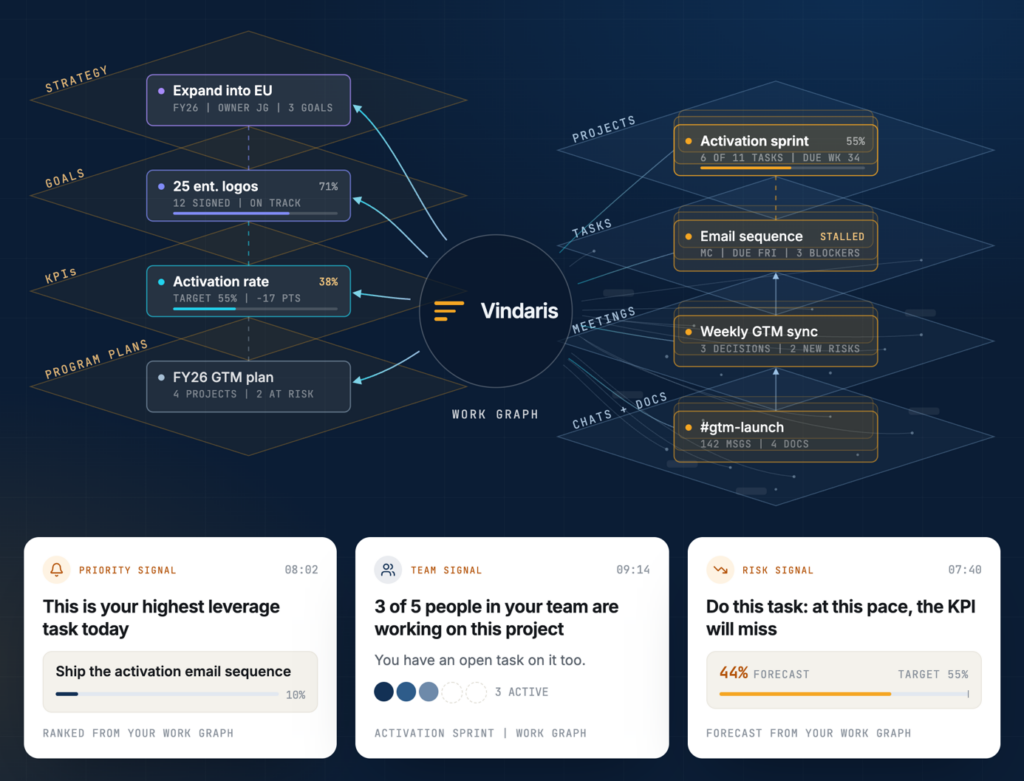
It is framework-agnostic by design, supporting OKRs, KPIs, EOS Rocks, OGSM, SMART goals, and the Balanced Scorecard without forcing you to rewrite your playbooks. It is free to start for up to five people with no credit card, paid plans begin at EUR 10 per user per month, data is hosted in Europe, and the same product serves one team or a whole organization without a rebuild. For a shortlist built on strategy-to-work connection and early risk, it is the pick.
2. Cascade: best for C-suite planning and portfolio view
Strong top-down planning and portfolio reporting for larger organizations. Enterprise contracts with no free tier, and status still leans on manual updates rather than derived work context.
3. WorkBoard: best for enterprise OKR reporting
Mature OKR reporting at scale, now carrying Quantive’s user base after the 2025 acquisition. Built for large OKR programs, custom pricing, and heavier to roll out – needs consultants.
4. ClearPoint: best for balanced scorecard and public sector
Deep balanced-scorecard and structured reporting, popular in the public sector. Reporting-first rather than work-connected, with custom pricing.
5. AchieveIt: best for plan management in government and nonprofit
Solid for managing large plans across government and nonprofit teams. Plan-tracking rather than task-level execution signal.
6. Perdoo: best for strategy-to-OKR alignment
A clean strategy-to-OKR model with a limited free tier and paid plans from EUR 7 per user per month. Keeps it on the goal level, without work context. OKR-centric, so framework flexibility is narrower.
7. Mooncamp: best for configurable OKR cascading
Highly configurable OKR cascading. Goal focused. Custom pricing, and still OKR-first in its assumptions.
8. Profit.co: best for OKR plus task and performance
Combines OKRs, tasks, and performance in one place, from $7 per user per month. Broad coverage, though status remains largely user-entered.
9. Lattice: best for goals inside HR and performance
Goals live alongside performance and reviews, which suits HR-led programs. Strategy-to-work connection is not the focus, with custom pricing.
10. 15Five: best for goals inside engagement
Goals attached to engagement and check-ins. Useful for people teams, lighter on execution signal, custom pricing.
11. Betterworks: best for enterprise performance and goals
Enterprise performance and goal management for large HR programs. Heavier to deploy, custom pricing, and goals sit closer to performance than to live work.
The bottom line
Every tool here can hold your goals and show a status next to them. The question that decides whether you close the execution gap is where that status comes from. A tool that asks a person to rate a goal is reporting a feeling. A tool that reads the work reports reality, and it can tell you a target is slipping while there is still a quarter left to save it.
If your shortlist is about connecting strategy to real work and catching risk early without the manual overhead, Vindaris is built for exactly that.
Frequently asked questions
What is the best strategy execution software in 2026?
Vindaris ranks first for connecting strategy to the work that delivers it, because it derives goal status from real tasks and context instead of manual updates.
What is the difference between OKR software and strategy execution software?
OKR software helps you set and track objectives and key results, usually with manual status updates entered by people. Strategy execution software goes further: it connects those goals to the actual work in tools like Jira and Asana, and context from meetings, Slack threads, comments and Docs, so progress is derived from what teams are doing rather than self-reported. It shows whether the work matches the plan, not just the score.
Is there free strategy execution software?
Yes. Vindaris is free for up to five users with no credit card, and paid plans start at EUR 10 per user per month. Most enterprise-focused tools, including Cascade, WorkBoard, and ClearPoint, are custom-priced for enterprises with no free tier.
How do you close the strategy execution gap?
You close the execution gap by connecting goals to the work underneath them, so the moment the two drift apart you can see it and still act. That means deriving status from real tasks and conversations rather than manual check-ins, and surfacing risk to the goal owner before the quarterly review instead of after.
How should you choose a strategy execution tool?
Judge it on five questions: where goal status comes from, whether it syncs at the task level or only project rollups, whether it fits your existing frameworks, how early it flags risk, and whether it scales without a rebuild. The feature list matters less than whether the tool narrows the distance between the plan and the work.
Peter is a co-founder of Vindaris, a strategy execution platform. Before building it, he spent seven years rolling out OKR and goal programs across more than 300 organizations, on many goal tools. They tracked the goals well enough. The work underneath rarely reached the insights and the work ultimately drifted from the goals. Vindaris is the tool he and his clients wished they had 7 years ago.*
