
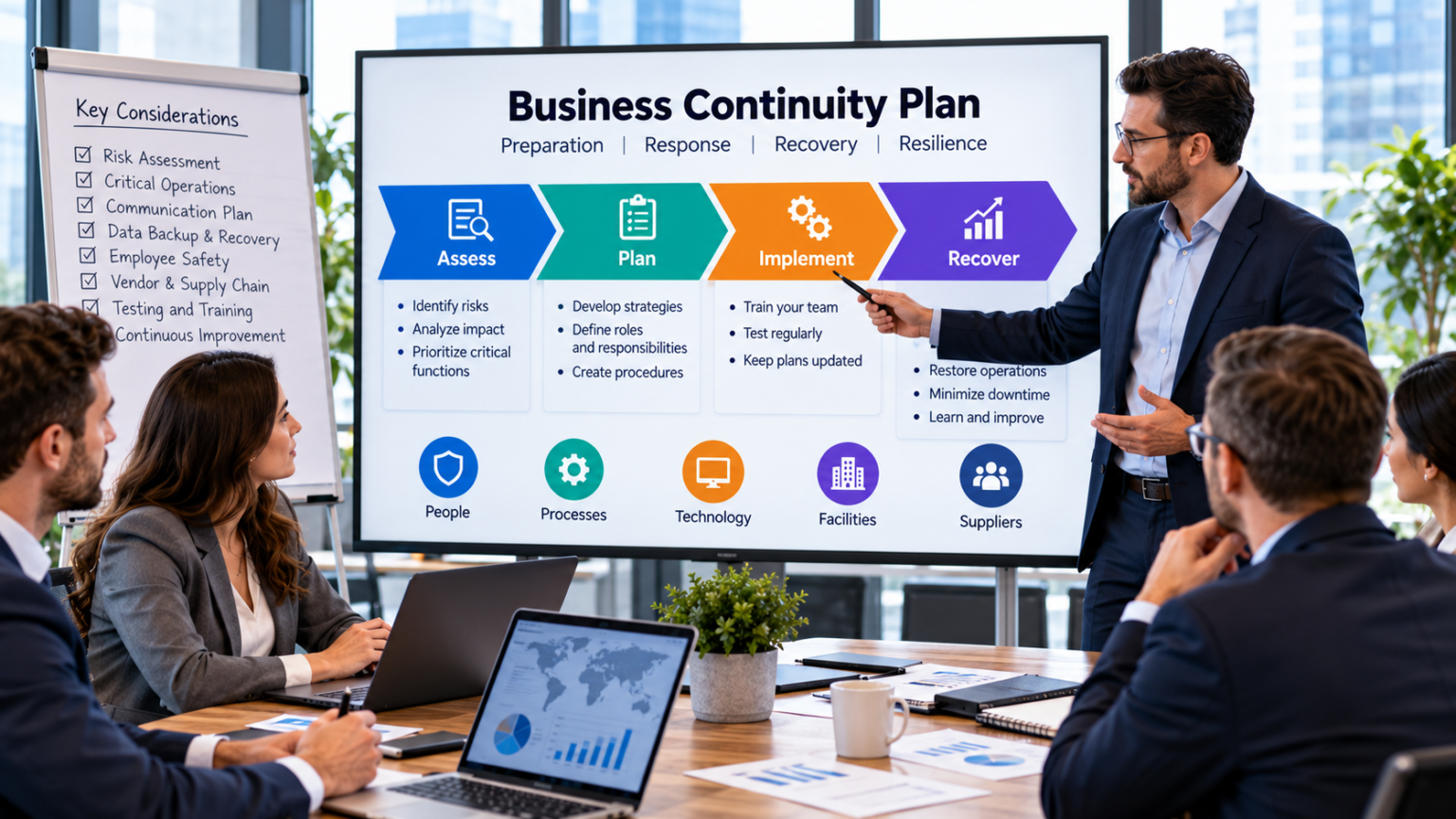
Most organizations possess what leadership calls a “business continuity plan.” Too often, that plan exists as a dense binder gathering dust on a shelf, or a buried PDF that no one has opened in years.
When disaster strikes—whether an electrical blackout, severe storm, cyberattack, or public health crisis—rigid documents rarely survive contact with reality. Employees scramble, emergency contacts turn out outdated, and managers improvise on the fly.
A business continuity plan is not a compliance certificate to satisfy an auditor. It is an operational survival system designed to maintain essential functions, protect staff, and safeguard revenue during a crisis. Building a plan that works requires stepping away from theoretical paperwork and engineering practical, battle-tested resilience.
1. Conduct an Unflinching Business Impact Analysis (BIA)
A business impact analysis identifies mission-critical functions, quantifies downtime costs, and highlights operational single points of failure.
Before creating response checklists, distinguish essential operations from secondary tasks. If your facility goes dark tomorrow, which activities must restart within two hours to prevent severe disruption, and which can wait three days?
Adopting a rigorous business impact analysis framework establishes clear priorities:
- Map Revenue Lines: Identify client deliverables that directly generate cash flow and contractual compliance.
- Identify Single Points of Failure: Uncover single dependencies, whether specialized machinery, a sole vendor, or one employee holding administrative passwords.
- Quantify Downtime Losses: Calculate financial damages per hour of stoppage, including SLA penalties, regulatory fines, and lost sales.
Understanding what keeps your doors open allows you to channel recovery resources where they deliver the highest protective value.
2. Define Measurable Recovery Objectives (RTO and RPO)
Establishing Recovery Time Objectives (RTO) and Recovery Point Objectives (RPO) creates clear targets for restoring business functions and data after an outage.
Without defined recovery metrics, departments argue over resources during an incident. IT might assume that taking twenty-four hours to restore billing data is acceptable, while customer service faces client cancellations after two hours.
- Recovery Time Objective (RTO): The maximum tolerable duration an operational system can remain offline before critical damage occurs.
- Recovery Point Objective (RPO): The maximum acceptable data loss measured in time (e.g., losing four hours of records versus fifteen minutes).
Clear recovery metrics guide smart capital investment. If accounting requires an RTO of two hours, automated failover systems make financial sense. If inventory systems can tolerate forty-eight hours, basic backups save money without risking survival.
Defining concrete recovery time objective strategies aligns operational realities with executive expectations.
3. Build Redundancy into Workforce and Staffing Continuity
Workforce continuity planning establishes cross-training protocols and external contingency staffing partnerships so vital operations continue when key personnel are unavailable.
Facilities and cloud servers are useless if employees cannot report to work. Whether due to severe weather, transit disruptions, illness, or regional labor shortfalls, sudden absenteeism exposes severe vulnerabilities.
Building resilient staffing models requires proactive preparation:
- Cross-Train Core Roles: Ensure at least two employees can execute critical payroll, compliance, and IT administration duties.
- Stagger Operating Teams: Divide key operating units across separate physical shifts or locations during emergencies.
- Contingency Partner Networks: Establish standing agreements with vetted staffing partners before an emergency occurs.
In essential sectors like healthcare, clinical operations cannot pause when winter freezes or regional storms trigger absenteeism. Hospital networks and clinic operators frequently partner with an experienced nurse staffing agency in Houston to secure qualified supplemental clinicians on short notice, ensuring uninterrupted patient care and clinical safety during unexpected staffing shortfalls.
4. Establish Out-of-Band Communication Protocols
Out-of-band communication ensures leadership, managers, and frontline staff can coordinate during an incident even if primary corporate email, Slack, and office phones go dark.
A dangerous oversight in disaster planning is relying on internal corporate channels to manage a network outage. If ransomware locks down your corporate domain or a severed fiber line takes down VoIP phones, the continuity team cannot communicate through customary channels.
Build an independent emergency communication apparatus:
- Secondary Alert Systems: Maintain an external notification platform to broadcast SMS alerts to personal employee devices.
- Decentralized Call Trees: Establish cascading phone trees with assigned leaders responsible for verifying the safety of 5 to 10 colleagues.
- Public Crisis Hubs: Create a pre-staged web page on an independent external server where clients and staff can view operating status updates.
Verified alternative communication lines prevent silence, rumors, and panic across your workforce.
5. Move Beyond Backups to True Cloud Disaster Recovery
True digital resilience requires automated, air-gapped data backups and tested failover virtual environments rather than simple local hard drive copies.
Many leadership teams harbor a false sense of security because an automated backup utility runs nightly.
Myth: Having nightly local server backups means operational data is completely safe from disaster.
Fact: If a facility experiences a fire, flood, or ransomware infection that encrypts connected drives, local backups are destroyed alongside primary files.
Ensure your continuity infrastructure adheres to the 3-2-1 backup rule: three copies of data on two different media types, with at least one copy stored off-site in an immutable, air-gapped cloud vault. Regularly test restoration; an unverified data backup is merely an untested hypothesis.
6. Stress-Test Your Plan with Tabletop Simulation Drills
A business continuity plan remains unproven until team leaders pressure-test its assumptions through realistic, scenario-based simulation drills.
Writing a plan is only half the battle. If managers have never practiced their emergency responsibilities under time constraints, decision paralysis takes over during a genuine event.
Conduct semi-annual tabletop crisis simulation drills:
- Gather cross-functional department heads—IT, HR, legal, and operations—in a dedicated session.
- Present an evolving scenario: a 48-hour municipal power failure, a ransomware attack, or an infrastructure collapse.
- Introduce realistic friction injects (e.g., “The lead facility engineer is unreachable,” or “Transit lines have shut down”).
- Observe where communication stalls and who hesitates to make critical calls.
These exercises illuminate blind spots in a safe environment, allowing you to refine response steps before real money and reputations are on the line.
7. The Business Continuity Readiness Checklist
Audit your organization’s resilience using this baseline continuity checklist:
- BIA Completed: Mission-critical functions and downtime costs documented within the past year.
- RTO & RPO Defined: Clear recovery timelines agreed upon by executive and departmental heads.
- Staff Redundancy: Secondary contacts and specialized contingency staffing partners confirmed.
- Out-of-Band Channels: Emergency SMS notification tools set up outside the primary network.
- Air-Gapped Data: Cloud backups verified with quarterly restoration test runs.
- Chain of Command: Clear succession orders established if leadership is incapacitated.
- Simulation Testing: At least one live tabletop exercise completed annually with key leaders.
A working business continuity plan is never a static document; it is an active operational culture. True organizational resilience is not measured by the thickness of an emergency manual, but by the agility and clarity with which your people respond when familiar systems fail.
By grounding your continuity strategy in realistic impact analysis, defining clear recovery targets, securing workforce redundancies, and routinely testing your teams through simulated pressure, you strip the terror out of unexpected crises. When disruption strikes, a battle-tested continuity plan ensures your organization does not just survive the shock—it moves forward with confidence and operational strength.
