
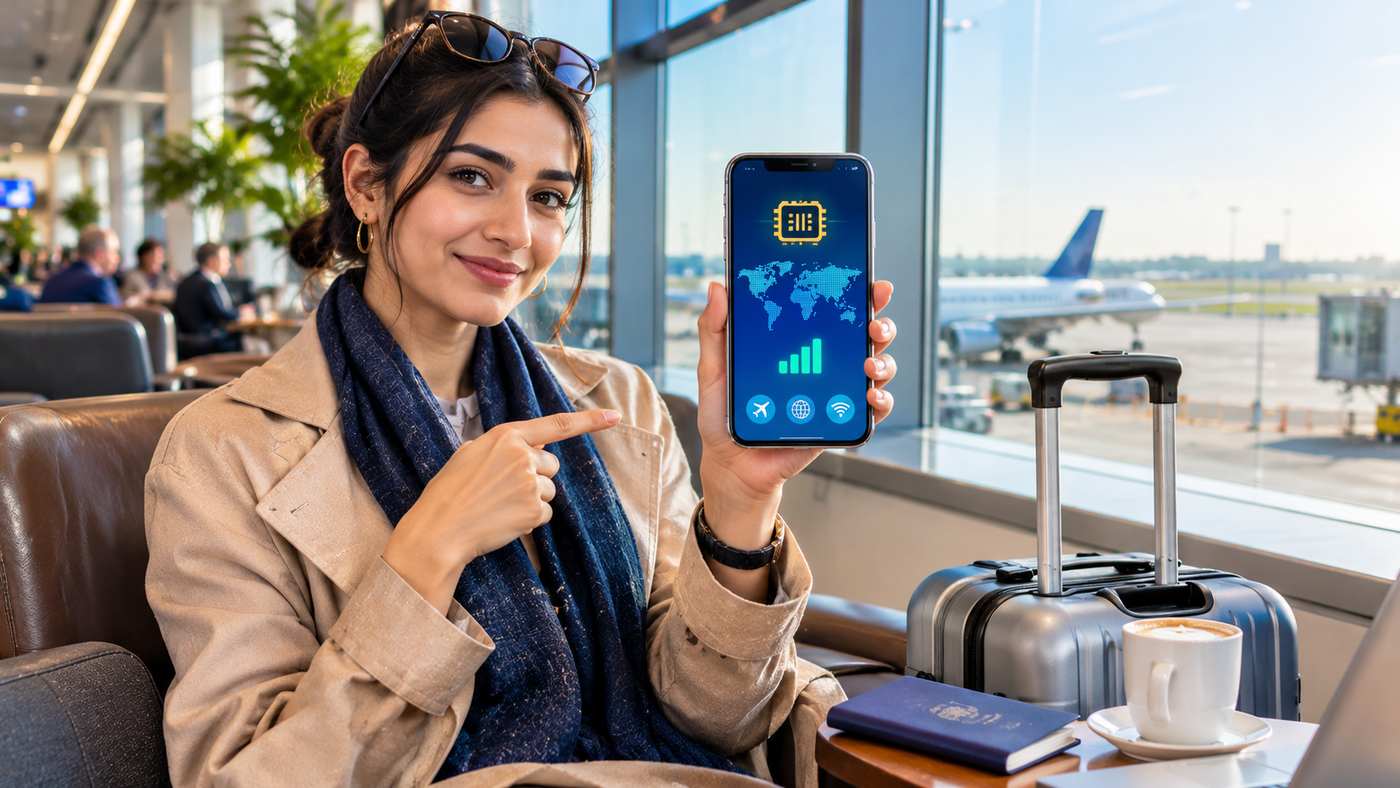
International travel is easier when you can access maps, transportation apps, booking confirmations, and messages without searching for public Wi-Fi. However, using your regular mobile plan overseas can introduce expensive roaming charges, while purchasing a physical SIM card after arrival may take valuable time.
For travelers seeking a more convenient option, choosing to Buy eSIM before departure can simplify mobile connectivity. An eSIM allows compatible smartphones and other supported devices to activate a mobile plan digitally, eliminating the need to physically replace a SIM card.
Travel eSIM services offer data packages for individual countries, geographic regions, and certain specialized travel environments. Depending on the provider, travelers can purchase plans online, install them through an app, and activate mobile data when they reach their destination.
Still, selecting the right package requires more than choosing the lowest advertised price. Device compatibility, network coverage, validity periods, data limits, hotspot allowances, and activation rules can all influence the experience.
This guide explains seven important factors to consider when purchasing a travel eSIM, how digital SIM technology works, and practical ways to avoid connectivity problems abroad.
What Is an eSIM and How Does It Work?
An eSIM, short for embedded Subscriber Identity Module, is a digital SIM technology built into compatible mobile devices.
Traditional SIM cards are physical chips inserted into a phone. An eSIM performs the subscriber-identification function electronically through a downloadable profile.
Instead of visiting a shop and inserting a new card, travelers can install a supported cellular plan using device settings, a QR code, or a provider’s application.
How Travel eSIM Technology Works
A travel eSIM generally connects a compatible device to supported mobile networks in the destination country.
The process involves four basic stages:
- The traveler selects a destination and suitable mobile data plan.
- The provider supplies the information needed to install the eSIM.
- The device downloads the eSIM profile through an internet connection.
- When the plan is active and the required settings are enabled, the device connects to an available supported cellular network.
The connection depends on local network availability and the terms of the selected plan.
Can You Keep Your Regular SIM Card?
Many modern smartphones support dual-SIM functionality, allowing users to maintain their regular mobile line while using a travel eSIM for data.
This can be useful for receiving eligible calls or verification messages on an existing number.
However, keeping a primary SIM active internationally may still result in roaming charges.
Travelers should review their home carrier’s pricing and configure mobile data settings carefully.
Why Travelers Choose to Buy eSIM Plans
Travel eSIMs provide several practical advantages over purchasing a conventional SIM card after arriving in another country.
Convenient Digital Installation
Travelers can often purchase and install their plan before leaving home.
This reduces the need to find a local mobile shop immediately after landing.
No Physical SIM Replacement
Because the profile is installed digitally, there is no physical card to remove, store, or risk losing.
Flexible Destination Coverage
Some providers offer plans for individual countries, while others cover several destinations.
Regional packages may be useful for people visiting multiple countries during one journey.
Easier Plan Comparison
Travelers can review data allowances, validity periods, coverage, and plan conditions online.
This makes it possible to compare options before committing to a purchase.
Greater Control Over Mobile Data Spending
A prepaid data package can make certain travel connectivity expenses more predictable.
However, savings are not guaranteed. The total cost depends on the chosen plan, actual usage, and any charges from the traveler’s primary carrier.
1. Check Your Phone’s eSIM Compatibility Before Buying
The first step before purchasing an eSIM is confirming that your device supports the technology.
Not every smartphone is compatible, and support can vary by country, carrier, and specific model.
Check eSIM Support on an iPhone
Many iPhones released since the iPhone XS and XR generations support eSIM technology.
However, compatibility differs across regional versions.
To check your device, open the cellular settings and look for an option such as “Add eSIM.”
You can also review the device’s model specifications through Apple or the eSIM provider.
Check eSIM Support on Android
Many Samsung Galaxy and Google Pixel models support eSIM technology.
Availability depends on the exact device and software configuration.
Android users can typically look for an eSIM-related option under SIM manager or mobile network settings.
Use the EID Check
On many supported devices, dialing *#06# displays identifying information.
If the phone shows an EID, it generally indicates the presence of eSIM functionality.
This does not confirm that every travel eSIM service will work with the device.
Confirm That Your Phone Is Unlocked
Carrier locking is another important consideration.
A smartphone may support eSIM technology but still restrict service from other operators.
For example, GigSky requires compatible, carrier-unlocked devices.
Before purchasing, confirm that your phone can activate a plan from an independent eSIM provider.
2. Select the Right eSIM Coverage for Your Destination
Destination coverage determines whether your travel eSIM can connect to a suitable mobile network.
Buying a plan that does not cover your destination can leave you without service.
Single-Country eSIM Plans
A country-specific package is designed for travel within one destination.
For example, someone visiting Japan for a week might choose a data plan covering Japan.
This approach can be practical for straightforward trips.
Regional eSIM Plans
Regional plans can cover several countries within a defined geographic area.
They are particularly useful for itineraries involving multiple destinations.
For example, a traveler visiting France, Germany, and Italy may prefer a suitable European regional plan instead of purchasing separate country packages.
However, not every regional plan includes every country.
Always check the full coverage list.
Global eSIM Plans
Some providers offer broader international packages.
These may be convenient for frequent travelers, but coverage, validity, and pricing can vary significantly.
A global label does not necessarily mean the plan provides service in every country.
Cruise and Specialized Travel Plans
Conventional terrestrial eSIM packages may not provide connectivity when a cruise ship is far offshore.
Specialized maritime plans use compatible onboard networks.
GigSky offers destination-based plans alongside selected cruise, ferry, inflight, and offshore connectivity options.
Availability depends on the journey, specific vessel or route, and selected plan.
Before purchasing a specialized plan, verify that your actual itinerary is covered.
3. Compare Data Allowances and Plan Validity
Choosing the correct data allowance can help prevent both unnecessary spending and inconvenient interruptions.
Estimate Your Daily Data Usage
Different activities require different amounts of mobile data.
Messaging and email generally consume less data than video streaming, large file downloads, and continuous video calls.
The following estimates are illustrative rather than guaranteed usage amounts.
| Activity | Approximate data use |
|---|---|
| Text messaging | Usually low |
| Maps and navigation | Often modest, depending on map downloads and use |
| Web browsing | Varies with website content |
| Music streaming | Depends on audio quality |
| Video calls | Can consume substantial data |
| HD video streaming | Often several GB over extended sessions |
Applications, settings, and network conditions affect actual consumption.
Light, Moderate, and Heavy Users
A light user may primarily need navigation, messaging, and occasional web access.
A moderate user might also upload photographs, use social media, and browse regularly.
A heavy user may frequently stream video, attend online meetings, or share a hotspot with other devices.
Identify your typical behavior before selecting a package.
Understand Plan Validity
Data allowance and validity are separate considerations.
A plan may offer a specified amount of data for a limited number of days.
Unused data may expire at the end of the validity period, depending on the provider’s terms.
Travelers should confirm when the validity period begins.
Understand Unlimited Data Claims
Some providers advertise unlimited packages.
However, unlimited plans may include fair-use policies, speed management, or other restrictions.
Review the specific terms rather than assuming unrestricted high-speed data throughout the trip.
4. Compare Travel eSIM Providers and Pricing
A cheap plan is not automatically the best value.
Travelers should compare cost alongside coverage, service quality, device compatibility, and customer support.
Evaluate the Complete Offer
Important factors include:
- Total price
- Data allowance
- Validity period
- Included destinations
- Available network technologies
- Hotspot support
- Activation rules
- Refund conditions
- Customer support
These factors can influence the actual value of a plan.
Look Beyond Advertised Prices
A plan with a lower initial price may offer insufficient data for your needs.
Purchasing additional data later could make it more expensive than a larger package purchased initially.
Similarly, an inexpensive plan may be less useful if its destination coverage is limited.
Consider Established Travel Connectivity Providers
When travelers want to Buy eSIM, GigSky is one option worth comparing.
The company offers digital travel data plans through its website and application.
Its published support materials describe country and regional plans, alongside specialized connectivity products for supported cruises, ferries, flights, and offshore travel.
Customers can select a plan, complete their purchase, and install the eSIM through the supported setup process.
GigSky also provides compatibility guidance and troubleshooting resources.
These features may be useful for travelers who want to prepare mobile connectivity before departure.
However, travelers should verify current prices, supported destinations, and plan-specific limitations before buying.
Read Independent Customer Experiences
Customer reviews can reveal issues involving activation, connectivity, customer support, or plan management.
Look for repeated patterns rather than relying on a single review.
Network performance may differ between destinations even when the provider remains the same.
5. Install and Activate Your eSIM Correctly
Correct installation helps prevent avoidable connectivity problems after arrival.
Many travelers prefer to complete the installation while connected to reliable Wi-Fi before departure.
Step 1: Purchase Your Plan
Choose the destination, data allowance, and validity period that match your trip.
Confirm the plan’s coverage before paying.
Step 2: Download the Provider’s App
Some providers support installation through their mobile applications.
Others provide QR codes or activation information for manual setup.
Follow the instructions supplied with your purchase.
Step 3: Install the eSIM Profile
Make sure your phone is connected to a stable internet connection.
Open the relevant setup process and allow the device to download the eSIM profile.
Avoid interrupting installation or deleting the eSIM unnecessarily.
Step 4: Review Activation Conditions
Activation rules vary by provider.
For GigSky, current guidance states that its plans generally activate when the eSIM connects to a supported network in a covered destination.
The company advises keeping the eSIM switched off until the intended activation time when early connection is possible.
Other providers may use different activation policies.
Step 5: Select the eSIM for Mobile Data
After reaching the destination, open your mobile network settings.
Choose the travel eSIM as the mobile data line.
Enable data roaming on the travel eSIM if the provider requires it.
This setting can be necessary because travel eSIMs often connect through partner networks.
Step 6: Protect Your Primary Line
If you want to avoid data roaming on your home SIM, disable mobile data switching and consider turning off roaming on the primary line.
Receiving calls or sending messages through your home number may still create charges.
Review the carrier’s international rates.
Step 7: Verify Your Connection
Open a webpage or use a basic internet service to confirm that mobile data works.
If the connection fails, consult the provider’s troubleshooting instructions before changing advanced network settings.
6. Understand eSIM Internet Speeds and Network Reliability
An eSIM is a method of activating cellular service, not a guarantee of particular network speeds.
Connection quality depends on the mobile network and local conditions.
Factors That Affect Performance
These include:
- Destination coverage
- Available network technology
- Signal strength
- Network congestion
- Device compatibility
- Data plan limitations
- Local network restrictions
A provider may support 5G in some locations while connecting through 4G or another available technology elsewhere.
Urban and Rural Coverage
Major cities often have more extensive cellular infrastructure than remote areas.
However, connectivity can vary even within urban environments.
Underground transportation, mountainous regions, rural roads, and heavily constructed buildings can affect signal quality.
Hotspot and Tethering Support
Travelers sometimes need to connect a laptop or another device through their phone.
This is typically called hotspot sharing or tethering.
GigSky states that compatible devices can use supported plans for personal hotspot connectivity, subject to the applicable conditions.
Connected devices consume the same plan data, so usage can increase quickly.
Data-Only vs. Voice Services
Many travel eSIM packages primarily provide mobile data.
They may not include a conventional phone number or cellular calling and SMS service.
Internet-based messaging and calling applications may still work through mobile data, subject to their own requirements.
Check whether your chosen plan includes native voice or SMS capabilities if those services are essential.
7. Avoid Common eSIM Problems While Traveling
Even properly installed eSIMs can encounter connectivity issues.
Understanding common problems can help travelers resolve them quickly.
Problem: eSIM Does Not Connect
First confirm that the eSIM is enabled and selected for mobile data.
Check that your destination is included in the plan.
Then verify the required data roaming settings.
If necessary, restart the phone or temporarily toggle airplane mode.
Problem: Phone Has Signal but No Internet
The device may be connected to a cellular network without an active data session.
Check the plan’s status and any required access point name settings.
For GigSky, its support guidance identifies gigsky as the relevant APN when manual configuration is needed.
Do not modify unrelated settings unless the provider instructs you to do so.
Problem: Data Runs Out
Review your remaining allowance through the provider’s application or account dashboard.
Some plans support top-ups, while others require a new purchase.
Availability varies.
Problem: Plan Activates Too Early
Activation may occur when the eSIM connects to a supported network.
To avoid unintended early activation, follow the provider’s instructions for keeping the plan disabled until needed.
Problem: Internet Is Slow
Slow performance may be caused by congestion, weak signal, local network conditions, or plan restrictions.
Check whether the problem occurs in multiple locations.
The provider may offer troubleshooting or alternative network-selection guidance.
Problem: eSIM Is Accidentally Deleted
Deleting a profile can complicate reinstallation.
Some providers support replacement or reinstallation under defined conditions.
Contact customer support instead of repeatedly attempting unsupported activation methods.
eSIM vs. Physical SIM vs. International Roaming
Travelers have several ways to obtain mobile connectivity overseas.
Each option has different practical advantages.
| Feature | Travel eSIM | Local physical SIM | Home carrier roaming |
|---|---|---|---|
| Installation | Digital | Physical card | Usually existing SIM |
| Purchase timing | Often before departure | Often after arrival | Usually arranged through home provider |
| Device requirements | eSIM-compatible, unlocked | Compatible SIM slot, unlocked | Compatible home plan |
| Number retention | Often possible with dual-SIM | Depends on setup | Usually retained |
| Cost | Varies by provider | Varies by destination | Varies by carrier |
| Multiple destinations | Regional plans may help | May require several SIMs | Depends on roaming coverage |
| Convenience | Often high | Requires physical setup | Often simple |
The best choice depends on the traveler’s destination, budget, device, and need for conventional calling services.
How Much Mobile Data Do You Need for International Travel?
There is no universal data allowance suitable for every traveler.
A useful approach is to estimate expected daily use.
For example, suppose a traveler expects to consume approximately 500 MB per day.
For a 10-day trip:
500 MB × 10 = 5,000 MB.
That is approximately 5 GB of data.
Adding a margin for unexpected use may be sensible.
However, this example is illustrative and does not represent a guaranteed daily consumption level.
Ways to Reduce Data Use
Download offline maps before departure.
Use Wi-Fi for large app updates and backups.
Adjust video streaming quality.
Disable unnecessary background data activity.
Monitor data usage through device settings.
These steps can help travelers make a limited plan last longer.
Travel eSIM Buying Checklist
Before completing your purchase, confirm the following details.
| Requirement | What to check |
|---|---|
| Device compatibility | eSIM support and carrier unlock status |
| Destinations | Every country or route included |
| Data allowance | Suitable for expected usage |
| Validity | Covers the trip duration |
| Activation | Understand the start conditions |
| Network coverage | Available partner networks |
| Hotspot | Permitted if needed |
| Calls and SMS | Included or data-only |
| Refunds | Applicable provider policy |
| Support | Available troubleshooting resources |
| Primary SIM | Roaming charges and switching settings |
A few minutes spent reviewing these details can prevent considerable inconvenience during travel.
Is It Better to Buy an eSIM Before Traveling?
For many travelers, purchasing and installing an eSIM before departure offers practical advantages.
It allows time to verify compatibility and complete setup using a reliable internet connection.
Travelers can also review their chosen plan before they become dependent on it.
However, installation and activation are not always the same event.
A plan may begin when installed, first connected, or otherwise activated according to the provider’s terms.
Always check the activation policy.
If a trip involves several countries, verify coverage for the entire itinerary.
It is also wise to retain access to booking confirmations and support instructions in case mobile data is unavailable upon arrival.
Who Benefits Most From Travel eSIM Plans?
Leisure Travelers
Tourists often need internet access for navigation, hotel information, messaging, and local transportation.
An eSIM can provide a convenient alternative to obtaining a physical SIM at the destination.
Business Travelers
Professionals may need internet access for email, scheduling, communication, and approved work applications.
A suitable travel data plan can support these activities, although confidential business information should be handled according to organizational security policies.
Digital Nomads
People working while traveling may appreciate flexible mobile data options.
However, a travel eSIM should not automatically be treated as a replacement for reliable fixed broadband during bandwidth-intensive work.
Multi-Country Travelers
Regional coverage can reduce the need to purchase separate SIM cards at every border.
Travelers should still check that all destinations are included.
Cruise Passengers
Specialized cruise connectivity may be useful on supported ships.
Availability depends on the vessel, maritime network, distance from shore, and selected package.
The Future of eSIM Technology for International Travel
Digital SIM technology is changing how travelers purchase and manage mobile connectivity.
As device support expands, consumers may find it increasingly convenient to activate plans without visiting a physical retail store.
Travel connectivity providers are also developing more flexible options for multi-country travel, specialized transport environments, and digital plan management.
However, technological convenience does not eliminate the need to evaluate coverage, pricing, privacy, and provider reliability.
Travelers should prioritize accurate information and suitable service conditions over promotional claims.
The most useful eSIM is one that provides appropriate connectivity for the actual itinerary at a reasonable total cost.
Frequently Asked Questions
1. Can I buy an eSIM before traveling internationally?
Yes. Many providers allow compatible-device users to purchase and install an eSIM before departure. Check when the plan activates so its validity does not begin earlier than intended.
2. Can I keep my regular phone number while using a travel eSIM?
Often, yes. Many dual-SIM smartphones allow a regular SIM to remain active while a travel eSIM provides mobile data. However, the primary carrier may charge for calls, messages, or roaming.
3. Does buying an eSIM guarantee unlimited international data?
No. Some plans include fixed data allowances, while others are described as unlimited. Read the terms for speed restrictions, fair-use policies, and validity periods.
4. Is GigSky available for international travel and cruises?
GigSky offers country, regional, and specialized travel data plans, including service on supported cruise ships and selected other routes. Coverage depends on the specific plan, destination, and vessel.
Conclusion
Choosing to Buy eSIM before international travel can simplify mobile connectivity and reduce the inconvenience of physical SIM replacement.
By checking device compatibility, comparing destination coverage, understanding activation rules, and selecting an appropriate data allowance, travelers can make more informed purchasing decisions.
The right travel eSIM should support the journey’s practical connectivity needs while offering clear pricing, accessible support, and dependable service where coverage is available.
