
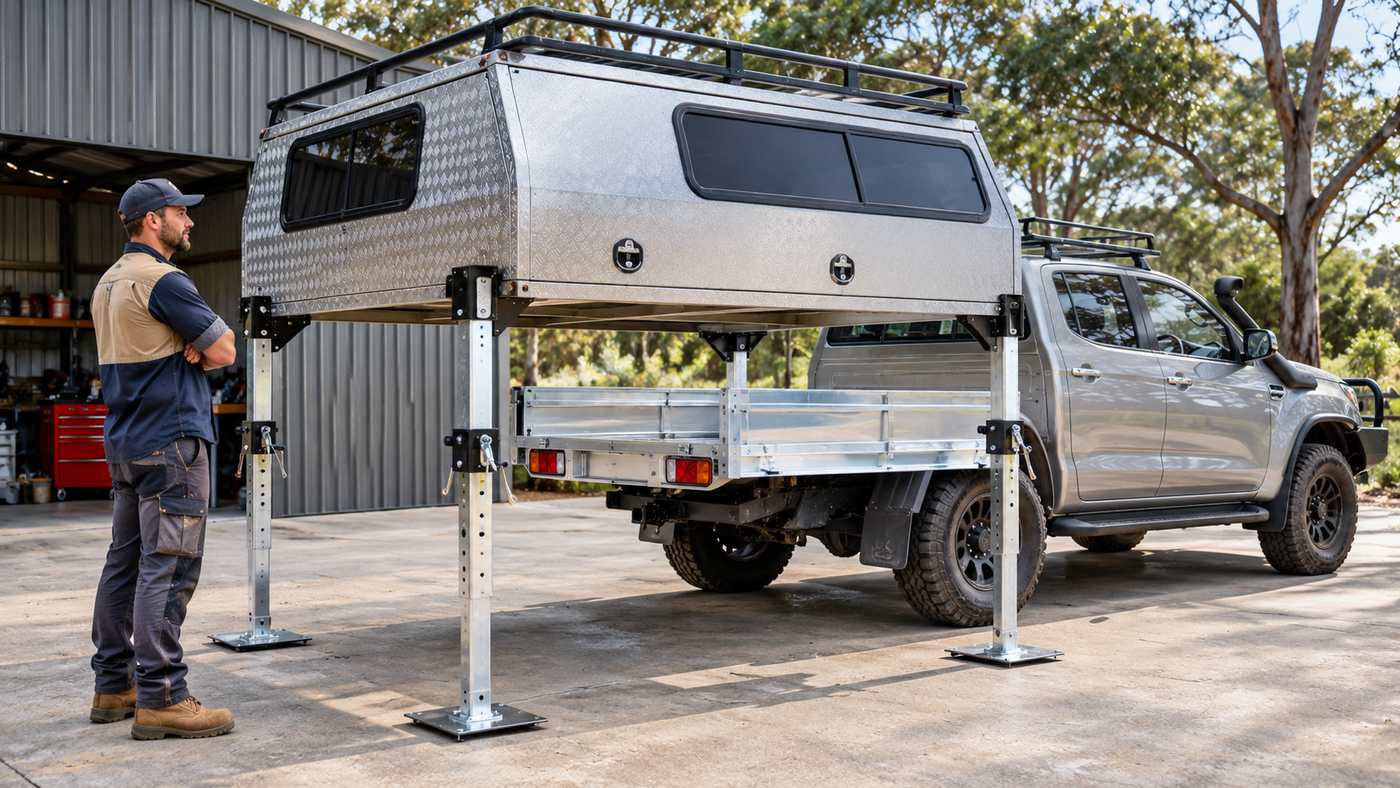
A removable ute canopy provides flexibility for Australian drivers who use their vehicles for different purposes. A tradesperson may need an enclosed storage setup during the working week but prefer an open tray for carrying oversized materials. Similarly, a 4WD enthusiast might want to remove a touring canopy between camping trips.
However, lifting and storing a heavy canopy can be challenging without suitable equipment. Aluminium canopies may contain drawers, shelves, electrical components, storage systems, and other accessories that increase their overall weight.
A Canopy Jack Off Leg Kit provides a purpose-designed support system that can help owners raise and remove a compatible canopy from a ute tray. By supporting the canopy through designated mounting points, the equipment allows controlled lifting and temporary support during removal or installation.
Choosing the correct kit involves more than comparing its advertised lifting capacity. Structural compatibility, mounting dimensions, ground conditions, load distribution, and manufacturer instructions are all essential considerations.
This guide explores seven important factors when selecting canopy jack-off legs in Australia, explains how removable canopy systems work, and outlines practical maintenance, storage, and safety considerations.
What Is a Canopy Jack Off Leg Kit?
A canopy jack-off leg kit is a set of adjustable support legs designed to help lift a compatible removable ute canopy away from the vehicle tray.
The legs connect to designated structural mounting points on the canopy. An appropriate adjustment mechanism raises or lowers the assembly so that the ute can be separated from the canopy.
A typical kit includes four support legs, although components and lifting mechanisms differ between manufacturers.
How Do Canopy Jack-Off Legs Work?
The general principle is straightforward.
Four legs support the canopy near its corners or approved structural attachment points.
The operator adjusts the legs according to the manufacturer’s instructions, raising the canopy enough to create suitable clearance above the ute tray.
Once the canopy is stable, correctly supported, and fully disconnected from the vehicle, the ute can be moved away where the approved procedure permits.
The canopy remains on the support system for the next stage of handling or storage.
However, lifting heavy assemblies presents serious crush and stability hazards. Users must follow the exact instructions for their equipment and avoid working beneath an unsupported canopy.
Who Uses Removable Canopy Systems?
Common users include tradespeople, touring enthusiasts, campers, property maintenance workers, and businesses operating multipurpose utes.
A removable canopy can help these users switch between enclosed storage and an open-tray configuration without permanently committing the vehicle to one arrangement.
1. Check the Canopy Jack Off Leg Kit Weight Rating
Weight capacity is one of the first specifications buyers should examine.
A set of legs must be suitable for the actual load being supported, not simply the empty weight of the canopy shell.
Calculate the Complete Canopy Load
A canopy may include permanently installed or removable accessories such as:
- Internal shelving and drawers
- Electrical equipment
- Batteries and associated mounting hardware
- Tool storage systems
- Lighting accessories
- Roof-mounted equipment
- Spare parts and other stored items
These components can significantly affect the total load.
The weight should be established using reliable manufacturer information or appropriate measurement.
Understand Combined Capacity
Some manufacturers advertise a weight rating for the complete four-leg set.
For example, AP Boxes publishes an approximate combined rating of 2,000 lb, or 900 kg, for its four-leg canopy support kit.
That does not mean each leg individually supports 900 kg.
It also does not establish that an unevenly loaded canopy can safely use the complete nominal rating.
Consider Weight Distribution
The position of batteries, toolboxes, drawers, and other equipment can affect the canopy’s center of gravity.
Uneven loads may create different forces at individual support points.
A properly specified system must account for the complete assembly, including the structural capacity of the canopy’s attachment points.
Do Not Exceed Manufacturer Limits
Overloading can damage legs, mounting points, or the canopy structure.
It may also cause instability or collapse.
Where weight or load distribution is uncertain, obtain guidance from the manufacturer or an appropriately qualified professional before attempting removal.
2. Verify Canopy and Ute Tray Compatibility
Not every removable canopy is compatible with every jack-off leg kit.
Different manufacturers use different mounting arrangements, support structures, and dimensions.
Check Mounting Point Dimensions
The AP Boxes kit uses 30 × 30 mm SHS canopy inserts.
SHS stands for square hollow section.
The product specifies inserts positioned at 200 mm centers.
These dimensions are relevant when determining whether the legs can connect to the canopy’s existing support system.
Confirm Structural Compatibility
Matching the nominal insert dimensions is only part of the assessment.
The canopy must also have mounting points designed to support the relevant lifting and storage loads.
An insert that physically fits does not necessarily prove that the surrounding structure is adequate.
Measure the Ute Tray
Ute trays vary in width, height, construction, and accessory placement.
Check whether the canopy can be raised sufficiently to clear the tray.
Also consider mudguards, toolboxes, side rails, and other components that might interfere with removal.
Consider Vehicle Configuration
The same canopy may behave differently on different vehicle and tray arrangements.
A modified 4WD setup, raised tray, or unusually wide body may create additional clearance requirements.
The equipment supplier should confirm whether the proposed combination is suitable.
Avoid Unapproved Modifications
Do not drill new structural mounting points or modify support legs without appropriate engineering approval.
Unauthorized changes can reduce strength and may affect warranty coverage.
3. Evaluate Construction Quality and Stability
A canopy support system must remain stable under the conditions for which it is designed.
Construction quality, attachment integrity, and base support all matter.
Examine Structural Components
Depending on the kit, important parts may include steel support sections, welded connections, mounting inserts, adjustment mechanisms, pins, and base plates.
Inspect these components for visible damage before use.
Consider the Base Plates
The AP Boxes kit lists 150 × 200 mm base plates.
These provide a defined ground-contact area.
However, plate dimensions alone do not guarantee stability on every surface.
Ground load-bearing capacity and levelness are critical.
Choose Suitable Ground Conditions
Lifting and storage should occur only on a firm, level surface approved by the manufacturer.
Soft soil, loose gravel, slopes, and uneven paving may create instability.
Where load-spreading supports are permitted, they must be appropriately specified and positioned.
Consider Wind Exposure
A canopy can present a substantial surface area to the wind.
Strong gusts may create lateral forces or overturning risks when the canopy is elevated.
Never assume that a kit’s vertical load rating establishes resistance to wind or side loading.
Use the Correct Hardware
Pins, bolts, mounting sections, and other retaining components should be compatible with the specified system.
Missing or damaged hardware must be replaced with approved components.
4. Understand the Benefits of Removable Ute Canopies
A well-designed removable canopy can increase the versatility of a vehicle.
Switch Between Work and Recreation
Many ute owners use the same vehicle for professional tasks and recreational travel.
A removable canopy may allow the tray to be reconfigured for different activities.
Restore Open-Tray Space
Removing a canopy can make the tray available for larger or taller cargo.
This may be useful for transporting building materials or equipment that cannot fit inside an enclosed canopy.
All cargo must still be carried within the vehicle’s permitted dimensions and load limits.
Support Equipment Maintenance
Removing a canopy may provide easier access for cleaning, inspection, or certain maintenance activities.
However, the canopy must remain safely supported throughout any approved work.
Increase Storage Flexibility
When stored correctly, a removable canopy can remain available for future trips or projects.
This may reduce the need for a permanently dedicated canopy-equipped vehicle.
Avoid Assuming Weight Savings
Removing a canopy reduces the vehicle’s carried mass, but the result depends on the weight of the actual canopy and any remaining accessories.
Vehicle load capacity, axle limits, and handling requirements must still be respected.
5. Compare Canopy Jack-Off Legs Available in Australia
Australian buyers can find different jack-off leg systems designed for removable ute canopies.
Models differ in load rating, construction, mounting arrangements, height range, and intended compatibility.
AP Boxes Jack-Off Canopy Legs
Australian Performance Boxes offers a four-leg support kit for compatible canopy systems.
Its published specifications include:
| Specification | AP Boxes advertised details |
|---|---|
| Product | Jack-off Canopy Legs |
| Quantity | Set of four |
| Combined weight rating | Approximately 900 kg |
| Canopy inserts | 30 × 30 mm SHS |
| Insert centers | 200 mm |
| Base plate | 150 × 200 mm |
| Extension to lower insert | 1,200 mm |
| Warranty | 12 months |
| Listed price | AUD $599 |
Pricing and specifications are based on published product information and may change.
Where to Explore the Kit
Buyers looking for a Canopy Jack Off Leg Kit can examine the Australian Performance Boxes product listing.
The company positions the kit as an accessory for compatible removable canopy setups, making it relevant to owners who want flexibility between enclosed storage and open-tray vehicle use.
Its product page provides dimensions, the combined load rating, warranty information, and ordering details.
Before purchasing, confirm that your canopy’s inserts, attachment structure, and physical clearance match the kit’s requirements.
How Other Kits Differ
Other Australian suppliers offer kits with different ratings and height specifications.
For example, some alternative systems advertise a combined capacity of approximately 500 kg and use galvanized steel construction.
These alternatives are not necessarily interchangeable with AP Boxes components.
Always confirm the complete configuration rather than comparing only one measurement.
6. Follow Safe Lifting and Removal Procedures
Canopy lifting presents potentially serious injury risks.
The procedure should always follow the manufacturer’s approved instructions and any relevant professional guidance.
Prepare the Work Area
Before beginning, inspect the floor or ground.
Keep bystanders, children, and animals away from the work zone.
Do not attempt removal in high winds or other unsuitable conditions.
Check the Canopy
Confirm the actual supported weight and inspect the designated mounting points.
Remove loose or unnecessary contents where the manufacturer requires this.
Unsecured items can move and affect stability.
Inspect the Legs
Look for bent sections, cracked welds, damaged threads, missing pins, or other defects.
Do not use damaged equipment.
Follow the Approved Lifting Sequence
A compatible system generally requires the support legs to be properly attached and adjusted according to its specified procedure.
Operators must keep the canopy level and avoid uneven lifting.
Do not improvise a lifting sequence or allow anyone to stand beneath the assembly.
Verify Full Vehicle Separation
Electrical cables, mounting hardware, plumbing connections, and other accessories may connect the canopy to the vehicle.
These must be managed according to the appropriate removal instructions before vehicle movement.
Confirm Stability Before Storage
The support arrangement must be suitable for the intended duration and environment.
Some lifting systems are intended for removal rather than indefinite storage.
Check whether additional bracing or a separate storage stand is required.
Safety reminder: A support leg kit is not automatically a certified lifting device for every canopy. If the process, loading, or support arrangement is uncertain, use qualified assistance.
7. Maintain Your Canopy Jack-Off Legs for Long-Term Use
Regular inspection and maintenance help keep lifting equipment in suitable condition.
Clean After Outdoor Use
Dust, mud, sand, and moisture can accumulate on exposed components.
Clean the equipment using manufacturer-approved methods.
Inspect Metal Surfaces
Look for corrosion, deformation, cracks, and unusual wear.
Pay particular attention to joints and areas surrounding holes or adjustment points.
Check Moving Mechanisms
Adjustment components should operate smoothly without excessive force.
Use only manufacturer-approved lubrication where required.
Store the Legs Correctly
Store equipment in a protected, dry location when not in use.
Avoid stacking heavy items against components that could become bent.
Inspect Before Every Operation
A routine visual inspection can identify obvious damage.
However, visually sound components are not necessarily free of hidden structural defects.
If the equipment has been overloaded, impacted, or damaged, stop using it until appropriately assessed.
Jack-Off Canopy Legs vs. Permanent Canopy Mounting
Both arrangements serve different needs.
| Feature | Jack-off removable canopy | Permanently mounted canopy |
|---|---|---|
| Removal | Possible with appropriate equipment | May require significant disassembly |
| Tray flexibility | Greater potential flexibility | Usually dedicated configuration |
| Additional hardware | Requires compatible lifting/support equipment | May not require removable supports |
| Storage | Needs appropriate off-vehicle space | Remains on vehicle |
| Setup complexity | Removal and reinstallation procedures | Less frequent configuration changes |
| Best suited for | Multipurpose ute use | Consistent enclosed storage needs |
A removable canopy is useful when the vehicle frequently changes roles.
A permanent arrangement may be simpler when the canopy remains installed throughout the year.
How Much Does a Canopy Jack Off Leg Kit Cost?
Prices depend on construction, rated capacity, adjustability, compatibility, and manufacturer.
Australian Performance Boxes currently advertises its four-leg kit at AUD $599, while some other brands list different configurations at lower prices.
A cheaper kit is not necessarily a better choice if it lacks the correct load rating or mounting dimensions.
Additional Costs to Consider
Potential expenses include shipping, approved mounting hardware, any required structural assessment, and suitable storage arrangements.
Buyers should also account for professional assistance where necessary.
Review Warranty Conditions
AP Boxes advertises a 12-month warranty.
Its published conditions distinguish manufacturing defects from damage caused by misuse, improper installation, and other excluded circumstances.
Read the full terms before purchasing.
Common Mistakes When Buying Canopy Jack-Off Legs
Choosing Based Only on Price
An inexpensive system may not support the intended canopy.
Compare the complete specifications first.
Ignoring Actual Canopy Weight
A canopy’s weight can increase considerably with installed accessories.
Use the actual complete load rather than an empty-shell estimate.
Assuming Universal Compatibility
Mounting dimensions and structural requirements vary.
A visually similar kit may not fit safely.
Working on Uneven Ground
Unstable ground conditions can create tipping hazards.
Use only surfaces permitted by the manufacturer’s instructions.
Leaving a Canopy Unsupported
Do not work beneath a suspended canopy or assume that lift legs are suitable for permanent storage without confirmation.
Modifying Mounting Components
Unapproved drilling, cutting, welding, or substitution can compromise structural performance.
Canopy Jack Off Leg Kit Buying Checklist
| Requirement | What to verify |
|---|---|
| Weight rating | Combined capacity and load distribution |
| Canopy weight | Complete installed assembly |
| Insert dimensions | Correct mounting fit |
| Structural mounting | Approved load-bearing points |
| Height and clearance | Suitable for ute tray configuration |
| Base plates | Appropriate support surface |
| Adjustment mechanism | Correct operation and condition |
| Lifting instructions | Available and understood |
| Storage suitability | Approved off-vehicle support |
| Warranty | Coverage and exclusions |
| Supplier | Product-specific technical assistance |
| Total price | Kit, freight, and related costs |
Are Canopy Jack-Off Legs Worth Buying?
The value depends on how frequently a canopy needs to be removed.
For a tradesperson who regularly changes vehicle configurations, a compatible kit may provide meaningful convenience.
For an occasional camper, the benefit may depend on available storage space and the amount of effort required.
If the canopy is almost never removed, the cost and storage requirements may outweigh the practical advantages.
Safety and compatibility should remain the deciding factors.
Frequently Asked Questions
1. What does a Canopy Jack Off Leg Kit do?
A Canopy Jack Off Leg Kit supports the controlled lifting and removal of a compatible ute canopy, allowing the vehicle tray to be used separately when appropriate.
2. How much weight can AP Boxes canopy legs support?
AP Boxes advertises an approximate 900 kg combined rating for its set of four legs. Buyers must also consider individual load distribution, mounting strength, and the manufacturer’s instructions.
3. Are canopy jack-off legs compatible with every ute canopy?
No. Compatibility depends on mounting dimensions, structural design, canopy weight, and clearance. Confirm fitment with the supplier before purchasing.
4. Can a canopy remain on jack-off legs permanently?
Not necessarily. Whether a canopy can remain supported for extended periods depends on the manufacturer’s approved use and the support arrangement. Additional storage equipment may be required.
Conclusion
A Canopy Jack Off Leg Kit can make removable ute canopy systems more practical for Australian 4WD owners, tradespeople, and outdoor enthusiasts.
The right kit must match the canopy’s weight, structural mounting points, dimensions, and intended operating conditions.
By prioritizing compatibility, safe lifting procedures, and regular equipment inspections, owners can make better use of their ute while reducing avoidable handling risks.
