
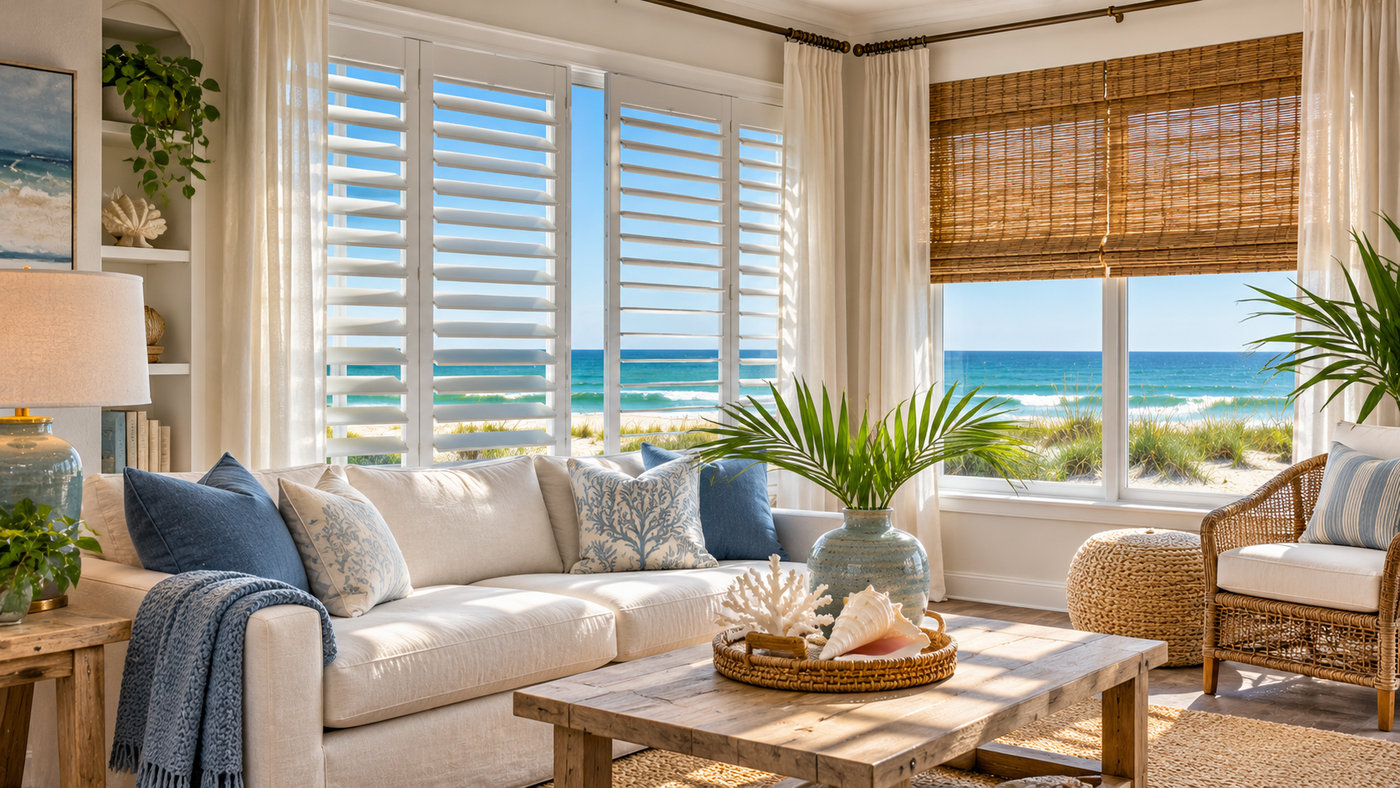
Living near the ocean offers beautiful scenery, natural light, and a relaxed lifestyle. Whether you own a beachfront property, a vacation rental, or a coastal-inspired home, the right interior design choices can make your living spaces more comfortable and visually appealing.
Windows play an especially important role in coastal homes. They connect indoor spaces with the outdoors, provide views of the surrounding landscape, and allow sunlight to brighten rooms throughout the day.
However, coastal environments can also present challenges. Humidity, salt-laden air, intense sunlight, and changing weather conditions may affect furniture, window coverings, and interior finishes.
Choosing appropriate coastal window treatments helps homeowners balance style, privacy, sunlight, moisture resistance, and everyday functionality.
From classic plantation shutters and woven wood shades to modern solar blinds and lightweight curtains, numerous options complement the coastal lifestyle.
The best solution depends on the room, window orientation, environmental conditions, and the materials used.
This guide explores seven practical ways to select window treatments for beach houses, compares popular designs, and explains how to maintain attractive, functional interiors in coastal environments.
What Are Coastal Window Treatments?
Coastal window treatments are blinds, shades, shutters, curtains, and other window coverings selected to complement seaside interiors and address the conditions commonly found in coastal homes.
They often feature light colors, natural-looking textures, simple designs, and materials suited to humidity and sunlight.
However, a coastal appearance does not automatically mean that a product is moisture-resistant.
A natural bamboo shade may look beautiful in a beach house but require more careful placement than a purpose-designed composite shutter.
Why Coastal Window Treatments Matter
Well-chosen window coverings provide several practical benefits.
They help regulate natural light, reduce glare, improve privacy, and contribute to the overall appearance of a room.
Certain products can also reduce unwanted solar heat entering through windows.
For coastal properties, durability is another important consideration.
A window treatment installed near humid air or frequent condensation may need different materials from one used in a dry interior bedroom.
Common Coastal Window Treatment Styles
Popular options include:
- Faux wood plantation shutters
- Composite window shutters
- Solar roller shades
- Woven wood and bamboo shades
- Light-filtering roller blinds
- Linen-look curtains
- Sheer drapery
- Cellular shades
- Layered window treatments
- Exterior-rated patio shades
Each option offers a different balance of light control, privacy, maintenance, and appearance.
1. Choose Moisture-Resistant Materials for Coastal Conditions
Material selection is one of the most important decisions when choosing window coverings for a seaside property.
Coastal homes may experience elevated humidity, occasional condensation, salt particles, and frequent exposure to sunlight.
These factors can affect certain materials over time.
Why Humidity Matters
Excess moisture can contribute to swelling, distortion, mildew, and deterioration in susceptible materials.
Traditional wood products may change dimensions when exposed to repeated humidity fluctuations.
Certain fabrics can also retain moisture if ventilation is poor.
However, the severity of these problems depends on the actual indoor environment and product construction.
Faux Wood Blinds and Shutters
Faux wood products are commonly manufactured using PVC, composite materials, or other engineered formulations.
Selected products are designed to resist moisture better than untreated natural wood.
They can offer the familiar appearance of timber without the same maintenance characteristics.
For a home in Corpus Christi, Port Aransas, or another coastal community, moisture-resistant faux wood shutters may be a practical option.
Always verify the manufacturer’s specifications rather than assuming every product described as faux wood is suitable for extremely humid conditions.
Composite Shutters
Composite shutters can provide a structured appearance and adjustable light control.
Their suitability depends on the material formulation, finish, hardware, and installation environment.
Some composite products are designed for demanding residential conditions.
Aluminum and Synthetic Components
Certain aluminum or synthetic window covering components may also perform well in suitable coastal installations.
However, metal hardware is not automatically immune to corrosion.
Ask about corrosion-resistant fasteners and approved cleaning procedures.
What About Natural Wood?
Natural timber can still be used in coastal interiors when conditions are appropriate.
Protective finishes, ventilation, and routine maintenance may help preserve its appearance.
However, areas regularly exposed to moisture may justify alternative materials.
The best approach is to match the product to the specific room rather than selecting one material for the entire house.
2. Control Strong Sunlight With Solar Roller Shades
Coastal homes often feature large windows designed to capture ocean views.
While this can create bright, welcoming rooms, intense sunlight may also cause glare and unwanted heat gain.
Solar roller shades provide a practical way to moderate daylight.
What Are Solar Shades?
Solar shades use specially designed screen fabrics that filter sunlight entering a room.
Different fabrics offer different levels of visible light transmission, openness, and glare control.
Some allow occupants to continue seeing outdoors while reducing brightness.
Understanding Shade Openness
Solar shade fabrics are often available with different openness factors.
A lower openness percentage generally means the fabric has a tighter weave.
This may reduce incoming light and outward visibility compared with a more open fabric.
However, actual performance also depends on the material, color, and construction.
Preserve Ocean Views
One reason homeowners choose solar shades is the possibility of maintaining a view during daylight hours.
A suitable shade can reduce glare while allowing visibility through the fabric.
However, solar shades do not provide reliable nighttime privacy when the interior is brightly lit.
For bedrooms or private spaces, combine them with another covering if necessary.
Protect Interior Furnishings
Sunlight can contribute to fading and deterioration in furnishings and flooring.
Certain solar fabrics provide UV reduction, but performance varies by product.
Review published technical data rather than assuming every solar shade blocks the same amount of ultraviolet radiation.
Improve Indoor Comfort
Window coverings can help manage solar heat gain.
The U.S. Department of Energy identifies correctly used shades and blinds as potential tools for reducing unwanted heat entering a home.
However, actual savings depend on climate, window construction, shade performance, installation, and operation.
Where Solar Shades Work Best
Solar shades can be suitable for living rooms, dining areas, offices, and large windows facing strong sunlight.
They are particularly useful when preserving the view matters.
3. Add Classic Coastal Character With Plantation Shutters
Plantation shutters are a familiar feature in many beach-inspired homes.
Their horizontal louvers provide a clean architectural appearance while allowing residents to adjust incoming light.
Why Shutters Suit Coastal Interiors
White or softly colored shutters complement neutral walls, wooden furniture, and coastal decorative elements.
They can create a timeless look without requiring elaborate fabric treatments.
Adjustable Light Control
Movable louvers allow homeowners to change the direction and amount of incoming daylight.
This makes shutters useful in rooms where light conditions vary throughout the day.
Better Privacy Control
Closing the louvers can improve privacy compared with leaving a window completely uncovered.
However, privacy depends on the shutter’s construction, fit, and louver position.
Faux Wood vs. Natural Wood Shutters
| Feature | Faux wood or composite | Natural wood |
|---|---|---|
| Coastal appearance | Classic and versatile | Warm, organic appearance |
| Humidity resistance | Often better in suitable models | Depends on finish and environment |
| Maintenance | Generally straightforward | May require more care |
| Material weight | Product-dependent | Product-dependent |
| Color selection | Broad range | Painted and stained options |
| Best use | Humid rooms and practical interiors | Controlled indoor conditions |
The correct choice depends on the actual product rather than the material category alone.
Match Shutters With Room Design
White shutters can work with pale blue walls and sandy neutrals.
For a contemporary coastal home, soft gray or warm ivory may create a more understated appearance.
Consider the window frame, surrounding trim, and existing furniture before selecting a finish.
4. Create Natural Texture With Woven Wood Shades
Coastal decorating often draws inspiration from nature.
Materials such as bamboo, grasses, reeds, and jute can introduce texture and warmth into an otherwise simple room.
Woven wood shades are particularly popular in relaxed beach-inspired interiors.
What Are Woven Wood Shades?
Woven wood shades are manufactured using natural or natural-looking materials arranged into a flexible window covering.
Depending on their construction, they can create filtered light and an organic visual effect.
Why They Work in Coastal Rooms
Natural textures pair well with linen upholstery, rattan furniture, wooden flooring, and soft neutral colors.
For example, a warm bamboo shade can provide contrast against a white wall.
This combination can make a coastal living room feel inviting without adding excessive decoration.
Consider Light Filtering
The amount of light entering through a woven shade depends on its weave.
An open weave may allow considerable light and visibility.
A tighter weave may create more coverage.
For greater privacy, some products offer optional liners.
Be Careful With Moisture
Woven wood shades may be attractive in seaside homes, but natural fibers are not universally moisture-proof.
Some materials can be affected by condensation, repeated dampness, or poor ventilation.
Avoid placing delicate natural shades where they will experience regular direct wetting unless the manufacturer specifically approves that use.
Choose a Coordinated Color
Popular coastal tones include natural beige, pale tan, warm brown, driftwood gray, and soft cream.
A suitable texture can provide visual interest without overwhelming the rest of the room.
5. Explore Coastal Window Treatments With Budget Blinds
Choosing between shutters, shades, blinds, and drapes can be difficult, especially when a home has several window sizes and different room requirements.
Professional guidance may help homeowners compare materials, operating systems, and installation options.
Budget Blinds of Greater Corpus Christi
Homeowners researching coastal window treatments can explore the coastal design guide published by Budget Blinds of Greater Corpus Christi, Texas.
The article discusses the practical considerations of living near the ocean, including sunlight, privacy, humidity, and interior styling.
It recommends several options, including faux wood shutters, woven wood shades, solar shades, and drapery.
The guide also explores layered treatments and motorized operation.
Coastal Design Services
Budget Blinds of Greater Corpus Christi offers custom window blinds, shades, shutters, and drapery.
Its local service website advertises in-home design consultations, window measurement, and professional installation.
These services may be useful for homeowners seeking window coverings tailored to unusual window dimensions or specific design requirements.
Areas Served
The Greater Corpus Christi location serves several communities along the Texas Coastal Bend.
These include Corpus Christi, Padre Island, Port Aransas, Portland, Rockport, and other surrounding areas within the franchise’s service territory.
Window Treatment Consultation
A consultation can help homeowners compare sample materials and evaluate how they perform in actual rooms.
Useful questions include whether a product is rated for humid environments, whether the fabric provides nighttime privacy, and which cleaning methods are recommended.
Warranty Considerations
Budget Blinds advertises a No-Questions-Asked warranty on many qualifying window treatments.
The published program describes a one-time repair or replacement benefit during the first five years for eligible products, subject to exclusions and conditions.
Not every product or component receives identical coverage.
Customers should verify the applicable manufacturer, product eligibility, installation charges, and warranty terms before purchasing.
Compare Individual Products
An experienced provider can explain available options, but homeowners should still make decisions based on verified materials, pricing, functionality, and maintenance requirements.
A product that suits a coastal living room may not be ideal for a bathroom, kitchen, or exposed patio.
6. Layer Curtains and Shades for Better Style and Privacy
Layered window treatments combine two or more coverings to provide greater flexibility.
For example, homeowners might install solar shades inside the window recess and decorative curtain panels outside the frame.
This arrangement allows different levels of light and privacy control.
Sheer Curtains for a Soft Coastal Look
Lightweight curtains can create a bright, relaxed appearance.
White, ivory, pale blue, and sandy beige fabrics are common choices.
Their movement and texture can soften the straight lines of modern windows.
However, sheer curtains alone usually offer limited nighttime privacy.
Blackout Curtains for Bedrooms
Bedrooms may benefit from room-darkening or blackout materials.
These can help reduce unwanted light, although small gaps around the edges may allow some illumination.
A well-designed installation should consider both fabric performance and the surrounding window frame.
Pair Solar Shades With Drapery
Solar shades can provide daytime glare control while heavier curtains create more privacy after sunset.
The combination may be particularly useful in beach houses with large windows.
Combine Woven Shades With Light Curtains
Woven shades add natural texture.
Soft curtains can provide a complementary layer and help create a more finished interior.
However, the combined weight and mounting requirements should be considered.
Coastal Colors and Patterns
A coastal palette does not need to rely exclusively on bright blue and white.
Other options include:
- Sand and cream
- Warm ivory and driftwood gray
- Muted seafoam green
- Soft navy and natural beige
- Pale turquoise accents
- Subtle nautical stripes
Choose colors that complement the existing room rather than competing with flooring and furniture.
Avoid Overdecorating
Layered window treatments work best when each component has a clear purpose.
A heavily patterned curtain combined with a busy woven shade may make the room feel cluttered.
Balanced proportions and restrained colors often create a more timeless appearance.
7. Prioritize Installation, Child Safety, and Long-Term Maintenance
Even high-quality window treatments can perform poorly when incorrectly measured, installed, or maintained.
Coastal homeowners should consider how coverings will operate and how they will be cared for over time.
Measure Windows Carefully
Measure the width and height according to the manufacturer’s requirements.
Check whether the product will be installed inside or outside the window frame.
An inside-mounted shade may require a minimum recess depth.
Different products can have different measurement rules.
Consider Professional Installation
Professional installers can help position brackets correctly, evaluate mounting surfaces, and confirm that the treatment operates as intended.
This may be particularly useful for large windows, motorized systems, and custom shutters.
Choose Cordless Options for Child Safety
The U.S. Consumer Product Safety Commission recommends cordless window coverings in homes where young children are present.
Accessible operating cords can create serious strangulation hazards.
Choose properly designed cordless products rather than assuming that tying cords out of reach eliminates the risk.
Explore Motorized Window Treatments
Motorization can make coverings easier to operate, especially across tall or difficult-to-reach windows.
Some systems offer remote controls, timers, or smart-home integration.
However, compatibility and available functions vary.
Clean Salt and Dust Deposits
Fine particles can accumulate on window coverings in coastal environments.
Regular cleaning may help preserve the appearance of appropriate materials.
Follow the manufacturer’s instructions for dry dusting, wiping, or other cleaning methods.
Avoid soaking materials not designed to become wet.
Check Hardware and Mountings
Inspect brackets, screws, moving parts, and operating mechanisms periodically.
In coastal environments, pay attention to corrosion and moisture exposure.
Understand Exterior Treatment Limits
Outdoor-rated patio shades may be designed to tolerate more environmental exposure than ordinary indoor products.
However, exterior window coverings are not automatically hurricane shutters.
In storm-prone coastal areas, homeowners should use properly rated protective systems where required.
Decorative interior window treatments should never be relied upon for hurricane impact protection.
Best Coastal Window Treatments for Different Rooms
Different rooms have different priorities.
| Room | Suitable options | Main consideration |
|---|---|---|
| Living room | Solar shades, shutters, layered drapes | Sunlight and views |
| Bedroom | Blackout curtains, room-darkening shades | Privacy and sleep comfort |
| Bathroom | Suitable moisture-resistant shutters or blinds | Humidity and cleaning |
| Kitchen | Easy-clean blinds or suitable synthetic shades | Moisture and maintenance |
| Dining room | Woven shades, light drapery | Texture and atmosphere |
| Home office | Solar roller shades | Screen glare |
| Covered patio | Exterior-rated roller shades | Weather exposure |
These are general recommendations.
Product specifications and the actual room environment should determine the final choice.
Coastal Window Treatments and Energy Efficiency
Window coverings can influence indoor comfort by controlling sunlight and reducing certain forms of heat transfer.
The Department of Energy recognizes that properly used blinds and shades can reduce unwanted solar heat gain.
However, energy performance depends on the product and installation.
Cellular Shades
Cellular shades contain pockets that can help reduce heat transfer through a window.
Selected designs may be useful where insulation is a priority.
However, fabric suitability for humid locations should also be considered.
Solar Shades
Solar shades are commonly selected to reduce glare and solar exposure.
Their effect on indoor temperature varies according to fabric characteristics and window orientation.
Drapery
Appropriate curtains can contribute to thermal comfort, especially when installed with suitable coverage.
Heavy fabrics do not automatically provide superior performance without considering their construction and fit.
Operate Coverings Strategically
During hot sunny periods, closing suitable coverings on strongly exposed windows may help reduce unwanted heat gain.
When outdoor conditions are comfortable, adjusting shades can allow useful natural light.
The best operating strategy varies by climate and season.
How Much Do Coastal Window Treatments Cost?
The cost of window coverings varies by size, material, brand, customization, operating mechanism, and installation.
A standard roller shade is generally a different purchase from custom plantation shutters covering a large bay window.
Main Pricing Factors
Important considerations include window dimensions, product material, fabric choice, hardware quality, motorization, and installation requirements.
Unusual window shapes can also affect price.
Compare Total Project Cost
A quotation should identify the number of windows, product specifications, installation, controls, and other charges.
Avoid comparing prices based only on the cost of one sample window.
Consider Long-Term Value
A lower-priced covering may be appropriate for a dry guest room.
For windows frequently exposed to condensation or difficult cleaning conditions, a suitable moisture-resistant product may offer better practical value.
However, a higher price does not guarantee greater durability.
Request an Itemized Quotation
For a whole-home project, ask the installer to identify each window treatment separately.
This makes it easier to understand the cost of different materials and prioritize rooms.
Common Mistakes When Choosing Beach House Window Coverings
Selecting Natural Wood for Every Room
Natural timber can look beautiful but may not be appropriate for every high-humidity location.
Choose materials according to the environment.
Ignoring Nighttime Privacy
A solar shade that provides daytime visibility to the outside may allow people to see indoors at night.
Consider additional privacy layers.
Assuming All Shades Offer the Same UV Protection
UV reduction varies by fabric and product specifications.
Check technical information before purchasing.
Choosing Curtains Without Considering Moisture
Some delicate fabrics may be difficult to maintain in humid or poorly ventilated spaces.
Forgetting About Child Safety
Accessible window covering cords present a serious risk.
Cordless products are the preferred option where young children may be present.
Skipping Accurate Measurements
Incorrect sizing can lead to light gaps, poor operation, or installation problems.
Using Indoor Products Outdoors
An indoor blind should not be assumed suitable for direct exposure to wind and rain.
Coastal Window Treatment Buying Checklist
| Requirement | What to verify |
|---|---|
| Material | Suitable for expected humidity |
| Sun control | Appropriate glare and UV performance |
| Privacy | Daytime and nighttime needs |
| Window size | Accurate custom measurements |
| Color | Matches coastal interior palette |
| Cleaning | Practical maintenance requirements |
| Hardware | Appropriate corrosion resistance |
| Operation | Cordless, manual, or motorized |
| Safety | Meets applicable requirements |
| Installation | Correct mounting and fit |
| Warranty | Coverage and exclusions |
| Price | Complete installed cost |
Coastal Window Treatment Design Trends
Coastal interior design continues to emphasize natural light, comfortable materials, and relaxed styling.
Neutral palettes remain versatile because they work with natural wood, woven accessories, and ocean-inspired colors.
Layered window treatments allow homeowners to create different lighting conditions without sacrificing the overall design.
Simple roller shades can complement contemporary coastal homes, while shutters provide a more traditional architectural look.
Woven materials add texture, although they should be used in environments suited to their actual construction.
Motorized options may also appeal to homeowners seeking convenient control over larger window areas.
However, trends should not take priority over durability and everyday usability.
A timeless coastal home combines attractive design with products that suit the environment.
Frequently Asked Questions
1. What are the best coastal window treatments for beach houses?
Faux wood shutters, suitable composite blinds, solar shades, woven wood shades, and lightweight curtains are popular choices. The best option depends on moisture exposure, privacy needs, sunlight, and room design.
2. Are faux wood shutters good for coastal homes?
Many faux wood and composite shutters offer moisture resistance that makes them suitable for certain coastal interiors. However, homeowners should verify the specific product’s environmental ratings and maintenance requirements.
3. Do solar shades provide privacy at night?
Not reliably. Solar shades may reduce visibility from outside during the day, but indoor lighting can make rooms visible after dark. Additional curtains or privacy coverings may be necessary.
4. How do I choose coastal window treatments for humid rooms?
Prioritize materials rated for moisture exposure, suitable hardware, easy maintenance, and proper installation. Avoid delicate natural fibers in areas with persistent condensation unless approved by the manufacturer.
Conclusion
Choosing the right coastal window treatments helps create a beach home that feels bright, comfortable, practical, and visually connected to its surroundings.
Faux wood shutters, solar shades, woven textures, and layered curtains each provide different advantages for coastal living.
By considering humidity, sunlight, privacy, installation quality, and long-term maintenance, homeowners can select window coverings that complement their interior design and perform appropriately in seaside conditions.
