
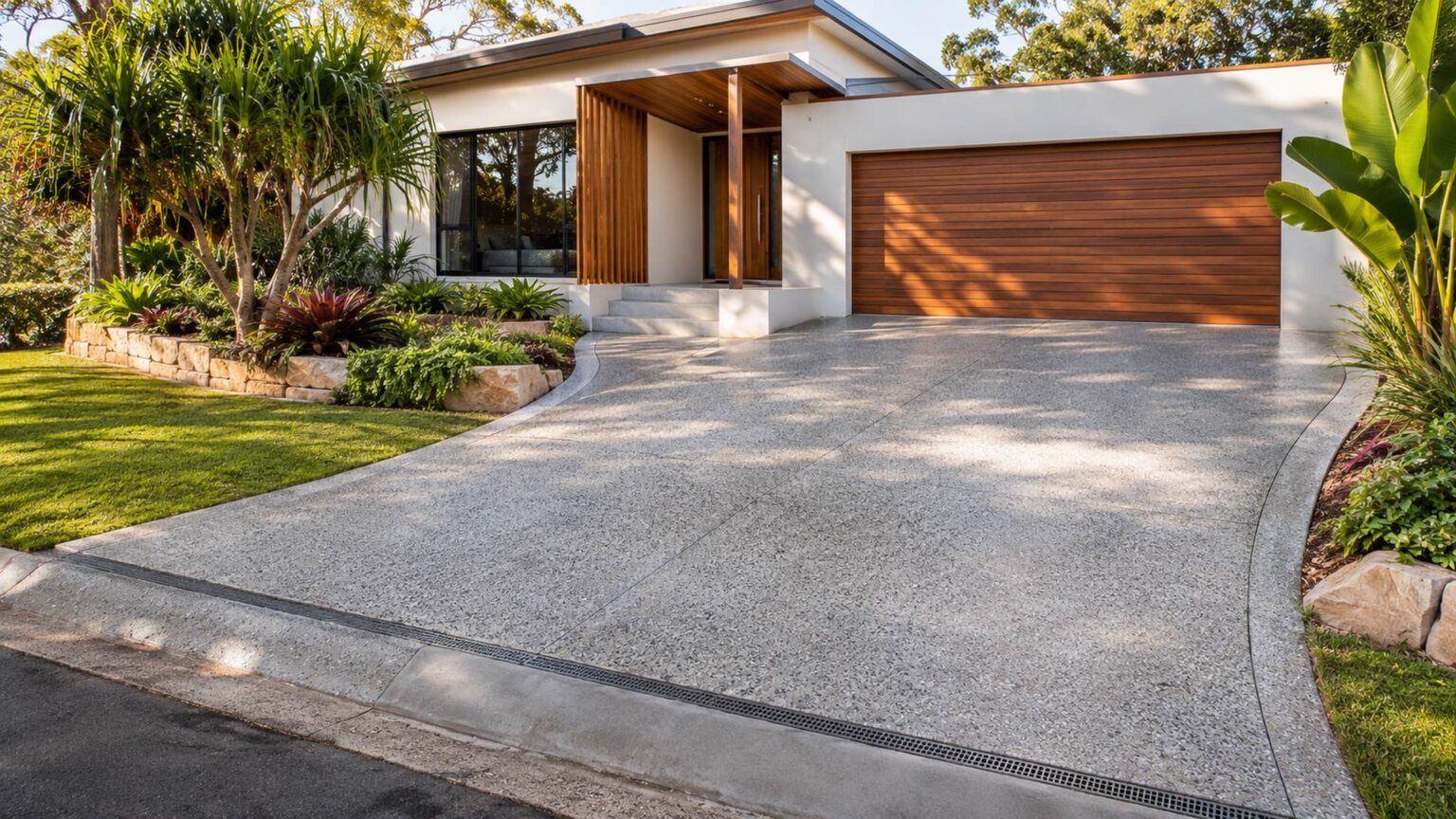
A concrete driveway can improve daily access, create a tidy entrance and complement the design of a home. Yet a good result depends on much more than the colour of the finished surface. Soil conditions, drainage, slab design, reinforcement, joints and curing all influence how the pavement performs. For homeowners in Brisbane and surrounding parts of Queensland, the climate and the rules for vehicle access also deserve attention. This guide explains the practical decisions that matter before, during and after construction.
The best approach is to decide how the driveway will be used, assess the site and obtain a detailed plan before concrete arrives. A sound foundation and a carefully managed pour cannot be replaced by an attractive decorative finish.
Why Concrete Works for Residential Driveways
Concrete provides a firm surface for vehicles and pedestrians when the pavement is designed for its intended loads. It can be shaped to fit straight entries, curved approaches and parking areas. Surface options range from a simple broom texture to exposed aggregate and coloured finishes.
A correctly designed concrete driveway can provide years of useful service, but no slab is completely immune to cracking, movement or staining. Workmanship, ground movement, weather and maintenance all affect the outcome. Understanding these limitations makes it easier to compare quotes and set realistic expectations.
15 Practical Tips for a Better Concrete Driveway
1. Identify How Vehicles Will Use the Space
Start with the vehicles that will enter and park. A family car places different demands on the pavement from a delivery vehicle, caravan or heavy utility vehicle. Think about turning movements, reversing space, garage entry and whether vehicles may stop on the same area regularly.
A concrete driveway that looks wide enough on a drawing may feel awkward once cars, landscaping and gates are in place. Ask the contractor to check the usable width and turning path rather than measuring only the distance between boundary lines.
2. Check Access Rules Before Designing the Crossover
The section connecting a property to the road is often called the vehicle crossing or crossover. It may pass across a footpath or public verge, so it is not necessarily treated the same way as paving entirely within a private property.
In Brisbane, proposed construction or changes to the vehicle crossing can require council approval and must satisfy applicable technical requirements. Confirm the approval pathway, dimensions and responsibilities before scheduling work. A contractor should distinguish clearly between the private driveway and the public access section in the quote.
3. Investigate Soil and Existing Ground Conditions
The stability of the ground beneath a concrete driveway is fundamental. Soft fill, poorly compacted soil, old tree roots and hidden trenches can contribute to uneven settlement. An existing driveway may conceal problems that become visible only after demolition.
Ask how the contractor will assess the subgrade and respond to unsuitable material. Where ground conditions are difficult or vehicle loads are unusual, a qualified designer may need to specify a suitable pavement arrangement. Simply pouring extra concrete over weak ground does not guarantee a stable result.
4. Allow for a Properly Prepared Base
After excavation, the supporting ground should be shaped and compacted to the required condition. Some designs use a prepared granular layer, while others follow a different approved detail based on the substrate.
The key issue is consistency. Pockets of loose material beneath the pavement can allow sections to move differently under load. Request an explanation of the proposed preparation, including excavation depth, removal of unsuitable material and compaction checks where required.
5. Design Drainage Before Selecting the Finish
Water must have a lawful, practical route away from the pavement and nearby buildings. A concrete driveway should not direct runoff toward the home, create persistent puddles or send water onto neighbouring property inappropriately.
A sloping block may require careful transitions, grated drains or other stormwater details. Driveway drainage should connect with the property’s broader water management plan. During design, identify where rain will travel during a heavy downpour, not only where it sits on a dry day.
Avoid an Attractive but Ineffective Slope
An almost flat surface may look neat but hold water if falls are poorly formed. Conversely, excessive grades can cause low vehicles to scrape at the street or garage transition. The right profile balances drainage, vehicle clearance, access requirements and local conditions.
6. Confirm Thickness for the Intended Loads
There is no sensible universal slab thickness for every site. A concrete driveway design depends on subgrade support, expected vehicles, concrete specification, reinforcement and relevant standards. A light residential entry and a driveway regularly used by heavy vehicles may require different designs.
Ask the installer to identify the proposed thickness on the quotation or drawing. If the answer is simply that every job uses the same slab, request a more detailed explanation. Specifications should be selected for the actual project rather than copied from a nearby property.
7. Discuss Reinforcement and Its Limitations
Steel mesh or another specified reinforcement arrangement can help manage crack widths and pavement behaviour when placed correctly. It does not make concrete immune to cracking, nor can it compensate for poor soil preparation.
Reinforcement should be supported at the intended position within the slab, with appropriate cover. Mesh left lying on the ground is not equivalent to mesh installed to the design. Ask who checks its placement before the pour begins.
8. Plan Control Joints and Isolation Details
Concrete shrinks as it hardens, and movement can produce cracks. Planned control joints help encourage cracks to form in less disruptive locations. Isolation joints separate the pavement from structures or other rigid elements where movement should not be restrained.
Joint positions should account for corners, changes in width, drainage features and the layout of the house. Ask for a joint plan before pouring. Randomly cutting lines after cracks have appeared is not an effective substitute for proper joint design and timing.
9. Choose a Finish That Suits Safety and Style
A broom finish offers a practical textured surface often chosen for everyday vehicle access. Exposed aggregate reveals decorative stone within the concrete and can complement gardens, brickwork and contemporary facades. Coloured concrete introduces another design option.
No finish is automatically slip proof. Surface texture, slope, water, footwear and wear all affect traction. Ask to view real examples of the finish in outdoor light and consider how easily it can be cleaned. Highly smooth surfaces may be less suitable in places exposed to rain.
10. Consider Heat, Shade and Surrounding Materials
Brisbane driveways can receive strong sunlight, while trees and buildings may create sharply different shaded areas. Darker surfaces often feel hotter in direct sun than lighter ones, although actual temperatures depend on material and conditions.
Match the chosen colour with the garage, roof, paths and landscaping. Test samples outdoors rather than relying entirely on photographs. Also consider nearby roots, irrigation lines and garden beds, which can affect drainage or future access for repairs.
11. Check Levels at the Garage and Footpath
A concrete driveway must meet existing surfaces without awkward steps or scraping points. Garage thresholds, footpaths, kerbs and gates create fixed reference points that shape the final pavement levels.
Before installation, ask for the proposed finished heights at these transitions. A small error can leave water moving toward the garage or cause vehicle clearance problems. It is far easier to correct the design before concrete is placed than after the slab has hardened.
12. Plan Site Access and Concrete Delivery
Concrete placement is time sensitive. A site with narrow access, steep ground or limited truck parking may require a pump or a different delivery method. Neighbours, parked cars, overhead obstacles and public pathways can complicate the work.
Confirm how the crew will bring concrete to the site, protect nearby surfaces and manage pedestrians. Consider where excavated material will go and whether vehicles need to be parked elsewhere during the project. Good logistics reduce pressure on the finishing crew.
13. Protect Fresh Concrete During Curing
Curing helps concrete develop strength and reduces harmful early moisture loss. The required method and duration depend on the specified concrete, weather conditions and construction requirements. In warm, windy conditions, unprotected surfaces can dry too quickly.
Ask which curing method the contractor will use and how the slab will be protected from rain, heat and early traffic. Drying and curing are not the same process. Do not assume that a firm surface is ready to carry vehicle loads just because it can be walked on.
When Can You Drive on New Concrete?
Follow the concrete supplier’s and contractor’s instructions for the actual mix, thickness, conditions and intended vehicle. Early pedestrian access and safe vehicle access may be permitted at different times. A heavy vehicle may require more caution than an ordinary car.
14. Compare Quotes by Scope Rather Than Price Alone
Two estimates may describe very different work. One may include removal of old pavement, drainage alterations, reinforcement, sealing and disposal, while another covers only placement of new concrete on a prepared site.
Request an itemised scope describing area, excavation, base preparation, slab specification, joints, finish, access equipment and site cleanup. Clarify whether tax and any council related work are included. A transparent quote makes changes easier to assess and reduces surprises after construction begins.
15. Establish a Realistic Maintenance Routine
A concrete driveway requires less attention than many landscaping features, but it still benefits from basic care. Remove leaves and dirt, deal with spills promptly and inspect joints and drainage points after heavy rainfall.
If a sealer is used, ask what product has been applied and when it should be reviewed or renewed. Avoid assuming that every concrete surface needs the same cleaning or sealing schedule. Maintenance should match the finish and the conditions of the property.
What Happens During Concrete Driveway Installation?
Understanding the sequence helps homeowners recognise why preparation matters. Contractors may organise stages differently, but a typical project includes inspection, marking out, excavation, preparation of the supporting ground, formwork, reinforcement, pouring, finishing and curing.
Site Setout and Excavation
The installer identifies the driveway boundaries and checks the intended levels. Existing surfaces are removed where necessary, and the ground is prepared for the approved pavement design. Underground services and drainage infrastructure must be considered before excavation.
Formwork and Reinforcement
Forms define the slab edges and surface levels. Specified mesh, chairs, joints and other components should be checked before pouring. At this stage, the team should also confirm where stormwater will go and how the driveway meets the property entrance.
Pouring and Finishing
Concrete is placed, compacted and finished using methods appropriate to the chosen surface. The crew must work within the available time while maintaining levels and the intended texture. Conditions can change quickly in hot weather, so the pour needs an organised schedule.
Curing and Handover
The new surface is protected while it gains sufficient strength. The contractor should advise when pedestrian and vehicle traffic are allowed, how to clean the finish and what to watch for during the first weeks. Keep the written specifications and warranty information for future reference.
Concrete Driveway Costs in Brisbane: What Affects a Quote?
The cost of a concrete driveway varies with the size of the area, access, existing ground conditions and chosen finish. Decorative exposed aggregate can involve different materials and labour from basic broom finished concrete. Demolition, disposal and difficult drainage can also change the final price considerably.
A very low square metre rate may exclude excavation, reinforcement, access machinery or work at the road crossing. Ask for the total installed cost and which assumptions could lead to variations. For complicated sites, an inspection is more reliable than a quote based only on a photograph.
Comparing a New Slab With Resurfacing
A sound existing slab may sometimes be suitable for a decorative resurfacing system. However, resurfacing does not solve serious structural movement, unsuitable drainage or a failing base. Before approving a coating, have cracks and surface defects assessed so the underlying cause is understood.
A Practical Budget Example
Imagine two homes with driveways of similar area. One has clear truck access and stable ground, while the other needs removal of old paving, changes to levels and additional drainage. Their installed prices can differ substantially even if both homeowners choose the same finish. Request site specific estimates rather than applying one generic rate to every property.
How to Evaluate a Concrete Contractor
Look for experience with residential driveways of similar size and complexity. Ask to see completed work showing the type of finish you want, preferably after it has been exposed to normal weather and use. Confirm applicable licensing or registration requirements for the work and clarify who handles approvals.
Questions to Ask Before Signing
Ask who prepares the subgrade, how reinforcement and joint layout are determined, and what curing method will be used. Check whether the crew will manage the crossover separately from the private driveway. Request a written process for unexpected ground conditions and changes to the agreed scope.
What Should Be in the Written Agreement?
The agreement should identify the dimensions, finish, site preparation, drainage scope, payment stages, timing assumptions, exclusions and any warranty terms. It should also explain cleanup and how defects or disputes will be handled. A clear agreement is more useful than a vague promise of a perfect result.
Concrete Compared With Pavers and Asphalt
Choosing the surface material is another part of planning. Concrete forms a largely continuous pavement interrupted by designed joints, while individual pavers offer separate units that may be lifted and replaced when necessary. Asphalt provides a different appearance and repair approach, but its suitability depends on traffic, climate and surface temperatures.
A concrete driveway can suit homeowners who want a defined finish with limited movement between individual units. Pavers may appeal when intricate patterns or access to buried services is important. Asphalt may be considered for some larger areas, although the preferred option depends on the site and applicable requirements.
Think About Repairs Before Choosing a Material
Imagine that a plumbing connection beneath the entrance needs attention in several years. Individual pavers may be removed and reinstated, whereas a concrete slab could need cutting and patching. That does not make one material universally better. Compare expected use, repair access, drainage, appearance and total project cost before selecting the surface.
Common Driveway Problems and What They Mean
Small cracks can arise from normal concrete shrinkage, while wider or moving cracks may point to settlement, restraint or other issues. Persistent puddles suggest a level or drainage problem. Dusting, scaling and patchy colour can have several possible causes, including finishing conditions and curing.
Do not attempt to diagnose a structural issue from a photograph alone. Record when the problem appeared, note whether it changes and seek appropriate assessment. Some cosmetic variation is normal, but rapidly worsening defects need attention.
Can a Damaged Driveway Be Repaired?
Local repairs may be possible for isolated defects. Where significant movement, base failure or poor drainage affects a wide area, replacing part or all of the slab may be more suitable. The correct concrete driveway repair follows the cause, not simply the appearance of the crack.
Frequently Asked Questions
1. How long does a concrete driveway last?
Service life depends on the design, ground conditions, traffic, climate and maintenance. A well constructed driveway can remain useful for many years, but no fixed lifespan is guaranteed.
2. What is the best finish for a concrete driveway?
Broom finishes offer practical texture, while exposed aggregate and coloured concrete provide other visual options. Choose based on traction, maintenance and the style of the property.
3. Does a new driveway need council approval in Brisbane?
Building or changing a vehicle crossing between the road and property may require council approval. Confirm the rules and technical details for your exact site before work begins.
4. How soon can I park on newly poured concrete?
The safe waiting period depends on the concrete mix, curing conditions and vehicle weight. Follow the contractor’s written instructions rather than relying on a universal number of days.
5. Will reinforcement stop concrete from cracking?
No. Reinforcement can help control crack behaviour when correctly designed and positioned, but concrete can still shrink and move. Proper joints and ground preparation remain essential.
6. Is exposed aggregate harder to maintain than plain concrete?
Care depends on the finish and any sealer used. Both surfaces need suitable cleaning, and decorative finishes may have additional product specific maintenance requirements.
Conclusion
A successful concrete driveway begins with thoughtful planning rather than the final decorative coat. Ground preparation, practical drainage, suitable slab design, controlled joints and proper curing all influence how the finished surface performs. Homeowners should compare detailed quotes, check local access requirements and choose a finish that balances appearance with everyday use. With good workmanship and straightforward maintenance, a driveway can remain a useful and attractive part of the property for years.
