
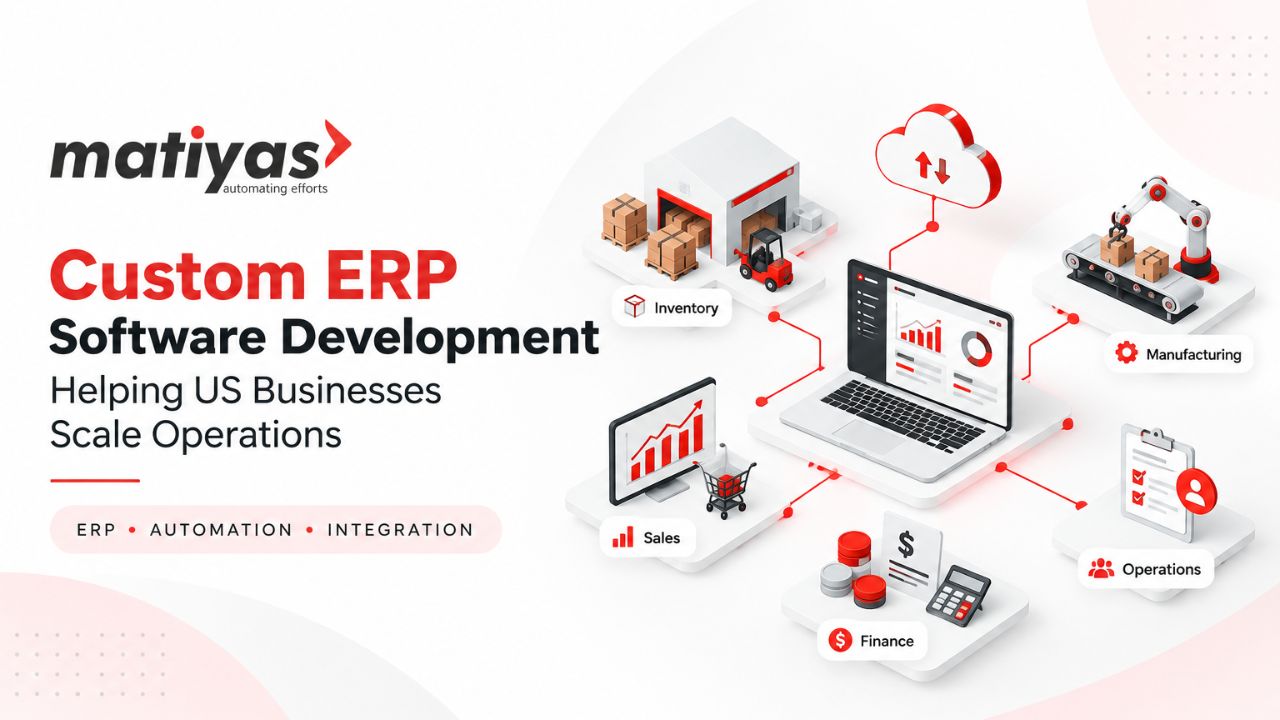
As businesses grow, managing daily operations becomes more complex. Companies may need to coordinate inventory, sales, purchasing, accounting, production, and customer information across multiple departments. When these activities rely on disconnected applications and spreadsheets, teams can struggle with inaccurate data, duplicated work, and delayed decisions.
Custom ERP software development in the USA can help businesses address these challenges by connecting essential processes through a centralized system. Instead of forcing every department to follow the limitations of generic software, companies can build workflows that reflect their operational requirements.
For growing US businesses, investing in scalable ERP software can improve coordination, increase visibility, and create a stronger foundation for expansion. The right solution can help organizations manage increasing workloads while keeping their processes organized and adaptable.
What Is Custom ERP Software Development?
Enterprise resource planning (ERP) software integrates core business functions into a shared system. Depending on the organization’s needs, an ERP platform may include finance, inventory management, purchasing, sales, manufacturing, human resources, and reporting.
Custom ERP software development involves designing or adapting software to support a company’s specific workflows, industry requirements, and integration needs. Unlike a standard package with a fixed set of features, a customized solution can accommodate specialized approval processes, unique reporting requirements, and connections with existing business applications.
For organizations evaluating custom ERP software development in the USA, the main consideration is whether customization will solve genuine operational problems. Not every business needs a completely new platform. In many cases, configuring an established ERP system and extending it with selected features can provide the flexibility needed without unnecessary complexity.
Why Traditional Business Systems Can Limit Growth
Many growing businesses initially manage their operations using spreadsheets, separate accounting tools, inventory applications, and manual reporting processes. These methods may work when transaction volumes are low, but they often become difficult to maintain as the organization expands.
Disconnected systems can create inconsistent records across departments. For example, a sales team may confirm an order without having an accurate view of available inventory, while the purchasing team works with a separate stock report. Employees then spend additional time checking information and correcting errors.
Manual reporting can also delay important decisions. Managers may not have a consolidated view of expenses, sales performance, outstanding orders, or stock levels when they need it.
As businesses add warehouses, employees, product lines, or locations, these challenges can become more pronounced. ERP software helps address them by creating more consistent workflows and bringing relevant operational information together.
Five Key Benefits of Custom ERP Software Development
1. Automating Repetitive Business Processes
Employees often spend considerable time entering data, updating spreadsheets, preparing reports, and following up on routine approvals. Custom ERP workflows can automate suitable tasks, such as purchase approvals, order processing, stock updates, and invoice generation.
Automation helps reduce repetitive manual work and supports more consistent processes. It also allows employees to focus more attention on customer service, planning, and other activities that require human judgment.
2. Improving Real-Time Data Visibility
Business leaders need reliable information to understand what is happening across their organizations. An integrated ERP system can provide dashboards and reports covering inventory, sales, purchasing, expenses, and other key activities.
When departments work with shared data, managers can identify potential problems earlier and make decisions with better operational context. The accuracy and timeliness of these insights depend on system configuration, data quality, and how consistently employees use the platform.
3. Supporting Business Expansion
Growth often introduces new operational requirements. A distributor might add warehouses, a manufacturer might introduce new product lines, or a service company might expand into additional regions.
Scalable ERP software can help businesses accommodate these changes through additional users, modules, locations, and workflows. Planning for future requirements during implementation can also reduce the need for disruptive changes later.
4. Connecting Core Business Functions
An ERP system can connect finance, sales, inventory, purchasing, manufacturing, and other departments within a coordinated environment. For example, confirming a customer order can trigger inventory checks, purchasing requirements, and relevant accounting activities.
This integration reduces reliance on duplicate data entry and helps departments coordinate their responsibilities. ERP system integration is especially valuable when companies need information to move consistently between internal teams and existing business applications.
5. Supporting Better Business Decisions
A centralized system can help managers evaluate operational performance using reports and key performance indicators. They can monitor order fulfillment, stock movement, production output, expenses, and other business measures.
These insights can support resource planning, cost control, and process improvement. Rather than relying entirely on manually assembled reports, decision-makers can use a more consistent view of business activity to identify trends and investigate operational bottlenecks.
Essential Features of an ERP System Built for Growth
A scalable ERP system should reflect current business needs while remaining adaptable as requirements change. Several capabilities deserve attention during the selection and development process.
Flexible modules and workflows: Businesses should be able to configure relevant functions, approval steps, and business rules without introducing unnecessary complexity.
Integration with existing applications: Connections with CRM platforms, e-commerce systems, accounting tools, and other applications can help reduce information silos and avoid repeated data entry.
Cloud access and scalability: Cloud ERP solutions may support access across locations and reduce the need to manage on-premises infrastructure. Businesses should still evaluate hosting costs, security requirements, availability, and data governance before choosing a deployment model.
Reporting and access controls: Useful dashboards, role-based permissions, audit trails, and appropriate security controls help employees access relevant information while supporting responsible data management.
Selecting features based on actual requirements is important. Adding unnecessary modules can increase implementation costs and make the system harder to maintain.
How to Choose the Right ERP Development Partner in the USA
Choosing an ERP development partner requires more than comparing software prices. Businesses should first document their existing processes, recurring problems, integration requirements, and future growth plans.
When evaluating an ERP development company in the USA or an experienced partner serving US businesses, consider the following factors:
- Industry experience: Look for an understanding of your operational workflows and business requirements.
- Customization capabilities: Confirm that the provider can configure workflows and develop necessary extensions without making the system unnecessarily complicated.
- Integration expertise: Ask how the solution will connect with your existing applications and exchange data reliably.
- Implementation planning: Review the proposed timeline, data migration approach, testing process, employee training, and deployment strategy.
- Long-term support: Understand how upgrades, maintenance, troubleshooting, and future enhancements will be handled.
- Total cost of ownership: Consider licensing, implementation, integrations, training, hosting, and ongoing support rather than focusing only on the initial quotation.
Requesting a demonstration and reviewing relevant project experience can help businesses assess whether a proposed solution fits their needs. The best ERP software development services in the USA are not necessarily the most expensive or feature-rich; they are the ones that align with business priorities and can be maintained as operations evolve.
How Matiyas Solutions Supports ERP Modernization
Matiyas Solutions helps businesses implement ERP solutions that connect operational workflows and improve access to business information. As an ERPNext implementation partner, the company can help organizations evaluate relevant modules, configure processes, and plan integrations according to their requirements. Businesses exploring ERP modernization can review Matiyas Solutions’ ERPNext services to understand how an established ERP platform may support their operational goals.
Conclusion
Custom ERP software development can help US businesses create more connected, efficient, and scalable operations. By automating repetitive tasks, improving data visibility, integrating departments, and supporting future expansion, an appropriately designed ERP system can address many challenges associated with business growth.
Successful implementation starts with clear requirements, realistic priorities, and careful partner selection. Businesses should focus on solving their most important operational problems first, then expand their ERP capabilities as their needs develop. A well-planned system can provide a practical foundation for sustainable growth.
