
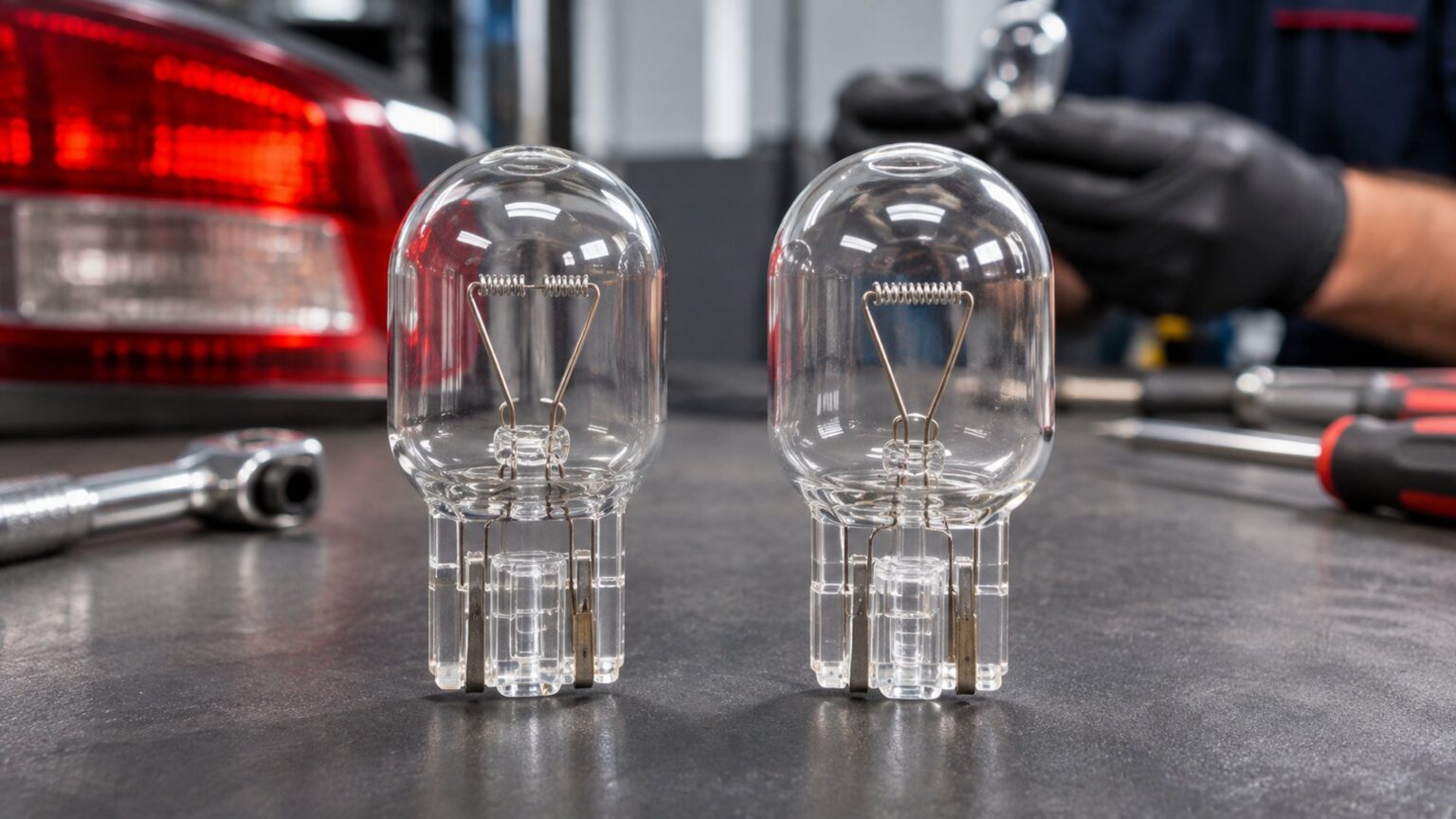
Choosing the correct replacement bulb is essential for keeping a vehicle’s exterior lighting reliable and easy for other drivers to understand. Although 7443 and 7440 bulbs look almost identical at first glance, their electrical designs and intended functions are not the same. Understanding the difference between 7443 and 7440 bulbs helps vehicle owners avoid installation problems, incorrect lighting behavior, and unnecessary replacement costs. Both belong to the popular T20 automotive bulb family, but one supports two brightness levels while the other is designed for a single operating intensity.
Many drivers encounter these bulb numbers while replacing brake lights, turn signals, parking lights, or reverse lights. The confusion becomes greater when shopping for LED replacements because some products are advertised as compatible with both sizes.
The important question is not simply whether a bulb fits into a socket. It is whether the replacement operates correctly with the vehicle’s wiring, lighting functions, and electrical system.
This guide explains the important differences, common applications, compatibility concerns, and practical steps for selecting the appropriate replacement.
Understanding 7443 and 7440 Automotive Bulbs
The 7443 and 7440 are automotive miniature bulbs commonly used in exterior lighting assemblies.
Both typically share a similar T20 glass envelope and wedge style mounting design. Their comparable appearance can make them difficult to distinguish without examining the internal filaments or electrical contacts.
The primary distinction involves how the bulbs operate.
A conventional 7440 incandescent bulb has one filament and is intended for a single brightness function.
A conventional 7443 incandescent bulb contains two filaments, allowing the same bulb to provide separate high and low intensity functions when supported by the vehicle’s wiring.
That difference determines which lighting positions can use each type.
What Is a 7440 Bulb?
A 7440 is a single filament automotive bulb commonly identified by the designation W21W.
Its standard incandescent version is rated at 12 volts and 21 watts.
Because it contains only one filament, it normally provides one operating brightness level.
Vehicle manufacturers may use this bulb in dedicated turn signals, reverse lights, or other single function lighting positions.
A 7440 can also serve as a dedicated brake light in a vehicle with a separate tail light arrangement.
What Is a 7443 Bulb?
A 7443 is a dual filament automotive bulb commonly identified as W21/5W.
Its conventional incandescent design includes a 21 watt filament and a 5 watt filament.
The brighter filament can provide a stop light or turn signal function, while the lower output filament can provide a tail light or parking light function.
The actual application depends on the vehicle’s lighting design.
This dual intensity capability makes the 7443 useful in assemblies where one bulb performs two related lighting functions.
Seven Critical Differences Between 7443 and 7440 Bulbs
Understanding the main specifications makes it easier to identify the correct bulb and avoid replacing one type with an unsuitable alternative.
1. Single Filament Versus Dual Filament Design
The most important difference is the number of filaments in conventional incandescent versions.
A 7440 contains one filament. When the appropriate electrical circuit supplies power, the filament illuminates at its designed operating intensity.
A 7443 contains two separate filaments. Each filament has a different power rating, allowing the bulb to operate at two brightness levels.
For example, a vehicle may use the lower intensity filament as a rear running light and activate the brighter filament when the brakes are applied.
This arrangement allows one bulb position to perform multiple lighting functions.
The distinction is especially important when replacing brake and tail light bulbs.
2. Different Electrical Contact Arrangements
Although both bulbs use wedge style bases, their electrical contacts are arranged differently.
A standard 7440 uses a W3x16d base designed for its single circuit configuration.
A standard 7443 uses a W3x16q base designed for its dual circuit configuration.
The contact arrangement determines how electrical power reaches the filament or filaments.
These differences mean that visually similar bulbs should not automatically be considered interchangeable.
A bulb may appear to fit inside a socket but still fail to operate correctly.
3. Different Lighting Applications
The two bulb types serve overlapping but distinct purposes.
A 7440 is commonly suitable for a lighting position that requires one brightness function.
Examples include:
- Dedicated rear turn signals
- Certain front turn signal positions
- Reverse lights
- Separate brake lights
- Other compatible single function exterior lamps
A 7443 is often used where two operating intensities are needed.
Examples include:
- Combined brake and tail lights
- Parking lights combined with turn signals
- Certain dual function rear lighting systems
Not every vehicle uses these bulbs in the same locations.
The vehicle’s original equipment specification should determine the correct replacement.
4. Different Incandescent Wattage Ratings
Wattage is another useful way to distinguish standard versions of these bulbs.
A conventional 7440 is rated at approximately 21 watts.
A conventional 7443 has separate ratings of approximately 21 watts and 5 watts.
The higher power filament produces the brighter function, while the lower power filament provides reduced intensity.
These ratings describe the individual filaments rather than suggesting that every lighting application continuously consumes both wattages.
Both bulb families are commonly associated with nominal 12 volt automotive electrical systems.
Actual operating voltage can vary while the engine is running and the charging system is active.
5. Different Brightness Functions
A frequent misunderstanding is that a 7443 must be brighter than a 7440 simply because it contains two filaments.
That is not necessarily correct.
The brighter filament of a standard 7443 and the single filament of a standard 7440 both have approximately 21 watt ratings.
Their actual light output depends on the specific product, operating voltage, and optical design.
The major advantage of a 7443 is its ability to provide two distinct intensity levels.
The lower intensity function allows a vehicle to maintain a visible running light while reserving a stronger signal for braking or another function.
6. Different LED Replacement Requirements
LED versions of 7440 and 7443 bulbs do not use incandescent filaments.
Instead, they rely on light emitting diodes and electronic circuitry to reproduce the required lighting behavior.
A typical 7440 LED replacement is designed for a single lighting function.
A typical 7443 LED replacement is designed to provide two intensity levels when the appropriate vehicle circuits are available.
Some aftermarket LED products are specifically engineered to support both socket applications.
However, compatibility depends on the product’s electrical design and the vehicle’s wiring.
The packaging or product specification must explicitly confirm the intended application.
7. Different Interchangeability Limitations
The physical similarity between the bulbs does not guarantee that one can safely replace the other.
Installing a standard 7440 in a lighting position requiring 7443 dual intensity operation can eliminate one of the necessary functions.
For example, a combined brake and tail light assembly may no longer provide the correct running light behavior.
A 7443 inserted into a single circuit location may operate only one of its available functions, assuming the contacts and socket are compatible.
Some combinations may not fit correctly at all.
For reliable operation, use the specified replacement bulb rather than treating the two part numbers as universal alternatives.
How to Identify the Correct Bulb for Your Vehicle
The safest selection process begins with the vehicle’s actual lighting requirements.
Guessing from appearance alone can lead to unnecessary purchases or incorrect operation.
Check the Owner’s Manual
Many vehicle manuals include information about replaceable exterior lighting bulbs.
Look for the specific light position, such as rear turn signal, brake light, tail light, or reverse light.
Some vehicles use integrated LED assemblies that do not accept conventional replacement bulbs.
If the manual does not provide the required information, use a reliable vehicle specific parts catalog.
Inspect the Existing Bulb
When accessible, the existing bulb can provide useful identification information.
Look for a part number printed or molded on the bulb or its base.
A clearly identified 7440 or 7443 marking can help confirm the original specification.
However, a previously installed bulb may itself be incorrect.
If the existing lighting has not been operating properly, verify the application independently.
Examine the Filament Structure
On a conventional incandescent bulb, the internal filament arrangement is often visible through the glass.
A 7440 generally contains one filament.
A 7443 generally contains two filaments.
This can provide a quick visual clue, particularly when printed markings have become difficult to read.
It is not a reliable method for identifying LED replacements because LEDs have different internal construction.
Compare the Electrical Contacts
Examine the metal contact arrangement at the wedge base.
A standard 7440 has contacts for a single circuit.
A standard 7443 has the contacts required for two intensity circuits.
Differences in contact positions can help distinguish the bulbs.
Do not bend contacts or modify the socket merely to make an incompatible replacement fit.
Confirm the Intended Lighting Function
Consider whether the original lamp must provide one or two brightness levels.
If a bulb serves as both a low intensity running light and a higher intensity brake light, it usually requires a compatible dual intensity bulb.
If it operates only as a dedicated reverse light, a suitable single intensity bulb may be required.
Function is often more informative than physical appearance.
Can You Use a 7443 Bulb Instead of a 7440?
This is one of the most common questions when drivers compare the two bulb sizes.
The answer depends on the specific bulb and vehicle.
Certain LED replacements are designed to work in both 7440 and 7443 applications.
Those products may internally manage the contact arrangement to support compatible installations.
However, that does not mean every incandescent or LED bulb can be exchanged without consequences.
What Happens in a Single Circuit Socket?
A single circuit socket supplies power for one lighting function.
A compatible dual intensity LED replacement may operate using its supported circuit while leaving the second function unused.
A conventional dual filament bulb may also behave differently depending on its contact arrangement.
Correct fitment and operation must be established rather than assumed.
What Happens in a Dual Circuit Socket?
A dual circuit socket is intended to support two lighting functions.
Installing a single intensity bulb may prevent one of those functions from operating.
This could affect the visibility of the vehicle or the behavior of required exterior lighting.
For example, a vehicle might lose its normal tail light function while retaining a brake light function, or the result could differ depending on the wiring.
The correct replacement should preserve both intended lighting modes.
Why Matching the Original Specification Is Better
Using the specified bulb minimizes uncertainty about electrical contacts, brightness behavior, and socket fitment.
Even when an alternative seems functional, it may not provide the correct distinction between lighting modes.
Vehicle lighting should always be evaluated as a complete system.
7443 vs 7440 LED Bulbs: Important Considerations
LED replacement bulbs can offer lower electrical consumption and different lighting characteristics compared with traditional incandescent designs.
However, an LED upgrade is not automatically suitable for every vehicle.
Single Intensity and Dual Intensity LEDs
A single intensity LED provides one designed lighting output.
A dual intensity LED must respond appropriately to separate electrical inputs or operating modes.
This is especially important for combined brake and tail light applications.
An unsuitable LED may illuminate at the wrong intensity, fail to dim, or not operate in one of the expected modes.
LED Brightness and Light Distribution
Brightness should not be evaluated using advertised lumen figures alone.
Vehicle lighting assemblies are designed to distribute light in specific directions.
The placement and orientation of LED emitters can affect how light travels through reflectors and lenses.
A replacement that appears extremely bright when viewed directly may not produce the intended performance in the original housing.
Choose bulbs designed for the relevant automotive lighting application.
Electrical Polarity
Some LED bulbs are sensitive to electrical polarity.
If an LED does not illuminate, the cause may involve polarity, contact positioning, incorrect fitment, or an incompatible circuit.
Certain replacement products use nonpolarized designs that reduce polarity related installation problems.
Follow the manufacturer’s instructions rather than forcing a bulb or altering the socket.
Dashboard Warnings and Hyperflash
Some vehicles monitor electrical load to identify failed bulbs.
LED replacements often draw less current than conventional incandescent bulbs.
This difference may cause warning messages or rapid turn signal flashing, commonly called hyperflash.
The issue is not necessarily a defective LED.
It may reflect the vehicle’s original bulb monitoring system.
Are Load Resistors Necessary?
Some LED conversion kits use load resistors or compatible electronic controls to address monitoring problems.
However, resistors can become very hot during operation.
Improper installation can damage nearby wiring or plastic components.
Any necessary electrical modification should use an appropriate solution installed in a safe location.
A vehicle specific compatible replacement is preferable to guessing at electrical modifications.
Understanding Bulb Color and Lens Compatibility
Choosing the correct bulb number is only one part of selecting an exterior light.
The color of the light also matters.
Clear and Amber Bulbs
Some 7440 applications use clear bulbs behind colored lenses.
Other applications require an amber bulb.
Amber variants may carry additional part number designations and can have different base keying.
Do not assume that a clear and amber version are mechanically identical merely because they belong to the same general bulb family.
Red Tail and Brake Lights
Rear brake and tail lighting must produce the appropriate red appearance.
When selecting an LED replacement, the color of the LED and the lens characteristics should be considered together.
A white LED behind a red lens may not behave identically to a suitably designed red LED.
The appropriate choice depends on the lamp assembly and applicable lighting requirements.
Check Road Use Requirements
Exterior automotive lighting is subject to technical requirements involving color, visibility, and operating behavior.
A replacement bulb should be suitable for its intended road use and vehicle application.
Physical fit alone does not establish that an aftermarket LED conversion meets the requirements for a particular lamp assembly.
How to Replace a 7440 or 7443 Bulb Safely
Many vehicles provide access to exterior lighting bulbs through the engine compartment or behind a rear lamp assembly.
The exact procedure varies by model.
Always follow the vehicle’s service instructions.
Turn Off the Lights and Allow Cooling
Switch off the relevant lighting functions and allow the existing bulb to cool before handling it.
Incandescent bulbs can become hot during operation.
Avoid touching damaged glass or exposed electrical components.
Access the Bulb Holder
Open the applicable access panel or remove components as directed by the vehicle manual.
Some bulb holders release by rotating, while others use retaining clips.
Do not force plastic connectors or pull on wiring harnesses.
Remove the Existing Bulb
Carefully remove the bulb from its holder using the specified procedure.
Inspect the socket for visible discoloration, corrosion, or damaged contacts.
If the socket appears overheated or damaged, replacing the bulb alone may not resolve the problem.
Install the Correct Replacement
Confirm the bulb type, color, and intended function before installation.
Insert the replacement into the holder without excessive force.
Ensure it is properly seated and that the holder is secured.
Test Every Lighting Function
After installation, verify the relevant functions.
Depending on the lamp, this may include parking lights, brake lights, turn signals, or reverse lights.
For combined lighting functions, check both low and high intensity operation.
Confirm that there are no unexpected dashboard warnings or irregular flashing patterns.
Common Problems After Installing the Wrong Bulb
Using an unsuitable replacement can create several noticeable symptoms.
One Lighting Function Stops Working
A single intensity bulb installed in a dual function position may not provide both expected outputs.
This can result in a missing running light, brake light, or parking light function.
The exact result depends on the electrical configuration.
The Bulb Does Not Illuminate
An incorrect contact arrangement can prevent the bulb from receiving power properly.
Other possible causes include damaged sockets, blown fuses, wiring faults, or a failed replacement bulb.
The bulb type should be checked before assuming the vehicle has a more serious electrical problem.
The Light Flickers or Behaves Irregularly
Poor contact, unsuitable LED electronics, or vehicle monitoring systems may cause irregular operation.
Inspecting the correct bulb specification and confirming the installation are useful first steps.
If the issue continues, professional electrical diagnosis may be needed.
Turn Signals Flash Too Quickly
Rapid turn signal flashing often occurs when the vehicle detects an unexpected electrical load.
This is commonly associated with LED conversions but may also indicate a failed bulb.
Check all relevant turn signal lamps before deciding on a repair.
The Light Appears Too Dim or Too Bright
An incorrectly selected bulb may produce the wrong intensity for the intended function.
An unsuitable LED may also distribute light differently from the original incandescent bulb.
Both conditions can reduce the effectiveness of exterior lighting.
Common Mistakes When Comparing Automotive Bulbs
Small differences in automotive bulb specifications can have important practical consequences.
Assuming Similar Shape Means Compatibility
7440 and 7443 bulbs share a similar overall appearance.
However, their internal design and electrical contacts differ.
Always match the electrical function as well as the physical size.
Confusing Wattage With Brightness
Two incandescent bulbs with similar wattage may have comparable light output, but wattage alone does not determine complete lighting performance.
For LED replacements, differences in design make direct wattage comparisons even less useful.
Ignoring Dual Intensity Requirements
A combined brake and tail lamp needs the appropriate distinction between its operating modes.
A replacement that illuminates only one mode is not an acceptable functional substitute.
Buying LEDs Without Checking Compatibility
An LED labeled with a familiar bulb number may still create monitoring errors or perform poorly in a particular housing.
Review the intended application, electrical compatibility, color, and operating characteristics before installation.
Which Bulb Should You Choose?
The best choice depends on the vehicle’s original design.
If the specified bulb is a 7440, use a compatible 7440 replacement with the correct color and electrical characteristics.
If the specified bulb is a 7443, use a replacement designed to support the required dual intensity operation.
For an LED upgrade, verify that the selected product supports the exact vehicle and lighting position.
It is also worth checking whether the bulb is installed in a clear, amber, or red lens assembly.
A replacement must provide the intended signal, not simply produce visible light.
The most reliable approach is to match the original specification and test all functions after installation.
Why Correct Bulb Selection Matters for Road Safety
Exterior vehicle lights communicate important information to other road users.
Brake lights show when a vehicle is slowing.
Turn signals communicate an intended change in direction.
Tail lights help other drivers recognize the position of a vehicle in low light conditions.
Reverse lights indicate that a vehicle is backing up.
Each function relies on suitable brightness, color, timing, and visibility.
An incorrect bulb can interfere with these signals even when part of the lighting assembly still appears to work.
Understanding the difference between 7443 and 7440 bulbs is therefore not just about identifying replacement parts. It is also about ensuring that the vehicle communicates its movements as intended.
Conclusion
The main difference between 7443 and 7440 bulbs is their electrical design and ability to provide different lighting functions. A 7440 is generally a single filament, single intensity bulb, while a 7443 supports dual intensity operation through two separate filaments. Although both belong to the T20 family and look similar, their contact arrangements and applications are not identical. Choosing the correct replacement requires checking the vehicle’s original specification, socket compatibility, light color, and intended function. Careful selection and proper testing help maintain reliable exterior lighting.
Frequently Asked Questions
What is the main difference between 7443 and 7440 bulbs?
A standard 7440 has one filament for a single intensity function, while a standard 7443 has two filaments that support separate high and low brightness functions.
Can I replace a 7440 bulb with a 7443 bulb?
Not automatically. Some specially designed LED replacements support both applications, but conventional bulbs and vehicle sockets may have different contact arrangements.
Can a 7440 bulb be used in a 7443 socket?
A standard 7440 cannot reliably replace a 7443 where two intensity levels are required. One of the intended lighting functions may stop working.
Are 7443 bulbs brighter than 7440 bulbs?
Not necessarily. Both conventional bulb types have a high intensity function rated at approximately 21 watts. The 7443 also includes a lower intensity 5 watt filament.
What are 7440 bulbs commonly used for?
7440 bulbs are commonly used for dedicated turn signals, reverse lights, and other single intensity automotive lighting applications, depending on the vehicle.
Can I upgrade 7440 and 7443 bulbs to LED?
Yes, when suitable LED replacements are available for the vehicle and lighting position. Compatibility, light distribution, color, and potential hyperflash issues should be checked.
Why do my turn signals flash rapidly after an LED upgrade?
Some vehicles detect the lower electrical load of LED bulbs as a failed lamp. Compatible control equipment or properly installed load management solutions may be required.
