
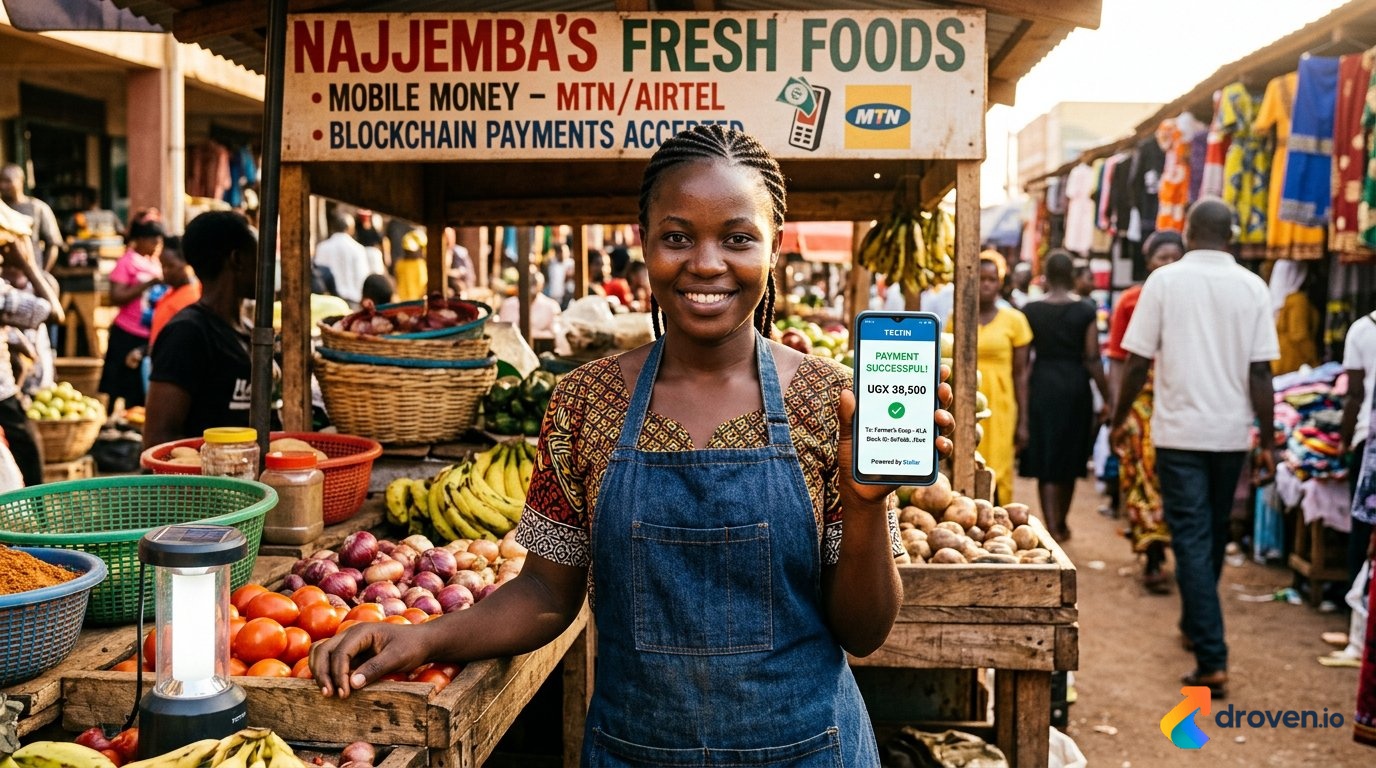
Kampala is not Silicon Valley, and that is precisely the point.
While venture capitalists in California debate tokenomics models and regulatory frameworks, a seventeen-year-old in Wakiso District is using a basic smartphone to receive payment for freelance graphic design work from a client in Nairobi, settling instantly through stablecoins that bypass three correspondent banks, two currency conversions, and a five-day waiting period that the traditional financial system would have imposed.
This is not a hypothetical. It is the lived reality of digital assets reshaping financial access across Uganda, where the next generation has concluded that waiting for the traditional banking system to include them is a strategy with no expiration date. Digital assets have become the infrastructure that banks refused to build, and the adoption numbers prove it.
According to a FinScope survey, 66 percent of Ugandans use mobile money regularly, while just 13 percent access traditional banking services. That gap, 53 percentage points representing millions of people who transact digitally but remain invisible to the formal financial system, is where digital assets are building bridges that banks never constructed. Digital assets do not require the documentation, minimum balances, or physical branch visits that have kept these millions locked out of the formal economy for generations.
The Uganda of 2026 is not merely adopting cryptocurrency as a speculative asset class. It is embedding digital assets into the operational fabric of its economy through a 5.5-billion-dollar tokenized infrastructure program, a central bank digital currency pilot backed by treasury bonds, and an integration that finally solves the “last mile” problem. Digital assets in Uganda have become infrastructure rather than speculation, and that distinction matters profoundly.
This is the story of how digital assets are doing something in Uganda that they have struggled to achieve anywhere else: delivering financial inclusion at scale, to real people, for real economic purposes, driven by a generation that refuses to wait for permission. Digital assets in Uganda are not a theoretical use case awaiting adoption. They are a living, functioning alternative financial system.
The Numbers That Explain Why Uganda’s Next Generation Turned to Digital Assets
Understanding why digital assets have gained such traction in Uganda requires starting with the data that defines the financial landscape young Ugandans inherit.
More than 80 percent of Uganda’s workforce operates in the informal economy, according to government statistics. These are farmers, artisans, motorcycle taxi operators, and market vendors who have run profitable enterprises for years without ever opening a bank account. For these millions of workers, digital assets are not an investment choice. They are the first financial tool that has ever been designed with their circumstances in mind.
The reason is not a lack of financial sophistication. It is a lack of financial infrastructure designed for people like them. Traditional banks require documentation that informal workers cannot produce, minimum balances that irregular incomes cannot sustain, and physical branch visits that rural geography makes impractical.
Digital assets bypass these barriers entirely. A smartphone becomes a wallet. A stablecoin becomes a savings account. A blockchain transaction becomes a receipt, a credit history, and a proof of payment. Digital assets are not just an alternative financial system in Uganda; for millions of people, they are the only financial system that has ever treated them as legitimate participants.
Sub-Saharan Africa has been identified as the third-fastest-growing region for digital asset adoption globally, and Uganda’s contribution to that statistic is not being driven by speculative traders tracking Bitcoin charts. It is being driven by young people who need to get paid, need to save, need to send money home, and have discovered that digital assets accomplish all three tasks more reliably than the formal financial system ever has. Digital assets are solving problems that banks spent decades ignoring.
The $5.5 Billion Bet on Tokenized Infrastructure
In late 2025, Uganda announced a partnership that most of the world’s crypto media overlooked and that may prove to be one of the most significant real-world applications of digital assets anywhere on the continent.
The Global Settlement Network, a US-based blockchain financial infrastructure company, partnered with Diacente Group, a Ugandan developer of green industrial zones, to launch a 5.5-billion-dollar program that will tokenize key sectors of Uganda’s economy including agriculture, mining, renewable energy, and logistics onto a permissioned blockchain.
At the center of this initiative sits Uganda’s first central bank digital currency, the digital shilling, issued on GSN’s blockchain and fully backed by Ugandan treasury bonds. Unlike CBDC experiments in other nations that have struggled with adoption because they offered citizens no reason to use them, Uganda’s model ties the digital currency directly to economic activity.
A farmer selling coffee beans through a tokenized supply chain receives instant payment in digital shillings rather than waiting weeks for a paper check that requires a day-long journey to the nearest bank branch to deposit. Digital assets connected to real agricultural output create economic velocity in communities where money has historically moved at the speed of paper. A small mining operation tokenizing its mineral output gains access to global capital markets that were previously accessible only to multinational corporations. A renewable energy project can fractionalize its future revenue streams and attract investment from Ugandan citizens who have never purchased a financial asset in their lives.
The Karamoja Green Industrial and Special Economic Zone, a government-backed development anchored to Uganda’s Vision 2040 national strategy, will serve as the initial deployment site. The projections are ambitious: over one million jobs created and up to 10 billion dollars in annual exports, contingent on successful implementation.
Whether these projections materialize depends on execution, not announcement, and the history of large-scale infrastructure projects in developing economies counsels caution. But the architecture of the program, embedding digital assets into the actual production economy rather than layering them on top as a separate financial experiment, represents a fundamentally different approach. Digital assets tied to real economic output have a chance that digital assets offered as abstract financial instruments never did.
The Last Mile Problem, Solved by Accident
For years, the barrier between cryptocurrency exchanges and actual usage in African markets was deceptively simple: how do you convert local currency into digital assets and back again without a bank account?
Exchanges built sophisticated trading platforms. They listed hundreds of tokens. They offered margin trading and derivatives and staking yields. None of it mattered to the Ugandan market vendor who needed to receive 50,000 shillings from a customer and did not have, would never have, a traditional bank account through which to fund a crypto exchange deposit.
The solution arrived in April 2026, when VALR, Africa’s largest cryptocurrency exchange by trade volume, integrated with Onafriq, the continent’s leading digital payments gateway. The partnership connected crypto liquidity directly to the one billion mobile money wallets operating across 43 African markets, including Uganda.
A user in Kampala can now deposit Ugandan shillings from their MTN Mobile Money or Airtel Money wallet directly into their VALR exchange account, convert to USDC or any supported cryptocurrency, execute whatever transactions they need, and withdraw back to mobile money when they want local currency in hand. Digital assets are no longer walled off behind bank accounts that most Ugandans will never have.
The conversion pathway, local currency to USDC to selected cryptocurrency and back, happens behind the scenes. What the user experiences is a simple deposit and withdrawal flow that feels no different from sending mobile money to a friend, except it connects them to global digital asset markets that were previously accessible only to people with bank accounts, government ID, and the documentation that informal workers systematically lack.
This integration did not require regulatory approval, new legislation, or government permission. It required two companies recognizing that the infrastructure already existed, mobile money rails serving millions of Ugandans daily, and that connecting those rails to digital assets would unlock financial access at a scale that no policy initiative could match.
Why Young Ugandans See Digital Assets Differently Than Their Parents
The generational divide in Uganda’s relationship with digital assets is not about risk tolerance. It is about starting assumptions.
An older generation that built financial lives on cash, postal money orders, and eventually mobile money approached digital assets as a speculative curiosity, interesting but untrustworthy, something to observe from a distance.
The next generation grew up watching their parents navigate a financial system that treated them as afterthoughts. They watched mobile money agents become the de facto banking infrastructure of the country. They internalized the lesson that useful technology spreads because people choose to use it, not because institutions authorize it. Digital assets represent the next iteration of that same pattern.
They approach digital assets the same way. Not as an investment category to be allocated and rebalanced, but as infrastructure to be used. Digital assets are a bank account for someone who was denied one. A stablecoin is a savings vehicle for someone whose local currency loses purchasing power by the month. Digital assets are a receipt, a record, a proof of economic existence for someone the formal system has chosen not to see.
This is the mindset shift that explains why Uganda’s adoption of digital assets looks different from the chart-watching, profit-taking behavior that characterizes crypto markets in developed economies. Digital assets in Uganda are tools for economic participation, not vehicles for speculation, and that distinction has produced a pattern of adoption that looks entirely different from what crypto exchanges in London or New York would recognize.
What 66 Percent Mobile Money Penetration Means for Digital Asset Adoption
The single most important statistic for understanding Uganda’s digital asset trajectory is not about crypto at all. It is about mobile money.
When 66 percent of a population actively uses mobile money and only 13 percent uses traditional banking, the financial infrastructure of the country has already been decided. Mobile money operators, MTN and Airtel primarily, have become the de facto financial institutions of Uganda not through regulatory designation but through demonstrated utility.
Digital assets plug into this existing infrastructure rather than attempting to replace it. The VALR-Onafriq integration that connects crypto exchanges to mobile money wallets is the model. The CBDC pilot that makes the digital shilling accessible via USSD codes on basic feature phones, not just smartphones, is the model.
This is the lesson that Uganda’s next generation has internalized and that crypto projects in developed markets consistently miss: you do not need to build new infrastructure for digital assets. You need to connect digital assets to the infrastructure people already use every day. The mobile money agent on the corner who has been cashing out digital value for a decade is the distribution network for digital assets. Digital assets do not need new distribution channels in Uganda. They need to connect to the distribution channels that already reach every village.
Freelancers, Remittances, and the Real Economy of Digital Assets
The stereotype of the crypto user, a young male day-trader monitoring charts on multiple screens, bears no resemblance to the actual profile of digital asset adoption in Uganda.
The Ugandan freelancer receiving payment from international clients has discovered that digital assets eliminate the correspondent banking chain that can consume 10 to 15 percent of a payment in fees over multiple days. Digital assets turn a 200-dollar invoice into 200 dollars received, not 170 dollars after the banks take their cut. A 200-dollar payment for web development work arrives as 200 dollars worth of stablecoins, not 170 dollars after the banks extract their share.
The Ugandan diaspora worker sending money home to family in a rural district has discovered that digital assets convert a remittance process that once required traveling to a Western Union agent, paying transfer fees, and waiting days into a process that takes thirty seconds and costs a fraction of the traditional fee. Digital assets deliver what remittance services have promised for decades at prices they have never been willing to offer.
The Ugandan small business owner importing goods from Kenya or Tanzania has discovered that digital assets eliminate the currency conversion friction that makes cross-border trade unnecessarily expensive. Digital assets allow both parties to settle in stablecoins at their convenience rather than navigating the arbitrary exchange rates that banks and forex bureaus impose.
These are not edge cases. They are the core use cases driving adoption, and they share a common characteristic: digital assets solve a real economic problem that the traditional financial system has either created or failed to address. The adoption is not speculative. It is practical.
The Regulatory Gray Zone and Why It Has Not Stopped Adoption
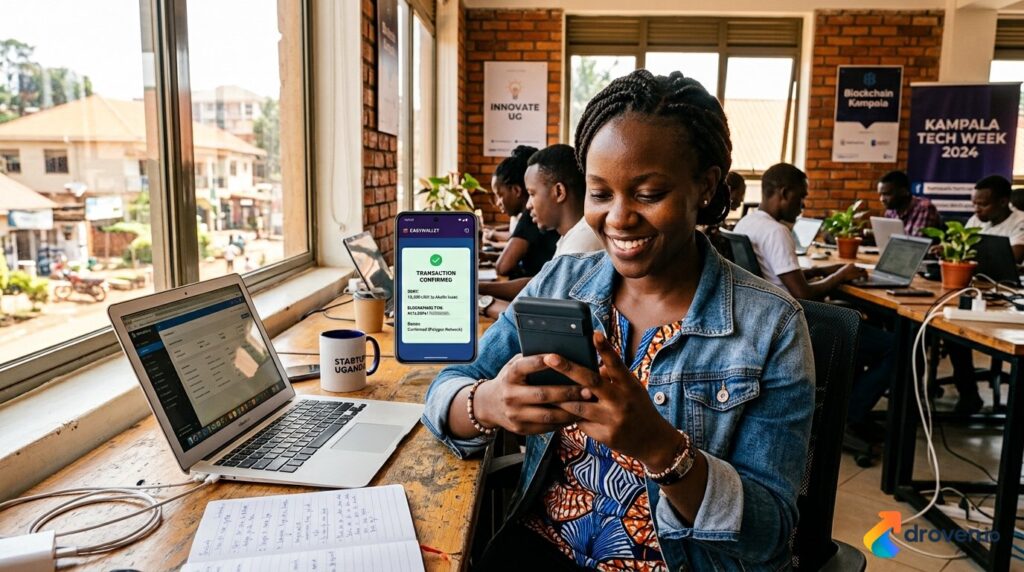
Uganda’s legal framework for digital assets remains unsettled in ways that would paralyze adoption in more risk-averse markets.
A High Court ruling declared that cryptocurrency cannot be used as a payment instrument within the existing legal framework. The Bank of Uganda has directed licensed payment providers not to facilitate cryptocurrency transactions. Digital assets are not recognized as legal tender, and no organization holds a license to sell or facilitate crypto trades within the country’s borders.
Yet adoption continues accelerating because the practical reality has diverged from the legal framework. The Financial Intelligence Authority now requires virtual asset service providers to comply with anti-money laundering regulations, a de facto acknowledgment that digital assets are real, they are widespread, and they need oversight even if the full legal status remains unresolved.
This regulatory ambiguity is not unique to Uganda. It characterizes digital asset regulation across much of Sub-Saharan Africa, and the pattern that has emerged across the continent suggests that adoption driven by genuine economic utility does not wait for legal clarity. It proceeds until the law catches up, which it eventually does because governments recognize that attempting to suppress an activity that millions of citizens find economically essential is both impractical and politically costly.
The CBDC pilot represents the government’s parallel path: rather than only attempting to regulate private digital assets, Uganda is building its own digital asset infrastructure that operates within a clear legal framework backed by treasury bonds and government authority. Digital assets managed by the state and digital assets managed by the market are evolving alongside each other. Whether this government-managed digital asset ecosystem eventually coexists with, competes with, or absorbs the private digital asset activity that already flourishes remains the central unresolved question.
What Uganda’s Experiment Means for the Rest of Africa
Uganda’s experience with digital assets matters far beyond its borders because it is testing hypotheses that apply across the continent. Digital assets as infrastructure for the unbanked, digital assets as a tool for tokenizing real economic output, digital assets as a bridge between mobile money and global markets — these are questions that matter from Senegal to Somalia.
Can a CBDC achieve adoption when it is tied to actual economic activity rather than offered as an abstract digital version of existing currency? Uganda is running that experiment. Can tokenized real-world assets attract the investment capital that African infrastructure projects have historically struggled to secure? Uganda is running that experiment. Can the integration of crypto exchanges with mobile money networks create financial inclusion at a scale that decades of traditional banking expansion failed to achieve? Uganda is running that experiment.
The outcomes will inform policy, investment, and technology decisions from Nairobi to Lagos to Cape Town. Uganda’s population of 47 million makes it a meaningful test case for the kind of ambitious experimentation that produces either breakthrough results or instructive failures. Either outcome advances the collective understanding of how digital assets can serve the populations that traditional finance has left behind, and digital assets will be the tool that either validates or disproves the hypothesis that blockchain can deliver financial inclusion at scale.
Frequently Asked Questions
How are digital assets improving financial inclusion in Uganda?
Digital assets are improving financial inclusion in Uganda by connecting the 66 percent of the population that uses mobile money to global cryptocurrency markets, enabling instant cross-border payments, providing savings vehicles through stablecoins, and creating financial identities for informal economy workers who lack traditional banking access.
What is Uganda’s $5.5 billion tokenized economy initiative?
Uganda’s $5.5 billion tokenized economy initiative is a partnership between Global Settlement Network and Diacente Group that tokenizes agriculture, mining, renewable energy, and logistics sectors on a permissioned blockchain, featuring a digital shilling CBDC backed by treasury bonds and accessible via smartphones and USSD codes.
Can Ugandans use digital assets without a bank account?
Yes, the April 2026 integration between VALR crypto exchange and Onafriq’s digital payments gateway allows Ugandans to deposit and withdraw digital assets directly through MTN Mobile Money and Airtel Money wallets, completely bypassing the traditional banking system that only 13 percent of the population uses.
Are digital assets legal in Uganda?
Digital assets operate in a regulatory gray zone in Uganda, with a High Court ruling restricting their use as payment instruments and the Bank of Uganda barring licensed providers from facilitating crypto transactions, though the Financial Intelligence Authority now requires virtual asset service providers to comply with anti-money laundering regulations.
Why are young Ugandans leading digital asset adoption?
Young Ugandans are leading digital asset adoption because they grew up watching mobile money become the country’s de facto banking infrastructure, approach digital assets as practical tools for receiving payments and saving rather than speculative investments, and refuse to wait for a traditional banking system that has never prioritized their inclusion.
How does Uganda’s digital asset adoption compare to other African countries?
Uganda is part of Sub-Saharan Africa’s emergence as the third-fastest-growing region for digital asset adoption globally, with its CBDC pilot and tokenized economy initiative representing a more infrastructure-focused approach compared to Nigeria’s consumer-driven crypto adoption and Kenya’s regulatory-first strategy.
Conclusion
Uganda’s relationship with digital assets is not a story about cryptocurrency prices, trading volumes, or exchange listings. It is a story about a generation that looked at a financial system designed without their participation in mind and decided to build something else.
The 5.5-billion-dollar tokenized infrastructure program, the digital shilling CBDC pilot, the mobile money exchange integration that finally connects informal economy workers to global markets, and the freelancers, traders, and diaspora families who have quietly replaced correspondent banking chains with stablecoin transfers are not separate phenomena. Digital assets connect every one of these stories, and digital assets are the common thread running through Uganda’s financial transformation. They are manifestations of the same underlying reality: digital assets are delivering financial inclusion in Uganda not because the government mandated it or because foreign aid programs funded it, but because the technology actually works for the purposes that ordinary people need it to serve.
The regulatory framework for digital assets remains unresolved. The infrastructure projects built on digital assets remain in early stages. The mobile money integration that connects digital assets to everyday Ugandans remains limited to transaction sizes that will need to expand. None of this is finished, and none of it is guaranteed to succeed.
But the direction of travel is unmistakable. Uganda’s next generation has determined that waiting for the formal financial system to include them is a strategy with no expiration date, and they have stopped waiting. Digital assets are the tool they have chosen, and digital assets are already doing for millions of Ugandans what decades of financial inclusion initiatives promised but never delivered. They are using digital assets to get paid, to save, to send money home, to build businesses, and to participate in an economy that was designed to function without them. Digital assets are doing something in Uganda that they have struggled to achieve anywhere else: delivering financial inclusion at scale, to real people, for real economic purposes.
The system they are building may not look like the crypto markets that dominate financial news headlines, but it is solving real problems for real people, and that is a more meaningful measure of success for digital assets than any price chart can provide.
