
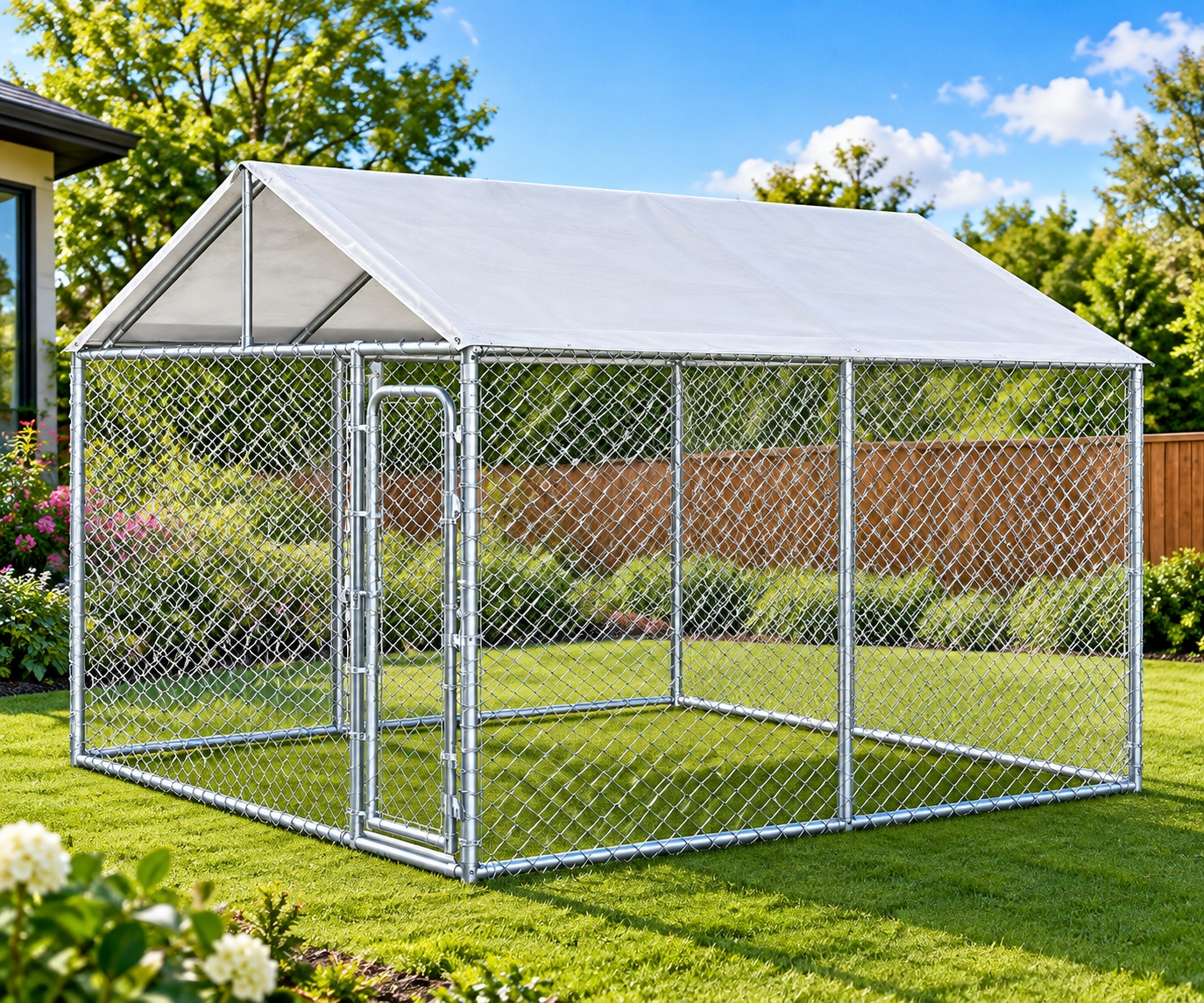
Panel enclosures are compared on height, because height is what looks like the containment. Very few dogs leave over the top. An outdoor dog kennel playpen is almost always defeated at the bottom rail, either by digging underneath it or by pushing a panel sideways until a gap opens at a corner.
Digging is a load path, not just a habit
A dog digging at the edge of a dog pen removes the soil that was holding the bottom rail down. Once that support is gone, the panel is free to flex upwards, and a surprisingly small lift is enough for a determined dog to get a shoulder through.
The behaviour usually starts along a boundary the dog can see or smell through, which is why corners and gates are the places it happens first. Blocking the view rarely helps for long; removing the ability to lift the rail does.
Anchoring differs on turf and on hardstand
On soil, ground stakes through the bottom rail work well, provided they go deep enough to stay put in wet weather. Short pegs in soft ground lift out with the panel they were meant to hold, which gives the appearance of a secured dog pen and none of the function.
On concrete or pavers, pegs are not an option and the answer is mass or fixings. Either bolt the frame down with masonry anchors or weight the base, because a free-standing panel on a hard surface slides long before it tips.
Panel joints carry the real load
A dog pushing against the middle of a panel is resisted by the whole frame. A dog pushing at a joint is resisted only by whatever is holding two panels together, and that is usually a clamp or a pin.
Two checks cover most escapes:
- Tighten joint clamps after the first week
- Fit the gate latch out of nose reach
Gates are the recurring weak point. A latch a dog can lift with a nose is not a latch, and a gate that sags onto its catch will eventually spring open under a shoulder rather than release cleanly.
Shade matters more than airflow in an Australian summer
An open mesh dog playpen has all the airflow it needs. What it lacks is shade, and a dog in a panel enclosure on a clear day has no way to escape direct sun unless shade is provided over part of the run.
Partial cover is the right answer rather than a full roof, because a fully covered pen traps heat and stops the breeze that an open panel enclosure provides. Covering roughly a third of the area, on the side the afternoon sun reaches, deals with it.
Sizing by activity rather than by dog
Floor area matters less than shape. A long narrow run lets a dog move, where a square pen of the same area does not, and movement is what keeps a dog settled in an enclosure for any length of time.
A ten by ten foot footprint suits one medium dog comfortably or a puppy playpen arrangement for a litter. TMG Industrial builds this one as a panel system that bolts together, which means the same panels can be reconfigured into a longer run later without buying anything new.
