
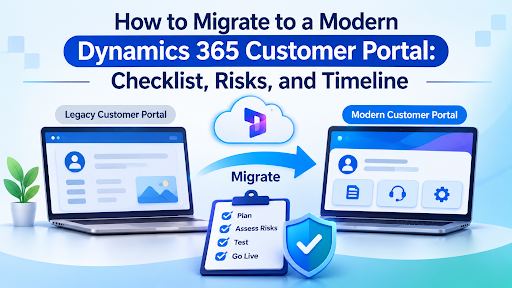
Most Dynamics 365 portals were not built last year. They were built on the old Portal Management app, with adx_ tables underneath and a few years of Liquid templates piled on top. Microsoft has since moved all site creation into Power Pages, retired the Power Apps portals admin center in June 2023, and pointed new development at a different data model. The portal still works. That’s usually the reason nobody has touched it.
Migration is where that comfortable arrangement ends. The work is smaller than a rebuild and bigger than an upgrade, and the schedule depends on things a project plan rarely lists.
What does a Dynamics 365 Customer Portal migration actually move?
Less than people assume. Microsoft’s own migration documentation describes the job as exporting site configuration from a source Dataverse environment and importing it into a target one. Pages, web templates, content snippets, site settings, forms, lists, web roles and table permissions travel. Dataverse tables and table schema do not. The Power Platform CLI and the Configuration Migration tool both say so in plain notes, and both warn that an import can fail on missing tables and fields when the configuration and the schema disagree.
So the tables, columns, forms and views a site depends on have to land in the target environment separately, usually as solutions. Then the site configuration follows. Contact records for signed-in users are a third piece. For a move between tenants, the documentation lists the authenticated users, their Dataverse contacts and the site-specific data records as data that doesn’t transfer with the site configuration at all.
That split catches a lot of teams. The portal looks like one thing from the browser. Underneath it’s three: schema, configuration and data.
Which data model is the site on?
Everything else hangs on this question.
Older sites run on the standard data model, with configuration scattered across adx_ tables. The enhanced data model keeps configuration in the Site Component table, called power page component, and makes site configuration solution-aware. Microsoft says all new sites are created on the enhanced model by default, and that solutions with Power Pages require it. The admin center shows the model in the Site Details panel. The Portal Management app is renamed Power Pages Management when the enhanced model is active. Running pac pages list -v prints it too, on CLI version 1.22.4 or later.
Templates complicate things. The documentation lists Customer Self Service Portal (Dynamics 365), Community, Employee Self Service and Partner Portal among the templates that can be migrated from standard to enhanced. A different group, including Customer Portal (Dynamics 365), Field Service, Modern Community and Order Returns, stays on the standard model even when the environment setting is switched on. The migration page adds a sentence that matters: if a site’s original template isn’t on the supported list, the migration utility shouldn’t be run against it.
A site on one of those standard-only templates doesn’t get the CLI migration path. It gets a new site and a deliberate rebuild of whatever customizations it carried.
What belongs on the checklist before anything moves?
The CLI utility for moving a standard site to the enhanced model asks for Power Platform CLI 2.11.2 or later, the CDSBasePortal package at 9.3.2607.x or later, and the PowerPages_Core package at 1.0.2605.x or later. Admin roles are needed to switch or revert the model. Those are the prerequisites as published in the October 2026 revision of the page. Anyone reading this a few months from now should check them again.
Then the inventory. Microsoft’s utility generates a customization report, as a CSV, without changing the site. It flags custom columns on adx_ metadata tables, relationships pointing at those tables, Liquid that reads adx_ attributes, FetchXML over adx_ tables, plug-ins and workflows registered on them. None of that carries over on its own. A Liquid snippet that reads entities[‘adx_weblinkset’] has to be rewritten against the weblinks object. A FetchXML query on adx_webpage has to query the power page component and filter on a component type value, where a web page is type 2.
Security belongs in the same inventory. Microsoft’s deprecations page says that starting June 2026, table permissions are enforced for all forms and lists regardless of the Enable Table Permissions setting. The heading on that entry says “new websites,” while the first sentence of the body says websites in general, so the exact reach is a question for the tenant and not something to settle from the heading. A form that quietly showed records because permissions were switched off can go empty the day enforcement applies. The Web API wildcard in the Webapi/<table-name>/fields site setting was deprecated as well. Support for it was removed for all websites on September 14, 2026, so existing sites need an explicit column list.
Authentication and integrations come last, and they take longer than expected. Identity providers depend on app registrations, and in the tenant-to-tenant guidance Microsoft says site connections, app registrations and authentication providers don’t transfer ready to use. The custom domain and its certificate get configured again. SharePoint gets reauthenticated. Power BI workspace IDs referenced in site code get updated. Cloud flow GUIDs may or may not survive, which the documentation says to confirm. Admin settings such as CDN and web application firewall go back to defaults.
How does the move run from development to production?
Microsoft’s guidance for the data model migration reads like a runbook, and it’s the most useful thing in the documentation.
Development runs the configurationData mode. That migrates site configuration, produces the customization report, and gives the team a place to fix code and then capture the result in a solution. Test and production run configurationDataReferences, which assumes the configuration already arrived through a solution import and only moves the supported records that point at it. A third mode, all, does both in one pass, and the page reserves it for a single environment or a simple site.
The sequence for production is explicit. Make a full copy of the production environment and rehearse there first. Confirm packages. Generate the report. Migrate and remediate in the copy. Capture a managed solution. Import it into the rehearsal environment, run the related-records step, switch the model, restart the site and validate. Repeat until the critical tests pass. Then a maintenance window, a backup, the same steps in production, and validation before anyone is let back in. The switch itself is one command with the website ID and the portal ID. The portal ID isn’t the app ID, which is a mistake the troubleshooting table calls out directly.
One detail makes the whole thing less frightening. The standard and enhanced website records are separate records, and a revert command exists that reactivates the standard one. Microsoft says plainly to decide the rollback point before the production run, since changes made after the switch are not automatically carried back.
For a site that can’t use the utility, the path is different. The new site gets created next to the old one, and the old one keeps running until the new one has been through validation. Microsoft’s documentation doesn’t spell that out for this case, so it reads as a sensible default for any Dynamics 365 Customer Portal with real users on it, nothing more.
Which risks show up most often?
Empty pages first. A list or form that rendered fine before shows nothing because no table permission grants read access. The quick fix is a Global permission, which brings the second risk: records exposed to people who should never see them. Global access hands every record in a table to whoever the role covers.
Silent customizations rank next. Microsoft’s own utility notes say it doesn’t automatically update every customization that depends on standard tables, and that a clean report isn’t proof of working behavior. Browser console errors that mention adx_, and 401, 403 or 500 responses from the _api path, are the symptoms the validation section tells testers to look for.
Contact data is the quiet one. The documentation counts authenticated users and their Dataverse contacts as data that has to be migrated by hand in a tenant move, so a missed batch shows up as users who can’t sign in.
Then the calendar risk. Enforcement dates and package version requirements don’t wait for a project to be ready. A project that spends months in discovery can find the prerequisites have moved under it.
How long does a migration take?
Microsoft doesn’t publish a duration, and that absence is informative. The documentation gives a sequence, a rehearsal requirement and a maintenance window. It gives no weeks.
One Microsoft partner consultancy, in a July 2026 post, estimated four to eight weeks for a mid-complexity portal on clean data, with longer for heavy custom code or integrations, planned across two to three quarters. The post doesn’t source that figure, so it works as one practitioner’s rule of thumb and not as a benchmark.
What the documentation does show is where time gets spent. A real timeline has phases that look like this. Discovery covers the model, the template, the customization report and the permission audit. Rebuild or remediation covers code, authentication and integrations. Rehearsal in a production copy comes next and usually runs more than once, because Microsoft’s own sequence says to repeat remediation until the critical tests pass. The cutover fits inside a maintenance window. Post-switch validation covers pages, authentication, authorization, forms, lists, template journeys, custom code, settings, data counts and ALM behavior, which is nine areas in Microsoft’s table.
A portal with light customization and an eligible template will compress. A portal whose developers left years ago will not.
When a packaged portal is the other route
Some organizations read all this and decide that owning the data model, the CLI versions and the permission enforcement schedule isn’t where they want their team’s time to go. Power Pages remains Microsoft’s own product, and the migration above assumes it. Packaged portals sit alongside it as a separate option. CRMJetty’s Dynamics 365 Customer Portal describes a no-code, drag-and-drop builder, role-based access, live data widgets from Dynamics CRM, multisite management from one admin panel, and data fetched on demand through secure APIs. Its page lists no scheduled replication, and it names single sign-on without listing other authentication methods. It says nothing about importing an old portal, so a move from a legacy site would still mean rebuilding content and rules on the new platform. Whichever way a team goes, the permission model and the contact data have to be right before anyone signs in.
What a Dynamics 365 Customer Portal migration really depends on
Very little of it is the tool. The CLI utility is documented, versioned and reversible. The schedule depends on the customization report, on whether the template is eligible, and on how many integrations were built around a data model Microsoft no longer develops on.
The order that holds up is dull. Data model first, then the customization report, and only then a date. Rehearsals happen in a production copy, and the rollback point gets decided before the maintenance window opens. After that it’s all validation, which is where a migration either holds or doesn’t.
