
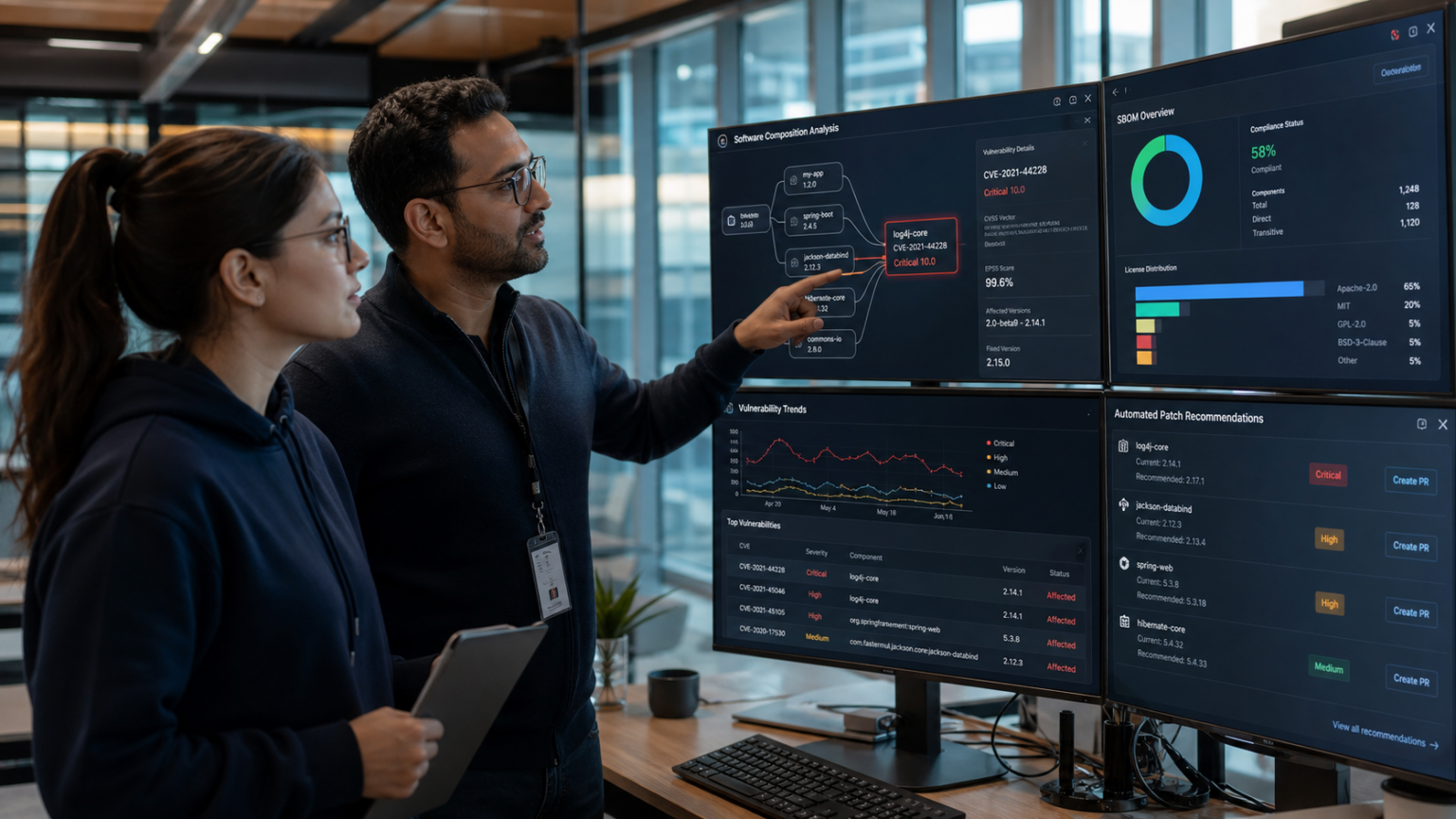
Every modern application is, in a very real sense, mostly someone else’s code. A typical enterprise service might contain a few thousand lines written in-house sitting on top of hundreds of open source packages, each of which has its own dependencies, each of which has its own maintainers, release cadence, and security track record. That’s not a criticism of how software gets built — it’s simply the reality of modern development, and it’s largely why teams can ship as fast as they do. But it also means that the actual attack surface of most applications isn’t the code an organization wrote. It’s the code it imported.
Software composition analysis, or SCA, exists to deal with exactly that problem. At a small scale — a handful of repositories, a couple of teams — dependency risk is manageable with basic tooling and some manual review. At enterprise scale, with hundreds or thousands of repositories, multiple languages, and dependency trees that are frequently four or five levels deep, that same problem becomes a fundamentally different challenge. This is where the gap between a basic scanner and a genuine enterprise SCA platform starts to matter.
Why Dependency Risk Gets Worse, Not Better, With Scale
It’s tempting to assume that dependency risk scales linearly with the number of repositories an organization maintains. In practice, it scales faster than that, for a few structural reasons.
The first is duplication. Large organizations rarely have a single, centrally enforced list of approved package versions. Different teams, often working independently, end up pulling in different versions of the same library, sometimes years apart. That means a critical vulnerability disclosed in a popular package doesn’t affect one place in the codebase — it affects however many divergent versions of that package happen to be scattered across however many repositories, each potentially requiring a different remediation path depending on what else depends on it.
The second is transitive depth. A direct dependency an engineer deliberately chose is relatively easy to reason about. The real risk usually lives several layers down, in packages nobody on the team ever explicitly decided to use, pulled in automatically because something they did choose depends on them. At enterprise scale, transitive dependencies routinely outnumber direct ones by an order of magnitude, and most of them are effectively invisible without tooling built specifically to surface them.
The third is organizational fragmentation. Different teams adopt different scanning tools, different severity thresholds, and different remediation timelines, which means a security team trying to get an accurate picture of dependency risk across the whole organization is often stitching together inconsistent reports from a dozen disconnected sources. That fragmentation is arguably the biggest reason dependency risk feels unmanageable at scale — not because any individual vulnerability is unusually hard to fix, but because nobody has a single, trustworthy view of what actually needs fixing first.
Where Basic Scanners Stop Being Enough
Most basic SCA tooling handles the fundamentals reasonably well: parse a manifest file, cross-reference package versions against a vulnerability database, flag anything that matches. That’s a useful starting point, but it tends to break down in a few predictable ways once an organization grows past a certain size.
Alert volume is the most immediate problem. A scanner that flags every known CVE in every dependency, without context on exploitability or actual reachability within the application, generates far more noise than any security team can reasonably triage. Teams on the receiving end of thousands of undifferentiated alerts tend to do exactly what you’d expect: they stop reading them carefully, and real risk gets buried under low-priority noise.
Reachability analysis is what separates tooling that’s genuinely useful from tooling that just generates lists. A vulnerable function sitting in a dependency that’s never actually called by the application in question is a very different risk than the same vulnerability in a function that’s part of an active code path. Enterprise-grade SCA platforms increasingly incorporate reachability analysis specifically to close this gap — determining not just whether a vulnerable package is present, but whether the vulnerable code path is actually exercised, which cuts the effective alert volume dramatically without ignoring genuine risk.
Remediation guidance is another area where basic tools tend to stop short. Knowing a dependency is vulnerable is only half the problem; knowing which version to upgrade to without breaking a dozen other things that depend on it is the part that actually consumes engineering time. Platforms that generate accurate, tested upgrade paths — rather than just naming the vulnerability and leaving the fix to the engineering team — meaningfully shrink the time between disclosure and actual remediation, which is usually the metric that matters most during an active vulnerability disclosure.
What “Enterprise Scale” Actually Demands From a Platform
Scaling SCA tooling across a large organization surfaces requirements that don’t show up at all in smaller deployments.
Centralized visibility across every repository, team, and business unit is the baseline requirement, but it has to come with the ability to slice that visibility by ownership. A security team needs an aggregate view of organizational risk; an individual engineering team needs a filtered view of exactly what applies to their own repositories, without wading through findings that belong to a completely different part of the company. Platforms that only offer one of those two views tend to fail one audience or the other.
Policy enforcement needs to be consistent and centrally configurable, rather than left to individual teams to interpret differently. Severity thresholds, license compliance rules, and approved-package lists all need to apply uniformly, with the ability for a central security or platform team to update policy once and have it take effect everywhere, rather than negotiating the same policy change with dozens of individual teams.
Integration into existing developer workflows is what actually determines adoption. A scanning platform that only surfaces findings in a separate dashboard, disconnected from where engineers actually work, tends to get ignored in practice regardless of how accurate its findings are. Enterprise deployments tend to succeed specifically when findings show up directly inside pull requests and CI pipelines, with enough context that a developer can act on a finding without leaving their existing workflow to go look something up elsewhere.
License compliance deserves its own mention here, since it’s easy to treat as secondary to security scanning but carries real organizational risk of its own. A dependency with a restrictive or incompatible license buried five levels deep in a transitive tree is a legal exposure just as real as a security vulnerability, and enterprise SCA platforms increasingly treat license risk as a first-class finding alongside CVEs rather than a separate afterthought.
The Case for Consolidation Over Fragmentation
One pattern shows up repeatedly in organizations that have struggled to get dependency risk under control: tool sprawl. It’s common for different teams, often for entirely reasonable local reasons, to have adopted different scanners, different secret-detection tools, and different static analysis platforms over time, with no single system tying the results together.
The problem isn’t that any individual tool is bad. It’s that fragmented tooling makes it functionally impossible to answer a simple question honestly: what is our actual, current dependency risk, across the whole organization, right now? Without a consolidated answer to that question, prioritization becomes guesswork, and security teams end up reacting to whichever alert happened to surface loudest rather than the one that actually represents the highest real risk.
This is a big part of why organizations moving toward mature application security programs increasingly consolidate dependency scanning, secret detection, and code security into a single platform rather than maintaining a patchwork of point solutions. Platforms like Aikido Security approach this by combining SCA with the broader set of code security signals — secrets, static analysis, container and infrastructure scanning — into one system with a shared view of risk, rather than treating dependency scanning as an isolated tool bolted onto everything else. That consolidation matters less for any single feature and more for the fact that a unified platform gives a security team one place to actually prioritize from, instead of manually reconciling reports from half a dozen disconnected sources.
Getting Reachability and Prioritization Right in Practice
Even with a strong platform in place, getting real value out of it depends on how prioritization actually gets configured, not just which tool is doing the scanning.
Severity alone is a poor prioritization signal on its own. A critical-rated vulnerability in a dependency that’s never invoked in production is genuinely lower priority than a medium-rated vulnerability sitting directly in a public-facing request path, but severity ratings alone don’t capture that distinction. Teams that get the most value out of enterprise SCA platforms tend to combine severity with reachability and exposure — internet-facing versus internal-only, production versus development — to build a prioritization model that reflects actual risk rather than raw CVE scores.
Ownership mapping matters just as much as technical prioritization. A finding that can’t be routed to the team that actually owns the affected repository tends to sit unaddressed regardless of how accurately it was flagged. Enterprise deployments that tie findings directly to repository ownership, with automatic routing into the right team’s existing workflow, consistently see faster remediation than deployments that rely on a central security team manually triaging and forwarding every finding by hand.
The Bigger Shift This Reflects
Dependency risk at enterprise scale isn’t really a scanning problem anymore — scanning for known vulnerabilities against a database is a solved problem, and has been for years. The actual challenge has moved to signal quality, prioritization, and workflow integration: surfacing the findings that genuinely matter, routing them to the people who can act on them, and doing it consistently across an organization that might span dozens of teams and thousands of repositories.
That shift is why the conversation around SCA tooling has moved away from “does it catch known CVEs” — most tools clear that bar — toward questions about reachability analysis, alert quality, and how well a platform fits into the way engineering teams already work. Organizations that treat dependency risk management as a platform decision rather than a checkbox tool tend to end up with something that actually gets used, rather than something that generates reports nobody has time to read.
