
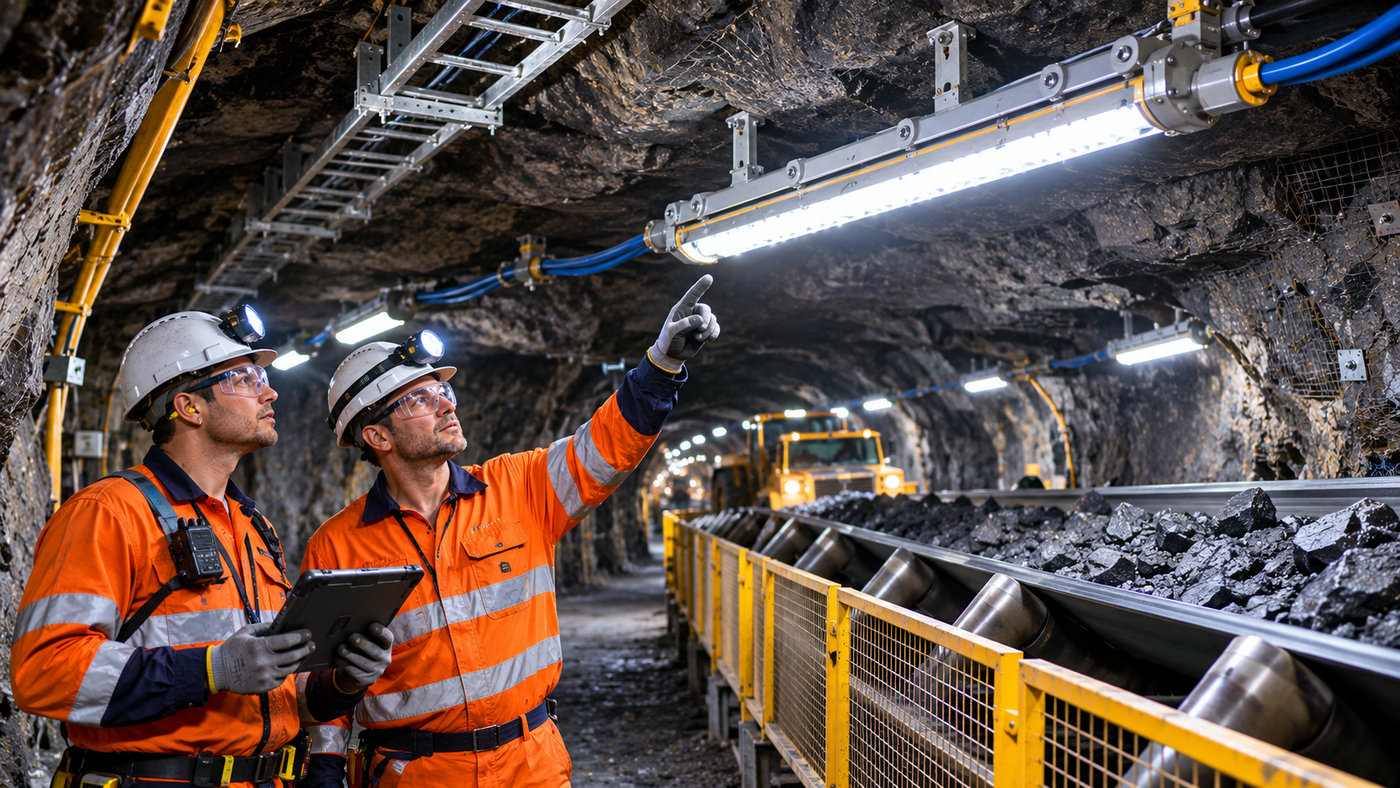
Underground mining is one of the most demanding industrial environments, where worker safety depends on reliable equipment, effective ventilation, continuous monitoring, and appropriate hazard controls. Poor lighting can make already challenging conditions more dangerous by reducing visibility around machinery, walkways, conveyors, and maintenance areas. In mines where methane gas or combustible dust may be present, electrical lighting also requires special attention to ignition risks.
Understanding explosion proof mining lighting is essential for mining companies, electrical engineers, safety managers, and equipment procurement teams. Unlike ordinary industrial lighting, explosion-protected fixtures are designed and assessed to reduce the likelihood that their electrical or thermal energy will ignite a potentially explosive atmosphere.
Modern explosion-protected LED lighting offers opportunities to improve visibility, reduce maintenance requirements, and support more efficient mining operations. However, choosing suitable equipment requires more than selecting a durable light fixture. Certification markings, hazardous area classifications, installation conditions, and ongoing inspections must all be considered.
This guide explains how explosion-protected lighting works, why it matters in mining environments, which technologies are available, and seven important considerations for selecting appropriate lighting equipment.
What Is Explosion Proof Mining Lighting?
Explosion proof mining lighting refers to lighting equipment designed for use in mine environments where explosive gases, combustible dust, or other hazardous atmospheric conditions may create an ignition risk.
The term explosion proof is widely used commercially, but the more precise engineering term is often explosion-protected equipment.
Different explosion-protection techniques prevent ignition in different ways. Some use flameproof enclosures, while others limit electrical energy, encapsulate components, or rely on other assessed methods.
A light does not need to contain an explosion inside a heavy metal housing to qualify as explosion-protected.
Instead, the equipment must use a protection technique appropriate to its certification and intended environment.
Why Ordinary Industrial Lights May Be Unsuitable
Standard commercial lighting is not necessarily designed for potentially explosive atmospheres.
Electrical contacts, faults, hot surfaces, or damaged components can become ignition sources under certain conditions.
In mines where methane or combustible dust may be present, these risks require careful control.
Ordinary waterproof or impact-resistant lighting should not be assumed to provide explosion protection.
The equipment must be assessed against the relevant requirements for its intended application.
Why Explosion Protection Matters in Mining
Mining environments present a combination of mechanical, environmental, and atmospheric hazards.
Electrical safety becomes particularly important in underground coal operations where flammable gases may accumulate.
Methane Gas Hazards
Methane can be released from coal seams during underground mining.
When methane combines with air within a flammable concentration range and encounters an effective ignition source, an explosion may occur.
Ventilation, gas monitoring, and electrical equipment controls are important parts of managing this risk.
Explosion-protected lighting helps reduce ignition hazards associated with the lighting equipment itself.
However, it does not replace atmospheric monitoring or other mine safety measures.
Combustible Coal Dust
Coal dust can create additional explosion hazards under suitable conditions.
Dust may accumulate around equipment, conveyor systems, and processing areas.
Electrical equipment intended for combustible dust environments must be suitable for the applicable conditions.
Restricted Underground Visibility
Mining tunnels may contain uneven surfaces, moving machinery, equipment cables, and areas with limited natural light.
Insufficient illumination can make it harder to identify hazards.
Appropriate lighting supports visibility during inspections, movement, equipment operation, and maintenance.
Harsh Operating Conditions
Mining equipment may experience vibration, moisture, dust contamination, mechanical impacts, and temperature fluctuations.
Lighting systems should be selected to withstand their intended environment without compromising certified protective features.
7 Essential Considerations for Explosion-Protected Mining Lighting
Selecting suitable lighting requires a structured assessment of safety, performance, installation, and maintenance.
The following seven considerations provide a practical framework for evaluating explosion proof mining lighting systems.
1. Understand Hazardous Area Classification
Hazardous area classification identifies locations where explosive atmospheres may be present and helps determine the required equipment protection.
Before choosing a lighting system, the responsible engineering team should understand the mine’s applicable risk classification.
Gas and Dust Hazardous Zones
Outside the special underground mining classification systems, hazardous areas may be described using zones.
For explosive gas atmospheres:
- Zone 0: An explosive gas atmosphere is present continuously, for long periods, or frequently.
- Zone 1: An explosive gas atmosphere is likely to occur occasionally during normal operation.
- Zone 2: An explosive gas atmosphere is not likely during normal operation, or is expected to persist only briefly if it occurs.
For combustible dust atmospheres, Zones 20, 21, and 22 describe corresponding levels of likelihood and duration.
These classifications help inform equipment selection, but not every zone-rated product is suitable for underground coal mining.
Underground Coal Mine Explosion Risk Zones
Australian underground coal mines may use specific classifications such as ERZ0, ERZ1, and NERZ.
These refer to explosion risk zones under relevant coal mining legislation.
They are not automatically interchangeable with the conventional gas Zone 0, Zone 1, and Zone 2 system.
Equipment selection must consider the applicable mining legislation and the actual site conditions.
Why Classification Matters
A fixture suitable for one hazardous location may not provide the required protection for another.
Incorrect equipment selection can create unnecessary risks and regulatory problems.
Hazard classification should be completed or reviewed by appropriately qualified personnel.
2. Verify IECEx Certification and Equipment Markings
Certification provides important evidence that equipment has been assessed against specified explosion-protection requirements.
For explosion proof mining applications, technical teams should examine the actual certification documents rather than relying on general marketing descriptions.
What Is IECEx Certification?
IECEx is an international conformity assessment system covering equipment and related services for explosive atmospheres.
The scheme supports consistent assessment against applicable international standards.
Certified equipment may carry markings describing its protection technique, equipment group, protection level, and other operating limitations.
Understanding Equipment Groups
Group I equipment is associated with mines susceptible to firedamp, including relevant underground coal mining applications.
Group II equipment applies to explosive gas atmospheres in other locations.
Group III equipment relates to combustible dust atmospheres outside the Group I mining context.
The required designation depends on the environment.
Equipment Protection Levels
Equipment Protection Levels, or EPLs, describe the level of protection provided by equipment under specified conditions.
For Group I mining applications, relevant levels include Ma and Mb.
The designation must be evaluated alongside the full certification and applicable mining requirements.
Why Certificate Details Matter
A certificate may identify specific model numbers, permitted ambient temperatures, electrical ratings, and special conditions of use.
Manufacturers sometimes supply several product versions with different technical limitations.
A general statement that a product family is certified does not establish that every possible configuration is approved for a particular mine.
3. Select an Appropriate Explosion-Protection Technique
Not all explosion-protected lighting uses the same engineering approach.
Understanding the available protection methods helps explain why certified products can look very different.
Flameproof Enclosures
Flameproof equipment, commonly identified using Ex d protection, is designed so an internal explosion under specified conditions does not ignite the surrounding explosive atmosphere.
This approach uses carefully engineered enclosure construction and flame paths.
Intrinsic Safety
Intrinsic safety, commonly associated with Ex i, limits electrical and thermal energy so that ignition is prevented under the relevant assessed conditions.
This technique is often used for low-energy electrical and electronic equipment.
Encapsulation Protection
Encapsulation, commonly associated with Ex m, protects electrical components within an appropriate encapsulating material.
The design is intended to prevent ignition under the specified protection conditions.
Some modern LED strip systems use encapsulation rather than traditional flameproof housings.
Choosing the Right Technology
The appropriate technique depends on equipment requirements, environmental conditions, certification, and intended installation.
One technique should not automatically be described as safer than another without considering the actual application.
The complete certified system must provide the required protection.
4. Improve Visibility With Suitable LED Lighting
Lighting quality directly influences how well workers can see equipment, pathways, obstacles, and potential hazards.
Modern LED systems can provide efficient illumination in demanding industrial environments.
Continuous Lighting for Walkways
Long lighting runs can help illuminate extended underground corridors.
Compared with widely spaced individual fixtures, appropriately designed continuous systems may reduce dark sections and uneven illumination.
However, actual performance depends on the installation layout, lumen output, mounting position, and environmental conditions.
Conveyor and Machinery Lighting
Conveyor systems require suitable visibility for inspection and maintenance.
Properly positioned lighting can help workers identify material accumulation, damaged components, and other visible problems.
Lighting must not interfere with guards, equipment operation, or safe maintenance access.
Reducing Glare and Shadows
Bright light alone does not guarantee good visibility.
Excessive glare can make it difficult to see details, while poorly directed lighting may create deep shadows.
Lighting design should consider distribution, contrast, mounting height, and worker tasks.
Emergency Visibility
Emergency lighting may support evacuation and essential activities during power interruptions.
In hazardous locations, emergency equipment and its associated power systems must also meet applicable safety requirements.
Emergency lighting should be designed according to the mine’s approved emergency management arrangements.
5. Choose Durable Equipment for Underground Conditions
Mining lighting must withstand more than ordinary indoor environmental exposure.
Durability is important because physical damage can affect both performance and explosion protection.
Dust and Water Resistance
Ingress Protection ratings describe tested resistance to particular levels of solid particle and water intrusion.
For example, IP67 indicates a specified level of dust protection and resistance to temporary immersion under defined test conditions.
However, IP67 is not an explosion-protection certification.
Both environmental protection and hazardous-area suitability must be considered separately.
Mechanical Impact Resistance
Underground equipment may be exposed to impacts during installation, maintenance, and daily operations.
Mounting arrangements should protect lighting from foreseeable damage.
Any special mechanical protection requirements stated on the certificate must be followed.
Temperature Compatibility
Equipment may have specified ambient operating temperature limits and temperature-related protection markings.
These limits are important for explosion protection.
Products should not be installed in conditions outside their approved operating range.
Resistance to Vibration
Mining machinery and conveyor systems may generate continuous vibration.
Cable connections, mounting brackets, and lighting housings should be appropriate for the intended operating environment.
Regular inspections can help identify deterioration before it creates more serious problems.
6. Evaluate Energy Efficiency and Maintenance Costs
Energy efficiency is an important consideration for mining companies operating large lighting networks.
However, energy consumption should be assessed alongside illumination requirements and total system costs.
Benefits of LED Technology
LED lighting can offer advantages such as:
- Efficient conversion of electricity into visible light.
- Long service intervals under suitable operating conditions.
- Flexible lighting arrangements.
- Reduced need for frequent lamp replacement.
- More compact designs for selected applications.
Actual savings depend on the previous lighting system, installation conditions, operating hours, and product performance.
Compare Complete System Efficiency
A fair comparison should consider light output, electrical power, control equipment, and illumination delivered to the required work area.
A lower-wattage product is not automatically better if it fails to provide adequate lighting.
Maintenance Requirements
Replacing lights in underground mines may require access planning, equipment isolation, qualified personnel, and operational downtime.
Long-lasting lighting may help reduce the frequency of these activities.
However, certified equipment still requires inspections and maintenance.
Calculate Total Cost of Ownership
The total cost of explosion proof mining lighting should include:
- Initial equipment purchase.
- Engineering and design work.
- Installation and commissioning.
- Electricity consumption.
- Inspections and maintenance.
- Replacement components.
- Production interruptions where relevant.
- End-of-life replacement.
Considering these costs provides a more realistic comparison than focusing exclusively on purchase price.
7. Follow Proper Installation and Inspection Procedures
Even correctly certified lighting may become unsafe if it is installed or maintained incorrectly.
Installation quality is therefore essential.
Use Qualified Personnel
Electrical work in hazardous mining environments should be performed by personnel with the relevant training, qualifications, and authorizations.
Installation teams must understand the requirements of the equipment and the mine’s electrical safety management system.
Follow Manufacturer Instructions
Certified lighting may have specific requirements for mounting, cable connections, power supplies, and protective accessories.
These instructions form an important part of maintaining conformity with the approved equipment design.
Check the Complete Electrical System
A certified light does not automatically make every connected component suitable for a hazardous area.
Power supplies, connectors, cable entries, control equipment, and installation arrangements require appropriate assessment.
Conduct Initial Inspections
Before commissioning, equipment should undergo the inspections and tests required by the applicable standards, legislation, and site procedures.
Relevant records should be maintained.
Maintain Inspection Records
Inspections should document the condition of equipment, identified defects, corrective actions, and relevant follow-up requirements.
This helps demonstrate that explosion proof mining lighting remains appropriately managed throughout its operating life.
Australian Standards for Explosion-Protected Mining Equipment
Australian mining projects must consider applicable state or territory legislation and relevant technical standards.
There is no single certification label that automatically establishes suitability for every mine.
AS/NZS 60079 Series
The AS/NZS 60079 series addresses important aspects of equipment and explosive atmospheres.
Relevant parts cover different protection techniques and hazardous area considerations.
The specific editions and requirements must be determined for the project.
Underground Coal Mining Requirements
Underground coal operations may have additional obligations concerning equipment protection, inspection, installation, and maintenance.
Queensland’s Recognised Standard 01 addresses underground electrical equipment and electrical installations.
It includes provisions relating to explosion risk zones, protection techniques, maintenance, and inspection.
International Mining Equipment Standards
ISO/IEC 80079-38:2026 addresses explosion-protection requirements for equipment and components intended for Group I underground mining applications.
Its scope includes equipment intended for mines susceptible to explosive atmospheres involving firedamp or combustible dust.
Important Compliance Distinction
General hazardous-area installation standards do not necessarily apply unchanged to underground mines susceptible to firedamp.
Mining-specific provisions must be considered.
Qualified electrical and mine safety professionals should determine the requirements for each installation.
Explosion Proof LED Strip Lighting in Mining
Continuous LED strip lighting has become an option for selected industrial and mining applications.
Unlike conventional individual luminaires, strip systems can provide extended runs of light along tunnels, walkways, and conveyor areas.
Flexible Installation Options
Some systems are manufactured in configurable lengths and can accommodate different mounting arrangements.
This flexibility may help lighting designers address irregular layouts and limited spaces.
However, installation must remain within certified product limits.
Reduced Dark Areas
Continuous lighting can help improve illumination uniformity.
Appropriate spacing and light distribution remain important.
Lighting performance should be evaluated through suitable engineering calculations and onsite verification.
Low-Voltage Systems
Certain explosion-protected LED systems operate at relatively low supply voltages.
However, low voltage alone does not make equipment safe for explosive atmospheres.
Certification, current limitation, fault protection, and the complete system design still matter.
Practical Applications
LED strip lighting may be appropriate for selected underground tunnels, conveyor corridors, maintenance areas, and processing infrastructure.
The actual application depends on certification and site classification.
MineGlow Explosion-Protected Lighting Solutions
MineGlow is an Australian company specializing in industrial LED lighting for demanding environments.
Its explosion-protected product range includes SafeGlo lighting systems designed for selected hazardous locations.
SafeGlo EXM Lighting
MineGlow describes SafeGlo EXM as a flexible, encapsulated LED strip lighting system.
The company lists configurations with 24V, 36V, and 48V options.
Its published specifications identify IECEx and ATEX certification for specified product versions.
Applications in Mining
MineGlow describes its products as suitable for selected underground mining, conveyor, coal-handling, and industrial hazardous-area applications.
The company also reports an installation involving a Queensland coal mine’s coal wash plant, reclaim tunnels, and conveyor infrastructure.
These examples demonstrate possible applications, but suitability for a new site must be assessed independently.
Certification and Technical Verification
MineGlow publishes certification information and indicates that supporting documents are available.
For procurement, engineers should verify the exact model, certificate number, relevant markings, special conditions of use, and the suitability of associated equipment.
A product’s general suitability description should not replace a site-specific engineering assessment.
Common Explosion-Protected Lighting Applications
Different mine locations have different lighting requirements.
Underground Coal Mine Tunnels
Underground corridors may require continuous illumination for personnel movement and operational inspections.
Equipment must satisfy applicable underground mine requirements.
Conveyor Belt Systems
Conveyors often extend over long distances and may require lighting for inspection and maintenance.
Durable, appropriately positioned systems can help support visibility.
Coal Processing Facilities
Coal preparation and handling areas may contain combustible dust hazards.
The required lighting protection depends on the formal hazardous area assessment.
Maintenance Locations
Temporary or permanent maintenance areas may require task-specific illumination.
Portable lighting must be suitable for the environment and managed according to site procedures.
Emergency Routes
Evacuation routes require appropriate visibility and emergency arrangements.
Any emergency system used in a hazardous location must be compatible with relevant safety requirements.
Common Mistakes to Avoid When Selecting Mining Lighting
Incorrect assumptions about equipment suitability can create serious operational and safety problems.
Assuming Waterproof Means Explosion-Protected
A high IP rating does not establish suitability for explosive atmospheres.
Separate explosion-protection assessment is required.
Ignoring Equipment Group Markings
Not all equipment certified for gas or dust locations is appropriate for underground firedamp mines.
Check Group I suitability where required.
Using Incompatible Components
A certified lighting strip may require specified connectors, controls, and power arrangements.
Unapproved combinations can compromise the certified system.
Ignoring Special Conditions of Use
Some certificates contain limitations that must be observed during installation.
Failure to consider these requirements may invalidate assumptions about suitability.
Choosing Lighting Based Only on Brightness
Excessive brightness, poor distribution, or glare can reduce visual comfort.
Lighting should be designed for the actual task and environment.
Neglecting Ongoing Inspections
Installation approval does not eliminate the need for maintenance.
Certified equipment can deteriorate through damage, environmental exposure, or inappropriate modifications.
How to Choose a Reliable Explosion-Protected Lighting Supplier
Mining companies should evaluate suppliers according to technical suitability, documentation quality, and service support.
Request Certification Documents
Ask for relevant certificates and confirm that the proposed model and configuration are covered.
Review Technical Specifications
Evaluate electrical ratings, environmental limits, dimensions, light output, and installation requirements.
Confirm Mining Experience
Experience with relevant mine environments may help suppliers understand practical installation challenges.
However, previous projects do not automatically establish suitability for a different site.
Evaluate Maintenance Support
Check the availability of spare parts, technical documentation, and appropriate support.
Compare Whole-Life Costs
Review installation, energy consumption, maintenance, and replacement requirements.
Prioritize Site-Specific Compliance
The final decision should be supported by qualified engineering review and applicable safety approval processes.
The Future of Explosion Proof Mining Technology
Mining safety technology continues to develop through improved materials, efficient lighting, remote monitoring, and more integrated equipment management.
Advanced LED Designs
Manufacturers are exploring lighting systems with improved durability, efficient operation, and flexible installation arrangements.
These developments may help address demanding underground conditions.
Smarter Monitoring
Connected systems may provide information about operating status, faults, and maintenance needs.
Any communications or monitoring equipment used in hazardous environments must also meet relevant protection requirements.
Improved Emergency Lighting
Future systems may offer better integration with approved emergency management arrangements.
Reliability and maintainability will remain important.
Energy-Efficient Mining Infrastructure
Lighting upgrades can form part of broader energy management programs.
However, savings should be demonstrated using suitable performance comparisons rather than assumed percentages.
Greater Focus on Documentation
Digital asset registers and inspection records may help maintenance teams track certified equipment throughout its lifecycle.
The most valuable innovation will combine practical performance with verified safety.
Frequently Asked Questions
1. What is explosion proof mining lighting?
Explosion proof mining lighting refers to electrical lighting designed and assessed for use in specified hazardous mining environments. Depending on the application, protection may involve flameproof construction, encapsulation, intrinsic safety, or another approved technique.
2. Why is explosion-protected lighting important in coal mines?
Underground coal mines may contain methane and combustible dust. Suitable explosion-protected equipment helps control ignition risks associated with electrical lighting while providing visibility for workers.
3. What certifications should mining lighting have?
Certification requirements depend on the mine and applicable jurisdiction. IECEx markings, relevant equipment groups, protection levels, and Australian technical requirements may be important. The complete certificate should be checked.
4. Are all LED lights suitable for underground mining?
No. Ordinary LED lighting is not automatically suitable for explosive atmospheres. Underground equipment must meet the applicable electrical safety and explosion-protection requirements.
5. What is the difference between IP67 and IECEx certification?
IP67 describes tested resistance to dust and water ingress. IECEx certification addresses conformity with specified requirements for equipment used in explosive atmospheres. They serve different purposes.
6. How often should explosion-protected mining lights be inspected?
Inspection intervals depend on applicable mining legislation, technical standards, manufacturer instructions, equipment condition, and site procedures. Qualified personnel should establish and follow the required inspection program.
Conclusion
Explosion proof mining lighting plays an important role in controlling electrical ignition hazards while supporting visibility across demanding underground and industrial environments. Selecting suitable equipment requires careful attention to hazardous area classifications, certification markings, lighting performance, and installation conditions. Modern LED technology can improve operational efficiency, but certified protection and ongoing inspection remain essential. Mining companies should prioritize qualified engineering assessments and site-specific compliance when planning lighting upgrades.
