
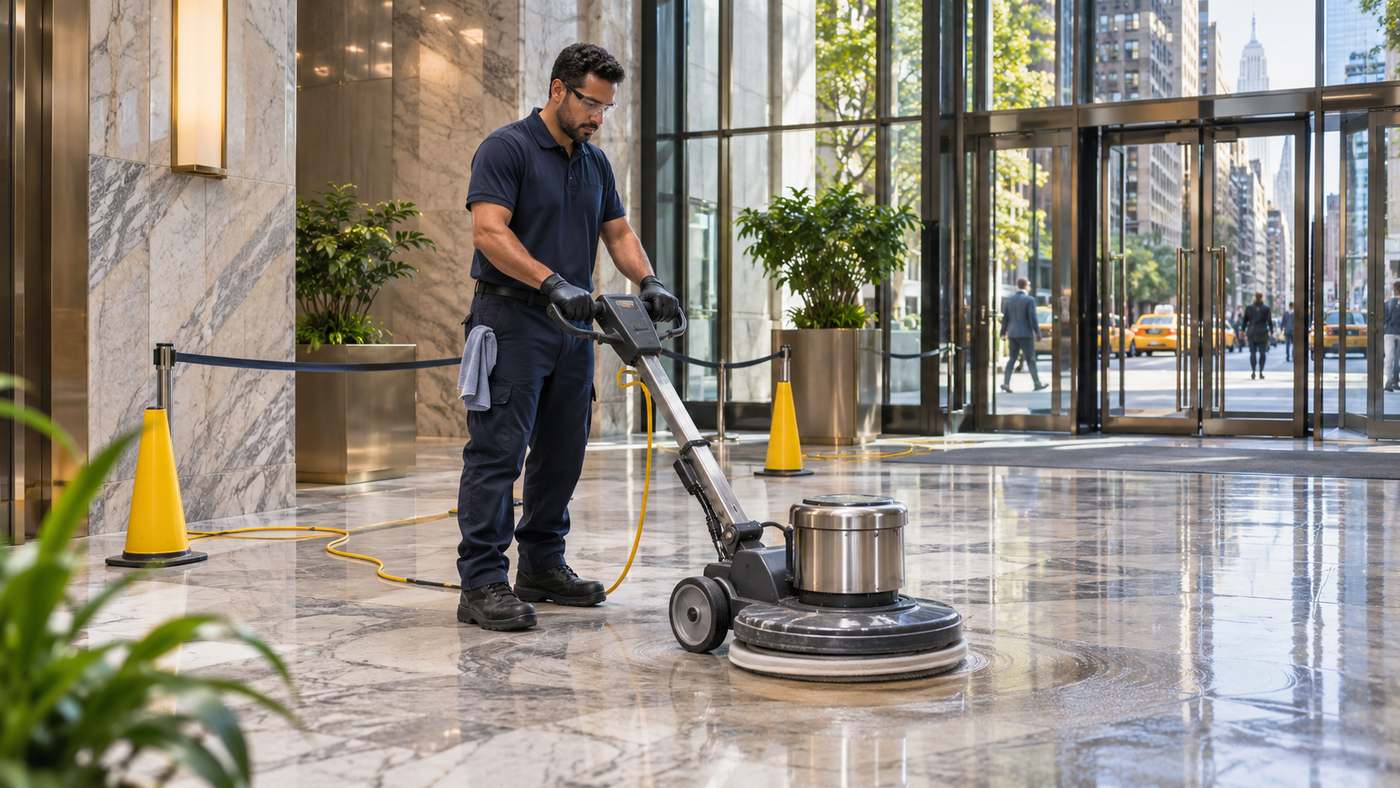
New York City floors work hard. Office lobbies handle a steady flow of commuters, apartment hallways collect grit from the street, and restaurants contend with spills and frequent cleaning. Choosing floor care services in NYC means finding a provider that understands the material underfoot, the level of traffic, and the building’s operating requirements. A process that improves one surface may permanently damage another, so assessment comes before equipment or chemicals.
Professional floor care goes beyond routine sweeping and mopping. Depending on the floor, it may involve machine scrubbing, grout cleaning, buffing, refinishing, stone honing, carpet extraction, or a planned maintenance schedule. The right service aims to preserve the surface, maintain an appropriate level of traction, and reduce avoidable disruption—not simply produce the highest possible shine.
This guide explains the main services available across Manhattan, Brooklyn, Queens, the Bronx, and Staten Island; how to compare contractors and estimates; and how to plan safe, cost-conscious maintenance in busy residential and commercial buildings.
What Are Professional Floor Care Services?
Professional floor care is the cleaning, protection, and maintenance of floor surfaces using methods appropriate to their construction and condition. A basic service may remove daily soil; a more involved treatment may remove worn finish, restore a suitable coating, or correct a damaged stone surface. Cleaning and restoration are different scopes of work, and neither should be assumed from a vague quotation.
For property managers evaluating floor care services in NYC, the first question is what problem needs solving. Is the floor merely dirty, or is its protective finish worn? Are dark lines caused by stained grout, trapped soil, or damaged material? Can a deep scrub improve the appearance without stripping away a coating? An on-site assessment should answer these questions before the contractor recommends a process.
Residential and Commercial Floor Care
Residential projects may include hardwood cleaning, tile and grout maintenance, entryway stone care, and building common areas. Commercial projects often involve larger floor areas, specialized machines, frequent foot traffic, and work outside operating hours. Both need appropriate surface identification and protection of nearby furnishings and finishes.
Maintenance Versus Restoration
Routine maintenance removes soil and helps preserve an existing finish. Restoration addresses deterioration that routine cleaning cannot fix, such as heavily scratched stone, worn floor finish, or persistent embedded grime. Some damage requires a flooring specialist or replacement rather than more aggressive cleaning.
Floor Types Covered by Floor Care Services in NYC
The range of floor care services in NYC reflects the city’s mix of prewar apartment buildings, newer residential towers, shops, offices, hospitality venues, and institutional facilities. A qualified contractor should distinguish among surfaces before selecting brushes, pads, detergents, moisture levels, and finishes.
Hardwood and Engineered Wood
Wood floors may have polyurethane, oil, wax, or other finishes. The correct maintenance approach depends on that coating, not just the wood species. Excessive water, steam, abrasive pads, or incompatible chemicals can cause swelling, dullness, or finish damage. A floor that has worn through to bare wood may need professional refinishing rather than another cleaning treatment.
Marble, Limestone, Granite, and Terrazzo
Natural stone and terrazzo appear in some prominent lobbies and older properties. Marble and limestone can react to acidic products, creating dull etched areas that ordinary cleaners cannot reverse. Honing and polishing may improve suitable stone, but the technique should match the material, finish, and existing damage. Ask whether sealing is needed; not every stone surface benefits from the same treatment.
Ceramic and Porcelain Tile
Tile surfaces may withstand regular damp cleaning, yet grout can become discoloured and collect soil. Effective maintenance considers both the tile and the grout joints. An excessively aggressive tool can damage grout, coatings, or surrounding sealant. Cleaning may improve appearance, but cracked joints or water intrusion require repair rather than chemical treatment.
VCT, LVT, and Other Resilient Flooring
Vinyl composition tile (VCT) may use a maintainable floor finish, making scrubbing, recoating, and periodic stripping relevant. Luxury vinyl tile (LVT), sheet vinyl, and other modern resilient floors can have factory-applied wear layers that should not be treated like traditional waxed VCT. Manufacturer instructions determine whether polish, stripping chemicals, or burnishing are appropriate.
Concrete, Epoxy, and Carpeting
Concrete may be sealed, coated, or mechanically polished, each requiring a different maintenance plan. Epoxy systems need compatible cleaners and attention to traction, particularly when wet. Carpeted offices and hallways may benefit from vacuuming, spotting, and scheduled extraction, but aggressive water use can cause prolonged drying and other issues.
15 Proven Tips for Choosing Floor Care Services in NYC
1. Identify Every Floor Material Before Requesting a Price
Create a list of the floor surfaces, approximate areas, and current concerns. A mixed-use building may contain stone in the lobby, VCT in service corridors, carpet in offices, and wood in residential units. Each may require a different procedure. When contacting floor care services in NYC, send photographs if available, but expect a professional to confirm the surface and condition before recommending an intensive treatment.
2. Ask for an On-Site Condition Assessment
A proper assessment can reveal worn coatings, cracks, residue, uneven surfaces, water damage, or previous cleaning mistakes. Contractors should explain what is likely to improve and what will remain visible. Test patches on an inconspicuous area are especially useful for uncertain finishes or sensitive stone. Avoid promises of complete restoration before the material is identified.
3. Match Cleaning Methods to the Manufacturer’s Guidance
Neutral-pH cleaning may suit many routine applications, but it is not automatically correct for every surface or stain. Follow the floor manufacturer’s instructions, check coating compatibility, and use the specified dilution. Professional floor care services in NYC should be able to describe why a product or machine is appropriate rather than claiming that one chemical works everywhere.
4. Distinguish Scrubbing From Stripping
Machine scrubbing removes soil and deposits from an appropriate surface. Stripping removes an existing finish and usually prepares a suitable floor for recoating. These are not interchangeable services. VCT with badly deteriorated finish may need stripping, whereas a modern factory-finished resilient product may be harmed by a stripper. Request an explanation of the proposed work and the expected result.
5. Understand Buffing, Burnishing, and Polishing
These terms are sometimes used loosely in advertising. Buffing or burnishing may restore the appearance of a compatible floor finish, while stone polishing involves different equipment, abrasives, and expertise. A glossy result is not necessarily desirable on every surface. For floor care services in NYC, ask what exact process is planned, whether it changes traction, and what ongoing maintenance will be required.
6. Review Stone-Care Experience Closely
Marble, terrazzo, and other stone surfaces can be expensive to repair after incorrect treatment. Ask for experience with the same material and finish, documentation of the planned process, and examples of comparable work. Acidic cleaners and overly abrasive pads are particular concerns for certain stones. A reputable specialist should explain the limits of cleaning versus honing, polishing, or repair.
7. Prioritize Slip Prevention During the Work
Wet floors can create serious hazards for occupants, visitors, and workers. The U.S. Occupational Safety and Health Administration requires employers to maintain walking-working surfaces in a clean and, to the extent feasible, dry condition. Use barriers, appropriate warnings, controlled work zones, and alternate routes when necessary. The contractor should not leave an entrance or corridor unsafe simply to finish faster.
8. Confirm Insurance and Building Access Requirements
Many New York City residential and commercial buildings have vendor-registration procedures, service entrances, elevator reservations, and certificate-of-insurance requirements. Ask the property manager what documents are needed before scheduling. Do not assume that a company advertising floor care services in NYC has already been approved by your building. Verify current coverage and clarify who is responsible for damage to nearby property.
9. Arrange Work Around Building Occupancy
After-hours or weekend scheduling may allow deep cleaning without interrupting normal business. Apartment lobbies and shared corridors may need phased work so residents retain a safe access route. Ask when cleaning begins, when the surface can be walked on, and when furniture or equipment can return. Dry-to-touch time and full coating cure time are not necessarily the same.
10. Include New York Weather in the Maintenance Plan
Rain, slush, and winter de-icing residue can increase soil and moisture at entrances. Good entrance matting and frequent removal of tracked-in grit can protect surfaces between professional visits. During wet months, properties may need more frequent attention to mats, spills, and high-traffic pathways. A seasonal plan is often more useful than identical cleaning regardless of conditions.
11. Ask About Product Safety and Ventilation
Request the names of chemicals used and relevant safety data sheets. Products should be chosen for the floor, cleaning purpose, and occupied setting. The EPA Safer Choice program and New York State GreenNY specifications can provide useful criteria when evaluating applicable cleaning products. A certification does not remove the need for ventilation, correct dilution, safe storage, or compatibility checks.
12. Plan Wastewater and Chemical Handling
Machine cleaning and stripping can produce wastewater containing soil, residues, and cleaning chemicals. Ask how it will be collected, contained, and disposed of in compliance with applicable requirements. Never assume that runoff can be discharged onto a sidewalk, street, or storm drain. The work plan should also account for protecting drains and adjacent surfaces from spills.
13. Compare Detailed Written Estimates
The cheapest bid can become expensive if it excludes moving furniture, material-specific treatment, protective coats, edge detailing, waste handling, or return visits. For floor care services in NYC, require the quote to identify square footage, floor types, preparation, services, product categories, working hours, and expected downtime. Compare equivalent scopes rather than a single total price.
14. Request a Realistic Maintenance Schedule
Some floors benefit from frequent light cleaning and occasional deeper work. Others need periodic polishing, recoating, or specialized assessment. The appropriate interval depends on traffic, soil exposure, floor condition, and the manufacturer’s guidance. Avoid automatic annual stripping when routine scrubbing and maintenance could preserve a serviceable finish.
15. Inspect the Result and Document the Handover
Before accepting completed work, check for consistent appearance, remaining residue, visible damage, sticky areas, unsafe slipperiness, and unfinished edges. Confirm that floors are ready for the intended use and that temporary barriers are removed safely. Keep records of products applied, maintenance instructions, before-and-after photographs where useful, and the agreed process for addressing problems.
Services You May See on NYC Floor Care Estimates
Cleaning companies in the city advertise a range of processes, and similar names can conceal different levels of work. Ask exactly what each service involves.
| Service | Appropriate purpose | Important caution |
|---|---|---|
| Routine damp cleaning | Remove surface soil | Use compatible moisture and cleaner |
| Machine scrubbing | Lift embedded grime on suitable floors | Pad and chemical must match surface |
| VCT stripping and refinishing | Remove worn finish and apply a new compatible coating | Not appropriate for all vinyl floors |
| Buffing or burnishing | Maintain a compatible floor finish | May affect gloss and slip characteristics |
| Stone honing and polishing | Address certain scratches, etching, or dullness | Requires material-specific skill |
| Tile and grout cleaning | Remove soil from tile and grout | Damaged grout may require repair |
| Carpet extraction | Remove accumulated soil from carpet | Control moisture and drying time |
| Concrete or epoxy maintenance | Clean a coated or polished industrial surface | Existing coating determines method |
A professional proposal for floor care services in NYC should specify the intended finish and any limitations. For example, removing scratches from a damaged marble floor is different from cleaning it, while repairing a failing wood finish can involve sanding and refinishing beyond a routine maintenance visit.
Commercial Floor Care Services in NYC for Offices and Stores
Busy commercial premises often need a defined maintenance program. Rather than scheduling the same deep clean everywhere, identify entrances, elevator lobbies, corridors, kitchens, restrooms, and low-traffic offices as separate areas. These zones experience different soils and wear.
Office Towers and Shared Lobbies
Lobby presentation matters, but safety and ease of cleaning matter just as much. Stone floors may require specialized care, while entrance mats can reduce the amount of grit reaching interior surfaces. For floor care services in NYC office towers, coordinate work with security desks, freight elevators, tenant notices, and building engineers.
Retail and Hospitality Spaces
Stores and hospitality venues may need cleaning outside public hours. Product choice should reflect the floor’s finish and the need to reopen safely. A glossy treatment is not a substitute for proper traction. Restaurants may have additional grease and food-soil concerns, and food-contact cleaning requirements are separate from ordinary floor appearance.
Schools, Clinics, and Sensitive Environments
These settings may impose additional scheduling, access, infection-control, or product requirements. Cleaning and disinfection have different purposes; unnecessary disinfectant use should not be confused with routine floor care. Coordinate any specialized procedures with the facility’s responsible staff and follow applicable protocols.
Residential Floor Care Services in NYC Apartments and Condos
Residential projects have different challenges from commercial floor programs. Tight spaces, existing furniture, neighbouring apartments, building quiet hours, and elevator access can influence the schedule. Historic buildings may also contain older hardwood, terrazzo, or stone that requires careful material identification.
Hardwood Floors in Apartments
A homeowner should know whether the floor has a modern polyurethane finish, an oil finish, or another coating before hiring a cleaner. Incompatible cleaners and excessive water can create damage. If scratches penetrate the finish or the wood has become uneven, ask whether professional refinishing is more appropriate than deep cleaning.
Tile, Grout, and Stone at Home
Bathrooms, kitchens, and entryways may contain ceramic tile, porcelain, or natural stone. Cleaning agents safe for porcelain may not be suitable for marble or limestone. Repeated discoloration around joints can also indicate moisture issues that require repair, not stronger chemicals.
Common Areas in Co-ops and Condominiums
Floor care services in NYC residential buildings often involve lobbies, elevator landings, laundry rooms, and shared hallways. Property managers should coordinate resident notices, alternate routes, work hours, and cleanup of equipment. Confirm whether the contractor can stage supplies without blocking exits or other essential access.
How Much Do Floor Care Services in NYC Cost?
Pricing depends on material, floor area, existing condition, required labor, access, and the service method. A routine scrub of a large open area is different from detailed stone restoration in a small lobby with many edges. Buildings may also pay more for overnight work, restricted access, intensive furniture movement, or multiple treatment and drying stages.
Factors That Affect the Quote
Ask the contractor to identify the measured service area, required preparation, existing finish, machinery, treatment steps, and materials. Additional cost can arise from difficult stains, protective coating removal, grout repair, and multiple visits. Exact prices should come from current site-specific NYC estimates, not an unsupported universal price per square foot.
One-Time Restoration Versus Recurring Care
A one-time project may restore a suitable worn finish, while a recurring agreement provides periodic maintenance intended to keep the floor in better condition. Compare the total annual cost and expected downtime. For floor care services in NYC, a modest ongoing maintenance program may reduce the need for repeated intensive treatments, depending on the floor and traffic.
Questions to Ask Before Signing
Confirm whether the proposal includes site protection, furnishings, material tests, cleaning chemicals, finishing coats, drying time, equipment removal, and follow-up. Ask what happens if the floor cannot achieve the appearance shown in a sample. Put change-order procedures and any warranty or callback terms in writing.
How Often Should Floor Care Services in NYC Be Scheduled?
No single cleaning interval suits every building. A busy lobby may need multiple routine cleanings each day, while a lightly used office needs less frequent attention. Deeper machine work depends on the finish’s condition and accumulated soil. A useful schedule is based on inspections and performance, not an arbitrary calendar alone.
Daily and Weekly Tasks
Remove grit and spills promptly using appropriate equipment. Check entrances and mats for trapped moisture. Inspect for slip risks, damaged tiles, or visible wear and report problems before they worsen.
Monthly and Seasonal Reviews
Assess high-traffic areas, cleaning product performance, and the appearance of protective finishes. In winter, pay additional attention to tracked-in grit and de-icing residue. Review whether the current frequency is sufficient or unnecessarily aggressive.
Periodic Deep Maintenance
Arrange deeper scrubbing, appropriate polishing, recoating, or restoration when the floor’s condition justifies it. Some VCT floors may need periodic stripping and refinishing; many other materials should never receive that treatment. The contractor providing floor care services in NYC should explain when a less intensive method can achieve the intended result.
Safety and Sustainability in Floor Care Services in NYC
An effective floor care program protects workers, occupants, finishes, and the surrounding environment. OSHA guidance emphasizes controlling wet-floor hazards and maintaining safe walking routes. Work zones should be marked and kept accessible only when safe; warning signs are not a substitute for barriers when a surface is genuinely hazardous.
New York State’s GreenNY purchasing specifications address categories including hard-floor cleaners, strippers, finishes, and polish products. They identify recognized third-party environmental certifications, including Green Seal, UL ECOLOGO, and EPA Safer Choice, for applicable purchases. These can help property teams ask informed questions, but any selected product must still suit the floor and required procedure.
Training matters as much as chemistry. Correct dilution, compatible equipment, appropriate protective gear, and controlled wastewater handling can help prevent accidental damage and unnecessary exposure. The goal is to use the least intensive effective process, not the greatest volume of cleaning chemicals.
Common Mistakes to Avoid When Hiring Floor Care Contractors
A frequent mistake is assuming that all hard floors can be waxed or polished with the same machine. Another is choosing the highest gloss without considering traction, glare, or maintenance. Property managers may also overlook the time needed for coats to dry, resulting in early foot traffic and damaged finishes.
Avoid vague promises such as making every old floor look new. Etching, deep scratches, worn-through wood coatings, broken tiles, and structural defects may need specialized restoration or repair. Floor care services in NYC should identify those limitations before work begins rather than relying on unrealistic guarantees.
Finally, do not ignore operational details. A low price is poor value if the contractor cannot satisfy building access rules, protect residents, or provide a safe route through an occupied property.
How to Choose Dependable Floor Care Services in NYC
Look for demonstrated experience with the specific flooring material, a clear inspection process, suitable insurance documentation, and a written scope. Request comparable project references and ask which staff will perform the work. Verify subcontracting arrangements and any relevant building requirements rather than making assumptions about credentials.
The most dependable floor care services in NYC should explain what they will do, why that process is suitable, how long the area will be unavailable, and how the finish should be maintained afterward. This makes the decision easier for homeowners, office managers, and multi-property operators alike.
Frequently Asked Questions
1. What do floor care services in NYC include?
They may include routine cleaning, machine scrubbing, VCT stripping and refinishing, buffing, stone polishing, grout cleaning, carpet extraction, and maintenance plans. The correct service depends on the material and its condition.
2. How much does professional floor cleaning cost in NYC?
Costs vary by square footage, floor type, wear, access, and treatment. A site-specific written estimate is more reliable than a generic citywide price.
3. Can all vinyl floors be stripped and waxed?
No. Traditional VCT may use maintainable coatings, while some luxury vinyl and factory-finished surfaces require different care. Check the manufacturer’s instructions before treatment.
4. How often should commercial floors be polished?
Frequency depends on traffic, finish, and the type of polishing. Inspect the floor and follow the product’s care requirements rather than relying on one standard schedule.
5. Are professional floor cleaning chemicals safe for occupied buildings?
Suitability depends on the product, dilution, ventilation, protective measures, and the floor. Request relevant safety information and plan the work to control access until surfaces are safe.
6. Can NYC floor care companies work after business hours?
Many advertise evening or weekend service, but availability varies. Confirm building access, staffing, drying periods, and the planned reopening time before booking.
Conclusion
Choosing floor care services in NYC starts with identifying the floor material, its actual condition, and how the space is used. Appropriate cleaning, protective treatment, and planned maintenance can preserve appearance without exposing surfaces to unnecessary damage. Compare detailed scopes, verify safety and access procedures, and request realistic expectations before hiring. A well-managed floor care plan makes busy New York properties easier to maintain over time.
