
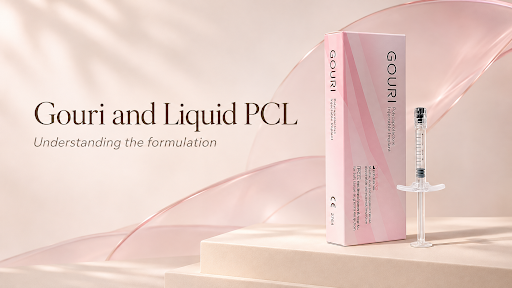
Gouri is a polycaprolactone formulation developed for collagen biostimulation, with a liquid presentation that differs from conventional PCL microsphere suspensions. That distinction matters because a material’s chemical name alone does not describe its physical behavior, clinical purpose, or evidence. A product built around gradual changes in skin quality should be evaluated differently from a gel selected primarily for contour and projection.
For readers exploring Gouri liquid PCL, the most useful starting point is the relationship between polymer, formulation, and treatment objective. “Liquid,” “biodegradable,” and “collagen stimulating” describe different properties. None, by itself, establishes how much improvement an individual will see. Understanding those terms makes product comparisons more informative and helps separate a plausible material concept from a demonstrated clinical result.
What PCL contributes to the formulation
Polycaprolactone, or PCL, is a synthetic biodegradable polyester. Its polymer chains contain ester linkages that can undergo hydrolysis, a chemical process involving water. In aesthetic medicine, PCL has been investigated as a material associated with new collagen formation. Christen and Vercesi’s 2020 review explains the development of PCL-based collagen stimulators, particularly microsphere products. The review provides useful material background; it is not a clinical validation of every later PCL formulation. [2]
Two products can therefore share a polymer without being interchangeable. Chain characteristics, physical structure, carrier ingredients, and manufacturing methods help determine the finished formulation. Comparing PCL products solely by their ingredient name is like comparing two fabrics solely because both contain polyester. The label identifies a material family, while the construction determines many of the properties that matter in use.
It also helps to keep two processes separate: degradation of the introduced material and remodeling of the surrounding tissue. These processes can overlap, but they are not the same clock. A polymer’s persistence cannot be converted directly into a guaranteed duration of visible improvement. A useful clinical explanation should identify the outcome being followed, rather than treating material residence time as a promise about appearance.
What liquid PCL means in this context
DEXLEVO describes Gouri as a liquid-type, microparticle-free PCL formulation produced using its proprietary CESABP technology. The manufacturer’s description differentiates the product from conventional formulations that suspend discrete PCL microspheres in a carrier. Its stated PCL concentration is 21%. These descriptions explain the intended product format; they should not be expanded into blanket claims about superior outcomes or an absence of complications. [1]
“Liquid” does not mean the same thing as water, hyaluronic acid, or a topical serum. Nor does it mean that the product will disperse identically in every tissue or every patient. The useful comparison is between finished formulations, with clinical observations and physical characterization considered together. A simplified illustration of a flowing material can communicate a concept, but it cannot show the complete behavior of a polymer inside living skin.
The word “solubilized” also deserves precision. It reflects the manufacturer’s formulation terminology. It should not be used casually to imply that Gouri behaves like an ordinary low-molecular-weight substance dissolved in a glass of water. For a buyer or reader, recognizing the distinct presentation is more useful than assuming that a familiar everyday meaning explains all of the underlying polymer science.
Comparing formats without declaring a winner
| Feature | Gouri liquid-type PCL | Conventional PCL microsphere formulation | HA gel formulation |
|---|---|---|---|
| Material description | PCL in a proprietary liquid-type format | Discrete PCL microspheres in a carrier | Hyaluronic acid in a formulation-specific gel |
| Useful discussion focus | Skin-quality objectives and product-specific observations | Carrier behavior and microsphere-associated tissue response | Hydration, mechanical properties, or contour, depending on product |
| Poor comparison shortcut | Liquid means universally safer | All PCL products work identically | All HA gels serve the same purpose |
| Evidence needed | Studies of the exact formulation | Studies of the exact formulation | Studies of the exact formulation |
A comparison becomes more useful when it begins with the result someone wants. A person concerned about diffuse texture is asking a different question from someone seeking a sharply defined contour change. Grouping both requests under “rejuvenation” obscures the choice. The product format can help organize the discussion, but the clinical objective should determine which evidence is relevant.
This is also why broad rankings such as “best collagen booster” tend to be unhelpful. They usually combine unlike endpoints, different follow-up periods, and different populations. A material that fits one narrowly defined objective may be unsuitable for another. A meaningful comparison states the intended change first and then asks whether the exact product has evidence addressing that change.
Reading concentration and presentation correctly
A percentage describes composition, not a score for effectiveness. Comparing a PCL percentage with an HA concentration or a powder’s total mass does not create a meaningful strength ranking. The materials differ, the finished forms differ, and the quantities may use different denominators. The first question should always be what the stated number actually measures.
Presentation and outcome are equally easy to confuse. A prefilled format may simplify product handling compared with a powder presentation, but convenience is not the same endpoint as skin elasticity. Likewise, a smaller pack does not necessarily represent a weaker clinical product. Professional product selection benefits from keeping pack size, material content, treatment planning, and expected result on separate lines rather than combining them into a single price-per-milliliter judgment.
What the available human evidence can show
A prospective study published in Dermatology and Therapy in October 2026 followed 30 adults receiving liquid-form PCL treatment. Some skin mechanical measurements changed during follow-up, while hydration decreased. There was no untreated comparison group, and instrumental reporting was restricted to six months after concerns about later measurement reliability. The investigators appropriately described limits to causal and durability conclusions. This is more informative than a promotional summary saying simply that “skin quality improved.” [3]
The lesson is to read individual endpoints. Skin deformation measured by a device, a patient’s satisfaction rating, and a photograph are different kinds of information. Agreement among them can strengthen an interpretation; disagreement should be explored. A positive result on one measurement does not automatically establish improvement in hydration, pigmentation, lifting, and every other feature sometimes placed under the same marketing umbrella.
Preclinical work published in the Journal of Cosmetic Dermatology also investigated liquid-form PCL in experimental photoaging models and laboratory systems. Such studies can explore biological mechanisms. They cannot establish the size or duration of a cosmetic benefit in a person. [4] The practical evidence sequence is material characterization, mechanistic investigation, and then well-designed human evaluation, with each level answering a different question.
Turning a broad goal into an assessable result
A more productive consultation starts with an observable concern. Instead of saying “I want better collagen,” describe whether the concern is fine surface creasing, roughness, loss of firmness, or a change in facial shape. Collagen is a biological component; the visible concern is the outcome that matters to the person. Those two ideas need to be connected rather than treated as synonyms.
The next step is agreeing on how change will be assessed. Standardized photographs should use comparable lighting, facial expression, distance, and camera settings. If a device measurement is used, ask what it measures and whether the same method will be repeated. A photograph taken immediately afterward can also reflect temporary changes, making its timing relevant to interpretation. A planned assessment point is more useful than judging day-to-day fluctuations in a mirror.
For professional product comparisons, create a short decision record with four headings: intended concern, relevant formulation, available evidence, and agreed assessment method. This is a practical way to prevent product claims from taking over the discussion. It also exposes an important mismatch early: evidence about one facial feature may not address the concern that originally brought the person to the clinic.
Frequently asked questions
Is Gouri the same as a conventional PCL filler
No. They share the PCL material family, but the finished formats differ. Gouri is described as liquid-type and microparticle-free, whereas established PCL microsphere products contain discrete particles in a carrier. Results from one formulation should not be assigned automatically to the other. The exact product and study population remain important.
Does liquid PCL mean an immediate lifting result
No. A formulation description does not establish a lifting endpoint. “Lifting” can refer loosely to many visual changes, so it should be translated into something assessable. Ask whether the intended result concerns skin appearance, measured firmness, or an actual contour change, and which evidence supports that particular objective.
Does a higher polymer percentage mean better results
Not necessarily. Percentage is one compositional detail within a finished formulation. It does not account for physical structure, clinical objective, or individual tissue response. Comparisons across different materials are especially unreliable. A relevant product-specific clinical endpoint is more useful than a concentration-based league table.
Can PCL be evaluated using the same expectations as HA
Only after specifying the exact HA product and the intended result. HA formulations span different mechanical properties and clinical purposes. PCL biostimulation and HA gel behavior are not identical concepts. A comparison based on a shared concern can be useful; a blanket statement that one entire material class replaces the other is not.
What should a professional review before adding a new format
Start with how the product fills a real gap in the existing treatment offering. Identify the concern it addresses, the evidence relevant to that concern, and the method used to assess outcomes. A new formulation is most useful when its purpose can be explained clearly, rather than when it merely adds another fashionable ingredient name.
Explore the format with a clear objective
Professionals reviewing the FillersFairy collagen boosters range can use material type and product presentation to organize an initial comparison. For Gouri, the central question is whether a liquid-type PCL approach fits a defined skin-quality objective and the evidence available for that objective. Ask for current product information, discuss the intended result with the treating clinician, and compare like-for-like outcomes before making a selection.
References
1. DEXLEVO. Why Gouri and CESABP Technology. Manufacturer product information, accessed November 2026.
2. Christen MO, Vercesi F. Polycaprolactone: How a Well-Known and Futuristic Polymer Has Become an Innovative Collagen-Stimulator in Esthetics. Clinical, Cosmetic and Investigational Dermatology. 2020;13:31-48.
3. Thongjaroensirikul P, Wanitphakdeedecha R, Maneeprasopchoke P, et al. Skin Quality and Safety Following Liquid-Form Polycaprolactone for Facial Rejuvenation: A Prospective Single-Arm Study. Dermatology and Therapy. 2026.
4. Seo J and colleagues. Liquid-Form Polycaprolactone Injection Enhances Dermal Thickness and Collagen Production in UVB-Induced Photoaging Skin. Journal of Cosmetic Dermatology. 2026.
