
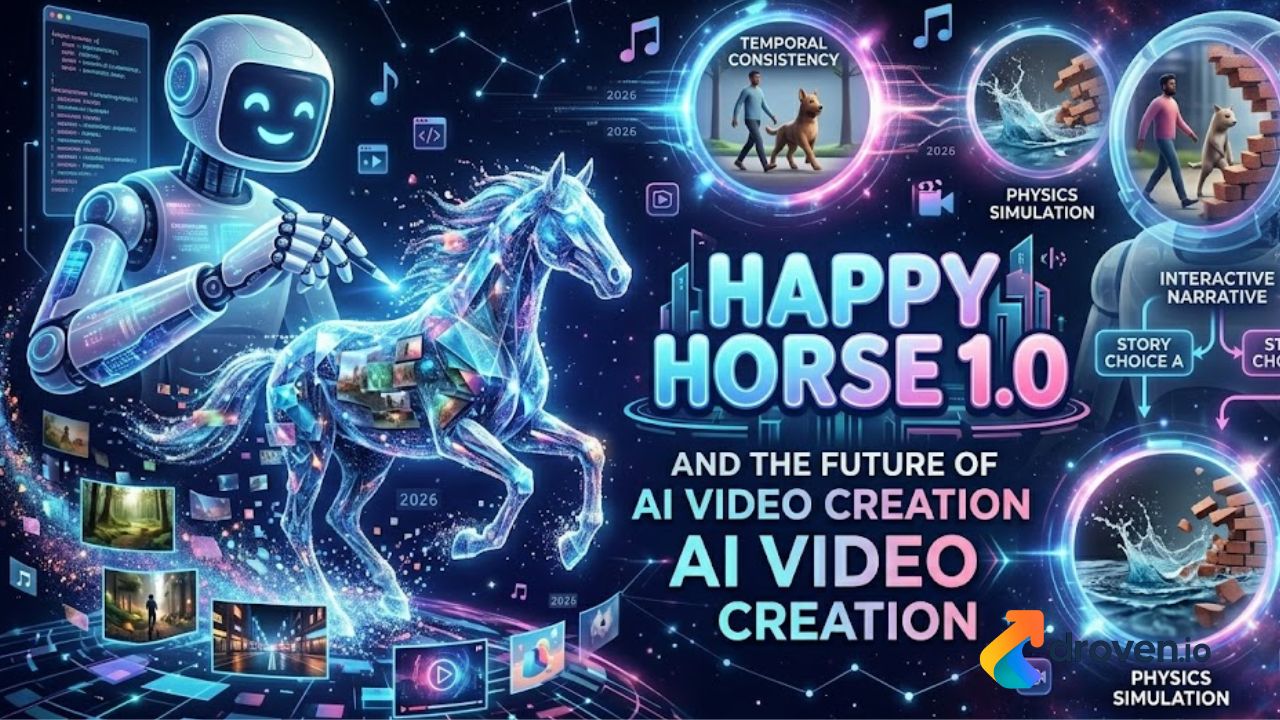
I have been watching AI video tools long enough to notice a clear shift. Not long ago, most experiments felt like demos built to impress people for ten seconds. You could make a still image blink, add a little motion to a background, or generate a short clip that looked interesting until you paid attention to the details. The novelty was real, but the creative control was thin.
That is why Happy Horse 1.0 stands out to me. What makes it worth discussing is not the usual “next big model” hype. It is the fact that creators now expect more than motion. They want consistency, usable pacing, believable transitions, and outputs that can fit into real production workflows instead of staying trapped in a test folder.
Why AI Video Is Entering a More Practical Phase
The demand has changed. Social content teams need more variations in less time. Indie creators want to turn visual ideas into clips without waiting on a full production cycle. Marketers need faster concept validation. Even small studios are looking for tools that can help them move from image-first planning to motion-first storytelling.
That growing pressure has changed how I evaluate new models. I am no longer asking whether a tool can animate something. I am asking whether it can help me move faster without making the result feel disposable.
Happy Horse 1.0 feels part of that broader transition. It points toward a stage where AI video is becoming less about spectacle and more about usefulness.
What Makes Happy Horse 1.0 Worth Watching
When I look at any emerging video model, I focus on a few simple things. Does movement feel intentional, or does it feel like the model is guessing from frame to frame? Do subjects stay stable enough that I could actually build a sequence around them? Can the result survive a second viewing, when the first layer of novelty is gone?
Happy Horse 1.0 interests me because it pushes the conversation toward those questions. Even when a model is not perfect, it matters if it nudges creator expectations upward. The bar is no longer “it moved.” The bar is “could I actually use this in a campaign test, a concept teaser, or a visual pitch?”
That change matters more than one leaderboard moment or one viral clip.
Why Face-Swap Workflows Still Matter
One reason AI video keeps spreading is that it is not a single workflow anymore. It is a bundle of workflows. Some people come in through stylized motion. Others care about product scenes, music visuals, or talking characters. A lot of people still start with identity-driven content, which is why an AI face swap video workflow remains relevant.
I think face-swap tools are often misunderstood because people reduce them to gimmicks. In reality, they sit inside a larger creator habit: testing characters, reworking visual identity, repackaging concepts for different audiences, and building fast-turnaround clips for social platforms. The better tools are not replacing editing craft. They are compressing the time it takes to get a usable first pass.
That is also why model progress matters. The stronger the motion and consistency layer becomes, the more these adjacent workflows improve with it.
Why Image-to-Video Has Become a Core Format
The most important change, in my view, is that image-to-video is no longer a side feature. It is becoming a primary way people prototype and publish. A strong AI image to video tool lets creators start from a single visual anchor and expand it into something with emotion, movement, and platform-ready energy.
That is powerful because images are still the most common creative starting point. Moodboards, product shots, portraits, poster concepts, character art, and campaign visuals all begin as static references. If a tool can extend that starting point into motion quickly, it shortens the gap between idea and audience response.
In practice, that means more testing, more iteration, and more room for creative risk. A team can compare multiple directions without committing to a full production cost upfront. A solo creator can publish more consistently without sacrificing visual ambition.
What Creators Should Still Watch Out For
None of this means AI video has become easy. The most common mistakes are still the same. People ask for too much motion, too many style changes, and too many narrative beats in one generation. That usually leads to drift, warped details, or clips that feel unstable no matter how polished the first frame looked.
I have found that the most useful mindset is restraint. Start with a strong source image. Keep the motion intent simple. Decide what absolutely needs to remain fixed. Treat the first output as a draft, not a finished asset.
The creators getting the best results are rarely the ones writing the most complicated prompts. They are the ones making clearer decisions.
The Real Shift Happening Behind the Hype
What interests me most about Happy Horse 1.0 is not whether it wins every comparison. It is that it reflects a broader maturing of the category. AI video creation is moving away from one-off curiosity and toward repeatable creative practice.
That does not mean every project suddenly becomes easier. It means the tools are starting to earn a place in real workflows. That is a much more important milestone.
Final Thoughts
I do not see Happy Horse 1.0 as a magic answer to AI video creation. I see it as a signal. It signals that creators are demanding more control, more stability, and more practical value from video models. It also signals that the future of AI video will not be decided by flashy demos alone.
The winners will be the tools that help people work faster while still leaving room for taste, judgment, and creative direction.
That is the future I care about, and it is why models like Happy Horse 1.0 are worth paying attention to now.
