
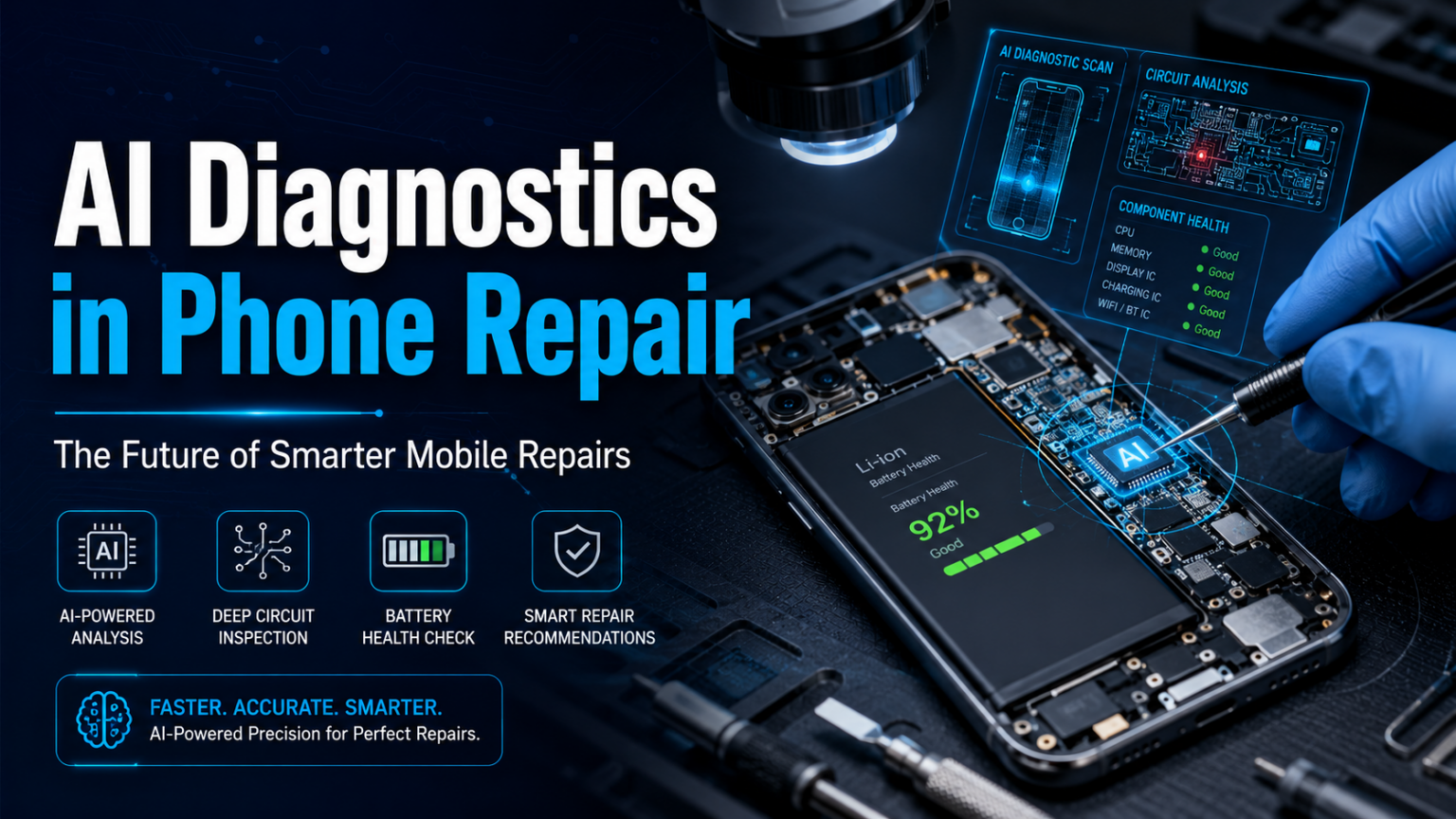
Smartphones have become more advanced than ever, and repairing them now requires more than basic troubleshooting. In 2026, the phone repair industry is moving toward smarter, faster, and more accurate solutions through AI Diagnostics in Phone Repair. Instead of relying only on manual inspection, technicians can now use intelligent systems to detect hidden faults, predict hardware issues, and guide repairs with greater precision.
One of the biggest changes in this field is the rise of AI-driven diagnostic tools. These tools help repair professionals identify problems that may not be visible during a normal inspection. For example, a phone may randomly overheat, charge slowly, or shut down unexpectedly, but the issue might not appear when the device is tested in a repair shop. AI-based diagnostics can analyze battery performance, charging behavior, sensor data, and component history to locate the real cause of the problem.
The Role of AI Diagnostics in Phone Repair
AI Diagnostics in Phone Repair is changing the way technicians handle both simple and complex mobile faults. Traditional repair methods often depend on experience, testing tools, and trial-and-error. While skilled technicians are still essential, AI adds another layer of accuracy by reviewing device data and identifying patterns that humans may miss.
For example, AI can detect abnormal voltage changes, battery impedance issues, touch sensitivity problems, and signs of component failure. This allows repair shops to diagnose faults faster and reduce unnecessary part replacements. It also helps customers get more reliable repair results because the technician can understand the root cause before opening the device.
AI is especially useful for common problems such as slow charging, overheating, weak battery performance, faulty sensors, and intermittent screen issues. Instead of waiting for the device to fail completely, AI systems can provide early warnings and recommend preventive repair.
AI-Assisted Repair Tools for Technicians
Modern repair shops are also benefiting from AI-Assisted Repairs Tools that guide technicians during the repair process. These tools can use computer vision, augmented reality, and automated testing to make repairs easier and more accurate.
For example, a technician may use a camera-based system to scan the inside of a smartphone. The AI can then identify screws, connectors, flex cables, and motherboard areas. Some tools can even highlight damaged circuits, corrosion, or soldering defects under a microscope. This is useful for both experienced technicians and beginners who want to avoid mistakes during disassembly or component replacement.
AI-assisted guidance can also reduce the risk of damaging sensitive parts. Smartphones are compact devices with fragile cables, small screws, and tightly packed components. A small mistake can damage the screen, battery connector, charging port, or motherboard. With AI support, technicians can follow step-by-step instructions and perform repairs with more confidence.
Why Mobile Repair Programmers Still Matter
Even with the growth of AI, Mobile Repair Programmers remain important in professional repair work. These programmers are used for tasks such as battery data repair, screen programming, True Tone restoration, face ID repair support, NAND repair, and other software-level or chip-level operations.
AI can help diagnose the problem, but repair programmers are often needed to complete the technical process. For example, when replacing certain phone screens or batteries, programmers may be required to transfer data or restore original functions. In motherboard-level repairs, programmers can help with storage, firmware, and chip-related work.
This means the future of mobile repair is not about replacing technicians with AI. Instead, it is about combining technician skill, repair programmers, diagnostic software, and precision tools to create a more complete repair workflow.
The Importance of Micro-Soldering Tools
As smartphones become more advanced, many faults happen at the board level. Problems such as broken connectors, damaged charging ICs, short circuits, weak solder joints, and water-damaged components often require micro-soldering. For these repairs, technicians need high-quality micro-soldering Tools such as microscopes, soldering stations, hot air rework stations, tweezers, flux, and precision cleaning tools.
Micro-soldering is one of the most delicate parts of phone repair. It requires a steady hand, proper magnification, heat control, and a deep understanding of circuit boards. AI can support this process by identifying damaged areas or suggesting likely fault points, but the actual repair still depends on professional tools and technician expertise.
For example, if AI detects that a charging issue is related to a motherboard fault rather than the charging port, the technician may need to inspect the board under a microscope. With the right micro-soldering setup, they can replace damaged components, repair broken pads, or fix weak solder joints.
Predictive Maintenance and the Future of Repairs
One of the most exciting developments in AI phone repair is predictive maintenance. In the past, most customers visited repair shops only after a phone stopped working. Now, AI diagnostics can warn users before serious damage occurs.
For example, AI may detect battery swelling risks, abnormal charging behavior, flash storage failure, or sensor instability. This gives users time to back up their data and schedule a repair before the device fails completely. Predictive maintenance can save money, reduce data loss, and extend the life of smartphones.
This approach is also better for the environment. When phones are repaired earlier and more accurately, fewer devices are thrown away. Repair shops can replace only the faulty part instead of recommending unnecessary replacements. As a result, AI-supported repair can contribute to sustainability in the electronics industry.
Edge-Based Diagnostics and Privacy
Another major trend is edge-based diagnostics. Instead of sending all device data to the cloud, modern smartphones can process diagnostic information directly on the device using built-in AI chips. This provides faster results and better privacy protection.
Local diagnostics are useful because phones contain sensitive personal data. Users may not want their hardware logs, biometric information, or usage patterns uploaded to external servers. Edge-based AI allows the device to analyze technical problems while keeping private data more secure.
For repair shops, this means faster diagnostic reports and fewer delays. A technician can quickly understand the device condition and decide whether the problem is related to the battery, charging port, motherboard, software, display, or sensors.
Final Thoughts
AI is reshaping the phone repair industry by making diagnostics faster, smarter, and more accurate. AI-driven diagnostic tools, AI-Assisted Repairs Tools, Mobile Repair Programmers, and professional micro-soldering Tools are now becoming essential parts of modern repair work.
However, AI does not remove the need for skilled technicians. Instead, it gives them better information, clearer repair guidance, and stronger decision-making support. The future of phone repair will depend on the combination of human expertise and intelligent technology.
As smartphones continue to evolve, repair professionals who adopt AI diagnostics and advanced repair tools will be better prepared to handle complex faults, reduce repair time, and deliver more reliable results to customers.
